In the sweltering heat of the New Guinea jungle, a single gunshot could mean the difference between life and death. For the Australian infantrymen fighting the Japanese in 1942, that shot often came from a weapon their own army had spent two years trying to bury. It was a gun designed by a soldier with no engineering degree, rejected by the military establishment, and yet it became the most beloved firearm of the Pacific War. They called it the ‘Digger’s Darling’—not for its looks, but because it kept firing when everything else failed.
This is the story of the Owen Gun, a weapon that defied its detractors, survived bureaucratic sabotage, and caught the eye of an American general who wanted it for his own troops. But to understand why Douglas MacArthur’s command placed an order for tens of thousands of these Australian submachine guns, we must first go back to where it all began: a small steel town south of Sydney, and a young man with a drawing and a dream.
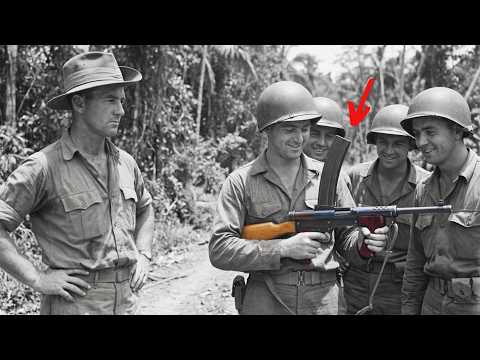
Evelyn Ernest Owen was in his twenties when he walked into the Australian Army’s ordnance office in 1939. He had no credentials, no sponsor, and no experience in arms manufacturing. What he had was a prototype and a simple idea: a submachine gun that could withstand the mud, sand, and water of jungle warfare. The army rejected him outright. They didn’t even bother to test it properly. For two years, the Owen Gun was shuffled between offices, subjected to endless delays, and denied the ammunition needed for trials. It seemed destined for obscurity.
But fate had other plans. Vincent Wardell, manager of the Lysaght steel plant in Port Kembla, saw something in Owen’s design. He knew Essington Lewis, the Director-General of Munitions, and passed the drawings along. That single act of bureaucratic courage pulled the Owen Gun out of military limbo and put it on a path to production. Meanwhile, the army’s obstruction continued: they demanded 10,000 rounds for a demonstration but then claimed no ammunition was available. They asked for a barrel of a specific caliber, then failed to supply it. Lysaght was forced to cannibalize an old Lee-Enfield rifle just to keep testing.
Finally, on September 29, 1941, at the Long Bay rifle range in Sydney, the Owen Gun faced its moment of truth. It was tested against the Thompson and the Sten—the standard Allied submachine guns of the time. The conditions were brutal: sand, water, and mud were poured over the weapons, and the men were told to make them fire. The Sten and Thompson jammed repeatedly. The Owen kept firing. It was a victory in a single morning, but it would take more than that to overcome the inertia of the military bureaucracy.
As the Owen Gun proved itself in the field, word spread. American troops in New Guinea, armed with Thompsons, saw the Australian weapon in action. They noticed that while their own guns seized up in the mud, the Owen kept chattering. Some even traded their Thompsons for Owens on the spot. It was this reputation that reached the ears of MacArthur’s headquarters in 1942, prompting an order for tens of thousands of the guns. But the story of whether that order was ever fulfilled—and why it mattered—is where the real drama begins.
The order from MacArthur’s headquarters was real, but the number attached to it was not. One account puts the request at 60,000 weapons; another says 45,000. The figures don’t agree, and there’s no point in picking the more impressive one. What can be said is that the demand was genuine, that it was for American troops, and that it ran into the tens of thousands.
The reasons it was never fulfilled were mundane—the same reasons that would have stalled any Australian war contract of that size in 1942. Australia had no surplus of steel and no spare machine capacity to open a second production line. The Owen Gun also required far more machining time per unit than a stamped-metal weapon like the Sten. Every working hour at the Lithgow workshops was already committed to the Australian Army’s own requirements.
The American infantrymen in New Guinea kept their Thompsons. Australia managed to produce more than 45,000 Owen Guns during the war—some accounts say nearly 50,000. Either figure means the same thing in practice: enough to arm Australian units across the Pacific, and not enough to fill a single foreign order on top of that.
What the contract proves is that MacArthur’s staff wanted the weapon in large numbers. It does not prove that the general himself ever handled an Owen or said a word about it. The paperwork carried the commander’s authority, not his personal opinion. That distinction matters, because the story of a famous American general falling in love with an Australian gun is a better tale—but a less accurate one.
Back in Port Kembla and Newcastle, the guns left the factories in ones and twos and hundreds while the argument over them still raged in Melbourne. Each piece was assembled at Illawarra and Hunter, in workshops that had been making iron roofing sheets just two years earlier. The Owen was present in Korea, during the Malayan Emergency, and in the early years of Vietnam—roughly twenty years of service for a design the ordnance branch had rejected in 1939 and delayed until the end of 1941.
Australian soldiers were still carrying a 9mm submachine gun with a top-mounted magazine, made in Port Kembla, in a war fought with helicopters. The Malayan Emergency alone lasted twelve years of patrol work in wet terrain—the exact conditions the weapon had been designed for.
Evelyn Owen received about ten thousand Australian pounds in royalties. He invested the money in a timber mill in the countryside behind Wollongong, and died on the first of April, 1949, at the age of thirty-three. He was a simple soldier when his weapon was rejected, a civilian when it was accepted, and in his twenties throughout the entire argument. The design he drew remained in Australian service for more than twenty years after he was gone.
His file at the Australian War Memorial is short, as such files usually are. The contract from the South West Pacific Area headquarters still sits in the records. 1942, tens of thousands of submachine guns for American infantrymen, naming a weapon from the steel mills of Port Kembla. The contract was never fulfilled, and no American unit in New Guinea was ever armed with it.
The Owen guns that left those factories went to Australian infantrymen, to New Zealanders who traded for them on Guadalcanal, and the Australians carried the last of them in Vietnam—twenty years after an officer in Sydney poured sand into the feed mechanism just to see if it would stop.
The story of the Owen Gun did not end with Evelyn Owen’s death or with the contract that never was. It lived on in the hands of soldiers who trusted it, and in the records that slowly, reluctantly, acknowledged its worth. The weapon that the army had rejected in 1939 was still being carried by Australian troops in the 1960s. Its service record spanned three decades and three conflicts, a testament to a design that was simple, robust, and perfectly suited to its environment.
In the years after World War II, the Owen was gradually phased out of frontline service, replaced by newer, lighter weapons. But it never quite disappeared. It remained in the arsenals of reserve units and was used in training. Its distinctive top-mounted magazine became a familiar sight to generations of Australian soldiers, a quirky but beloved feature that set it apart from everything else in the armory.
The Malayan Emergency, which lasted from 1948 to 1960, was the Owen’s swan song. In the dense, humid jungles of Malaya, the gun once again proved its worth. Patrols would return with stories of the Owen firing flawlessly after days of rain and mud, while other weapons failed. It was the same story as New Guinea, and it cemented the Owen’s reputation as the most reliable submachine gun in the Australian arsenal.
By the time the last Owen was retired from active service in the early 1960s, over 45,000 had been produced. Many were destroyed, but some found their way into museums and private collections. Today, they are highly sought after by collectors, a testament to their historical significance and their unique design.
The story of the Owen Gun is also a story about the people who believed in it. Vincent Wardell, the manager who saw potential in a young soldier’s drawing, never sought fame for his role. Essington Lewis, the industrialist who bypassed the military bureaucracy, acted out of a sense of what was right. And Evelyn Owen himself, who died at just thirty-three, never lived to see the full impact of his creation. But their legacy lives on in the weapon that bore his name.
The Australian War Memorial in Canberra holds a small collection of Owen Guns, along with the documents that tell its story. Visitors can see the original prototype, the drawings, and the correspondence that trace its journey from rejection to acceptance. It is a reminder that innovation often comes from the most unlikely places, and that the fight for a good idea can be as fierce as any battle.
In the end, the Owen Gun was more than just a weapon. It was a symbol of Australian ingenuity and perseverance. It was a gun that refused to die, much like the soldiers who carried it. And though the contract from MacArthur’s headquarters was never fulfilled, the Owen’s place in history is secure—not because of a general’s order, but because of the men who trusted it with their lives.
The last Owen Guns were retired from the Australian Army in the early 1960s, but their story continues to be told. They are a reminder of a time when a simple soldier’s design outmatched the best the military establishment could offer, and when a steel town in New South Wales became an unlikely arsenal for the Pacific War.
Yet the deepest irony is not that the order failed, but that it was ever placed at all. MacArthur’s staff wanted a weapon their own supply chain could not deliver, from a factory that was already stretched to its limits. The Owen was never meant to be exported; it was meant to keep Australian soldiers alive in a jungle that devoured metal and hope in equal measure.
And that is precisely what it did. From Kokoda to the Malayan Emergency, the gun with the top-mounted magazine became a quiet legend. Soldiers did not love it because it was beautiful or light or elegant. They loved it because it fired when everything else stopped.
Evelyn Owen died at thirty-three, never knowing that his rejection would become a national icon. Vincent Wardell never sought credit. Essington Lewis simply did what needed doing. The real story of the Owen Gun is not about a contract or a general—it is about a handful of Australians who refused to let a good idea die in a filing cabinet.
Today, the Owen sits in museums, its odd silhouette a reminder that innovation rarely follows the proper channels. The steel mills of Port Kembla have long since gone quiet, but the echo of that stubborn, mud-loving weapon still speaks.
So here is the question worth asking: how many brilliant ideas have been buried not by the enemy, but by the bureaucracy on our own side? Tell us in the comments—what would you have done differently?
Report this article
Select a reason for reporting:






