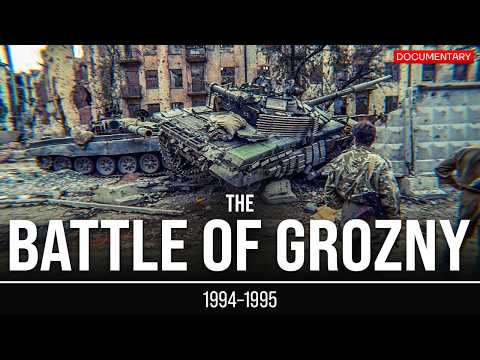
On New Year’s Eve 1994, the city of Grozny lay under a cold winter sky, its streets quiet only in appearance. Russian armored columns moved into the city, their engines echoing against ruined buildings. Tanks and personnel carriers rolled along cracked roads, prepared to strike at the heart of Chechen resistance. Moscow expected a rapid victory, confident that the separatists would be overwhelmed.
The reality on the ground was very different. Buildings already damaged from weeks of preliminary bombardment stood hollowed and unstable. Streets were littered with rubble, burned vehicles, and remnants of homes. Chechen fighters had prepared the city for resistance. Snipers occupied rooftops, makeshift barricades blocked avenues, and hidden ambush points turned familiar streets into deadly traps.
For civilians caught inside, there was no safe shelter. The noise of artillery and automatic fire punctuated the winter night. Smoke and dust filled the air, choking those who tried to move or hide. The Russian offensive would quickly become the bloodiest urban war fought by Moscow since the Second World War. Expectations of a swift, decisive battle were shattered as resistance held firm and the human cost mounted.
Grozny, the symbolic and logistical center of Chechnya, would resist for weeks, demonstrating both the challenges of urban warfare and the heavy toll it takes on both combatants and civilians alike. In this city, the consequences of war were immediate and devastating. Military objectives, political calculations, and civilian lives were all bound together in the ruins of Grozny.
The events that unfolded in these streets would not only define the First Chechen War but would leave a lasting legacy for modern military operations in urban environments.
When the Soviet Union began to unravel in the late 1980s, no one could have predicted how violently the consequences would reshuffle power in the North Caucasus. Chechnya, long a restive region under Soviet rule, saw nationalism rise rapidly under the policies of Glasnost and Perestroika. In 1990, the All-National Congress of the Chechen People was formed under the leadership of Dzhokhar Dudayev, a former Soviet air force general.
As Soviet authority weakened, Dudayev’s movement seized the opportunity. In October 1991, forces loyal to him took over the KGB headquarters in Grozny along with the radio and television installations. On November 2, 1991, Dudayev’s Congress declared Chechnya independent.
Moscow, newly led by Boris Yeltsin, refused to accept this. The declaration was not recognized, and tensions escalated. The Russian government tried to assert its legal and constitutional framework over Chechnya, insisting that secession was unlawful. While Dudayev’s government moved to establish independent institutions, the constitutional treaty offered in 1992 by Moscow to the various republics of the former Soviet space was rejected by Chechnya. Dudayev’s administration instead adopted its own constitution, flag, and anthem, acting substantively as a state, even while many of its institutions were fragile and underresourced.
Meanwhile, Chechnya suffered internal strife. Non-Chechens, especially ethnic Russians, fled or were expelled. Crime, lawlessness, factional politics among opposition groups, and power struggles weakened central control in Grozny. Dudayev’s opponents formed the Provisional Council, which, though divided, received tacit backing from Russia. Prominent among these tensions were incidents of violence, sabotage, and small-scale armed clashes inside Chechnya between pro-Dudayev forces, opposition groups, and Russian security services.
Such instability gave Moscow cause to push back, arguing that Chechnya was becoming a lawless breakaway that threatened both regional stability and Russia’s territorial integrity. Grozny, the Chechen capital, stood at the heart of this conflict. Once a major industrial city under Soviet rule, it housed oil refineries, factories, pipelines, rail junctions, and an infrastructure built to serve the broader Soviet economy. The city was not just symbolically important as the seat of Dudayev’s separatist government but also economically vital. Control over oil fields, pipeline transit routes, and refining capacity meant control over revenues, capacity to import weapons, and legitimacy over civilian administration.
Moscow’s concerns included not only stopping secession but also reining in economic leakage through illegal oil exports and loss of revenue from pipelines running through Chechnya. In 1994, the situation reached a breaking point. Russia under Defense Minister Pavel Grachev began to prepare for a military intervention. Internal debates in Moscow showed there were some senior military officers who voiced concerns about both underestimating Chechen resolve and overestimating Russian capabilities. Intelligence gathering was weak. Maps were inaccurate. Logistics underprepared. But despite this, plans were made to restore what Moscow termed a constitutional order through force if necessary.
Pro-Russian opposition within Chechnya was cultivated. For example, backing the Provisional Council led by Umar Avturkhanov and covert operations were conducted to destabilize Dudayev’s government. In late November 1994, a Russian-backed opposition force launched a failed attempt to seize Grozny, which made it clear that Dudayev was not going to fall easily. On the 29th of November, Yeltsin issued an ultimatum: disarm, release prisoners, and disband what Moscow called illegal armed formations. Dudayev refused. Soon afterwards, orders were issued to prepare for a full-scale invasion.
By early December 1994, tens of thousands of Russian regulars and paramilitary units were massed in neighboring regions—Dagestan, Ingushetia, North Ossetia—and air strikes on Grozny and its environs began. Russian forces launched their assault on Grozny late in December 1994, expecting a swift victory. On the 11th of December, a three-pronged ground advance towards the Chechen capital began with columns moving in from the north, east, and west. Their aim was to encircle Grozny, cut off supply and escape routes, and force Dudayev’s government into submission.
One major axis was the 131st Motorized Rifle Brigade advancing from the northwest, supported by the 81st and 276th Motorized Rifle Regiments. Another advanced from the northeast under Rokhlin’s 255th, and a third from the southwest. The plan was for converging attacks to aim at key infrastructure: the railway station, major arteries into the city, and ultimately the presidential palace. These initial moves were preceded by heavy aerial and artillery bombardment. Russian jets and helicopters alongside rocket artillery pounded Chechen positions, villages near Grozny, and even suburban areas. Civilians tried to flee or take shelter in basements, cellars, or underground shelters, but many remained in the city, trapped by lack of transport and humanitarian corridors.
Human Rights Watch published a report in January 1995 describing Russia’s bombing of the city. “Such tactics cruelly punished the estimated 100,000 civilians who remained in Grozny, some tenaciously clinging to their homes, but most lacking anywhere to go or transport out of the war zone. They have been reduced to a brutal subterranean existence.” Those who remained represented the most vulnerable segments of society: the old and feeble, the handicapped, the poor. Eyewitnesses told researchers of spending whole weeks in basements only to then face attack when they ventured out to get water or an occasional loaf of bread. They described being burned out of a cellar because shelling ignited the floors above them. Russia’s 5-week offensive caused an estimated 350,000 displaced, an untold number of civilian deaths, and the destruction of a city once home to 400,000.
As December turned into New Year’s Eve 1994, the ground assault began in earnest. Russian armored columns entered Grozny from several directions, supported where possible by Mi-24 attack helicopters, artillery, and air strikes. However, logistical problems, lack of accurate intelligence, unfamiliarity with the city terrain, and poor coordination dogged the assault. Some units, late or misrouted, found themselves isolated and exposed. The dense urban terrain of narrow streets, clusters of apartment blocks, and ruined or abandoned factories favored the defenders.
Chechen defenders made full use of every advantage. They blended into civilian populations, using sewers, cellars, tunnels, and basements to move, hide, strike, and then vanish. They booby-trapped buildings, mined roads, barricaded avenues, then ambushed Russian armor at choke points. RPG teams operated from roofs or upper floors. Snipers picked off officers. Machine gun teams laid down suppressive fire.
On New Year’s Eve 1994, at around dawn, Russian forces attempted a decisive push towards the central railway station and the presidential palace. One prong of the attack was to approach the railway station, another down Pervomayskaya Street, while others were to converge towards the palace. The presidential palace itself, defended under the command of Aslan Maskhadov, was a primary objective. Chechen leadership apparently planned to allow the Russian armor to approach, then strike at them under the cover of darkness.
What was intended as a fast and coordinated operation soon became a disaster for the Russians. Armored units, often lacking infantry support, advanced into ambushes in narrow streets. Bulldozers, APCs, and tanks all became targets. Russian units reported heavy losses. One brigade, the 131st Motorized Rifle Brigade, is widely cited as suffering catastrophic damage near the railway station. Many of its vehicles were destroyed or rendered inoperable in just the opening hours. Chechen guerrilla fighters struck from hidden positions in basements, upper stories, behind rubble, and through gaps in walls.
By early January 1995, the nature of the battle had shifted into brutal block-by-block street fighting. Russian air power was handicapped at times by weather. On New Year’s Day and thereafter, artillery became their principal tool. Massive barrages were directed often at areas thought to hold Chechen defenses. Unfortunately for civilians, that often meant apartment blocks, marketplaces, hospitals.
A 44-year-old resident of Grozny, Sergey Kuklin, described his experiences as he lay in a hospital bed: “There was artillery shelling from all sides. It wasn’t clear where it was coming from and what it was aiming at. There were no planes, just shelling. I have a house. At 1:00 p.m., a shell landed on my house. At the time, I was in my neighbor’s basement. When I heard the explosion nearby, I had a look and I saw that my house was hit and that the roof was blown off. I saw that the house wasn’t burning, but the roof was blown off completely. About 3 minutes after I went out, I was hit in the back. The explosion was about 20 or 30 meters away and about 500 or 600 meters from the bomb shelter. Fragments wounded me. After that, people who were there wrapped up my wound. But where could they take me? The shelling kept on going. There was whistling everywhere, beeping everywhere. Fragments were pouring out. I didn’t lose consciousness. I lay there until about 4:00 p.m. To my great fortune, my neighbor arrived from Nazran. He put me in his car and brought me here.”
Inside Grozny, Russian units found themselves repeatedly ambushed at street corners, ruined courtyards, and derelict buildings. Chechens used them all. One survivor recalled Russian tanks entering side streets only to be hit by RPG fire from rooms above. As the tanks paused, their trailing infantry were targeted. Snipers, often unseen until the shot, picked off officers and signalmen. Maskhadov and other Chechen commanders employed hit-and-run tactics, avoiding large formations. Some brigades found themselves cut off, forced to defend makeshift positions under relentless fire.
Destruction mounted. The architecture of the city became ruinous. Long rows of apartment blocks built in the Soviet style. Narrow alleys and little cover outside built-up streets. Buildings collapsed after bombardments. Smoke, dust, and fires choked the air. Electricity, water, and sanitation all but ceased. The few surviving hospitals overflowed or were destroyed. Civilians scavenged for food and water, and few had safe shelter. Many displaced people streamed out of the city, while others stayed despite the bombing, trapped by rubble or unwilling to abandon their homes.
By late January, Russian forces had taken partial control of some sectors—key roads, parts of the city center—but the cost had been enormous. What had been intended as a quick victory now stretched into weeks of urban warfare. Russian morale was shaken by the unexpected resistance. Chechen defenders, though lacking in heavy weaponry, had turned the city’s destruction into a weapon itself. The assault had devolved into grinding combat. Each street, each building, and each hallway was contested. The winter cold, lack of clear communication, isolated units, and incidents of friendly fire all compounded Russian losses.
By February 1995, Russian commanders realized that Grozny would not fall by shock alone. The daring armored thrusts and helicopter inserts of late December and January had cost far more lives and vehicles than they ever anticipated, and they had failed to break the Chechen will. Instead, the Russians moved to a slow and grinding strategy: isolate sectors, tighten control over captured buildings, and apply overwhelming firepower to reduce resistance, one block, one building, or one corridor at a time.
Russian forces shifted their focus to key strongholds. They systematically cleared the downtown area, the industrial zones, and then moved into the Minutka and Staropromyslovsky districts. The Council of Ministers building, a symbolic and tactical objective, was captured by mid-January after hand-to-hand combat with the Chechens mounting repeated counterattacks to retake or at least contest it. Meanwhile, Russian bombardment never let up. Artillery barrages, rocket attacks, and heavy bombing made every advance costly. Civilian infrastructure turned into battlefields. Many residential blocks that had been Chechen defensive positions were reduced to rubble. The Russian tactic was attritional: deny supply, exhaust the defenders, and gradually degrade capacity to resist.
The Chechens defended fiercely, but increasingly their ammunition, food, medical supplies, and even their water lines were disrupted by enemy fire and logistical superiority. Within the Russian ranks, however, the cost was mounting both materially and psychologically. Armored vehicle losses remained high. Tanks and armored personnel carriers were regularly destroyed in ambushes or by teams of anti-armor units. Russian conscripts and even some contract soldiers complained of inadequate winter clothing, of having to fight in cold and damp buildings with the water and heating cut off. Command and control remained uneven. Units often became isolated after pushing forward, and communications were frequently severed by damage to infrastructure or by technical failures. Morale suffered, especially when expected rapid advances got bogged down into weeks of bitter close-quarters fighting.
By late February, Russian forces had seized the presidential palace. It was no longer an intact symbol of Chechen power, but a wrecked fortress. Its interior gutted and its defenders forced to withdraw. From that point, momentum was decisively with the Russians. The Chechen forces, vastly outnumbered in heavy weaponry and lacking the capacity to replace destroyed armor or to sustain large prolonged defensive lines, made more limited defensive stands and counterattacks. But these became more costly and less sustainable. As the Chechens withdrew from some sectors, so too did their ability to mount effective resistance. The Russian perimeter expanded, supply lines tightened, and Chechen routes for reinforcement or resupply were progressively cut.
On March 6, 1995, after nearly 10 weeks of relentless pressure, Russian troops finally declared Grozny fully under their control. The downtown, industrial, and administrative core was theirs. Many remaining defenders either withdrew or were captured. The battle was over. Though the city itself was a shell of its former glory.
Yet the victory for the Russians was pyrrhic indeed. Russian military losses were significant even by conservative estimates: some sources report that the Russian side admitted to about 1,834 soldiers killed, 4,670 wounded, and 96 captured, while Chechen claims and independent estimates suggest much higher numbers. Dozens of tanks were destroyed and many more armored vehicles rendered inoperable. The 131st Motorized Rifle Brigade was nearly wiped out around the Central Railway Station—only a fraction of its original force survived.
Civilian suffering was even more severe. Sources place at least 25,000 civilians killed during the Battle of Grozny, including thousands of children; historian Dmitri Volkogonov’s estimates reached 35,000. Homes, hospitals, schools, and basic services were destroyed. Water, electricity, and sanitation collapsed. Bodies lay buried in mass graves or uncleared on the streets.
Human rights violations were numerous. Observers reported indiscriminate shelling of civilian zones. Russian forces were accused of summary executions, random detentions at filtration checkpoints, torture, and using civilians as human shields. Aisha Albogachieva, a former resident who fled to Ingushetia, tried to organize a convoy to evacuate civilians left behind. A Russian interior ministry patrol stopped them, and she recalled: “One soldier swung around and said, ‘Why can’t we agree?’ He then fired a burst from his automatic and killed that guy. His name was Ruslan. I didn’t know his last name.”
At home in Russia, the reaction was mixed but growing critical. General Lev Rokhlin, whose unit seized the palace, was offered the Hero of the Russian Federation award but refused, saying he saw nothing glorious in “fighting a war on my own land.” Families of the lost demanded answers. Human rights activists including Sergey Kovalev spoke of an unimaginable catastrophe and moral disaster.
After the Russians declared victory in March 1995, the city lay in ruins and Chechen resistance went underground. But the battle was far from over. Chechen fighters regrouped in the mountains and in the ruins of towns, adapting yet again. Officials in Moscow, including President Boris Yeltsin, saw the growing cost in men, material, and domestic unease mounting into a political burden.
The stage was now set for a renewed push. On August 6, 1996, Chechen forces under commanders like Shamil Basayev and Aslan Maskhadov launched a bold offensive to retake Grozny, often called Operation Jihad. With roughly 1,500 fighters, they infiltrated the city from multiple axes, bypassing many Russian checkpoints and striking at military and administrative installations. Russian garrisons, estimated at between 7,000 and 12,000 troops, were caught off guard. The Chechens encircled many outposts, cut off supply routes, and sparked panic among pro-Moscow forces.
Within days, the Chechens held control over large swathes of the city, or at least denied free movement to Russian forces. Many Russian units were trapped, demoralized, or forced into defensive pockets. The capture of Grozny shocked Moscow and forced a political reckoning. Negotiations resumed, mediated in part by Alexander Lebed, Russia’s then Security Council Secretary.
These dialogues culminated in the Khasavyurt Accord, formally signed on August 30, 1996, between Lebed and Maskhadov. Under its terms, Russian forces were to withdraw from Grozny and federal troops were to pull out of Chechnya by December 31, 1996. Joint bodies were to be formed to maintain order and prevent looting. The question of Chechnya’s ultimate legal status, however, was postponed until the end of 2001.
For a few years, this settlement brought a fragile peace. Grozny was now under Chechen control, though badly damaged. Maskhadov became the elected president of the Chechen Republic of Ichkeria. Efforts were made to rebuild schools, basic infrastructure, and local governance. Yet the ceasefire never meant complete stability. Lawlessness remained widespread. Warlords operated in the countryside. Kidnappings, abductions, and internal rivalries persisted. Russia continued to economically isolate Chechnya and periodically launched cross-border raids. The federal government did not formally recognize Chechen independence, nor was it recognized internationally, and many within the Russian political and military establishment viewed the Khasavyurt Accord as a pause, not a peace.
Those tensions erupted again in 1999. In August, militants from Chechnya crossed into Dagestan, attempting to establish autonomous Islamist influence, which Russia used as a casus belli to relaunch full-scale operations. Heavy air strikes were followed by ground incursions. By late 1999, Moscow declared that Chechen authorities had lost control of the situation, and thus began the Second Chechen War.
Among its early and decisive events was the second battle of Grozny, from December 25, 1999, to February 6, 2000, in which Russian forces laid siege to the capital. The assault was yet again characterized by overwhelming firepower, strategic bombardment, and extensive destruction. Civilian casualties were estimated variously, but in that siege alone, between 5,000 and 8,000 civilians were reportedly killed.
The second battle of Grozny did not rewrite everything established by the first war, but it reinforced many of its harsh lessons. Russian forces were determined this time not just to push into Grozny, but to destroy pockets of resistance entirely, with less hesitation over heavy bombardment. Chechen fighters, far fewer in number and with diminished resources, nonetheless resisted fiercely. The city yet again was devastated, infrastructure destroyed, civilians displaced, and works of reconstruction set back.
By early 2000, Moscow had reasserted control over Grozny and installed a pro-Moscow administration, though insurgency and guerrilla actions continued for years afterward. The aftermath of this cycle left a deep imprint. Chechnya had obtained de facto independence for a brief period, but it lacked recognition. The Russian state had suffered reputational, moral, and material damage. For the people of Grozny and for Chechnya as a whole, the wars meant recurring devastation, loss, and trauma.
The counteroffensive in 1996 showed that the resistance was resilient, and the second war illustrated how Moscow would respond with overwhelming force once it committed. In the end, neither side achieved a clean, lasting resolution to the underlying conflict in that decade—only recurring cycles of destruction, negotiation, and renewed fighting.
Chechnya today presents a paradoxical image. While the region is officially part of the Russian Federation, it operates with a significant degree of autonomy under the leadership of Ramzan Kadyrov. Kadyrov has declared the defeat of terrorism within the republic, asserting that the region has achieved stability and development. However, reports of recent attacks on security forces suggest that challenges persist. Despite this, some international actors, such as Ukraine, have recognized the Chechen Republic of Ichkeria as temporarily occupied by Russia.
The first battle of Grozny profoundly impacted Russian military doctrine. The initial assault revealed significant deficiencies in urban combat tactics, leading to a re-evaluation of strategies for future conflicts. Lessons learned emphasized the need for improved coordination, intelligence gathering, and respect for civilian infrastructure. But while these insights may have been integrated into Russian military training and operational planning, Russia’s urban combat strategies in the current conflict in Ukraine have often mirrored the initial tactics used in Grozny—characterized by extensive bombardment followed by infantry assaults, sometimes referred to as meat grinder tactics. In the battle for Mariupol, for instance, Russian forces employed similar heavy artillery and air strike tactics, resulting in significant civilian casualties and extensive damage to infrastructure.
Internationally, the battle of Grozny has become a cautionary tale for modern militaries. The extensive destruction of the city and the high civilian toll underscore the complexities of urban warfare and the challenges of distinguishing between combatants and civilians. The conflict has spurred discussions on the ethical implications of military strategies and the importance of adhering to international humanitarian law. Military analysts and historians often reference the battle to highlight the necessity of adapting tactics to the urban environment and the unpredictable nature of such engagements.
The battle of Grozny serves as a poignant reminder of the devastating consequences of urban warfare. Its legacy continues to shape military strategies and policies, emphasizing the need for careful planning, respect for civilian lives, and adaptability in the face of complex combat scenarios. But as the ruins of Grozny remind us, the lessons of history are only as valuable as our willingness to learn them.
What do you think—has the world truly learned from Grozny, or are we condemned to repeat its tragedy in every new city that becomes a battlefield? Share your thoughts in the comments below.
Report this article
Select a reason for reporting:






