Imagine waking up to the news that your family’s thousand-year-old estate has been confiscated, your castle reduced to rubble by siege guns, and your title declared useless and dangerous. The grand chamber where your ancestors shaped the laws of the realm has been padlocked and voted out of existence. And the king you poured your fortune into protecting has just had his head severed in public view outside the Banqueting House in Whitehall. This was the brutal reality that crashed down on England’s aristocratic families in the space of a single decade.
The names that had dominated English life for centuries—the Howards, the Cavendishes, the Somersets, the Stanleys, the Herberts—suddenly found themselves at the mercy of a man most of them had barely taken seriously only a few years earlier. His name was Oliver Cromwell. And the question of what actually happened to those great houses after he seized power is one of the most extraordinary stories in the history of European wealth. It involves fire sales of entire counties, exile in Antwerp and Paris, duchesses pawning their clothes for dinner, the deliberate destruction of some of the finest castles ever built in the British Isles, and a legal machinery of such ruthless efficiency that even the hardest Tudor confiscations look tame next to it.
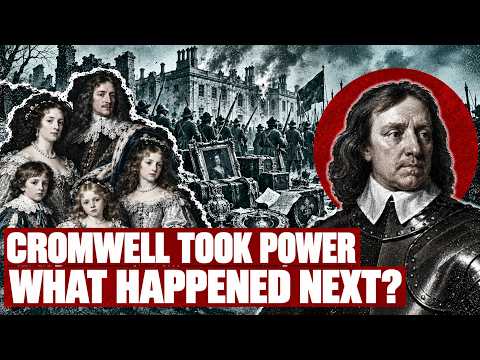
And yet, when the dust had finally settled a few decades later, something strange had happened. Most of these families were still there. Battered, broke, humiliated, in some cases unrecognizable from what they had been before, but still there. To understand how any of that was possible, we have to go back to the England that existed before Cromwell. Because what Cromwell took on in the 1640s was not just a king, it was an entire social order.
The England of 1640 was still, in most practical ways, a feudal society. Perhaps 2% of the population owned around half the cultivated land, and within that 2% sat a tight circle of great peers whose estates stretched across whole counties. The Earl of Pembroke’s house at Wilton controlled a vast slice of Wiltshire. The Earl of Worcester, from his pink sandstone castle at Raglan in Monmouthshire, ran what was arguably the largest and best-run private estate in Wales. The Cavendishes, descendants of the formidable Bess of Hardwick, owned so much of Derbyshire and Nottinghamshire that their rent rolls read like a county atlas. The Earl of Derby controlled vast swathes of Lancashire and the Isle of Man.
These were not just rich landlords. They were political actors in their own right. The House of Lords, which met in a chamber just upstairs from the Commons at Westminster, was where their power was formally exercised. Being summoned to sit in that chamber was both a right and a trade. A peer was expected to bring his tenants to war when the king called, to provide hospitality to visiting royalty, to sit as a magistrate, to patronize churches, to educate the sons of lesser gentry. The whole structure of local justice, local administration, and local defense ran through these men.
And here is the detail that often gets missed. By the time Charles I started quarreling with his Parliament in the late 1630s, the great families were not uniformly on the king’s side. They were split. Some were devout Protestants who distrusted Charles’s high church bishops. Some had Catholic sympathies and wanted a monarch strong enough to protect them. Some simply wanted the old constitutional balance preserved in which neither the king nor the Commons could ride roughshod over the Lords. When the war broke out in August 1642, those internal divisions turned into open fractures that would cut through houses, families, and sometimes individual marriages.
The Herbert family of Pembroke is a perfect example. Philip Herbert, the fourth Earl of Pembroke, sided openly with Parliament. His younger son, William, by contrast, took up arms for the king and was killed in battle in 1646. The Howards, Earls of Arundel, drifted abroad to avoid the fight altogether. The Cavendishes split in a different way. William Cavendish, Earl of Newcastle, became one of the King’s most important field commanders in the north. His cousin William Cavendish, the third Earl of Devonshire, was impeached by Parliament, fled abroad, and had his estates sequestered. One branch of the family was fighting Charles’s war. The other was running from it. Even in Kent, in the small parish of Nonington, the Boys family literally divided along the lines of the war, with some brothers fighting for Parliament, and others, like Sir John Boys of Bonnington, serving as ardent royalists. The war did not politely stay out on the battlefield. It walked into dining rooms and estate offices and tore them in half.
And when Parliament started to win, which it did decisively from about 1645 onwards, thanks to the New Model Army and a largely unknown cavalry commander called Oliver Cromwell, the losing side faced a form of economic warfare that no English aristocracy had ever experienced before. Parliament had figured out early on that a war against the King was going to be ruinously expensive. The Scots had to be paid. The New Model Army had to be fed, clothed, and armed. The Navy had to be kept at sea. Taxes alone would not cover it. So, in 1643, Parliament set up two committees that would reshape English land ownership for a generation.
The first was the Sequestration Committee. It had the power to seize the estates of anyone it classified as a delinquent, which was shorthand for anyone who had actively helped the King. The second was the Committee for Compounding with Delinquents, which met at Goldsmiths’ Hall in London and gave sequestered royalists a way back. If you had lost your estate because you had fought for Charles, you could apply to compound. You would admit your delinquency, swear an oath to the new regime, declare the full value of your estate, and then pay a fine. The committee set the fine as a percentage of your estate’s capital value, and the percentage depended on how deeply involved you had been. A minor supporter who had maybe sent a few horses to the king might get away with a fine of a tenth. A committed royalist officer or courtier might be fined a third. A Catholic royalist, or anyone judged particularly notorious, could face a fine of two-thirds. And if you failed to pay, or if the committee thought you were lying about the value of your lands, the sequestration became permanent and the estate was sold outright.
This was not a small operation. It covered every English county. There were committees whose records still survive in the National Archives, and the sheer volume of them is staggering. The Yorkshire royalist composition papers alone contain detailed records of hundreds of cases. These committees knew which fields you owned, which tenants rented them, what the rents were, which woods you harvested, which mills you drew income from, and how much silver plate was in your house. If you tried to hide a manor by transferring it to a cousin, they would find out, because another committee, the Committee for Advance of Money, specialized in sniffing out concealed royalist estates. By 1650, these three bodies were meeting together, and by 1656, they had merged into one streamlined apparatus of confiscation.
The effect on individual gentry families was devastating. Colonel Ralph Sneyd of Keele Hall in Staffordshire, already in debt before the war, saw his estate sequestered and had to compound at terms that forced him to sell land for the rest of his life just to pay the fine. In Wales, the compounding regime deliberately targeted the royalist gentry whose landholdings had anchored the local social order. Philip Jones of Llangyfelach, a parliamentarian, emerged from the process rewarded with land and titles. His royalist neighbors emerged ruined.
Still, if the compounding system was brutal, outright confiscation was worse. And confiscation on the grand scale was reserved for three categories: the lands of the Crown, the lands of the Church, and the lands of certain named enemies the regime considered beyond compromise. Royal estates totaling around 10% of all the land in England were sold off during the Interregnum. Bishops’ lands and cathedral lands were sold off alongside them. And this is where the land market got genuinely wild. Because none of these buyers were traditional aristocrats. They were army officers who were owed back pay, investors who had bought up government debt, London merchants looking for status, parliamentarian lawyers, and committee men who had placed themselves perfectly in the right offices at the right time.
Entire estates that had been in a single family’s hands for centuries were suddenly carved up, surveyed, auctioned, and resold. In southeast England alone, land taken from 50 royalists was broken up and sold to more than five times that number of purchasers. The historian Joan Thirsk, who did the definitive work on all this, documented how the Interregnum created a frantic secondary market in land. Buyers flipped properties, speculated, borrowed against them, mortgaged them, resold them, and in general treated what used to be ancient landed property as if it were just another asset.
While this economic storm was ripping through the country, something even more unthinkable was happening in London. On January 30th, 1649, Charles I was executed on a scaffold outside the Banqueting House. On March 17th, Parliament abolished the monarchy itself. And then, two days later, on March 19th, 1649, Parliament passed an Act for the abolishing the House of Peers. The language was stark. The House of Lords, it declared, was useless and dangerous to the people of England. The peers simply walked out of the parliamentary story. For eleven years, from the spring of 1649 until the spring of 1660, there was no official seat for a hereditary English nobleman in the English government. The dukes, marquesses, earls, viscounts, and barons who had, between them, dominated English politics for the best part of five centuries, were no longer legally recognized as a political class.
Cromwell did try to put something back in its place. In 1657, he created what became known as the Other House, a new upper chamber of nominated life peers, limited to about seventy members chosen by the Lord Protector. It was meant to look like a House of Lords. Cromwell himself called it our House of Lords, but almost none of the old peerage would sit in it. One peer, Lord Eure, was the only old-regime nobleman who took his seat. Other members included Cromwell’s generals, officials, judges, and allies. To the old aristocracy, it was an insult, a cheap imitation stuffed with what one old peer sneered at as lucky draymen and shoemakers. The Other House lasted barely a year. By early 1658, Cromwell had dissolved the parliament it sat in, and the experiment was quietly dropped.
Nowhere was the fate of a great royalist family written out more dramatically than at Raglan in Monmouthshire. The Marquess of Worcester, Henry Somerset, had been one of the wealthiest peers in the kingdom before the war. He had advanced huge sums to Charles I, so much that he was created Marquess of Worcester in November 1642, largely as a reward. In October 1642, Charles I had sent his own son, the future Charles II, to Raglan as part of a fundraising tour, because that is how important Worcester’s purse was to the royalist war effort.
Raglan Castle itself was no ordinary country house. It had a great hexagonal keep known as the Yellow Tower, long galleries, formal water gardens, a library famous across Wales, and a Catholic household stocked with chaplains and musicians. When the first civil war collapsed around the king in 1646, Raglan became the last major royalist stronghold still holding out. Sir Thomas Fairfax, commander of the New Model Army, laid siege to it in June of that year. The Marquess was almost seventy years old. He refused to surrender for eleven weeks. By mid-August 1646, with his supplies gone and his walls breached, he gave up the castle. He was taken to London as a prisoner. Within four months, he was dead.
Raglan Castle was then systematically slighted on Parliament’s orders. The Yellow Tower was undermined and much of its upper stories collapsed. The Great Gatehouse was broken open. The lead was stripped from the roofs. One of the finest libraries in Wales, said to contain irreplaceable Welsh and Latin manuscripts, was lost in the sack. The castle, which had taken more than two centuries to build, was effectively killed in a few months.
Worcester’s son, Edward Somerset, the second Marquess, inherited mostly a title. The family lands were sequestered. For years, Edward lived in a kind of political limbo, half tolerated by the regime because he dabbled in mechanical inventions and worked with the engineer Caspar Kaltoff on an early steam device, and half despised because he was a Catholic and an unrepentant royalist. He was eventually granted a small pension in 1655. His estates were only recovered at the Restoration in 1660, by which point the family was buried in debt.
And here is the twist that makes the Somerset story so revealing. Edward’s son Henry, the third Marquess, inherited a title, a ruined castle, and a mountain of IOUs. By grinding patience, by a shrewd marriage to Mary Capell, daughter of another prominent royalist martyr, and by thirty years of careful estate management, he rebuilt the family’s finances from Badminton in Gloucestershire. In 1682, Charles II made him Duke of Beaufort. The castle at Raglan was never restored, but the dukedom of Beaufort was. The Somerset family did not just survive, they climbed back into the first rank of the English peerage, and they are still there today, holding one of the largest private landholdings in England. But Raglan, that extraordinary monument, remained a shell. It still stands as a shell today, a visible reminder of what the Civil War did to Cromwell’s enemies.
The Cavendishes offer a very different, and in some ways more painful, kind of story. William Cavendish, Earl of Newcastle, was easily one of the richest peers in England in 1642. His inherited lands in Nottinghamshire and Derbyshire, swollen by his father’s marriage to the Ogle heiress, included Welbeck Abbey, Bolsover Castle, and vast stretches of coal-bearing countryside. When the war broke out, he was appointed royalist commander in the north. He personally financed troops of cavalry. He raised regiments. He fortified towns. He fought in the sieges of Hull. He commanded the right wing at the catastrophic Battle of Marston Moor on July 2nd, 1644, the single largest battle of the war, which the royalists lost decisively to the combined forces of the parliamentarians and the Scots.
Within days of that defeat, Newcastle took ship for the continent. He left behind an England that was no longer safe for him and sailed into exile, first in Hamburg, then in Paris, then in Antwerp. He stayed abroad for sixteen years. His estates were sequestered. His houses were occupied, raided, and in parts torn down. His cousin, Sir Charles Cavendish, who had been a lieutenant general of horse under Newcastle’s command, also had his estates sequestered in 1649, preventing him from settling land on his creditors. The family’s income from their coal-rich Midlands properties, which should have been huge, dried up.
In exile, Newcastle set up a riding school in Antwerp, where he kept Barbary horses and bred his own line of chargers. He wrote plays, including The Country Captain and The Variety. His wife, the famously eccentric Margaret Cavendish, wrote some of the first scientific and philosophical treatises published by a woman in English. According to a story preserved in later encyclopedias of the Cavendish family, they were at one point reduced to the sort of embarrassing circumstance in which the Duke and Duchess had to pawn their clothes just to put dinner on the table. This was a man who, before the war, had entertained Charles I at Welbeck at a famously extravagant feast, said to have cost around fifteen thousand pounds in 1634 money—perhaps a few million in modern terms—in a single evening.
Newcastle came home with Charles II in 1660. He was created Duke of Newcastle in 1665, but his biography is clear on one thing. He never recovered the full value of what he had lost. He had spent an estimated personal fortune on the royalist cause during the war, and much of what had been sold off during the Interregnum had passed through so many hands that unwinding the sales was legally and politically impossible. He retreated to Welbeck, bought Nottingham Castle in 1664, and rebuilt it as a ducal mansion where the medieval fortress had stood, and devoted the rest of his life to horse breeding, writing, and licking his wounds. He died at Welbeck on Christmas Day, 1676. His biographer wife wrote a defense of his character and expenditure in the Civil War that reads in places like a cry of baffled rage at a king who had, in her view, failed to reward loyalty.
The Duke’s cousin, William Cavendish, third Earl of Devonshire, had a happier arc. He had fled abroad early in the war, which spared him the ruinous expense of actually fighting. His estates were sequestered, but because he had not been a military commander, he was able to compound and recover most of them. By the Restoration, he had slipped back into the Lords, and by the end of the century, his family would receive a dukedom of their own. The Cavendishes of Devonshire are, to this day, among the greatest landowners in England, their seat at Chatsworth almost legendary. The Cavendish story is thus two stories at once. One branch, the Dukes of Newcastle, was essentially broken by the war and never fully recovered. The other, the Dukes of Devonshire, survived, adapted, and prospered.
Away from the great families, the picture at the lower end of the aristocracy was often even harsher. In Kent, Cromwell set up a special commission from 1655 to 1657 to monitor landowners suspected of royalist sympathies, forcing them to bring in particulars of their estates or provide security for their peaceable behavior. In Lancashire, Cheshire, and Yorkshire, the compounding fines fell hardest on the mid-ranking gentry. Families whose entire income depended on one or two manors. If the fine was a third of your estate’s capital value, and you had no cash reserves because you had spent them on the war, your only option was to sell land to pay it.
And here is the quiet, often ignored tragedy of the Interregnum. A huge chunk of the actual turnover in English land during these years did not come from Parliament seizing estates and auctioning them off. It came from royalists privately selling off parcels of their own land to raise the cash to pay fines, taxes, free quarter demands, and bribes. These were legally voluntary sales. They were conducted through ordinary conveyancing. And they were, in most cases, permanent. The old family had the money for a year or two, until the next tax demand came in. The new buyer had the land, forever.
By the time Cromwell himself was dead in September 1658, and the regime began to unravel, the English land market had been more thoroughly churned than at any time since the dissolution of the monasteries a century earlier. And then, almost without warning, it was over. Cromwell’s son Richard, who inherited the protectorship, lacked both the authority and the appetite to hold the system together. By early 1660, General George Monck had marched his army from Scotland to London and begun negotiating with the exiled Charles II. On April 4th, 1660, from the Dutch city of Breda, Charles issued the Declaration of Breda. It promised four things: a general pardon for crimes committed during the Civil War and Interregnum, with the specific exception of those directly involved in the trial and execution of his father, liberty of conscience in matters of religion, payment of the army’s arrears, and, crucially, that the complicated question of disputed land ownership would be left to a free Parliament.
Charles landed at Dover on May 25th, 1660, and reached London on his thirtieth birthday, May 29th. The House of Lords, abolished eleven years earlier, resumed its sittings with immediate effect. The Convention Parliament, elected that spring and overwhelmingly royalist in sympathy, got to work on the twin pillars of the Restoration Settlement. The first was the Act of Indemnity and Oblivion, which received royal assent on August 29th, 1660. It pardoned almost everyone for almost everything done during the previous twenty years, excepting only the regicides who had signed Charles I’s death warrant. Thirteen regicides were eventually executed. Several more died in prison and a further twenty-one fled abroad. Twenty years of civil violence, in other words, were legally wiped away in a single act, for all but a handful of named men.
Now, if you were a royalist aristocrat watching this unfold, you might reasonably have expected the second pillar of the settlement to be a sweeping restoration of all the land that had been taken from your family. It did not happen. What happened was more complicated, more cautious, and in a way, more revealing of how the new order was going to work. Crown lands, which had been sold during the Interregnum, were returned to the Crown. Church lands were returned to the restored bishops and cathedrals. The great majority of these were simply pulled back from their purchasers, often by leasing them back at nominal rents to soften the blow. Royalist estates that had been seized by the state and sold at auction were, in most cases, also returned to their original families, because such sales were considered acts of the usurping regime and could be reversed.
But, and this is the critical but, land that royalists had sold privately, voluntarily, to raise the money to pay their compounding fines or their taxes or their debts, was treated as a legally valid transaction between willing parties. Those sales stood. And a huge portion of the actual turnover in royalist land during the Interregnum had been through these private sales, not through state auctions. The result was that a lot of royalists came home from exile, surveyed their lost estates, and realized the restoration was not going to put them back together. The old loyalists coined a bitter phrase to describe the Act of Indemnity and Oblivion. It was, they said, “Indemnity for the king’s enemies and oblivion for the king’s friends.”
The Earl of Derby, Charles Stanley, became the talismanic figure for this disappointment. His father, James Stanley, the seventh Earl, had been captured after the Battle of Worcester in 1651 and executed by the Commonwealth. The family’s estates had been massively depleted by sequestration and forced sales. Charles Stanley spent most of the 1660s introducing private bills in Parliament trying to reclaim land that had been conveyed to other owners during the Interregnum, often through legal procedures that had the appearance of voluntary sale. He had some wins. He had many defeats. Most of the land he had hoped to recover remained in the hands of the Interregnum purchasers.
Even the Marquess of Worcester’s son, Edward, when his estates came back to him, found that he was so deep in debt that recovery was almost worse than loss. He died in 1667 complaining that he had received no reward from Charles II worthy of what his family had suffered. Newcastle, as we have seen, died in semi-retreat at Welbeck in 1676 having never fully recovered his fortune. For every family that was lovingly restored to its old estates with its old rank, there was another that found itself back on paper but hollowed out in substance.
So, what in the end is the pattern? Who actually came out of the Cromwell years intact and who was broken? The historian who did more than anyone else to answer this question was H. J. Habakkuk, whose 1965 study of landowners during the Civil War concluded with a verdict that has largely held up ever since. The great land-owning families of England in 1660 were, essentially, the great land-owning families of 1640. There had been enormous churn, enormous suffering, enormous disruption, and some genuine casualties. But as a class, the aristocracy survived Cromwell.
This was partly luck, partly political cunning, partly the fact that Cromwell himself never attempted to abolish large landed property as such. He confiscated it, redistributed it, taxed it, fined it, and sold it, but he did not attack the principle of hereditary ownership itself. It was partly also because Charles II, advised by his chancellor Edward Hyde, the Earl of Clarendon, chose reconciliation over revenge. If every Interregnum purchase had been unwound, the country would have been plunged into a second civil war of lawsuits and seizures. Clarendon decided it was better to irritate loyal royalists than to re-enrage the men who had done well under Cromwell. The decision made the Restoration stick. It also meant that the aristocracy as a group, rather than individual families within it, won in the end.
The names on the doors of Chatsworth, Petworth, Badminton, Welbeck, and Wilton in 1700 were by and large the same names that had been on them in 1640. In Ireland, the land settlement went differently and more harshly, with Catholic landowners largely losing out to the Cromwellian soldiers and adventurers who had been granted their lands. But in England itself, the aristocracy had, in the end, bent without breaking. A few individual families, though, never did fully come back. The Stanleys of Derby limped on with a shrunken estate. The Catholic royalist gentry of Lancashire and Wales suffered permanent erosion through a mixture of fines, forced sales, and the extra penalties applied to Catholics. The Herbert family of Powis Castle, having held the castle for Charles I until it fell to Sir Thomas Myddelton in October 1644, spent decades trying to rebuild. Minor gentry families right across the country, the sort who had owned one manor and left no particular mark on the national record, were ground down into obscurity. Their names disappear from the muster rolls and the sheriffs’ lists. Someone else lives in the manor house now. For every family that survived, like the Beauforts or the Devonshires, there is a quieter story of a line that simply faded into the background of the English countryside.
What makes this story so strange when you step back from it is how modern it feels. Cromwell’s regime pioneered the use of expert committees, standardized valuations, written depositions, and detailed estate surveys to tax and reorganize private wealth on a national scale. It created a secondary market in land that behaved, in some ways, like a modern property market, complete with speculators, flippers, and bundled portfolios. It abolished hereditary political privilege and tried to replace it with nominated meritocratic membership of an upper chamber. It confiscated the wealth of the losing political side and used it to pay off its own army. In other words, it did many of the things that revolutionary regimes in continental Europe would do a hundred and fifty years later, and that modern states have been doing in various forms ever since.
The fact that it did not actually destroy the English aristocracy is, in some ways, the most English part of the whole story. The system adapted. The losers compounded. The winners sold. The new owners married into the old families. The old families bought back whatever they could. By 1700, the chamber of the House of Lords was full again. The great estates were still mostly held by hereditary families, and the Dukes of Beaufort were sitting on top of the Somerset wealth that Cromwell had tried to confiscate. The Civil War did not break the aristocracy. It bent it, bled it, and tested it. And in doing so, it also, strangely, prepared it for the long, slow transformation into the constitutional monarchy of the eighteenth and nineteenth centuries.
The great houses that are open to the public today, the ones with the gift shops and the tea rooms and the carefully maintained herbaceous borders, are in many cases held by families who nearly lost everything in the 1640s and 1650s and clawed their way back. Chatsworth, Welbeck, Badminton, Wilton—all of them carry inside their walls the memory of a decade when their owners were in exile or in prison or dead on the scaffold or hiding in a cottage in the next village hoping the sequestration commissioners would not knock on the door.
So, the answer to the question of what happened to England’s aristocratic families after Cromwell took power is really two answers at once. In the short term, between 1642 and 1660, they lost on a scale that is genuinely hard to overstate. They lost their king, their chamber in Parliament, their legal immunity, a huge chunk of their income, their most prominent castles and houses, and in some cases their heads. They watched a professional meritocratic army dismantle five centuries of political convention in a few years. They saw their estates auctioned off to men they considered social inferiors. They were taxed, fined, compounded, sequestered, and in some cases exiled.
But, in the long term, over the four decades from 1660 to 1700, most of them came back. The grand names reappeared on the lists of ministers, lords lieutenant, and ambassadors. The land market slowly reconcentrated. The great estates were patched together again, often by marriage, sometimes by inheritance, occasionally by outright purchase. The aristocracy as a political class learned to work with Parliament rather than against it. It learned to put its sons into the Commons, to control county elections, to manage the city of London from a distance. And it emerged from the Cromwell years with a kind of hard-won flexibility that would carry it more or less intact through the Glorious Revolution of 1688, the Hanoverian succession, and the industrial century that followed.
The aristocracy that walked out of the 1660s was not quite the aristocracy that had walked into the 1640s. It had been through fire and some of it had melted away. But what remained was tougher, more politically agile, more aware that its position depended on the consent of the governed, and in many cases, quietly richer than before. Cromwell had tried, in his own particular way, to clip the wings of hereditary privilege. In the end, he had taught the surviving birds how to fly in a storm.
Which of these families would you have bet on to survive—the ones who fought, the ones who fled, or the ones who quietly sold their land and waited? Let me know in the comments.
Report this article
Select a reason for reporting:






