Imagine the sheer relief: after years of brutal captivity in German camps, the roar of Soviet tanks signals your salvation. The Red Army is coming, and you dare to believe that your suffering is finally over. You dream of a hero’s welcome, of being reunited with your family, of recognition for the sacrifices you made for the Motherland. But in the twisted logic of Stalin’s Soviet Union, that dream is about to become a nightmare.
As the Red Army storms toward Berlin in April 1945, millions of Russian prisoners are liberated. Yet, their joy is short-lived. On May 11, 1945, just days after the war ends, Stalin orders the creation of concentration camps—not for the enemy, but for his own former soldiers. These camps, some 100 in number, each capable of holding 10,000 men, become the new prisons for the very people who survived the German onslaught.
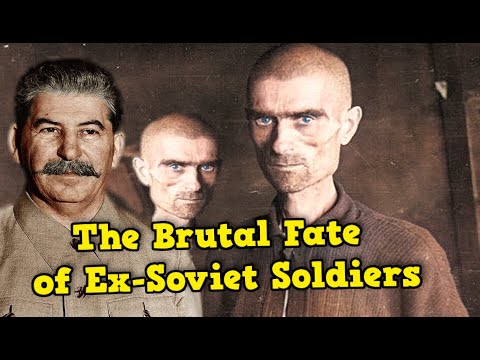
The rescued prisoners are immediately handed over to the NKVD for merciless interrogations. The goal: to determine why they were captured, to root out any potential traitors or deserters, and to assess how their time outside the Soviet Union has influenced them. These interrogations drag on until the end of 1946, lasting nearly a year and a half. For these men, the ordeal is far from over.
But why this cruelty? The answer lies in a decree Stalin issued in 1941, as the German invasion began. “Capture is an active treason against the Homeland,” it declared. Any soldier who surrendered—for whatever reason—was a traitor, deserving of the harshest punishment. This decree extended even to the soldier’s family, who could be deported or have their assets confiscated. The message was clear: fight to the death, or face the wrath of the state.
Stalin’s own son, Yakov, was captured by the Germans in 1941. Stalin’s response was chilling: “I have no son,” he said, and ordered the arrest of Yakov’s wife. The decree also forbade any prisoner exchanges, even for Stalin’s own blood. This ruthless policy meant that millions of Soviet soldiers who fell into German hands were automatically branded as enemies of the state.
When the war ended, the survivors—about two million soldiers—were sent to those concentration camps. There, they faced the same question over and over: “Why did you surrender?” Many wondered, “What was my fault? My company ran out of ammunition.” Others compared their treatment to the German camps: “The experience was even worse than the one we lived in the German enclosures… They had made us prisoners of the country whose liberation we had fought for.”
Of the five million civilians and soldiers repatriated, over 1.5 million were sent to the gulags or forced labor battalions. Their sentence: 25 years. For those who survived the German camps, the Soviet camps became their final destination.
Why did the Soviets treat their own so harshly? The roots go back to 1917, when the Bolsheviks refused to sign the Hague Conventions on POW treatment. Stalin’s paranoia and the fear of foreign influence only deepened this stance. The result was a tragedy of immense proportions—a betrayal of those who had already suffered unspeakably for their country.
For the men arriving at these camps, the shock was compounded by the sheer absurdity of their new status. Many had been decorated for bravery before their capture, their chests still bearing the scars of wounds received in the desperate retreats of 1941. Now, they were stripped of their uniforms, their medals, and their dignity, and assigned numbers like common criminals.
The NKVD interrogators were relentless. “You were in German territory for three years,” they would say. “What did you see? Who did you talk to? Why didn’t you escape?” The questions were a trap. Any answer could be twisted into a confession of espionage or collaboration. A man who had worked in a German factory might be accused of sabotage; a man who had simply starved in a stalag was suspected of having been turned into a spy.
One survivor later recalled the moment his interrogator leaned across the table and whispered, “The Motherland knows everything. We know you ate German bread. We know you wore German rags. Now you will tell us what else you did.” The implication was clear: survival itself was a crime.
Families back home were not spared. Wives who had waited years for their husbands’ return were now told they were married to traitors. Some received notification that their husbands had been sentenced to 25 years in the gulag—without trial, without appeal, without even a chance to say goodbye. Children were taunted at school as the offspring of enemies of the people. The collective guilt Stalin had decreed in 1941 was now being enforced with a terrifying thoroughness.
Yet even within this machinery of suspicion, there were moments of dark irony. Some prisoners who had been captured and then escaped back to Soviet lines were treated not as heroes but as double traitors—first for being captured, then for having been behind enemy lines long enough to be “contaminated.” One such man, a scout who had spent six months in a German camp before escaping and returning with valuable intelligence, was arrested the moment he crossed back. “You expect us to believe you walked out of a German camp?” his interrogator sneered. “No one walks out. You were sent.”
The camps themselves were a grim echo of what the men had just endured. Barbed wire, watchtowers, starvation rations, and the ever-present threat of being shot for the slightest infraction. But there was a crucial difference. In the German camps, the enemy was clear. Here, the guards spoke Russian. The interrogators wore Soviet uniforms. The cruelty came from their own countrymen, and that betrayal cut deeper than any German rifle butt.
By the end of 1946, the interrogations finally wound down. Of the two million former soldiers, over a million and a half were released—but only to be sent to remote regions of Siberia, the Urals, or Central Asia, where they were forbidden from returning to their home cities or reclaiming their old lives. They were marked men, forever listed in NKVD files as “former prisoners of war, unreliable.”
Some tried to rebuild their lives in these frozen outposts, working in mines or logging camps, marrying local women, and raising children who would never fully understand why their father flinched at the sound of a knock on the door. Others simply gave up, their spirits broken by the realization that the country they had bled for had never intended to welcome them back.
And in the West, the story remained largely untold. The Soviet Union’s liberation of Berlin had made headlines; the fate of its own liberated prisoners did not. It would take decades, and the collapse of the Soviet regime itself, before the full scale of this betrayal began to emerge from the archives.
But the story does not end with the camps. For those released into exile, a new kind of purgatory began—one of silence and invisibility. They were not prisoners anymore, yet they were not free. They were “special settlers,” a bureaucratic label that meant they could not leave their assigned region without permission from the NKVD. To travel, even to visit a dying parent, was to risk arrest. To change jobs was to invite suspicion.
In the years that followed, the Soviet state kept its former soldiers under quiet surveillance. Their mail was opened, their conversations monitored, their children’s school records flagged. “He was in Germany,” the file would note. “His loyalty is unverified.” The stigma passed from father to son, a hereditary stain that could not be washed away by hard work or good behavior.
Yet some refused to be erased. In the late 1940s, a former lieutenant named Mikhail Ivanov, who had survived both a German stalag and a Soviet filtration camp, began writing letters to the Central Committee. He wrote not for himself, but for his men—the dozen soldiers from his platoon who had been captured together and were now scattered across Siberia. “We fought until our rifles were empty,” he wrote. “We did not choose captivity. We chose to live, so that we might one day return to serve the Motherland again.”
His letters went unanswered. But they were not destroyed. Decades later, they would be found in the archives, a testament to a quiet, desperate resistance.
As the years passed, the war generation began to die off, and with them, the memory of what had been done. But in the 1960s, under Khrushchev’s thaw, a small window opened. Some former prisoners were quietly rehabilitated—not fully exonerated, but allowed to return to their hometowns and claim their old apartments. For many, it was too late. They had spent their best years in the mines and forests of the north, and they returned as old men, strangers in their own cities.
One such man, a former sergeant named Alexei, returned to his village in the Ukraine in 1964. He had been captured at Kiev in 1941, survived three years in a German labor camp, and then twenty years in the Soviet system. When he knocked on the door of his old house, a young woman answered—his daughter, whom he had last seen as a toddler. She did not recognize him. “My mother said you were dead,” she whispered. “She said you were a traitor.”
Alexei would spend the rest of his life trying to prove otherwise. He wrote to the local party office, to the military archive, to anyone who would listen. He had no documents—they had been taken from him in 1945—and no witnesses, for his comrades were scattered or dead. He died in 1978, still waiting for a letter of exoneration that never came.
It was only in the late 1980s, as the Soviet Union began to crumble, that the truth started to surface. Glasnost opened the archives, and historians began to piece together the scale of the tragedy. In 1995, a decree from the Russian government finally declared that the treatment of former POWs had been “unjustified and contrary to the principles of humanity.” But by then, most of the men were gone. The decree was a gesture, not a remedy.
Today, in a small museum outside Moscow, there is a room dedicated to their memory. It contains photographs, letters, and a single display case holding a worn soldier’s cap and a rusted mess tin. “They were not traitors,” the plaque reads. “They were victims of a system that feared its own people.” The visitors who pass through are few, but those who stop to read the names of the dead often leave in silence.
For the survivors, the question remains: what was it all for? They fought for a country that called them traitors. They survived for a home that sent them into exile. And when the war was finally over, they learned that the enemy they had feared most was not the one in front of them, but the one behind.
In the end, the men who returned from German captivity discovered that their real sentence had only just begun. The Motherland they had bled for did not greet them with medals, but with barbed wire and interrogation lamps.
One veteran, decades later, told a historian: “I survived the Germans by believing I would come home. I survived the camps by believing the truth would come out. I am still waiting.”
Their story is a warning about what happens when a state fears its own people more than any foreign enemy—when loyalty is measured not by sacrifice, but by suspicion.
Today, the archives are open, the plaques are hung, but the silence of those lost years still echoes. Were these men heroes, traitors, or simply victims of a system that could not forgive them for surviving?
What do you think—could such a betrayal ever happen again, and would we recognize it if it did? Share your thoughts below.
Report this article
Select a reason for reporting:






