On a crisp autumn morning in Portland, Maine, antique appraiser Sarah Mitchell stepped into a Victorian home on Elm Street, expecting nothing more than a routine estate sale. But among the sepia-toned portraits and family heirlooms, one photograph from 1914 seized her attention—a formal studio portrait of a prosperous Boston family. The father stood stern in a dark suit, the mother elegant in a white blouse, two young children posed stiffly beside them. It was the kind of image that usually blended into the background of history. Yet something about the mother’s left hand was off. Her fingers curved as if concealing a small object, a deliberate gesture that didn’t match the rigid conventions of the era.
Sarah’s trained eye caught it immediately. “Interesting piece, isn’t it?” a voice behind her said. Margaret Whitmore, the great-granddaughter of the home’s original owners, knew little about the family in the photo—only that it belonged to someone named Patterson. Back in her office, Sarah placed the photograph under magnification. The detail that emerged made her pulse quicken: between the mother’s fingers was the edge of something white, a folded piece of paper, carefully hidden yet not entirely invisible. “She was holding it deliberately,” Sarah murmured, reaching for her phone to call historian Dr. James Reed.
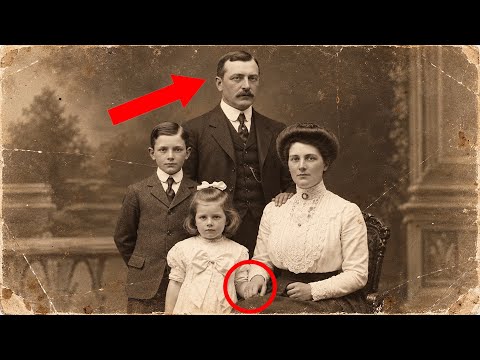
James examined the enhanced images and agreed—1914 was a pivotal year, and nothing in a studio portrait happened by accident. The photographer’s mark led Sarah to the Massachusetts Historical Society, where she found the appointment book for March 15, 1914: “Patterson family portrait, 2:00 p.m. Payment, $12.50, premium sitting.” The address was 145 Beacon Street, Boston. A premium sitting meant wealth and status. But when Sarah dug into newspaper archives, she uncovered a chilling context: just five days before the portrait, Thomas Patterson had been questioned by federal investigators for customs fraud. “The family sat for their expensive portrait while under federal investigation,” Sarah realized, her heart racing.
The mystery deepened at the National Archives, where Sarah found a Treasury Department memo dated March 8, 1914, recommending an immediate search of the Patterson residence. The search was scheduled for March 16—one day after the portrait. “Eleanor Patterson knew they were coming,” Sarah whispered. The evidence inventory noted that no additional documentation was recovered, and a handwritten note from the lead investigator suggested Eleanor was more involved than she claimed. Witness statements painted a picture of a desperate mother: a housekeeper recalled Eleanor burning papers in the fireplace, a neighbor saw her burying something in the garden at midnight, and a schoolteacher remembered her saying, “I have to protect what matters most.” Shortly after Thomas’s conviction in 1915, Eleanor and the children vanished.
Sarah’s breakthrough came from a genealogy website. Ruth Caldwell, a retired teacher in Burlington, Vermont, believed her grandmother was Catherine Patterson—the little girl in the photograph. “She kept a small metal box her entire life,” Ruth wrote. “She said it contained proof of the truth.” In Ruth’s cozy home, Sarah opened the box, engraved with the initials E.P. Inside, wrapped in oiled cloth, was a letter dated March 15, 1914—the day of the portrait. Eleanor’s elegant, hurried handwriting began: “My dearest Catherine, if you are reading this, then the truth has finally come to light.”
With trembling hands, Sarah read on. Eleanor revealed that Thomas was innocent—the real culprit was his business partner, Jonathan Hardwick, who had forged Thomas’s signature and threatened the family. “Hidden in my hand was the key to a safety deposit box at the First National Bank of Boston, box number 247,” Eleanor wrote. “Inside that box is all the evidence needed to prove your father’s innocence.” Sarah looked up at Ruth, both women speechless. The key to a century-old secret had been in plain sight all along, clutched in a mother’s hand during what might have been her family’s final portrait.
But the story was far from over. The safety deposit box had been sealed for over a hundred years, and retrieving it would require more than just a key—it would require proving that the truth was worth unlocking.
At the bank, Sarah and Ruth met with manager Jennifer Walsh, who listened with a mixture of skepticism and fascination as they explained the photograph, the letter, and the key. “Safety deposit box 247 has been dormant since 1917,” Walsh said, reviewing the records. “But given the documentation and Mrs. Caldwell’s status as next of kin, we can proceed.” In the vault, the key turned smoothly, as if the lock had been waiting a century for this moment.
Inside the box lay a bundle of documents wrapped in oilcloth. Sarah’s hands shook as she unfolded them: correspondence between Jonathan Hardwick and corrupt port officials, bank records showing bribes, and practice sheets where Hardwick had perfected forging Thomas Patterson’s signature. “This is it,” Ruth whispered. “Grandmother was right.” But Sarah’s eyes were drawn to a second letter, this one addressed to Eleanor and dated March 5, 1914—ten days before the portrait.
It was from Hardwick, and the threat was explicit: “If your husband continues asking questions about the import documentation, I will ensure he takes responsibility for irregularities he knows nothing about. Your family’s reputation and safety depend on his cooperation.” Sarah felt a chill. Eleanor hadn’t just been protecting evidence—she had been protecting her children from a man who had already proven he would stop at nothing.
Among the papers was a final item: a photograph of Thomas and Hardwick shaking hands in front of their textile warehouse, both smiling. “The bitter irony,” Sarah murmured. She photographed every document and sent them to Dr. Reed, who confirmed the signatures were forgeries and that Hardwick had fled to South America in 1916, just after Thomas’s conviction. “This is a miscarriage of justice,” Reed said. “And now we have the proof to correct it.”
Ruth agreed to donate the contents of the box to the Massachusetts Historical Society, ensuring public access. But as Sarah drove back to Portland, she couldn’t shake one question: whatever happened to Eleanor and the children after they vanished? The letter mentioned Canada, but the trail had gone cold. She decided to dig deeper, starting with a name from the witness statements—Margaret Donnelly, the former housekeeper.
After a week of searching, Sarah found a death certificate for a Margaret Donnelly in Halifax, Nova Scotia, dated 1952. The informant on the certificate was a Catherine Patterson. “She made it to Canada,” Sarah breathed. The address on the certificate led to a small cemetery outside Halifax, where a weathered headstone read: Eleanor Patterson, 1878–1948, Beloved Mother. Beside it, a smaller stone: William Patterson, 1906–1920, Taken Too Soon. Sarah’s heart sank. The boy from the photograph had died at just fourteen.
She called Ruth immediately. “Your grandmother never spoke of a brother?” Sarah asked. Ruth’s voice trembled. “She mentioned a brother who died young, but she never said how.” Sarah stared at the headstone, the weight of the family’s tragedy settling over her. Whatever had happened to William, Eleanor had carried that loss for the rest of her life. The photograph in Sarah’s bag suddenly felt heavier—a frozen moment of a family on the brink, unaware of the sorrow ahead.
Back in Portland, Sarah pulled the 1914 portrait from her files and studied William’s face—the boy of eight, stiff in his collar, trying not to fidget. “Fourteen,” she murmured. Six years after the photograph, the boy was gone. She needed to know why.
The Halifax death records from 1920 were sparse, but a city archivist named Douglas Fraser agreed to help. Two days later, he called with a grim discovery. “William Patterson died of influenza in the epidemic’s second wave,” Fraser said. “But there’s a note in the margin—’buried from St. Mary’s, service delayed four days, family in quarantine.'” Sarah wrote it down. The boy had died in the great influenza pandemic, the same one that had killed millions worldwide.
But it was the next detail that made her sit up straight. “There’s a second name in the same plot record,” Fraser continued. “A woman, Margaret Donnelly, died 1952—same grave marker base.” The housekeeper from the witness statements. She had followed Eleanor to Canada and stayed with her for decades.
Sarah called Ruth with the news. For a long moment, Ruth was silent. “Grandmother always said there was a woman named Maggie who lived with them when she was small,” Ruth finally said. “She called her ‘Aunt Maggie.’ I thought it was a relative.” Sarah explained: Margaret Donnelly had testified about Eleanor burning papers—yet she had remained loyal, crossing an ocean to stay with the family she once served. “She wasn’t a witness against Eleanor,” Sarah said. “She was a witness for her.”
The pieces were falling into place, but one question still nagged at Sarah. If Eleanor had proof of Thomas’s innocence, why had she never used it? Why live out her life in exile, letting her husband die in disgrace?
The answer came from an unexpected source: a bundle of letters tucked at the bottom of Eleanor’s metal box that Sarah had initially overlooked. They were addressed to Eleanor from a Boston attorney named Arthur Pennington, dated 1916 and 1917. Sarah read them slowly, her stomach tightening with each page.
“Jonathan Hardwick has returned from abroad under an assumed name,” Pennington wrote in the first letter. “My sources indicate he has hired men to watch your whereabouts. He has stated openly that if the Patterson evidence ever surfaces, he will see to it that your children do not live to testify.” Sarah set the letter down, her hands cold. Eleanor hadn’t stayed silent out of fear for her own life. She had stayed silent to keep Catherine and William alive.
The final letter, dated December 1917, was shorter and more chilling. “Hardwick’s agents have traced you to Halifax. I urge you to move again. Destroy nothing—but speak to no one. The moment you reveal what you hold, you become a target. Your silence is your children’s shield.” Sarah stared at the page. For thirty years, Eleanor had carried the proof of her husband’s innocence like a stone in her chest—unable to use it, unable to destroy it, waiting for a safety that never fully came.
She looked again at the 1914 photograph, at Eleanor’s curved fingers, and understood the gesture differently now. It was not merely preservation. It was defiance. A mother holding the truth in her hand, in plain sight, daring the world to look closely enough to see it.
Sarah sat back in her chair, the weight of Eleanor’s decades of silence pressing against her chest. “She chose her children over her husband’s reputation,” she said softly to Ruth over the phone. “Every single day, for thirty years.” Ruth’s voice cracked. “And no one ever knew.”
But Sarah wasn’t finished. She sent the letters to Dr. Reed, who cross-referenced Pennington’s warnings with immigration records. Hardwick, it turned out, had died in Buenos Aires in 1923—his threats expired long before Eleanor’s did. She had simply never learned she was safe. The shield stayed up until it became a habit, then a way of life.
When Sarah presented her findings at the Massachusetts Historical Society that autumn, she saved the letters for last. The auditorium fell silent as she read Pennington’s warning aloud. “Your silence is your children’s shield.” Ruth, seated in the front row, pressed a handkerchief to her eyes.
Afterward, a young woman approached the podium—a graduate student in history. “So Eleanor never knew she’d won?” she asked. Sarah shook her head. “She died believing the truth was still dangerous. But she kept it anyway—for us.”
The 1914 photograph now hangs in the historical society, Eleanor’s hand visible to anyone who looks closely. Sarah visits sometimes, standing before the curved fingers that held a key, a secret, a mother’s fierce defiance. Some stories end in vindication. Others end in quiet endurance, waiting for a stranger to notice.
What would you have done in Eleanor’s place—spoken the truth and risked everything, or held silent to keep your children safe?
Report this article
Select a reason for reporting:






