In the dense jungles of the Philippines, September 1902, an American corporal empties his revolver into a charging Moro warrior. Six shots, center mass, all hits. The warrior keeps coming. Thirty feet. Twenty. Ten. The soldier dies with his throat cut, his empty .38 caliber pistol still gripped in his hand. When reinforcements arrive, they count six bullet holes in the Moro’s chest. None of them stopped him.
This scene repeats itself dozens of times across Mindanao. American soldiers are dying because their weapons can’t drop charging enemies. The .38 caliber revolvers that looked so modern on paper are failing where it matters most: on the battlefield. The army needs answers. They need stopping power. They need a weapon that will neutralize an enemy before he can close the distance.
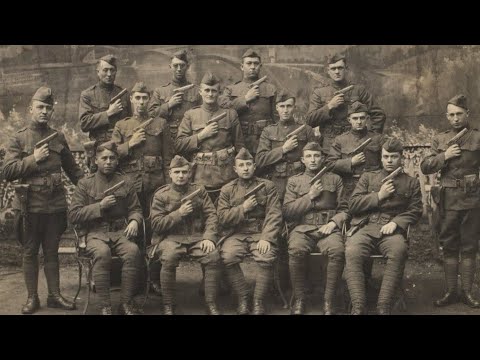
What they don’t know yet is that the solution is already being designed in a gunsmith’s workshop in Utah. His name is John Moses Browning, and he’s about to create the most enduring combat pistol in American military history.
Mindanao, 1900. The Philippine-American War is entering its most brutal phase. American forces are fighting Moro tribesmen who’ve resisted foreign conquest for four centuries. First the Spanish, now the Americans. These warriors are unlike anything US troops have encountered. They wear armor crafted from water buffalo horn and brass plates connected with chain mail. They don Spanish-era helmets. Before battle, many consume drugs that numb pain and induce what soldiers describe as religious frenzy. The combination of armor, drugs, and warrior culture creates a nightmare scenario for American infantrymen.
A lieutenant writes in his field report, “Our men engage enemies at close range. They fire repeatedly, striking vital organs. The enemy continues advancing. By the time our soldiers realize their weapons are ineffective, it’s too late to retreat or reload.”
In Washington, these reports pile up on the desk of General William Crozier, Chief of Ordnance. The pattern is undeniable. The Model 1892 revolver, adopted just eight years earlier as a modern replacement for heavier .45 caliber pistols, lacks the kinetic energy to stop determined attackers. Lighter weight and higher accuracy mean nothing if enemies reach your position with blades drawn.
Crozier authorizes the Thompson-LaGarde tests in Chicago, 1904. The methodology is controversial: live cattle, cadavers, ballistic pendulums. Critics call it barbaric. But the army needs data, and they need it fast. After months of testing different calibers against various targets, the conclusion arrives in stark language: Any handgun smaller than .45 caliber provides inadequate stopping power at close range. The recommendation is clear: return to the .45 caliber round.
But there’s a problem. The old single-action revolvers are obsolete. American forces need a modern weapon, a semi-automatic that combines the hitting power of the old .45s with the speed and capacity of 20th-century firearms. The military puts out specifications for a new pistol. And in Ogden, Utah, a 48-year-old gunsmith reads them with interest.
John Moses Browning doesn’t look like a revolutionary. Born in 1855, he grew up in his father’s gunsmith shop, learning the trade by watching, listening, and experimenting. By age 13, he’s built his first functional firearm. By his 20s, he’s designing weapons that Winchester eagerly purchases. His falling-block rifle becomes the Winchester Model 1885. His lever-action designs become legends of the American West.
But Browning sees beyond lever actions and revolvers. He understands that the future belongs to self-loading firearms, weapons that harness their own recoil to chamber the next round. In the 1890s, while most gunsmiths perfect existing designs, Browning experiments with semi-automatic mechanisms. He files patents for gas-operated shotguns and recoil-operated pistols. The concepts are so advanced that some manufacturers don’t understand what they’re looking at.
By 1900, Browning has developed a working semi-automatic pistol based on short recoil operation. The principle is elegant: when fired, the barrel and slide remain locked together for a brief moment, moving rearward as a unit. Then the barrel unlocks and stops while the slide continues back, ejecting the spent case. A recoil spring drives the slide forward, stripping a fresh round from the magazine and chambering it. The shooter never touches a cylinder or manually works a lever. Just pull the trigger. The gun does the rest.
This system will become the foundation for virtually every modern semi-automatic pistol designed in the 20th century. But in 1900, it’s radical technology. Browning refines the design over several years, working with Colt’s Patent Firearms Manufacturing Company to develop a pistol that can meet military specifications.
The challenge is substantial. The Army wants a .45 caliber semi-automatic that’s reliable, accurate, easy to maintain, and soldier-proof. It must function in mud, dust, extreme heat, and freezing cold. It must be simple enough for conscripts to field-strip and maintain without specialized tools. And it must demonstrate absolute reliability. No jams, no malfunctions, no failures.
Browning designs a new cartridge specifically for the weapon: the .45 ACP (Automatic Colt Pistol). The round delivers devastating energy transfer. A 230-grain bullet traveling at approximately 850 feet per second. It’s subsonic, which reduces barrel wear and allows for effective suppression. More importantly, it achieves the stopping power the army demands.
The pistol itself features innovations that seem obvious in hindsight but are revolutionary in 1905. A grip safety prevents accidental discharge if the weapon is dropped. A slide stop locks the action open after the last round, providing immediate visual confirmation that the magazine is empty. The single-stack magazine holds seven rounds. Small by modern standards, but revolutionary compared to six-shot revolvers. And the entire system is built around principles of controlled recoil and mechanical simplicity.
Between 1906 and 1911, the Army conducts exhaustive trials. Multiple manufacturers submit designs. Colt’s Browning-designed pistol competes against entries from Savage Arms, Luger, and others. The tests are merciless: thousands of rounds, mud tests, sand tests, water immersion, deliberate abuse. The army wants to know which pistol will function when everything goes wrong.
March 29, 1911. The final torture test. Under John Browning’s personal supervision, a single Colt pistol fires 6,000 rounds over two consecutive days. The barrel grows so hot that observers worry it will fail. Browning’s solution is pragmatic: dunk the weapon in a bucket of water to cool it, then continue firing. The military observers watch for any sign of malfunction: a jam, a misfire, a failure to eject. Nothing. The Colt pistol chambers round after round without hesitation. Meanwhile, the Savage pistol competing alongside it suffers 37 malfunctions during the same trial.
The decision is unanimous. On March 29, 1911, the United States Army officially adopts Browning’s design as the Automatic Pistol, Caliber .45, Model of 1911. The Navy and Marine Corps follow shortly after. Production begins immediately. The manufacturing cost: approximately $14.50 per unit for Colt during World War I. The pistol weighs 39 ounces unloaded. Overall length: 8.25 inches. Seven rounds in the magazine, one in the chamber. Simple, powerful, reliable.
Nobody realizes it yet, but this pistol will still be eliminating America’s enemies more than a century later.
France, October 8, 1918. The Argonne Forest. Corporal Alvin York and sixteen other soldiers advance through heavy timber toward German machine-gun positions near Hill 223. The mission: silence the guns pinning down their regiment. As they approach, German gunners open fire. York’s squad takes casualties immediately. Several men fall in the first burst.
York, a Tennessee mountain man who learned marksmanship hunting to feed his family, drops prone and returns fire with his M1903 Springfield. His accuracy is devastating. He dispatches German machine gunners with precise rifle shots. The position begins to collapse.
Then everything changes. Six German soldiers charge York with fixed bayonets, trying to overrun him before he can reload. York drops his rifle and draws his M1911.
What happens next becomes legend. York shoots the charging Germans from back to front, the last man in line first, working forward so those behind don’t see their comrades falling and halt the charge. It’s the same technique he used hunting wild turkeys in Tennessee. Six men charge, six men fall. York’s M1911 doesn’t jam, doesn’t misfire, doesn’t fail.
With the bayonet charge broken, York advances on the German trench with his pistol drawn. A German lieutenant, seeing the carnage and believing he faces a larger force, signals surrender. By the time York and his remaining men reach American lines, they’ve captured 132 German prisoners and silenced more than 30 machine guns. York receives the Medal of Honor. When reporters ask how he did it, he credits three things: divine providence, mountain-bred marksmanship, and the M1911 that never let him down.
In 2006, nearly ninety years later, forensic investigators locate the precise site of York’s action and recover shell casings. Ballistic analysis confirms 46 .30-06 casings from his rifle and 23 .45 ACP casings from his M1911. The evidence corroborates his account exactly. Those 23 shots, fired under extreme stress in close combat, prove the pistol’s effectiveness in ways no peacetime test ever could.
Stories like York’s spread through the American Expeditionary Force. Soldiers who initially doubted the new pistol become converts. The M1911 isn’t just reliable, it delivers the stopping power the .38s couldn’t provide in the Philippines sixteen years earlier. Tank crews keep them close in cramped turrets. Officers wear them on their hips. Pilots carry them in cockpit holsters. The pistol becomes synonymous with American combat power.
But wartime performance reveals problems. Soldiers request modifications based on battlefield experience. The hammer spur is too long and bites the web of the shooter’s hand during recoil. The grip safety tang is too short, failing to deactivate reliably under stress. The trigger is wide and smooth, difficult to control with gloved hands. The flat mainspring housing is uncomfortable for some shooters.
Between 1920 and 1926, Army engineers incorporate these field modifications into an improved design. The changes are subtle but significant: a shorter hammer spur, a longer grip safety tang, a narrower serrated trigger, an arched mainspring housing, and simplified checkering on the grip panels. The modifications improve ergonomics without altering Browning’s fundamental operating system.
In 1926, the Army designates the improved pistol the M1911A1. The suffix distinguishes it from the original, though both variants remain in service for decades. The cost stays low, roughly $24 per unit. When Springfield Armory contracts with Colt in 1936, the design is mature, the manufacturing efficient, the weapon proven.
Three months after the Army adopts the A1 variant, John Moses Browning dies of a heart attack in Belgium. He is 71. He leaves behind an extraordinary legacy: the M1918 Browning Automatic Rifle, the M1917 and M2 machine guns, the Browning Hi-Power pistol, and dozens of other firearms that will influence weapons design for generations. But nothing will prove more enduring than the M1911. It will outlast him by more than a century.
June 6, 1944. Normandy. The largest amphibious assault in human history unfolds across fifty miles of French coastline. Among the tens of thousands of American soldiers storming ashore, the M1911A1 is everywhere. Officers wear them in shoulder holsters. Tank commanders keep them within reach. Paratroopers drop into the pre-dawn darkness with them strapped to their harnesses.
The demand is staggering. America needs pistols by the hundreds of thousands. Colt is already overwhelmed producing machine guns, so the government contracts companies that have never manufactured firearms. Remington Rand, a typewriter company, becomes the largest producer of M1911A1s during the war, manufacturing approximately 900,000 pistols. Union Switch and Signal, a railroad equipment maker, produces 55,000. Ithaca Gun Company makes 335,000. Even Singer, the sewing machine company, receives a contract for 500 pistols at $557.75 each, an educational order designed to develop manufacturing processes rather than produce weapons at scale.
Wartime production introduces changes to speed manufacturing. Bluing gives way to parkerized finishes. Wooden grip panels are replaced with brown plastic. But the core design, Browning’s 1905 concept, remains unchanged. And the pistol performs flawlessly in the frozen Ardennes during the Battle of the Bulge. It works in the burning deserts of North Africa. It works in the steaming jungles of the Pacific. It works.
American tank crews particularly favor the M1911A1. Sherman tanks carry up to five pistols for crew personal protection. The reasoning is practical: if the tank is hit and the crew must bail out, a pistol is faster to draw and more maneuverable than a rifle. One tanker explains the doctrine: “You lift the pistol above the hatch and spray rounds at anyone trying to stop you from abandoning the vehicle. The .45 keeps them honest.”
German forces even adopt captured M1911A1s, designating them Pistole 660(a), the letter indicating American origin. In the war’s final months, Germany’s desperate Volkssturm militia carries any weapon it can find, including thousands of captured American pistols. For a weapon designed to fight Moro warriors in the Philippines, the M1911 has traveled an improbable distance.
By 1945, approximately 1.9 million M1911A1 pistols have been produced for World War II. When peace comes, military planners expect the design to fade into obsolescence like most wartime weapons. They’re wrong.
Korea, 1950. The pistol serves again, this time in sub-zero temperatures that jam lesser weapons. Vietnam, 1965 to 1975: tunnel rats crawl into Viet Cong underground complexes with the .45 in hand, choosing its compact size and devastating close-range power over any rifle.
By the late 1970s, political pressure to standardize on NATO 9mm ammunition forces the Air Force to run trials for a new sidearm. On January 14, 1985, the Beretta 92F is officially adopted, ending 74 years of service as America’s standard sidearm. Except it doesn’t end.
Delta Force, formed in 1977, adopts the M1911A1 as standard issue, each pistol meticulously customized by unit armorers. Navy SEALs, Marine Force Recon, FBI hostage rescue teams, and SWAT units across America keep the .45 close. The stopping power that dropped Moro warriors in 1902 remains unmatched by lighter 9mm rounds.
In 1991, during Operation Desert Storm, soldiers report using pistols forty-five years old that still function perfectly. In 2012, the Marine Corps awards Colt a $22.5 million contract for 12,000 modernized M45A1 pistols. In 2019, a Delta Force veteran commanding in Afghanistan is photographed carrying a customized M1911. 108 years after its adoption, the pistol is still going to war.
Today, the M1911 has fought in more American conflicts than any other sidearm in history, from Pancho Villa to Osama bin Laden. Walk into a gun store and you can buy a pistol functionally identical to the one Alvin York carried in the Argonne. Same operating system, same .45 caliber round, same grip angle. A 120-year-old design that shows no signs of obsolescence.
John Browning understood something fundamental in 1905 that remains true today: complexity is the enemy of reliability. His short recoil system uses gravity, springs, and momentum, nothing more. No gas systems to foul, no fragile linkages to break. Generous tolerances let the weapon function when dirty, wet, or damaged.
The Philippine-American War created the requirement. Browning designed the solution. York proved its effectiveness. Millions carried it into combat. Some weapons are revolutionary, some are reliable, some are elegant. The M1911 is all three. It was supposed to cost $15 and last a decade. Instead, it became immortal.
So here’s the question for you: in an age of polymer frames and 17-round magazines, would you still trust a 114-year-old design with your life—and if so, why?
Report this article
Select a reason for reporting:






