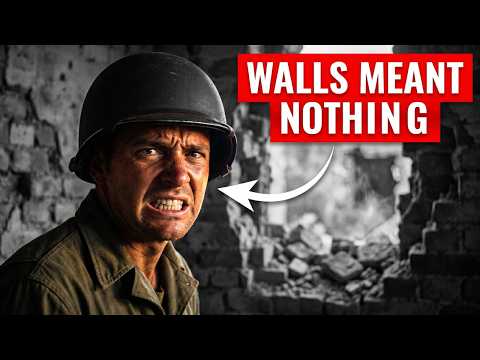
October 13, 1944, 0930 hours. A narrow street in the eastern quarter of Aachen, Germany. Oberst Gerhard Wilck, newly installed garrison commander, stands in a cellar beneath a bombed-out apartment block, reviewing the defensive positions his men have prepared. He has been in command for less than 24 hours. His orders from the highest authority in the Reich are simple: hold this city to the last man and the last bullet. Do not surrender. Do not withdraw. If necessary, allow yourself to be buried beneath the ruins.
Wilck has studied the ground. His men have turned the streets into kill zones. Machine guns are sighted at intersections to sweep the roads in interlocking arcs of fire. Anti-tank guns are positioned to catch any Sherman that tries to push down a boulevard. Barricades of rubble and overturned streetcars block the main avenues. The cellars are connected through the city’s sewer system, allowing his troops to move underground, surface behind an advancing enemy, fire, and disappear again. Every doctrine the German army has written about urban defense, every lesson extracted at terrible cost from the rubble of Stalingrad, has been poured into these positions. The defense is oriented to do one thing: destroy an enemy that comes down the streets.
The Americans do not come down the streets.
When the assault begins, what Wilck’s garrison encounters is something no German urban defense manual has prepared them for. The Americans do not pour infantry into the boulevards where the machine guns are waiting. They do not send tanks around corners into the teeth of anti-tank fire. Instead, a sound begins that the German defenders in the forward buildings hear before they see anything. It is the sound of walls exploding. Not the exterior walls facing the street—the interior walls, the shared walls between apartments, the basement partitions that separate one building from the next.
The Americans are inside the buildings, and they are moving through the city without ever stepping outside. They are blowing holes through the walls, climbing through the dust and rubble into the next room, clearing it with grenades and bayonets, and blowing through the next wall after that. They are entering from directions that have no doors. They are arriving on floors that have no stairs leading to the street. They are, in the most literal sense, coming through the walls.
For a German sergeant crouched behind a machine gun at the end of a street he has been told to defend, this changes everything. His field of fire covers the road. His position is designed to stop men who are advancing toward him in the open. But the men who appear behind him have not used the road at all. They have come through three apartments, two basements, and a shared attic. And they are now inside his building, firing down at his position from above.
The question this story sets out to answer is not simply how the Americans learned to fight this way. The question is why the Germans—who had survived Stalingrad, who had written the book on urban defense, who understood better than any army on earth what a city does to an attacking force—were unable to counter a method that was, at its core, not complicated. The Americans were blowing holes in walls. It was not a secret. It was not sophisticated. Yet it systematically dismantled the most carefully prepared urban defense on the Western Front.
To understand why, we need to go back—not to Aachen, not to D-Day, but to the reason every army in the world feared cities in the first place. And to the small number of soldiers in several different armies who, between 1941 and 1943, had quietly figured out how to turn that fear inside out.
There is a reason generals have avoided fighting in cities for as long as there have been cities to fight in. Urban terrain negates almost every advantage a modern army possesses. Artillery, the great killer of the open battlefield, cannot be aimed precisely enough to hit a single room in a single building without destroying the structure entirely and potentially burying both the enemy and your own troops. Armor, the decisive arm of maneuver warfare, becomes a steel coffin in a narrow street where a single man on a rooftop with a shaped charge weapon can destroy a 40-ton tank. Air power, the weapon that had reshaped every major campaign since 1939, cannot distinguish a defended building from an empty one. Radios, the nervous system of modern command, are blocked and distorted by concrete and steel. Lines of sight collapse from kilometers to meters. A single sniper in a fourth-floor window can pin down an entire platoon for hours.
The open field calculus of modern war—in which superior firepower plus superior mobility equals victory—ceases to function. The city makes the attacker stupid, slow, and vulnerable. The city makes the defender, even a weak one, dangerous.
The example that hung over every military planner in 1944 was Stalingrad. Between August 1942 and February 1943, the German Sixth Army, under General Oberst Friedrich Paulus, had driven into the city on the Volga expecting to take it in a matter of weeks. The Luftwaffe had already reduced much of the city to rubble before the ground troops entered. Ironically, the rubble made the defense easier. Tanks could not navigate collapsed streets. Infantry lost all sense of direction in the featureless wasteland of broken concrete. Soviet defenders under General Vasily Chuikov’s 62nd Army fought from sewers, from basements, from the upper floors of shattered factories like the Barrikady and the Red October works. They invented what Chuikov called storm groups—small teams of 10 or 15 soldiers loaded with grenades and submachine guns, who would infiltrate at night, seize a floor of a building, and hold it against counterattack by day. They turned every stairwell into an ambush, and every pile of rubble into a fighting position. The Germans called it Rattenkrieg—rat war. A German officer wrote that the distance between the enemy and us was measured not in meters, but in floors, sometimes in ceilings.
The battle consumed over 700,000 German and Axis casualties. It consumed over a million Soviet casualties. The Sixth Army, one of the finest field formations Germany had ever produced, ceased to exist when Paulus surrendered on January 31, 1943—the day after his promotion to field marshal, making him the first German field marshal in history to be taken alive by an enemy. The remaining northern pocket of German resistance capitulated two days later.
Every officer who had studied Stalingrad drew the same conclusion: cities devour armies. Avoid them when you can. When you cannot, prepare to pay a price in blood that no general wants to calculate.
But Stalingrad also produced something else. It produced, in the rubble and the sewers and the blasted factory halls, the first widespread use of a technique that had no official name yet, but that soldiers on both sides were already practicing out of sheer necessity. When a Soviet squad needed to move from one building to the next, and the street between them was a kill zone covered by German machine guns, the squad did not cross the street. The squad went through the wall. They used explosives, pickaxes, sledgehammers—anything that could breach the masonry. They blew or smashed a hole large enough for a man to climb through, moved into the next building, and continued the fight from inside. It was not elegant. It was not planned. It was survival. But it worked.
And the lesson, like most battlefield lessons, began to travel.
It traveled first to the British Army. By the early 1940s, British military doctrine had formalized a concept called the vertical technique for fighting in built-up areas. British training materials showed infantry entering a building from the top floor, clearing downward through each level, and breaching through shared walls to move laterally between structures without using the street. The idea was simple: the street was where the defender expected you. The walls were where he did not.
It traveled next to the Canadians, and it was the Canadians who gave the technique the name that would stick. In December 1943, at a small Italian port town called Ortona, on the Adriatic coast, the Loyal Edmonton Regiment and the Seaforth Highlanders of Canada, supported by tanks of the Three Rivers Regiment, fought one of the most intense small-unit urban battles of the entire war. The German 1st Parachute Division had fortified the town, turning every stone building into a strongpoint and every narrow medieval street into a death trap. The paratroopers were among the best soldiers in the Wehrmacht. They had mined the buildings, rigged entire blocks to collapse with demolition charges, and created interlocking fields of fire that covered every approach.
The Canadians attacked and were immediately channeled into the killing ground the Germans had prepared. The fighting lasted eight days, from December 20th to December 28th. Casualties mounted. Progress, measured in single buildings, cost entire platoons. Then the Canadians began to adapt. They stopped using the streets. They entered buildings from the rooftops, clearing downward. They blasted holes through the connecting walls of the tightly packed row houses with explosive charges and anti-tank rounds, moving from one structure to the next without ever exposing themselves to the fire in the streets below. The soldiers called it mouse holing. You became the mouse, the wall became the hole. You went through it because the door was death. They used shaped demolition charges called beehives to punch man-sized holes through brick and stone walls in a single detonation.
By the end of the battle, Ortona had become a laboratory for urban combat innovation—a place where existing tools and doctrines were refined under fire into a coherent method of fighting through a city without using its streets. At Ortona, mouse holing was not a doctrinal innovation handed down from a staff college. It was a field adaptation created by sergeants and corporals who were watching their friends die in the streets and who decided to stop going into the streets.
After the battle, the technique was documented, studied, and circulated. But the crucial point—the point that matters for what happened at Aachen ten months later—is that the technique was available to anyone who was paying attention. The British had it. The Canadians had it. The Soviets had been doing it since Stalingrad. The Americans had published Field Manual 31-50, titled Attack on a Fortified Position and Combat in Towns, on January 31, 1944, which described the fundamentals of fighting in built-up areas. The technique was not a secret. It was common knowledge among Allied armies by the time the invasion of France began.
And yet, when the 1st Infantry Division applied it at Aachen in October 1944, the result was not a repetition of Ortona. It was something different. Something that went beyond the survival trick the Canadians had improvised in a medieval Italian port town and became, in the hands of American infantry, engineers, tankers, and artillerymen, an industrial-scale method for taking apart a city one room at a time. To understand why, you have to understand what the 1st Infantry Division was by the autumn of 1944—and what the men inside it had already been through.
So when Wilck’s garrison heard the walls exploding, they were hearing the sound of a method that had traveled from Stalingrad to Ortona to the training grounds of England, and had finally arrived in the hands of men who had spent two years learning that the manual was never going to save them. The Big Red One did not invent mouse-holing. They industrialized it. They married the breach to the firepower, the squad to the tank, the private to the 155, and they did it because their culture had taught them that a wall was not a barrier but an invitation.
That is the answer the rubble of Aachen keeps giving up, no matter how many times you ask the question. It was never about the technique. It was about the men who were free to use it.
What would you have done, standing in that cellar, hearing the walls come down around you?
Report this article
Select a reason for reporting:






