In the frozen hell of the Ardennes, the snow was not just a backdrop to battle—it was a shroud for secrets. December 1944, and the United States Army was locked in a desperate struggle against Hitler’s last great offensive. But amid the chaos of war, a chilling event would ignite a cycle of violence that even the victors would try to bury.
On December 17, 1944, near the town of Malmedy, Waffen SS troops committed an unspeakable atrocity: 84 American prisoners of war were lined up and gunned down in cold blood. The few who tried to flee were shot in the back; others were burned alive in a nearby farmhouse. When the news reached American commanders, it spread like wildfire among the troops—indignation mixed with rage, hatred, and a burning desire for revenge.
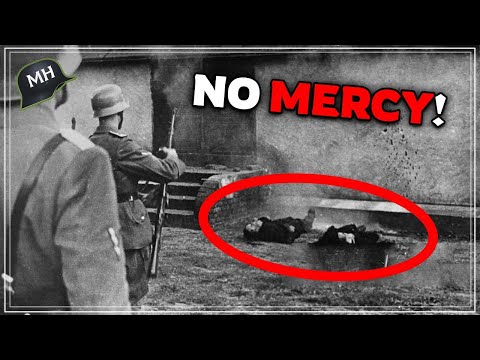
The Germans had no idea they had just inaugurated a cycle of violence that would soon turn against them. “The Germans have no humanity,” commanders told their men, using the massacre as propaganda. “They are little more than wild beasts.” And with that, a subtle but deadly directive was issued: no SS prisoners were to be taken. It was a green light for retribution.
By January 1, 1945, the Ardennes campaign raged on. The 11th Armored Infantry Division, green and untested, received orders to capture the village of Chenogne. “We had no battle experience,” one soldier recalled. “But we were sure of air support—until the fog rolled in and grounded our planes.” The Americans advanced blindly through mist and bitter cold, straight into a German ambush.
The fight for Chenogne was brutal. Anti-tank and anti-aircraft fire tore through the American ranks, turning the village into a smoking heap of ruins. “Dozens of our boys died,” Sergeant John Fague remembered. “And those who survived were in shock, enraged by the ambush and the memory of Malmedy.” When the Germans finally surrendered, the Americans forced them into line. Fague knew what was coming. “I didn’t like it at all,” he said.
Some prisoners were marched up a hill, out of sight. The remaining 25 were taken to a field and made to stand along a path. “These boys were about to be shot with machine guns,” Fague recalled. “We Americans were repeating the crimes of the Germans and the Japanese.” A shower of lead rained down, killing them instantly. Between 50 and 60 Germans died that day, their bodies left in the snow.
It was one of the largest war crimes committed by the U.S. Army. General George S. Patton noted in his diary: “The 11th Armored Division is still too green. They murdered about 50 Germans. I hope we can hide it.” And hide it they did. The massacre at Chenogne remained silent for decades, the bodies buried by villagers who believed they were fallen soldiers. Only in 2018 did journalists uncover the truth.
But the story of Chenogne is more than a forgotten atrocity—it is a mirror reflecting the darkest corners of war, where vengeance and justice blur, and where even the righteous can become what they despise. As the snows of the Ardennes melted, they revealed not just the scars of battle, but the secrets of men who fought and the price of revenge.
The villagers of Chenogne had buried the dead without ceremony, assuming they were simply casualties of the artillery duels that had shattered their homes. For decades, the field where the prisoners fell was just another patch of farmland, plowed and harvested by families who never knew its dark history. “We thought they were soldiers who died in the fighting,” one elderly resident later told investigators. “No one told us otherwise.”
But the truth had a way of clawing its way out of the frozen ground. In the years after the war, veterans of the 11th Armored Division carried the burden in silence. Some wrote letters to each other, hesitant confessions that were never sent to newspapers. “I saw what happened,” one veteran wrote in a private journal discovered by his grandson. “I didn’t fire, but I didn’t stop it either. That’s the part that keeps me awake.”
The U.S. High Command’s cover-up was remarkably effective. Official reports from Chenogne made no mention of the executions—only that prisoners had been taken and the village secured. Patton’s diary entry was locked away in archives, and the soldiers involved were told to never speak of it. “It was swept under the rug so thoroughly that even the Army’s own historians didn’t find it for decades,” a military archivist later admitted.
Then, in 2018, a team of investigative journalists from a major American newspaper stumbled upon a footnote in a declassified document that hinted at something called “the Chenogne incident.” They began digging—interviewing surviving veterans, tracking down families of the dead, and cross-referencing German records that listed 50 soldiers as “missing in action” after the battle for the village.
What they found was damning. “The evidence was overwhelming,” one journalist wrote. “We had eyewitness accounts from both sides, Patton’s own diary, and the location of the mass grave. The Army had no way to deny it anymore.” But when the story broke, the Pentagon offered only a terse statement: “The events of January 1945 remain a matter of historical record, and we honor all those who served.”
For the families of the German soldiers executed at Chenogne, the revelation brought a strange mix of grief and vindication. “My father was just a boy, drafted into a war he didn’t choose,” said one daughter, now in her seventies. “For years, we were told he died in battle. Now we know he was killed after he surrendered. It doesn’t bring him back, but at least we know the truth.”
The Chenogne massacre remains one of the least-known atrocities of the Western Front—a grim reminder that war does not divide men neatly into heroes and villains. The snows of the Ardennes have long since melted, but the stain of that day lingers, buried in unmarked graves and the memories of those who were there.
The journalists’ investigation did not end with the newspaper story. Historians, drawn by the scent of a buried truth, descended on the archives with fresh eyes. Among them was a young Belgian researcher named Élodie Marchand, whose grandfather had owned the very field where the prisoners fell. “I grew up hearing whispers,” she said. “That the field was cursed, that the crops grew crooked there. My grandfather never spoke of it directly, but he refused to sell that land.”
Marchand began piecing together the fragments the American reporters had missed. She pored over German military records, cross-referencing the names of the missing with the dates of the Chenogne battle. What she found was startling: the 50 soldiers listed as “missing” belonged not to a single unit, but to three different companies—a sign that the prisoners had been a mixed group of stragglers and support troops, not hardened SS men.
She also uncovered a letter, tucked into the margins of a Belgian parish register, written by a local priest in the spring of 1945. “The Americans came through like a storm,” the priest had scrawled in faded French. “They were kind to us, but there was a darkness in their eyes. I saw them lead the Germans away. I heard the guns. I said nothing. God forgive me.”
What Marchand discovered next would reframe the entire episode. In a box of unprocessed American military correspondence, she found a letter from a lieutenant in the 11th Armored Division, dated January 3, 1945—two days after the massacre. The lieutenant, whose name she withheld from publication, wrote to his wife: “Something terrible happened yesterday. We took prisoners and then we shot them. I didn’t pull the trigger, but I stood there. The boys said it was for Malmedy. I keep telling myself that. It doesn’t help.”
The letter had never been sent. It was found in a dead-letter bin, returned to the Army after the lieutenant’s wife had moved without leaving a forwarding address. “He tried to tell someone,” Marchand said. “He tried to confess. But the letter never reached her, and he carried it alone until the day he died.”
Meanwhile, in the United States, the families of the German soldiers began to organize. They formed a small association, the Chenogne Memorial Group, and petitioned the U.S. Army for access to the site and for an official acknowledgment. Their request was met with silence for months—until a low-level Pentagon official leaked a memo that revealed the Army’s internal position: “Any formal recognition of Chenogne would set a precedent for reparation claims and could undermine the historical narrative of American moral superiority in World War II.”
The memo caused a firestorm. Editorial boards across Europe and America weighed in. Some argued that the massacre was a crime and deserved condemnation, regardless of the circumstances. Others insisted that dwelling on Chenogne dishonored the veterans who had fought and died to liberate Europe. “We can hold two truths at once,” one historian wrote. “That these men were heroes, and that they did something unforgivable. That is what war does to people.”
Sergeant Fague, by then in his nineties and living in a veterans’ home in Ohio, was asked by a reporter to comment on the renewed attention. He was silent for a long moment, his hands trembling on the armrests of his wheelchair. “I’ve had seventy years to think about it,” he finally said. “And I still don’t know what I could have done differently. That’s the worst part. I’ll never know.”
The Army, under mounting pressure, quietly agreed to send a representative to a small memorial ceremony in Chenogne in the summer of 2019. No senior general attended; the representative was a colonel from the historical division, who laid a wreath and read a brief statement. “We acknowledge the events that occurred here,” he said, “and we honor the memory of all who suffered in this war.”
The statement was carefully worded—acknowledgment without apology, memory without admission. But for the families who had gathered, it was something. “It’s not justice,” said one son of a German soldier. “But it’s a stone in the wall. Maybe the next stone will be an apology. Maybe the one after that will be a plaque.”
As the ceremony ended, a light rain began to fall on the field where the prisoners had fallen. The villagers had planted a small oak tree at the edge of the field, its roots reaching down into the soil where the blood had soaked. “Trees remember,” Marchand said. “They hold the history in their rings. In a hundred years, someone will cut this tree open and see the year 1945 written in its heartwood. They’ll wonder what happened here.”
But the story of Chenogne was not yet finished. In the archives, Marchand had found one more document—a photograph, grainy and creased, showing a group of American soldiers standing in a loose semicircle near the edge of the field. In the background, barely visible through the fog, were the shapes of men kneeling in the snow. The photograph had no caption, no date, no name. “Someone took this,” Marchand said. “Someone wanted a record. Maybe they were proud. Maybe they were ashamed. Either way, they left it behind.”
The photograph would become the centerpiece of a new exhibit at a small museum in Bastogne, dedicated to the forgotten atrocities of the Ardennes. It would hang on a white wall, under a simple caption: “Chenogne, January 1945. What happened here is still being written.”
The exhibit opened quietly, without fanfare. Élodie Marchand stood before the photograph, studying the blurred figures in the snow. “They were just boys,” she murmured. “All of them. The ones who fired and the ones who fell.”
In Ohio, Sergeant Fague’s grandson visited the museum months later. He stood before the image for a long time, then wrote in the guestbook: “My grandfather never forgave himself. Now I understand why.”
The oak tree still stands at the field’s edge, its roots deep in frozen memory. Some truths, once unearthed, can never be reburied—and perhaps that is the only justice war allows.
But the question remains: when vengeance wears the uniform of the righteous, where does justice end and atrocity begin?
Report this article
Select a reason for reporting:






