In the freezing mud of late 1944, a captured German Panzer general sat in a canvas tent, his uniform immaculate, his chin raised in defiance. He had demanded an apology from the United States Army. He had demanded a private chef, a hot bath, and an interrogator of equal rank. He believed his aristocratic status made him untouchable. He was wrong.
The man who was about to walk through that tent flap was not a bureaucrat. He was General George S. Patton—and he was coming to answer the demand personally.
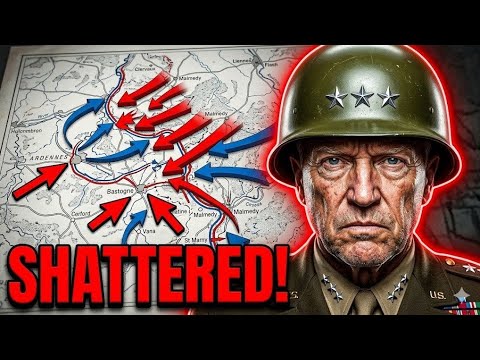
The German general had spent the last hour polishing his Iron Cross and rehearsing his list of grievances. He had refused to speak a word of military value until his absurd demands were met. The American interrogators were exhausted, frustrated, and trapped in a bureaucratic nightmare. He knew they needed his intelligence. He knew they were bound by the rules. He smiled his infuriating smirk and waited for the Americans to bend.
What he did not know was that his report had landed on Patton’s desk. And Patton did not send a staff officer. He did not authorize a transfer to a luxury facility. He grabbed his ivory-handled revolvers and ordered his driver to the camp.
The sound of screeching tires in the mud broke the camp’s silence. The German general did not bother to look up. He simply adjusted his posture, preparing his most condescending expression for whoever had finally come to apologize. But the footsteps approaching the tent were heavy, deliberate, and aggressive. The canvas flap was thrown open.
General George S. Patton stepped inside. The freezing air rushed in with him, but it was nothing compared to the terrifying pressure of his presence. His boots were polished to a mirror shine, his brass buttons gleamed, and his legendary revolvers rested on his hips. He did not salute. He did not nod. He simply stood in absolute silence, his eyes locked onto the German general with the cold detachment of a scientist examining a diseased insect.
The German general’s smirk vanished. He smoothed his uniform, raised his chin, and waited for Patton to offer the standard military courtesy. Patton gave him nothing. The silence stretched, becoming unbearable. The German’s hand twitched. He suddenly felt incredibly small.
Unable to bear the silence, the German general finally spoke. He stated his rank, his name, and his position. He protested his treatment. He cited the Geneva Convention. He complained about the mud. He demanded a formal reprimand for the military police who had transported him in an open truck. He demanded a private officer compound with accommodation suited for a man of his strategic importance. He even demanded a hot meal prepared by a dedicated cook, claiming his digestion could not handle American field rations.
Patton let him finish every sentence. He did not interrupt. When the German finally ran out of breath, Patton took one slow step forward. His voice, notoriously high-pitched, was now razor-thin, cold, and dripping with venom.
“Do you understand the mathematical reality of your current situation?” Patton asked. The German blinked, confused. Patton did not wait for an answer.
With brutal forensic precision, Patton described exactly what the Third Army had done to the general’s elite Panzer division over the last 72 hours. He named the coordinate points of the defensive lines that American armor had crushed. He described the exact number of German tanks burning in the frozen forests. He detailed how his artillery had severed the supply lines, starving the infantry battalions the arrogant general was supposed to be leading.
Patton leaned in closer, his eyes burning with hatred. He told the man that while he sat in his heated bunker ordering his subordinates to polish his boots, his own teenage soldiers were suffocating in the mud, being crushed under the treads of American Sherman tanks.
The German general tried to interrupt, tried to defend his tactical decisions. Patton silenced him by stepping violently into his personal space, towering over him. “You are not a victorious conqueror,” Patton hissed. “You are the defeated manager of a collapsing, murderous, bankrupt regime that is currently being burned to the ground by the industrial fury of the United States of America.”
Patton then addressed the demands for a private chef and luxury accommodations. He pointed a gloved finger at the Iron Cross pinned to the German’s chest. He told the man that serving the psychotic ambitions of Adolf Hitler stripped him of any right to claim military honor. His voice dropped to a terrifying whisper.
He told the German general that he was not going to get a clean bed. He was not going to get a dedicated cook. He was not going to get an apology. If the German refused to cooperate, Patton promised to personally strip him of every medal, every rank insignia, and every piece of tailored fabric on his body. He swore he would dress the general in the ragged, blood-soaked uniform of a dead private, hand him a shovel, and march him out into the freezing mud to dig graves for the American boys killed by his artillery.
“I will leave you in the mud until your hands bleed and your aristocratic spine snaps,” Patton promised.
The German general stared in absolute horror. This was not a bluff. He looked into Patton’s eyes and saw a man entirely capable of bypassing every regulation to execute that dark frontier justice. The American chain of command was not going to protect him. The paperwork was not going to save him. The illusion of his untouchable status shattered.
His rigid posture collapsed. His chin dropped. His shoulders slumped. The manic confidence that had allowed him to demand a private chef while his men died had been violently exterminated. He looked down at the muddy floor, suddenly hyper-aware of the freezing temperature and the absolute hopelessness of his situation.
Patton stepped back, sensing the psychological spine of his enemy had just snapped. He did not offer words of comfort. He simply told the man that the American intelligence officers would return in exactly five minutes. When they arrived, the general was going to open his mouth and provide the exact coordinates of the secondary defensive lines, the fuel reserves, and the remaining artillery batteries. He was going to answer every question with absolute precision. If he hesitated, if he lied, or if he ever mentioned the Geneva Convention again, Patton promised he would return.
Patton turned his back and walked out of the tent with the same terrifying energy with which he had entered. When the intelligence officers walked in five minutes later, they did not find an arrogant aristocrat demanding luxury. They found a pale, shaking man staring blankly at the mud, who immediately began to surrender the deepest, most protected tactical secrets of the German war machine.
The intelligence officers could barely conceal their astonishment. They had spent days trying to crack this man with patience and procedure, and Patton had dismantled him in under ten minutes without raising his voice or drawing a weapon. They spread their maps across the wooden crate, and the German general leaned over them with trembling hands, tracing the locations of fuel depots and artillery batteries with a finger that would not stay still.
Within the hour, the coordinates were racing up the chain of command. This was the defining rhythm of Patton’s Third Army—intelligence did not gather dust on a desk while bureaucrats debated. It moved. It became steel and fire.
Miles away, the frozen night was torn apart by the synchronized roar of American howitzers. The 155-mm batteries opened fire with surgical precision, their shells screaming over the black landscape and landing directly on the hidden fuel reserves the general had just betrayed. Massive fireballs erupted into the sky, illuminating the forests in a hellish orange glow, and the fuel dumps that kept the remaining Panzer battalions alive were vaporized in seconds.
Then came the armor. Sherman tanks and mechanized infantry slammed into the precise weaknesses the captive had outlined, catching the German defenders completely off guard. Their secondary lines, so carefully camouflaged, were flanked and torn apart by an enemy that seemed to possess supernatural knowledge of their entire defensive network.
Back in the muddy camp, the German general sat alone in his canvas tent. He did not need a radio to tell him what was happening. As a professional officer, he could read the tempo and direction of the explosions like a score of sheet music. He knew exactly which coordinates were being bathed in high explosive fire. He knew that the thunder rolling across the frozen landscape was the sound of his own men dying.
The psychological torment of that realization was absolute. He had spent his entire career cultivating the image of an unstoppable aristocratic warlord, convinced his bloodline and rank elevated him into an untouchable caste. But the brutal arithmetic of his situation had finally caught up with him. He had not lost his division in an honorable tactical masterstroke. He had personally guaranteed the destruction of his own command because an American general had terrified him into submission in less than ten minutes.
The next morning, the military police arrived to transfer him to a permanent facility in the rear. The transformation was pathetic. He did not ask to speak to the camp commandant. He did not complain about the freezing weather. He did not demand a staff car. When the guards ordered him toward the open transport truck, he moved silently, eyes fixed on the ground.
He climbed into the back and sat on the hardwood bench alongside the enlisted men he had previously refused to acknowledge. As the truck bumped along the shell-cratered roads, a young American military policeman handed him a cold metal tin of standard army rations. Just twenty-four hours earlier, he had thrown a similar tin onto the floor and demanded a dedicated cook. Now he took it in his freezing hands without a word, opened it with a trembling grip, and ate in absolute, humiliating silence.
But the story of Patton’s psychological warfare did not end with a single broken general. Word of the interrogation spread through the Third Army’s intelligence network with remarkable speed, and it reached the ears of officers who had been quietly wrestling with the same problem—dozens of captured German commanders who believed their rank entitled them to deference, private quarters, and polite conversation.
One by one, those commanders were brought to the same muddy tent, and one by one, they were reminded of what awaited them if they chose arrogance over cooperation. The rumor of the American general who stripped men of their dignity without ever touching them became a weapon in itself. Interrogation times collapsed. Information flowed. The Third Army’s advance accelerated.
Patton never spoke of the incident publicly. He considered it no triumph, merely a necessary correction of a grotesque illusion. To him, the German elite had confused rank with virtue, and privilege with immunity. The war had been their grand delusion, and the muddy tent was where the bill came due.
Years later, in a divided Germany, the old general would sometimes be asked by younger officers about the defeat. He would fall silent, stare at his hands, and change the subject. He never told them the truth—that his surrender had been completed not on the battlefield, but in a canvas tent, by a man with a high-pitched voice and ivory-handled revolvers who understood that some egos can only be broken, never bargained with.
The lesson of that frozen winter remains uncomfortably relevant. Arrogance built on cruelty is never truly armor; it is only a costume. And when it meets a force willing to call its bluff, the costume falls away and reveals the small, frightened man beneath.
So here is the question worth asking yourself: when the powerful demand respect they never earned, should we offer them the courtesy of procedure—or the cold clarity of Patton’s tent? Was Patton’s approach a necessary weapon of war, or a line that should never be crossed? Let us know in the comments.
Report this article
Select a reason for reporting:






