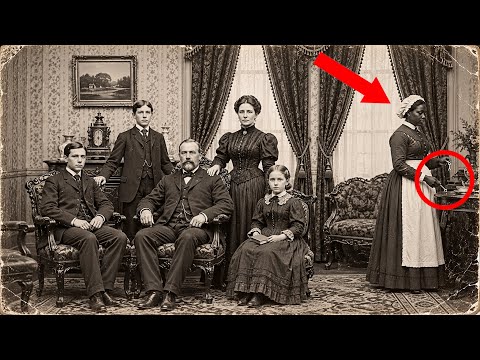
Jennifer Walsh had spent the better part of a gray March morning in 2024 browsing through boxes of old photographs at a sprawling estate sale in the suburbs of Atlanta. The Hendrickx family was liquidating the contents of their ancestral home, a Victorian mansion that had stood since 1887. And Jennifer, a historian specializing in post-Reconstruction Southern history, couldn’t resist the opportunity to search for hidden gems.
Most of the photographs were predictable: stiff formal portraits, faded wedding pictures, children in elaborate period clothing staring solemnly at the camera. Jennifer had examined hundreds of similar images over her 15-year career at Emory University, where she taught courses on Southern labor history and race relations.
Then, tucked between two landscape paintings in a box marked “Miscellaneous Estate Items,” she found a large-format photograph in an ornate gilt frame. The image showed a wealthy family posed in an elaborately decorated parlor. Jennifer recognized the photographic style immediately: albumen print, probably from the mid-1890s based on the clothing and interior decoration.
The family consisted of five people arranged in the formal composition typical of the era. A stern-faced man in his 50s sat in an upholstered chair at the center, his posture rigid, his expression conveying authority. Beside him stood a woman of similar age, her hand resting lightly on his shoulder, wearing an elaborate dark dress with fashionable sleeves. Three children—two boys and a girl, ranging in age from about 10 to 16—completed the grouping.
The parlor itself spoke of wealth: patterned wallpaper, heavy curtains, ornate furniture, and various decorative objects ranged on tables and mantels. Everything conveyed respectability, prosperity, and social standing.
But what caught Jennifer’s attention was a figure in the background, almost peripheral to the main composition. A Black woman, probably in her 30s, stood near a side table in the rear left of the frame. Unlike the family members who were clearly posing, this woman appeared to be in the middle of work, her body angled slightly away from the camera, her attention seemingly on something she was arranging on the table.
She wore a plain dark dress with a white apron, the standard uniform of a domestic servant. Her hair was pulled back severely, covered partially by a white cap. While the family stared directly at the camera with studied seriousness, this woman seemed almost incidental to the scene.
Jennifer turned the frame over. On the backing, in faded ink, someone had written: “The Caldwell family, Atlanta residence, March 14th, 1895.” She purchased the photograph for $40.
Back in her office at Emory University the following Monday, Jennifer carefully removed the photograph from its frame. The backing was brittle with age, and she worked slowly to preserve both the image and any potential historical information. Behind the main photograph, she found a studio card from J.M. Harrison, a prominent Atlanta photographer.
Jennifer placed the photograph on her light table and began her standard examination process. She pulled out her magnifying glass and started with the family members, studying their clothing, jewelry, and expressions for clues about their social status and the photograph’s precise dating. Everything confirmed her initial assessment of 1895, give or take a year.
Then she moved her attention to the background figure, the domestic worker. The woman’s face was less clearly defined than the family’s, probably because she hadn’t been the photographer’s primary focus, but Jennifer could still make out her features: a strong face, neither young nor old, with an expression that was difficult to read.
Jennifer’s eyes traveled down to the woman’s hands. One hand rested on the edge of the side table. The other hand, partially obscured by her white apron, seemed to be holding something.
Jennifer adjusted her magnifying glass, trying to see more clearly. There was definitely an object in the woman’s hand, but the detail was insufficient for identification.
She moved to her desk and began the process of creating a high-resolution digital scan. She used a specialized scanner designed for fragile historical photographs. Forty minutes later, she opened the digital file on her computer. The scanning technology was remarkable—it could reveal details invisible to the naked eye, capturing subtle variations in tone and contrast.
Jennifer zoomed in on the background figure, enhancing the resolution until the woman’s form filled her screen. She adjusted the contrast and brightness, bringing out details that had been hidden in shadow for more than a century.
And there it was: in the woman’s left hand, partially concealed in the folds of her white apron, but unmistakable once properly illuminated, was a small metal object. Jennifer zoomed in further, her pulse quickening as the shape became clear.
A key. The woman was holding a key.
It wasn’t large—perhaps two or three inches long, the kind that might open a desk drawer or cabinet. But why would a domestic servant be holding a key during a formal family photograph? Why would she have it concealed in her apron?
Jennifer sat back in her chair, staring at the image. Something about this felt intentional. The woman’s posture seemed purposeful. There was tension in her body language.
She searched for information about the Caldwell family of Atlanta and found Marcus Caldwell, one of Atlanta’s most prominent businessmen in the 1890s. Born in 1843, he had built his fortune in the chaotic years of Reconstruction that followed the Civil War. The family owned extensive land holdings outside Atlanta, operated several businesses in the city, and maintained the kind of social position that warranted formal family portraits by expensive photographers.
Jennifer found references to the Caldwell family in newspaper archives, city directories, and historical society records. Marcus Caldwell had served on various civic boards. His wife, Eleanor, had been active in ladies’ charitable organizations, and their children had attended the best schools available to white Southerners of their class.
But as Jennifer dug deeper, she found information that cast a different light on the family’s prosperity. An article from 1896 in a small reform-minded newspaper called The Southern Advocate mentioned Marcus Caldwell in connection with labor practices on his rural properties. The article was brief and carefully worded, but it referenced concerns about the treatment of Negro laborers and questions regarding the voluntary nature of work contracts.
Jennifer knew exactly what those euphemisms meant. In the 1890s South, a system called peonage had emerged as a way to maintain a captive Black labor force after slavery’s legal end. Under this system, Black workers would be arrested on minor or fabricated charges, fined amounts they couldn’t pay, and then offered the option of working off their debt. The system was technically illegal—the 13th Amendment had abolished slavery and involuntary servitude—but Southern states enforced it through biased courts, corrupt sheriffs, and the threat of violence. Thousands of Black Americans were trapped in peonage well into the 20th century.
Jennifer pulled up more sources, cross-referencing Caldwell’s name with federal investigations into peonage. In 1895, there had been a brief federal inquiry into labor practices in Georgia. The investigation had been largely ineffective, but the records had been preserved in the National Archives.
She found a reference to Caldwell in a report dated April 1895: “Investigation into labor practices at Caldwell properties outside Atlanta suspended due to lack of witness cooperation. Several potential witnesses failed to appear for scheduled testimony, citing fear of retaliation.”
April 1895—one month after the photograph had been taken.
Jennifer’s mind raced. She pulled up the digital image again, zooming in on the woman in the background, the woman holding a key. What if she hadn’t been just a domestic servant going about routine household tasks? What if she had been doing something far more dangerous?
She needed more information about the federal investigation. She needed to know what had happened in March and April of 1895. And most importantly, she needed to discover the identity of the woman in the photograph.
Jennifer reached for her phone and called Dr. Marcus Reed at Howard University.
Dr. Marcus Reed arrived in Atlanta three days later, his research materials packed in two large bags. At 65, Marcus had dedicated his entire career to uncovering the hidden histories of Black labor exploitation in the South. His definitive book on peonage systems remained the standard academic reference on the subject.
Jennifer met him at her office early Thursday morning. She had the Caldwell photograph displayed on her large monitor, the image zoomed to show the woman in the background with the key visible in her hand. Marcus studied the image in silence for several minutes, occasionally asking Jennifer to zoom in on different details. He examined the woman’s posture, her positioning relative to the family, the way her hand concealed the key while still holding it.
“Tell me what you found so far,” he said.
Jennifer walked him through her research: the Caldwell family’s wealth and social position, the newspaper references to questionable labor practices, the federal investigation in 1895, and the timing of the photograph—taken exactly one month before the investigation was suspended.
Marcus nodded slowly. “The Caldwells were typical of a certain class of Southern businessmen. They presented themselves as respectable pillars of the community while profiting from slavery in everything but name.” He pointed to the photograph. “This formal portrait was part of that presentation. Expensive furniture, clothing, the very fact of hiring a professional photographer. This was meant to be a public statement of status.”
“But the woman in the background,” Jennifer prompted.
“Yes, she’s the anomaly.” Marcus zoomed in on her face. “Domestic servants were sometimes included in family photographs, usually standing very formally. But this woman isn’t posed. She’s working—or appearing to work. And that key—that’s what makes this extraordinary.”
He opened his laptop and pulled up his research files. In 1895, there had been a coordinated effort by federal investigators to document peonage operations in Georgia, Alabama, and Mississippi. The effort was led by a Justice Department attorney named Samuel Price. Price was unusual: he actually cared about enforcing the 13th Amendment.
Marcus found a document and displayed it. “Price’s investigation strategy relied on gathering documentary evidence—contracts, ledgers, correspondence—because witness testimony alone was too easily dismissed. He needed papers that proved the system existed.”
“But getting those documents would be nearly impossible,” Jennifer said.
“Exactly. Which is why Price relied on informants—people who had access to the records and were willing to risk everything to expose the truth.” Marcus looked at the photograph again. “People like the woman in this picture.”
Jennifer felt her understanding crystallizing. “You think she was collecting evidence for the federal investigation?”
“I think it’s very possible that key gave her access to something. Probably the private office where Caldwell kept his business papers.”
Finding the identity of the woman in the photograph proved challenging. Domestic servants in wealthy white households were rarely documented by name in official records, and when they were mentioned, it was usually only in the most minimal way—just a position, with no personal details.
Jennifer and Marcus started with Marcus Caldwell’s household records, hoping to find employment ledgers or payment records that might list domestic staff. The Caldwell family papers had been donated to the Atlanta History Center in the 1960s, and Jennifer requested access to the collection.
Two days later, she sat in the history center’s reading room with several boxes of Caldwell documents spread before her. Most were business correspondence, legal papers, and social invitations. But in a box labeled “Household Accounts, 1890–1900,” she found what she was looking for.
A leather-bound ledger recorded household expenses, including wages paid to domestic staff. The entries were sparse—just names, positions, and monthly wages. But there, in the March 1895 entries, Jennifer found it: “Esther Williams, housemaid, $4 per month.”
Esther. The woman finally had a name.
Jennifer photographed the page and continued searching. She found Esther’s name in earlier ledgers going back to 1892, always listed as housemaid with the same minimal wage. There were no other details—no age, no home address, nothing personal.
But Marcus had another idea. If Esther was working with Samuel Price’s investigation, there might be records in the Justice Department files. Price kept detailed notes about his informants, though he used coded language to protect their identities. They submitted a request to the National Archives for Price’s investigative files related to Georgia.
The documents arrived as digital scans a week later—hundreds of pages of reports, correspondence, witness statements, and personal notes. Jennifer and Marcus divided the files and began reading.
Most of Price’s reports were frustratingly vague about his sources, referring to “a reliable informant” or “a person with access to relevant documents” without providing names. This had been necessary: if the documents fell into the wrong hands, Price didn’t want to expose the people helping him.
But in Price’s personal notebook, which had apparently never been intended for official files, they found more specific information. An entry dated March 10th, 1895, read: “Met today with E.W., domestic servant in the Caldwell household. She reports that Marcus Caldwell maintains detailed records of labor contracts at his rural properties, including evidence of debt manipulation and forced labor. E.W. has access to Caldwell’s private office and believes she can obtain copies of key documents. I have provided her with specific items to look for. E.W. understands the danger but insists on proceeding. Her courage is remarkable.”
Jennifer felt her heart racing. “E.W. Esther Williams. This is her. She was Price’s informant.”
Marcus was already reading ahead in the notebook. “Look at this entry from March 15th—one day after the Caldwell photograph was taken. ‘E.W. successfully obtained access to Caldwell’s files yesterday evening. She copied several contracts and a ledger showing systematic debt inflation. The evidence is damning. However, E.W. reports that she believes Caldwell may be growing suspicious. She noticed him watching her more closely than usual. I have advised extreme caution, but E.W. insists there are additional documents we need. She will attempt to access these within the week.’”
“She was gathering evidence the same week the photograph was taken,” Jennifer said. “That key she’s holding—she must have used it to get into Caldwell’s office.”
They continued reading through Price’s notes. Over the following weeks in March 1895, Esther had provided Price with increasingly damaging evidence: contracts that showed workers being charged for their own food, housing, and tools at inflated prices, ensuring their debts never decreased; correspondence between Caldwell and other property owners discussing how to prevent workers from leaving; letters to local law enforcement requesting the arrest of specific Black men on fabricated charges.
It was a comprehensive system of exploitation documented in the perpetrator’s own words—and Esther had risked everything to expose it.
Then, on March 30th, 1895, Price’s tone shifted dramatically: “I have received word that E.W. has disappeared. She failed to appear for our scheduled meeting yesterday, and inquiry suggests she left the Caldwell household suddenly three days ago. I fear the worst. Caldwell may have discovered her activities. I am attempting to determine her whereabouts and ensure her safety.”
Jennifer and Marcus sat in heavy silence, staring at the words on the screen.
“She disappeared,” Jennifer finally said. “Right after providing all that evidence, she vanished.”
Marcus’s expression was grim. “The question is whether she disappeared because she fled to safety—or because Caldwell silenced her.”
Jennifer felt sick. This woman, Esther Williams, had stood in that parlor on March 14th, 1895, posing as nothing more than a servant while secretly holding the key to her employer’s crimes. Within two weeks, she had vanished.
“We have to find out what happened to her,” Jennifer said. Marcus searched records from the African Methodist Episcopal Church in Atlanta and found a letter from April 1895: “A member of our congregation who aided federal authorities has been forced to flee Atlanta for her safety… The woman’s name is Esther Williams, aged 32.”
She got out. In the 1900 census they found her in Philadelphia—a washerwoman, then a dressmaker, taking in young women who had fled Georgia. She died in 1934, age 71, her courage hidden for 129 years.
Jennifer built an exhibition around the photograph. At the opening, an elderly woman approached: “My grandfather’s mother worked for a white family in Atlanta and had to leave suddenly. I believe that woman was Esther Williams.”
The key had opened a door to freedom—for Esther, for those she helped, and now for everyone who learns her story. How many other Esthers are still waiting in the backgrounds of old photographs for someone to look closely enough?
Report this article
Select a reason for reporting:






