In the quiet village of Münzkirchen, Austria, a family tomb stands as a silent witness to a story of unimaginable horror and extraordinary moral courage. For three generations, the Mandl family has tended this grave, inscribing the names of parents, siblings, children—a shoemaker, his wife, the people they raised. But one name is conspicuously absent. Not because they forgot, not because they ran out of space, but because they erased her on purpose.
The missing name belongs to Maria Mandl, the woman prisoners called the Beast of Auschwitz. As head overseer of the women’s camp, she personally selected hundreds of thousands of women and children for the gas chambers. She held absolute power over life and death. And when the war ended and everything collapsed, she returned to Münzkirchen, walked up to her father’s house, and knocked. The door stayed shut.
This is the story of Maria Mandl and the family who decided she was never one of them.
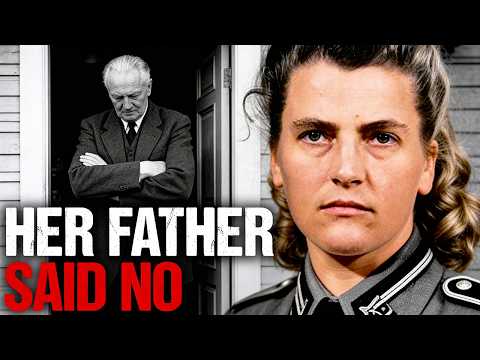
Maria Mandl wasn’t just a guard. She wasn’t following orders from someone else. She was the head overseer of the women’s camp at Auschwitz-Birkenau, one of the highest-ranking female SS officers in the entire Nazi camp system. The women and children who passed through those gates answered to her. She personally selected prisoners for the gas chambers. She organized the selections with the same efficiency other people might bring to scheduling a work shift.
Survivors would later testify that she took pleasure in the power she held, that she would beat prisoners for minor infractions, that she showed no hesitation when sending mothers and their children to die. One survivor recalled that Mandl would walk through the barracks at night selecting women at random for punishment or worse.
She also created the women’s orchestra at Auschwitz. Prisoners with musical talent were gathered together and forced to play as new transports arrived, as columns marched to forced labor, as selections took place. The music was meant to create calm, to mask the horror of what was happening. Mandl considered it one of her proudest achievements.
The death toll attributed to her complicity reaches 500,000 people. Half a million human beings. For this, prisoners gave her a name that stuck: The Beast of Auschwitz.
But here’s what makes her story different from so many others. Maria Mandl came from what the locals called a good Catholic family—a family that actively opposed the Third Reich when supporting it would have been easier, safer, and more profitable. Which raises the question that drives everything else: How does a family like that produce someone like her? And more importantly, what did they do when they realized what she had become?
To understand what the Mandl family did after the war, you first have to understand who they were before it. Franz Mandl was a shoemaker in Münzkirchen, a small village in Upper Austria near the German border. He supported the Christian Social Party, the conservative Catholic faction that stood in direct opposition to Hitler’s movement. This wasn’t a casual political preference. In the Austria of the 1930s, choosing sides meant something. The Christian Socials and the Nazis were bitter enemies, and Franz Mandl made his position clear.
When Austria was annexed in 1938, Nazi membership became the path to opportunity. Franz Mandl didn’t take it. Joining the party would have meant more customers, better standing in the community, protection from the suspicions that fell on those who held back. He stayed exactly where he was politically and morally.
His wife Anna was devoutly Catholic. Their household ran on the rhythms of the church: mass on Sundays, prayers before meals, the steady certainty of faith in a world that was becoming less certain by the day. They raised four or five children in that small village, and by all accounts, they were respected members of the community—the kind of family that neighbors trusted, that the local priest would speak well of. The former mayor of Münzkirchen, Martin Zouer, would later describe them as a good Catholic family who were definitely against the Third Reich.
This is important because when we talk about perpetrators’ families—the wives, parents, children of people who committed atrocities—we usually assume they were complicit, that they enabled the evil, or at least looked the other way, that they benefited from the regime and therefore shared in its guilt. The Mandl family was none of those things. They were the exact opposite. And that makes what happened next even more significant.
Here’s what most people miss about this story, and it changes everything. Franz Mandl didn’t disown his daughter after the war. He didn’t disown her when the crimes became public, when the trials began, when the full horror of Auschwitz was revealed to the world. He severed contact in 1938, the moment Maria voluntarily took a job at the concentration camps. Her father was done.
Think about the timing. In 1938, the death camps hadn’t been built yet. The gas chambers didn’t exist. The systematic murder of millions was still years away. What Franz Mandl knew in 1938 was simply that his daughter had chosen to work for a system he found morally repugnant—a system built on cruelty and control. The early camps were brutal enough: political prisoners, Jews, anyone the regime deemed undesirable. They were beaten, starved, worked to exhaustion. Franz didn’t need to know what the camps would become. He knew enough about what they already were. That was enough.
A shoemaker in rural Austria made a moral judgment about his daughter that history wouldn’t confirm for another seven years. He didn’t need the Nuremberg trials to tell him what he already knew. He didn’t need photographs of mass graves or survivor testimony. He looked at the path his daughter had chosen and decided: That is not my daughter anymore.
Most parents would have rationalized. Most parents would have told themselves that their child was just following orders, just doing a job, just trying to get ahead in difficult times. Franz Mandl refused to tell himself those lies. When Maria returned home in 1945, she wasn’t returning to a family who would discover what she’d done. She was returning to a family who already knew they wanted nothing to do with her.
While Maria was rising through the ranks at Auschwitz—perfecting the selection process, overseeing the orchestra that played as prisoners marched to their deaths—her mother Anna was attending mass every single day in Münzkirchen. She prayed for her daughter’s eternal soul. Every morning in that small village church, a mother knelt and asked God for mercy on behalf of someone whose crimes she couldn’t fully imagine.
Anna knew her daughter had chosen something terrible. She knew Franz had cut contact. She knew that Maria had placed herself beyond the reach of family, beyond the values they had tried to instill. But faith offers possibilities that family bonds cannot: the hope that even the worst among us might find redemption, that no soul is beyond saving if God wills it.
Anna Mandl died in 1944, before the camps were liberated. Before the world saw the photographs. Before her daughter stood trial. She never knew the full scope of what Maria had done—and perhaps that was a mercy. She spent her final years seeking divine forgiveness for someone whose sins exceeded anything she could have conceived.
There’s something unbearably sad about that image: a mother on her knees praying for a daughter who at that very moment might be pointing at a line of women and children, sending half to the right for slave labor and half to the left for immediate death. The contrast is almost too stark to hold in your mind at once. When Maria heard of her mother’s death, she was still at Auschwitz—still selecting, still overseeing. Whatever grief she felt, it didn’t stop her from doing her job.
Maria Mandl survived the war as Soviet forces closed in on Auschwitz in January 1945. She fled west with other SS personnel, disappearing into the chaos of a collapsing Reich. The Nazis had destroyed what records they could, burned documents, tried to erase the evidence of what they had done. Maria was part of that exodus—thousands of perpetrators melting into the flood of refugees, hoping to disappear.
For six months, she evaded capture, moving through a Germany that was burning, hiding among the millions of refugees flooding the roads. Cities lay in ruins. The infrastructure had collapsed. In that chaos, a woman without her SS uniform was just another face in the crowd.
In July 1945, she made her way back to Münzkirchen—back to the village where she had grown up, back to the house where her father still lived. Perhaps she thought that enough time had passed. Perhaps she thought that blood would prove thicker than politics. Perhaps she simply had nowhere else to go. She walked up to Franz Mandl’s door and knocked.
What happened next defined everything that came after.
Franz Mandl refused to let his daughter inside. The man who had raised her, who had taught her right from wrong in a Catholic household, who had watched her take her first communion and learn her prayers—he looked at what she had become and said no. No shelter, no food, no family. The rejection wasn’t quiet or ambiguous. It was absolute.
Maria Mandl, who had held the power of life and death over hundreds of thousands, now stood on her father’s doorstep and was turned away like a stranger. Seven years earlier, he had made his decision. Nothing since—not the war’s end, not Germany’s defeat, not his daughter’s obvious desperation—had changed his mind.
But here’s the detail that turns the knife even deeper. She wasn’t alone when she arrived. Maria was traveling with two companions: her lover, a camp commandant named Walter Adolf Langl, and a Jewish prisoner named Mo. Let that sink in. The woman who had sent hundreds of thousands of Jews to their deaths was now fleeing alongside a Jewish prisoner. The hierarchy that had defined her existence had completely inverted. She, who had held total control, now depended on the mercy of others—and from her own blood, she found none.
Maria fled to her sister’s farm in Wuk, Poland. The sister, unlike Franz, offered temporary refuge. Three days—that’s all the time Maria Mandl had left as a free woman. On August 10, 1945, US Army military police arrived. Her crimes were too well documented, her rank too high, her victims too numerous for her to simply disappear.
She was transferred to Polish authorities. The trial was held in Kraków before Poland’s Supreme National Tribunal. Survivors testified. Documents bearing her signature were reviewed. On December 22, 1947, Maria Mandl was convicted. On January 24, 1948, at 7:32 in the morning, she was hanged in Kraków Prison. She was 36 years old. Her body was buried in an unmarked grave. Her father did not request her remains.
The Mandl family tomb still stands in Münzkirchen. Franz is listed there. Anna is listed there. The other children are listed there. Maria’s name is not engraved anywhere on it. This wasn’t an oversight. It was a choice—a deliberate, permanent act of rejection maintained across generations. When Franz died, he didn’t add her name. When his other children took over the plot, they didn’t add her name either. They carved their verdict into stone and made it visible for anyone who cared to look.
In April 2017, seventy years after the war, an Austrian court finally corrected Maria Mandl’s death certificate. Until that moment, the official record had listed her as a victim of national socialism. Not a perpetrator—a victim. It took until 2017 for the paperwork to match reality.
But the Mandl family had delivered justice long before the courts did. Franz Mandl made a moral judgment in 1938 that the world wouldn’t confirm until 1945, and he never wavered from it. Most people bend. Most people find ways to excuse the inexcusable when it wears a familiar face. Franz Mandl didn’t bend. The tomb with no name isn’t just a family decision. It’s a rebuke—a verdict rendered not by judges in Kraków or tribunals in Nuremberg, but by a shoemaker in a small Austrian village who knew the difference between right and wrong and refused to pretend otherwise.
Some bonds can be broken—and sometimes choosing to break them is the most moral choice a family can make.
What would you have done if the knock at the door had come from your own child?
Report this article
Select a reason for reporting:






