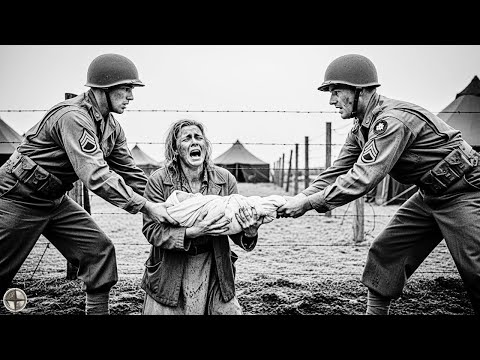
June 15, 1945. Camp Rustin, Louisiana. The wooden barracks door burst open, hinges screaming, and two American guards stepped in, faces hard in the yellow light. A young German woman clutched her newborn, shaking with fear as heavy boots pounded closer. All her life, she had been told, “The Americans will steal your children. They will use them. They will erase them.” Her wool blanket scratched her arms. Her thin gown was wet with milk and sweat. And her baby’s weak cry cut through the smell of soap and fear. When the soldiers reached for the child, she let out a scream in German that didn’t sound human at all.
What she did not know was this: the men she feared most were about to save her baby’s life.
Spring 1945. After days inside a dark, shaking train, the doors slid open with a hard metal scrape. Heat rushed in like a wall. The German women blinked in the bright Louisiana sun, stepping down one by one onto red clay dust. Margaret Wolf was 23, in a faded gray uniform that hung loose on her thin body. Under the cloth of her jacket, four months along, a child grew that no one here knew about. The father, a Luftwaffe pilot named Carl, was already dead.
She had crossed half a world as a prisoner. First the air raid sirens and bombs over German cities. Then the long train west, past shattered stations and burned fields. Then the ship across the Atlantic, the smell of salt and diesel and fear. Now enemy soil. For years Nazi radio had warned her about this place. Americans, she had been told, beat German prisoners, starved them, used them in experiments. Better to die than fall into their hands, some officers had said.
As she stepped down, her legs shaking, she waited for shouting, for rifle butts, for dogs. Instead, the first thing that hit her was the smell. The air was thick and wet, heavy with pine sap, and something sweet she did not know yet. Magnolia. From a low wooden building nearby came another smell, shocking in its richness. Hot fat, roasting meat, coffee. Her empty stomach twisted so hard she almost bent double.
Across the United States, more than 400,000 German prisoners would be held in over 500 camps by the end of the war. Camp Rustin was just one of them. Rows of unpainted wooden barracks, wire fences, watchtowers, and gravel paths neatly swept. To Margaret, it looked wrong in a way she could not name. Where were the snarling guards? The barbed wire crowned with skulls and warning signs from the posters? Here the towers were manned, but the rifles pointed down. Guards walked slowly, caps pushed back, talking in easy English. Somewhere a radio played brassy jazz that made no sense to her ears.
“This is a prison,” one woman muttered in German beside her. “It looks like a farm.”
The women were formed into a column and marched toward the mess hall, their boots crunched on gravel. Sweat ran down their backs inside wool uniforms built for European winters, not the American South. Above them, the sky was a hard, endless blue. As they neared the mess hall, the smells grew stronger. Fried chicken, flour, and fat for biscuits, real coffee. Inside, metal trays clattered, voices rose in a low roar. Margaret could smell salt and pepper, onions cooking, something sweet like apples.
“They are trying to trick us,” whispered an older prisoner, a former party member from Hamburg. “Food like this cannot be real. It is a trap.”
Later, she would remember that sentence word for word. Margaret wanted to believe her. It was easier to cling to fear than to accept that the enemy was feeding them better than their own cities now could. In Hamburg, her cousin had written, “People boiled turnip peels for soup.” Here she saw plates piled with meat. When her turn came, she slid her tray forward with shaking hands. A tall black American in a stained white apron smiled at her as if she were any other hungry person and dropped a piece of golden chicken onto her plate. Mashed potatoes followed, then bright green beans, a slice of soft white bread, a glass of cold milk that beaded with condensation in the heat.
The paradox was almost too much to hold. She had arrived expecting beatings and crusts of bread, and instead the first American to speak to her wordlessly gave her more food than she had seen in months. She sat at a long table under buzzing electric lights. The rooms smelled of grease, soap, and human bodies. Around her, some women ate in silence, tears running down their faces. One crammed food in so fast that she had to run outside, wretching, her starved body unable to handle richness.
“Remember who they are,” another woman hissed. “This is not kindness. This is a weapon.”
Margaret raised the chicken to her lips. The skin cracked between her teeth. Hot fat and salt filled her mouth. For a moment she forgot the train, the ship, the guards. All she knew was that her body was suddenly warm from the inside. Then her hand went by habit to her belly. Two heartbeats now, not one.
After the meal, the column moved again, this time toward a low white building. Inside, the air was cool and smelled sharply of disinfectant. Bright electric bulbs hummed overhead. To Margaret, used to dim German flats and blackout curtains, it seemed like a hospital from another world. One by one, the women stepped forward to give their names, ages, and ranks to a clerk and a translator. An American nurse in a stiff white uniform, lipstick a bright red slash on her pale face, waited with a clipboard. When Margaret’s turn came, the nurse’s eyes met hers for a second. There was no hate in them, only tired focus.
Margaret stated her name, Margaret Wolf, her rank as a communications helper, her age. The translator, a German American soldier, repeated each detail in English. Then came the physical exam. The nurse pressed a cold stethoscope to Margaret’s back, checked her eyes, her throat, her teeth worn down by years of poor food. At last, the nurse’s hand rested just for a moment on Margaret’s abdomen. Margaret froze. If they found out she was pregnant, what would they do? Separate her? Punish her? Take the child? The nurse paused, frowned slightly, and made a note on her paper. She did not say a word.
Outside, beyond the white walls, the camp settled into its evening rhythm. Boots on gravel, a bugle in the distance, the low hum of voices. Inside, one life and one life not yet born waited to see how the enemy would choose to act. What they did next would surprise her even more than the first hot meal.
The nurse’s hand left Margaret’s stomach and reached for the clipboard. She spoke a few quick words in English. The German American translator listened, then turned to Margaret.
“You are pregnant,” he said in slow German. “About four months. You will get extra food. The doctor will see you every week.”
Margaret stared at him for a heartbeat she did not understand. In her mind, discovery of the baby meant punishment, maybe even losing the child. But here it was written like a simple note. Name, age, pregnant. No anger, no threat. Across America, the army had orders to feed prisoners. According to the Geneva Convention, many camps gave German POWs around 3,000 calories a day, more than many people in bombed German cities were now getting. To Margaret, who had lived for months on thin soup and bread mixed with sawdust, those numbers had no meaning. Only the weight of hot food in her stomach did.
She was led with the other women to their barracks. Inside, rows of metal bunk beds lined both walls. Each had a thin mattress, two wool blankets, and a flat pillow. The rooms smelled of old wood, dust, and the faint clean sting of soap. At the far end were washrooms with real toilets and showers. When Margaret turned the tap, water gushed out, first cold, then slowly warming. Steam rose into the air. That night, as she lay on a lower bunk near the corner, she slipped a hand to her belly. The fabric of her uniform felt rough under her fingers.
“You will eat,” she whispered in German, though no one was listening. “You will not starve like my aunt.”
Days settled into a pattern. A bell rang at 6 each morning. Boots hit the floor. Blankets folded, a roll call in the cool dawn air. The guards counted heads with clipboards, not with rifles. Then breakfast, oatmeal, bread, sometimes scrambled eggs. The mess hall always hummed with voices, tin cups clinking, chairs scraping the floor. Margaret was given light work in the camp laundry. The heat inside the wooden building wrapped around her like a wet cloth. Steam rose from big metal tubs. American uniforms in olive green and khaki slid through her hands, heavy when wet, stiff when dry. The smell of soap flakes and damp cotton filled her nose.
On paper, she was working for the enemy, washing the clothes of the men who had defeated her country. In reality, each day of work earned her small colored tokens, camp money she could use at the canteen. There she could buy things that had vanished from German shops years ago. Chocolate, cigarettes, soap, even simple magazines in English she could not read, but still held like proof of another life.
As the weeks passed, her belly began to show. Some women whispered at first, then spoke more openly. “You should have said no,” one older woman from Bremen told her in the yard. “To bring a child into this, it is selfish.” Others were softer. A former nurse from Cologne quietly slid half her bread across the table one evening. “Eat it,” she said. “The baby needs it more than I do.”
Every few days, the American nurse appeared again. Her name, Margaret learned from the translator, was Dorothy. In the small exam room, Dorothy wrapped a tape around Margaret’s growing waist, pressed a metal tube to her skin to listen for the quick beat of the baby’s heart, checked her blood pressure with a rubber cuff that hissed with air. “Any pain?” the translator would ask in German. “Only in my back,” Margaret would say. “Are you eating enough?” Yes, always. Though guilt often made each bite feel heavy. Dorothy almost never smiled at her, but she was careful. Her hands were clean, her touch steady. To Margaret, it was another strange contrast. A woman who might have lost friends to German bombs now checking carefully on a German prisoner’s unborn child.
In July, a letter arrived. Mail for prisoners came through slow channels, opened and stamped by censors on both sides. The paper in Margaret’s hands was thin, almost see-through. The writing, her cousin’s, shook across the page. Hamburg is ruins now, the cousin wrote. Our street is gone. Your mother’s building was hit. We think she is dead. Aunt Greta died in February. The doctor said starvation, but there are hardly doctors anymore. Children beg in the streets. Some say the Americans feed their prisoners like kings. Others say they torture them. If you live and if you can, send food. We are hungry all the time.
Margaret read the letter again and again. That evening, the camp served pork chops, potatoes, green beans, and a small square of apple pie. The meat was tender. The pie smelled of cinnamon and sugar. She put each forkful in her mouth as if it might turn to ash. Later, she went to the canteen and filled a small box with crackers, chocolate, a tin of condensed milk, thinking of her cousin and the children in Hamburg. At the mail desk, a sergeant shook his head. “No food to Germany,” the clerk explained. “Regulations, security.” So all she could send was a short reply saying she was alive, that she was not beaten, that there was enough to eat. She did not write about the pie.
One afternoon, near the laundry, a young American guard with sandy hair and a boyish face watched her pass. He said something quickly in English, smiling and nodding toward her stomach. The translator walking nearby stopped. “He says his sister just had a baby,” he explained. “He asks if you need anything.” Margaret stiffened. “What could I need from him?” she said. A week later, the same guard came up again. His name, she learned, was Jimmy, from a farm in Iowa. In his hand, he held a small wooden object, sanded smooth. “For your baby,” the translator said simply. It was a rattle carved from light-colored wood. When she shook it, it clicked softly. The grain felt warm and fine under her fingers. No one in the barracks had given her anything for the child. Now here was an enemy soldier offering a handmade gift.
That night, under the creak of beds and the soft breathing of fifty women, Margaret lay awake, the rattle hidden under her blanket. Outside, crickets sang in the grass. A guard’s footsteps crunched on the gravel path. She thought of her cousin’s words, starvation, ruins, hunger, and of this place where the enemy fed her and made toys for her unborn child. This was not propaganda. It was reality, and it left her with more questions than answers. As summer deepened and her belly grew heavy, those questions would only multiply.
By late summer, Margaret moved slowly. Her ankles were swollen, her back ached, and the Louisiana air felt like a hot, wet cloth pressed over her face. Even simple tasks in the laundry left her breathless. Camp Rustin held more than 4,000 German prisoners at its height. Nearly all of them thousands of kilometers from home. Yet many days it felt to Margaret like a small village: the same paths, the same faces, the same sounds of buckets, boots, and distant radios.
In the evenings, she liked to sit on the low steps outside the barracks. The wooden boards were rough under her hands. The smell of pine trees mixed with cigarette smoke as women gathered in small knots, talking quietly. Sometimes American soldiers played baseball on a field beyond the wire. The crack of the bat, the shouts of English words she did not know, and the thud of feet on dry ground drifted across the fence.
“They look like boys,” said L, a young woman from Munich, one evening as they watched. “They laugh as if there is no war.”
“They came late and took the victory,” answered the older woman from Hamburg sharply. “Do not forget that.”
Margaret watched one soldier, maybe 19, slide in the dust and jump up, grinning. He brushed the dirt from his uniform, called to his teammates, and for a second she saw not a conqueror, but someone’s son. The paradox grew clearer each week. Germany had promised strength and honor, yet her cousin now wrote of ruins and hunger. America had been painted as cruel and weak. Yet here its guards tossed balls, served hot food, and checked on prisoner babies.
At night, the bunks creaked as women shifted, unable to sleep in the heat. Whispers rose through the dark. “It is a trick,” said the former party member more than once. “They make us soft. They make us forget. Then they will show their true face.” L’s voice would answer from the shadows. “Their true face is three meals a day and medicine. Our cities are rubble. Which truth do you like better?” Arguments like this never had clear winners. Voices grew tight, then fell silent. Only the crickets outside and the soft snore of exhausted women remained.
One night, Margaret lay awake listening to the guard’s slow steps outside, gravel crunching under his boots. Her back throbbed. The child inside her rolled and kicked, a strong insistent motion under her ribs. She stared up at the dark ceiling. She remembered how three years earlier she had sat in a Berlin classroom reading poetry. Her biggest worry had been passing an exam. When she joined the Wehrmacht auxiliaries, she had believed the radio speeches, that Germany was threatened on all sides, that the Führer was saving them, that enemies were monsters who would burn German children alive. Now in a camp surrounded by those same monsters, she had more food, more medical care, and more safety than her cousin in Hamburg. This was not propaganda, but it was reality, and it did not fit the stories she had trusted.
One afternoon in September, as the heat pressed down and the laundry building dripped with steam, a sharp pain cut across her stomach. At first, she thought it was just another ache. Then it came again harder. Her hand grabbed the edge of the table. The smell of hot soap and wet cloth grew strange and far away. “Are you all right?” the woman beside her asked. “I… I don’t know,” Margaret said, her breath short.
The supervisor called the guards. They brought a stretcher, the canvas rough under her fingers as they lifted her. The sky above her was bright white, making her squint as they carried her across the yard to the infirmary. Inside, the air was cool, the floor smooth under their boots. Dorothy appeared quickly, hair pinned back, white uniform crisp, even in the long day. She checked Margaret’s pulse, her belly, the timing of the pains. The rubber cuff around Margaret’s arm squeezed tight, then hissed as it released. After a while, Dorothy shook her head and spoke to the translator.
“It is not the real labor yet,” he said gently. “False pains. Your body is getting ready, but not today.” They gave her water and something mild for the pain, then helped her to a small bed in a side room. Dorothy did not leave right away. She sat on the edge of the bed for nearly an hour, saying little, just being there. “Why do you stay?” Margaret asked at last in slow German, knowing Dorothy might not understand. Dorothy looked at her, then at the curve of her stomach. She reached out and just for a second squeezed Margaret’s hand. No words, only that firm, warm grip. Later, one former nurse from the German side would recall in her own memoir, “It was the first time I saw an American touch a German prisoner without anger. That small touch did more to end the war in my head than all the speeches.”
The pains faded. Margaret returned to the barracks, tired and shaken, but with a new awareness. The woman she had been told would hate her had held her hand in the dark. In the weeks that followed, the false pains came and went. Each time they left her a little more worn, a little more aware that the real birth was getting close. The baby kicked stronger now, as if impatient. Her world shrank to the narrow space between barracks, mess hall, infirmary, and the distant sound of bats hitting balls in the evening. Some nights she lay awake and tried to imagine the moment the child would arrive. Would the Americans take him? Would they raise him here? Would he ever see Germany? She had no answers. Only the slow swing of the ceiling shadows and the hum of insects outside. The war of bombs and bullets was over for her. But inside her mind, the war of beliefs and fears still raged. It would take one long, painful night in October to decide which side would win.
Report this article
Select a reason for reporting:






