On the night of February 8, 1965, a lone aircraft circled above the Vietnamese jungle, its engines humming a deadly lullaby. Inside, the crew watched the ground below, waiting for the order. Then, the sky lit up as 20,000 rounds of ammunition rained down in a four-hour barrage, obliterating a Viet Cong outpost. This was the AC-47, the first true gunship, and it was just the beginning.
From that moment, the gunship concept was proven. But the AC-47 was only a taste of what was to come. The real revolution was brewing in the minds of military strategists who saw the potential for something far more powerful.
In the mid-1960s, the idea of mounting heavy weapons on a transport aircraft was still novel. The gunship concept, inspired by naval vessels with lateral guns, allowed an aircraft to loiter over a target and deliver continuous fire. Unlike traditional strafing runs, which required flying directly at the enemy, a gunship could orbit overhead, its guns trained on a designated area, providing sustained support.
This concept had roots in World War II, when aircraft like the B-25 Mitchell were modified with forward-facing guns for strafing. But it was the Vietnam War that truly honed the idea. The AC-47, nicknamed “Spooky,” was the first to demonstrate the devastating potential of a fixed-wing gunship. Its success led directly to Project Gunship II, which aimed to surpass the AC-47 with a larger, more capable platform.
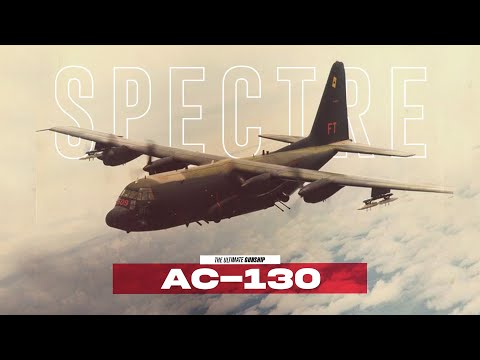
The C-130 Hercules, a rugged transport aircraft, was chosen as the basis for this new gunship. Modified at Eglin Air Force Base, the prototype AC-130A featured cutting-edge systems for its time: forward-looking infrared, night vision devices, and an analog fire control system. On the left side of the aircraft, a battery of miniguns was installed, ready to unleash hell.
Arriving in Vietnam in September 1967, the AC-130A underwent a three-month test deployment. By 1968, it was ready for official deployment, and several more airframes were modified. Designated AC-130A, these aircraft reached Tan Son Nhut Air Base in June 1968, supporting operations during the Tet Offensive.
The AC-130A, called the “Spectre,” quickly earned a reputation for precision. Its slow speed and large size made it an easy target, but its advanced fire control system allowed it to engage targets mere hundreds of feet from friendly forces. In 1969, the “Surprise Package” upgrade transformed several airframes, adding a digital fire control computer, laser designator, and improved infrared and TV systems. These enhancements defined the Spectre’s enduring legacy.
By 1970, most AC-130As had been upgraded to the Surprise Package standard, and they excelled in night operations. With low-light TV systems, they could pinpoint mechanized and motorized units with ease, making quick work of any detected enemies with bursts of 20 or 40 mm fire. Some models even incorporated a magnetic anomaly detector, originally designed for submarine hunting, to detect vehicles and transmitters by homing in on unshielded engine ignition signals.
Then, in 1971, the AC-130E “PAVE Spectre” emerged. Powered by more powerful engines, it was stronger and more advanced, closer to what we know today as the AC-130 gunship. It fielded similar weapons to the Alpha Surprise Package models, and some E-models tested a 105mm howitzer. By mid-1972, select Echo models were upgraded to the Hotel standard under the PAVE Spectre II program, standardizing the 105mm M102 and T-56 engines while upgrading avionics, radar, and night vision systems.
By 1973, these gunships had reportedly destroyed approximately 10,000 trucks during the conflict. The aircraft would return to the region in April 1975, flying overwatch missions during the emergency withdrawal from Cambodia and the evacuation from Saigon. Throughout the 70s and 80s, AC-130 upgrades continued, adding new guns, computers, and camera systems.
The US Air Force operated Alpha, Echo, and Hotel variants concurrently, deploying them for critical missions, including planned support for the 1980 Tehran hostage crisis operations in Iran. During the 1980s, two other important events would see the AC-130 put to use. The first was the invasion of Grenada in 1983, during which time an AC-130 crew was sent in to provide suppression of enemy forces and conduct suppression of enemy air defenses, enabling rapid allied control of the island.
Then, between 1983 and 1989, AC-130H crews of the 16th Special Operations Squadron were tasked with tracking and monitoring the activity of the Communist Farabundo Martí National Liberation Front, or FMLN, during the Salvadoran Civil War. Rules of engagement were loosened as the war dragged on, and eventually AC-130 crews were given the green light to engage FMLN targets as well as other guerrilla outposts in the region. The AC-130 played a crucial role in hastening the FMLN’s defeat.
In 1989, during the US invasion of Panama, AC-130 crews identified and destroyed crucial government infrastructure, including control posts and military headquarters. They then provided close air support for troops as they secured important objectives.
The Spectre’s most notable engagements would occur in 1991. As part of Operation Desert Shield, AC-130 Alpha and Hotel models in complementary tasking were deployed to the Middle East. Once Desert Storm began, these crews received a variety of tasks. Commonly, they would provide overwatch for coalition forces as they traveled or captured particular objectives. Operating at 10,000 to 12,000 feet, their low altitude limited most missions to nighttime, reducing exposure to enemy threats.
In one rare example, a Hotel model gunship, Spirit 03, had been providing close air support to a group of Marines during the Battle of Khafji. As dawn broke, the gunship crew requested to stay in the fight and continue to protect the Marines. However, with the aircraft now exposed by the rising sun, it was shot down by an SA-7 missile.
Just as in Vietnam, the AC-130’s role in Desert Storm also included identifying and destroying armored columns. When intelligence had confirmed enemy armor approaching coalition forces, AC-130s would be dispatched to cut off these advancing enemy forces, essentially shielding Allied forces from oncoming armor. It was this role that earned the AC-130 a fearsome reputation during the conflict, having taken part in a number of large-scale attacks on enemy columns.
The most infamous was the operations staged along Highway 80, dubbed the Highway of Death. According to contemporary online recollections of the events, AC-130s did not bring the bulk of the firepower to the fight. Rather, it was primarily from A-6 Intruders and A-10s supported by further strikes from F-15Es and F-16s. What the AC-130s brought to the operation was nighttime precision hitting of moving armor along the highway.
These Middle East operations would make the AC-130 legendary, particularly Spirit 03 and an Alpha model nicknamed Azrael, not only due to the loss of Spirit 03, but because of their remarkable troop support during night operations.
Following the Gulf War, a new upgrade was sought. This upgrade would be used to supplement the Hotel model while replacing the old Alpha model in its support role. The solution would be the AC-130U Spooky, named in honor of the original AC-47 gunship. Practically every internal system would be upgraded in some way for this new model. The two 20 mm cannons of the H model would be exchanged for a single more accurate 25mm cannon while retaining the 40mm Bofors and 105mm M102.
Most importantly, the U model would feature a far more advanced targeting and TV system. The three main guns could be set up in a dual target attack mode, allowing two operators to focus selected guns on two targets at once, providing individual tracking to each. Coupled with a new fire control system, new Hughes APQ-180 radar, improved infrared, and all-light television, the new Spooky was by far the best in the AC-130 lineup, and would excel in all-weather operations, especially at night.
Deliveries began in 1996, bolstering Hotel model Specters and phasing out Vietnam-era Alphas. Over the next few years, the Iraq War and the war in Afghanistan would change the way coalition forces approached combat. While the AC-130 had proven itself in Vietnam and Desert Storm, it faced tougher challenges against insurgents demanding extreme precision in close air support near friendly forces.
Counterinsurgency missions in urban areas heightened the risk of civilian casualties. Hence, the focus would be on achieving pinpoint accuracy, usually at night, and the ability to loiter for as long as possible during operations. Plans were already on the table for the next major AC-130 model. However, Special Forces through Special Operations Command wanted an interim aircraft specifically to assist in high-intensity special operations.
The United States Special Operations Command would in 2010 procure new aircraft to be modified just for this purpose. The aircraft in question would be the MC-130W Combat Spear, a Hercules model specifically designed for use by special forces under SOCOM. Modifying these airframes with similar armament to previous gunship iterations, the result would be the AC-130W, initially dubbed the Dragon Spear and later renamed the Stinger II.
Arriving in Afghanistan in late 2010, the new W model would be truly unique amongst its contemporary Hercules gunships. It would feature a new 30mm Bushmaster II chain gun, as well as a precision-guided munition system, allowing the aircraft to store AGM-176 Griffin missiles, GBU-44 Viper Strike, and even Hellfire missiles, as well as pylons for 250lb bombs under the wings. It would use Hellfire missiles in combat for the first time one month after arriving in Afghanistan, neutralizing several insurgents. Fourteen such aircraft would serve, with 12 being converted from existing MC-130s.
However, the development wouldn’t end there. Given its success, the AC-130W inspired the next major AC-130 variant, the AC-130J, or Ghost Rider. First procured in 2014, the new model would enter service in late 2017 and be deployed with Air Force Special Operations Command to Afghanistan in 2019. By 2022, all other AC-130 variants, including the W model, had retired, leaving the Ghost Rider as the sole operator.
As with each successive model before it, the Ghost Rider has seen significant upgrades, integrating systems from both the legacy models of the AC-130 Spectre and Spooky, as well as Special Operations Command’s favored MC-130. For nearly six decades, the AC-130 has reigned as an indispensable asset for American Defense Forces. From its innovative origins as the Spectre, it has exceeded expectations, proving pivotal in conflicts from Vietnam to Afghanistan.
Its design has pioneered a platform that redefined close air support, forging a gunship that is still more than capable in modern warfare and will likely remain so for a long time to come. Yet the story of the AC-130 is not merely one of technological evolution. It is a story of the crews who flew these aircraft into harm’s way, night after night, orbiting above friendly forces in the darkness. Their skill and nerve turned a lumbering transport into one of the most feared and respected weapons in the American arsenal.
But as the Ghost Rider settles into its role as the sole remaining gunship, new questions loom on the horizon. The rise of advanced surface-to-air missiles and the shifting nature of modern conflict have forced planners to reconsider the future of the gunship concept itself. Will the AC-130 continue to evolve, or has the age of the gunship finally begun to wane? The answer, as history has shown, may lie in the ingenuity of those who have always found a way to keep the Spectre flying.
From Vietnam’s jungles to Afghanistan’s mountains, the AC-130 has remained a constant, a guardian in the night sky. Its story is one of adaptation and resilience, a testament to the vision of those who first dared to mount cannons on a transport plane.
As the Ghost Rider flies into an uncertain future, one thing is clear: the gunship’s legacy is secure. For the crews who fly them and the troops they protect, the sound of those engines means one thing—help is on the way.
But with new threats emerging and technology advancing, will the AC-130’s orbit ever truly end? Share your thoughts below—do you believe the gunship will continue to dominate the skies, or is its time finally coming to a close?
Report this article
Select a reason for reporting:






