In the heart of the 20th century, as the world recovered from the devastation of World War II, a small Southeast Asian nation became the epicenter of a conflict that would reshape global politics and leave deep scars on the American psyche. The Vietnam War, spanning two decades, was more than a battle between communism and capitalism—it was a collision of cultures, a test of wills, and a tragedy of epic proportions.
At its core, the war was a struggle for Vietnamese independence, led by the charismatic Ho Chi Minh, a man who had traveled the world, from the kitchens of London to the peace talks of Paris, in pursuit of freedom for his people. His journey from a young nationalist to the leader of a communist revolution would set the stage for a confrontation with the world’s greatest superpower.
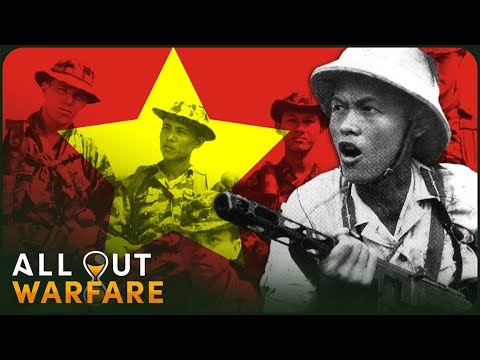
The roots of the conflict lay in the aftermath of World War II, when France, reeling from defeat by Nazi Germany, sought to reclaim its colonial empire in Indochina. But the Vietnamese, having endured years of foreign occupation, were not willing to return to subjugation. “They were tired of being dominated by the French and now the Japanese and fought for their freedom,” recalls a historian, capturing the fervor of a people determined to control their own destiny.
Ho Chi Minh’s Viet Minh forces, though initially supported by the United States in their fight against the Japanese, would soon find themselves on the opposite side of the Cold War divide. As the French sought to reassert control, the Americans, driven by the domino theory—the belief that if Vietnam fell to communism, so would the rest of Southeast Asia—began to pour money and military aid into the French war effort.
By 1954, the French were decisively defeated at Dien Bien Phu, a battle that shocked the world and signaled the end of colonial rule in Vietnam. The Geneva Accords divided the country at the 17th parallel, with Ho Chi Minh’s communist government in the North and a Western-backed regime in the South. But the peace was fragile, and the stage was set for a deeper American involvement.
As the 1950s gave way to the 1960s, the United States found itself increasingly entangled in a war it could not win and could not easily exit. “The domino theory and they all believed it and it was dead wrong,” reflects a former official, highlighting the flawed assumptions that led to America’s quagmire.
In the South, a series of unstable governments, coupled with the growing insurgency of the Viet Cong—the communist guerrillas supported by the North—created a vortex of chaos. The assassination of President Ngo Dinh Diem in 1963, followed by the assassination of President John F. Kennedy just weeks later, plunged both Vietnam and America into deeper uncertainty.
Lyndon B. Johnson, thrust into the presidency, inherited the commitment to South Vietnam and the burden of containing communism. The Gulf of Tonkin incident in 1964 provided the pretext for escalation, and by 1965, American combat troops were pouring into Vietnam. The war had begun in earnest.
But as the body bags returned home and the nightly news broadcast the horrors of war, public opinion began to turn. The Tet Offensive in 1968, though a military defeat for the communists, shattered the illusion of progress and exposed the credibility gap between the government’s optimistic reports and the grim reality on the ground.
In the wake of Tet, the American public no longer trusted its leaders. “If I’ve lost Walter, I’ve lost the American public,” Johnson reportedly muttered after Walter Cronkite’s damning broadcast, and soon the president stunned the nation by announcing he would not seek reelection.
The year that followed was one of the most turbulent in American history. Martin Luther King Jr. was gunned down in Memphis, and Robert Kennedy was assassinated in Los Angeles moments after winning the California primary. Cities burned, campuses erupted, and the Democratic convention in Chicago descended into chaos as police clashed with protesters in the streets.
Into this maelstrom stepped Richard Nixon, promising “peace with honor” and a secret plan to end the war. Many soldiers in Vietnam believed him. “I decided I would vote for Nixon because he, rather than Humphrey, would end the war,” recalled one veteran. But the peace he delivered was anything but honorable.
Rather than withdraw, Nixon widened the conflict, secretly bombing Cambodia to destroy Viet Cong sanctuaries along the border. For months, this covert campaign was hidden from Congress and the public—half a million tons of ordnance dropped on a neutral nation. When the truth finally surfaced, it would ignite a firestorm.
The revelations came in stages. First, news of the secret bombing. Then, in 1969, the story of My Lai: more than four hundred unarmed villagers slaughtered by American troops under Lieutenant William Calley. “When you put young men in harm’s way, they lose control,” one observer noted grimly. Calley was sentenced to life, but served only eighteen months under house arrest.
In April 1970, Nixon announced an invasion of Cambodia, and the anti-war movement exploded. At Kent State University in Ohio, National Guard troops opened fire on student protesters, killing four. “These are nice middle-class kids shot down by their own people,” a commentator said. Congress reacted with fury, moving to cut funding and rein in the president’s war powers.
Meanwhile, the war ground on. Vietnamization—the policy of training and equipping South Vietnamese forces to fight on their own—was meant to allow American troops to come home. But the South Vietnamese army was plagued by poor leadership and low morale. “A lot of these guys considered the Americans the enemy as much as the communists did,” one observer recalled. “They didn’t want to die fighting with their brothers.”
In 1972, the North Vietnamese launched a massive conventional offensive, and Nixon responded with devastating force—mining Haiphong harbor and unleashing B-52s over Hanoi in what became known as the Christmas Bombings. “The administration made it clear to the North Vietnamese that no area of Vietnam was off limits,” a historian noted. The message was brutal: peace would come on American terms, or not at all.
Under relentless pressure, the Paris Peace Accords were finally signed in January 1973. American combat troops withdrew, and 591 prisoners of war came home. “For the Americans, the war was over,” one analyst said. “They just wanted to get out.” But for the Vietnamese, the fighting continued—thousands dying each week while the world looked away.
Nixon’s presidency, meanwhile, collapsed under the weight of Watergate. Resigning in disgrace in August 1974, he left South Vietnam with promises of aid that Congress would never honor. The South Vietnamese, betrayed and exhausted, fought on alone. “President Thieu made a huge strategic blunder,” a witness recalled, “and it was just a matter of time.”
By April 1975, the North Vietnamese army closed in on Saigon. Panic engulfed the city as desperate crowds stormed the American embassy, clawing at helicopters and clinging to skids. “Mothers were throwing their babies to strangers on the ships,” a journalist remembered. “Save my baby, save my baby.” The signal for evacuation was Bing Crosby singing White Christmas—absurd, surreal, and heartbreaking.
When the tanks finally rolled through the gates of the presidential palace, it was over. Vietnam was reunified under communist rule, and Saigon was renamed Ho Chi Minh City. The war had claimed millions of lives, shattered three nations, and left a legacy of Agent Orange, unexploded bombs, and refugees scattered across the globe.
Today, Vietnam is a thriving economy, its cities glittering with skyscrapers and luxury shops. But the scars remain—in the birth defects caused by chemical defoliants, in the veterans who never found peace, and in the question that still haunts history: Was any of it worth the cost?
What do you think—was America’s involvement in Vietnam a tragic necessity, or a catastrophic mistake that should never have happened?
Report this article
Select a reason for reporting:






