In the dark waters off Darwin, a Japanese submarine stalked its prey. It was January 1942, and the Imperial Japanese Navy had sent four massive submarines to shut down the port, to cut off Australia’s northern edge from the sea without a single plane appearing overhead. One of them, I-124, had already laid 27 mines in the approaches. On board were 80 men. On January 20, it fired a torpedo at a brand-new Australian corvette crewed almost entirely by reservists—bank clerks, farm workers, teachers who had never fired a shot in anger. The torpedo missed by ten meters.
That miss would seal the submarine’s fate and etch a forgotten chapter into history. For the next 13 hours, a deadly game of cat and mouse unfolded above and below the Timor Sea. It would end with the first Japanese warship ever sunk by the Royal Australian Navy—and with 80 men entombed 50 meters below, where they remain to this day.
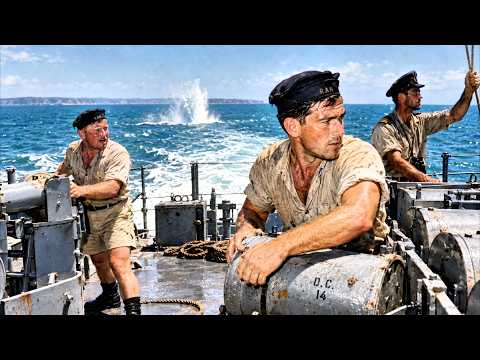
The corvette was HMAS Delorain, a 650-ton Bathurst-class ship that had been in service for just seven weeks. Her captain, Lieutenant Commander Desmond Menlove, was a professional officer, but most of his crew were civilians turned sailors. Among them was 25-year-old Lieutenant Bruce Harvey, a reservist who operated the ship’s ASDIC—the sonar that was the most important anti-submarine weapon of its day. In skilled hands, it could detect a submarine hull amid the clutter of the sea. Harvey had trained for hours in a soundproof booth, learning to distinguish whale from rock from submarine. He was very good.
When the torpedo missed, Menlove made a decision. Instead of retreating, he turned Delorain back along the torpedo’s track and attacked. Harvey picked up a solid, metallic echo moving ahead and below. Depth charges rolled off the stern. The explosions shook the sea. Then, briefly, the submarine surfaced—a gray mass visible for seconds before diving again, this time not by choice. More charges followed. A large oil slick spread across the waves, a sign of a ruptured hull.
Other ships arrived: HMAS Lithgow, HMAS Katoomba, and the American destroyer USS Edsall. They pounded the area until darkness fell. Delorain, out of depth charges, raced back to Darwin to rearm and returned overnight. By the next morning, three more attacks were launched. Later that day, the Australian ship HMAS Coongoola arrived with divers. The hunt was over.
But the story was just beginning. What happened next would become the subject of legend. Days after the sinking, a diver descended 50 meters in the dark, current-swept waters. He found the submarine largely intact, resting upright on the seabed. Then he heard something: a rhythmic tapping from inside the hull. A human hand, or a metal object, striking the inner wall. It was the only documented detail from inside the wreck—and it was never explained.
Today, I-124 lies where it fell, a protected war grave. Its hatches remain sealed. Inside are 80 men who never returned home. The story of how they got there, and why their submarine still matters, is one of the most haunting tales of the Pacific War.
The tapping stopped. The diver stood in the silt of the Timor Sea, his brass helmet a fragile bubble against the weight of the ocean, and listened. Nothing. Only the hiss of his air supply and the distant thrum of the support ship’s engines. He reported it later, and the report entered the record as a single line: “Knocking heard from within the hull.” No one ever determined who was alive down there, or for how long. The depth charges had done their work, but the sea does not always kill quickly.
When the war ended, the story of I-124 was already fading. The bombing of Darwin on February 19, 1942—a month after the submarine’s sinking—had eclipsed everything that came before it. The Japanese carriers that darkened the sky that morning killed hundreds and left the city in ruins. Compared to that, the quiet sinking of a single submarine in the Timor Sea seemed almost trivial. But the men who had been there never forgot.
In the decades that followed, the wreck became a touchstone for two nations on opposite sides of the war. For Australia, it was a trophy—the first Japanese warship sunk by the Royal Australian Navy, a validation of the reservists who had done their job under fire. For Japan, it was a tomb. The families of the 80 men waited for word that never came, until the silence became a kind of answer.
Then, in the early 1950s, a woman named Atsuko Kishigami began writing letters. She was the daughter of Lieutenant Commander Koichi Kishigami, the submarine’s captain. She had never known her father—he had gone to sea before she was old enough to remember his face. All she had was a name on a list of the missing and a photograph of a young officer in a dark uniform. She wanted him brought home.
Her campaign was patient and unglamorous. She wrote to Australian officials, to Japanese officials, to anyone who might listen. She traveled. She built connections with the families of the other 79 men, some of whom wrote letters of their own. She did not ask for anything dramatic. She asked for the submarine to be raised so that the remains of the men inside could be returned to their families. The request was denied—not out of indifference, but out of respect. The Japanese government, and later the Australian government, considered the wreck a war grave. The men should be left where they fell.
Atsuko accepted the decision. But she did not stop. She shifted her fight from recovery to remembrance. If the men could not come home, then the world should at least know they had existed.
The years passed. The wreck was located and surveyed. In 1977, it was officially declared a historic shipwreck under Australian law. Diving on it was restricted. The Japanese government continued to regard it as sacred ground. The story of the tapping was repeated in books and articles, always with the same caveat: no one knows what it meant.
Then came the myth. In the 1980s and 1990s, a new claim began to circulate. According to this version, Allied divers had entered the wreck in the days after the sinking and recovered codebooks from the submarine’s radio room—books that helped the Allies break Japanese naval codes and change the course of the Pacific War. It was a compelling story: the little corvette from Darwin had not just sunk a submarine, it had handed the Allies a key to victory.
The claim was supported by some serious historians. Edward Drea, an American scholar of Allied signals intelligence, argued that materials recovered from I-124 had contributed to codebreaking efforts. But others rejected it outright. The technical objections were formidable. In January 1942, Allied diving equipment in Darwin was primitive—heavy helmets, air hoses, telephone lines. A diver at 50 meters, in darkness and current, could work for perhaps 20 or 30 minutes before nitrogen narcosis forced him to ascend. Cutting into a sealed submarine hull, finding the radio room, opening a safe, and bringing paper documents to the surface without destroying them would have been at the extreme edge of what was possible. Archaeological surveys of the wreck in recent years have found no evidence of hull penetration.
The documentary objection was equally strong. Released records show that Allied breaks into Japanese naval codes in 1942 came from other sources—signals traffic, captured materials from other ships, and the extraordinary work of codebreakers themselves. No Allied intelligence document attributes any codebreak to a recovery from I-124.
So the codebook story remains contested. Some believe it. Some do not. The wreck itself offers no answer. What it offers instead is a different kind of story—a story about the slow way a small engagement in a large war becomes something else entirely.
In 2014, a Japanese destroyer, JS Hatakaze, visited Darwin for a joint naval exercise. Her captain, Tokihiko Umezaki, arranged a memorial ceremony on board for the crew of I-124. Australian and Japanese officers attended. The event was small and solemn, barely noticed outside the harbor.
In 2017, a memorial plaque was installed on the shore at Darwin. It listed the names of the men who had died on the submarine. It listed the names of the ships that had sunk her. It was fixed to the ground in an official ceremony, and it remains there today.
In 2018, the Prime Minister of Japan, Shinzo Abe, visited Darwin. Among his engagements was a memorial service for the crew of I-124. He stood on Australian soil at the edge of the harbor his country had once tried to close, and he paid his respects to the 80 men who were still on the bottom of the sea, a few dozen kilometers from where he stood. The Australian government stood beside him. The moment did not last long. It was not widely reported outside the specialist press. But it happened.
In 2022, the eightieth anniversary of the sinking brought another kind of remembrance. A team of maritime archaeologists led by Dr. John McCarthy of Flinders University, working with the Northern Territory government and the Australian Institute of Marine Science, released a virtual reality reconstruction of the wreck. Using multibeam sonar surveys of the actual submarine on the seabed, combined with historical plans and photographs, they built a digital dive that anyone with a headset could take without leaving land.
The model shows the submarine as it is now, not as it was the day it sailed. It appears largely intact, resting upright on a sandy seabed with some erosion of the outer hull. Large living corals and sponges have begun to reclaim the steel. It shows the single blown hatch. It shows the lines of the hull that made her, in life, an elegant and dangerous machine. What it does not show—what it deliberately does not attempt to show—is anything inside the hull. Some things belong to the historian. Some things belong to the diver. Some things belong to the family, and some belong to no one at all because they belong to the men who were there when it happened. And those men can no longer be asked.
Delorain sailed away. She was in Darwin harbor on February 19, 1942, when Japanese carrier aircraft came, and she survived that morning untouched. She served out the rest of the war escorting convoys and hunting submarines between Darwin and Thursday Island, chased by aircraft several times and never hit. She was lucky for the duration. She was paid off in the peace that followed and eventually broken up. Her officers were decorated. Lieutenant Bruce Harvey, the 25-year-old reservist sonar operator, was awarded the Distinguished Service Cross. The citation read that the award was for his skill and coolness in HMAS Delorain when the Japanese submarine I-124 was destroyed off Darwin on January 21, 1942. Able Seaman Carson Jefferson Tate was awarded the Distinguished Service Medal on similar grounds. Lieutenant Commander Desmond Menlove was mentioned for his ship’s performance that day.
These are the surface facts. They are the kind of thing written in unit histories, in newspaper columns, in anniversary recollections, in the citations hung on the walls of naval museums. They form the skeleton of the story as the records have preserved it. But the deeper thing in this story, the thing that keeps drawing people back, lies beneath those surface facts—beneath the citations and the ship names and the patterns of depth charges.
Beneath the surface facts lies a submarine. It lies at about 50 meters in the Timor Sea, out of sight of any coast. It has lain there for more than 80 years. It has been colonized by coral. It has been surveyed by sonar and photographed by cameras. It has been declared, and remains, a war grave. Its hatches, for the most part, are still closed. Inside are 80 men who sailed from a Japanese port in the winter of 1941 to wage an aggressive war against countries that had not attacked their own, and who paid the price in the way submariners of every navy in that war paid it: in a hole in the seabed, in the dark, with no chance at all.
The moral weight of what those men were sent to do does not disappear because of the way they died. Nor does the ordinary human weight of the deaths themselves. Both things are true. Both lie there together on the seabed. And above them, at intervals of years and decades, small things happen on the surface that keep the memory of what they were doing, and who sank them, from fading entirely. A memorial ceremony aboard a visiting Japanese destroyer. A plaque fixed in the ground of Darwin. A prime minister paying his respects. A daughter’s letters from Japan in the 1950s that started a current of remembrance. A virtual reconstruction released on the eightieth anniversary that lets anyone with a headset stand for a few minutes beside a Japanese submarine on the floor of an Australian sea, and consider what it was, what it did, and what became of it and of the ship that stopped it.
The story of the sinking of I-124 is a small story by the measure of the Second World War. It cost 80 lives on one side and none on the other. It happened in a corner of the ocean on an afternoon, during a brief and technically successful attack by a warship that had been in service for seven weeks. No one in Berlin or Tokyo or Washington paid it much attention at the time. No one in Darwin in the weeks that followed was in a position to. A month later, the sky over Darwin filled with Japanese aircraft and the city burned, and the news of the submarine engagement on January 20 was buried behind images everyone remembers now—images that actually came second in the sequence, while this came first.
It was the first Japanese warship sunk by the Royal Australian Navy in the Second World War. It was the first enemy submarine sunk in Australian waters. It was achieved by a brand-new corvette, crewed almost entirely by reservists on their first serious assignment, using underwater detection equipment that had barely been in service long enough to be trusted, and directed by a 25-year-old lieutenant who learned his trade in peacetime and applied it that afternoon at the outer edge of what the technology could do. That fact is worth noting in itself, in a war that produced a great many facts.
And the last thing worth remembering before this account closes is what lies on the floor of the Timor Sea off Darwin today, at 50 meters. It is a Japanese submarine. It is a war grave. It is a piece of Australian history most Australians have never heard of. It is the reason a Japanese prime minister once stood on the shore above it and bowed in respect. It is the reason a Japanese woman spent decades of her life writing letters that eventually, in a way she did not live to see, brought her father’s ship under the lenses of virtual reality and allowed strangers on the other side of the world to walk around it in the dark.
It is, in truth, the answer to a question most people never thought to ask. When did the Royal Australian Navy sink its first Japanese warship in the Pacific War? On the afternoon of January 20, 1942, off Darwin, a month before the more famous morning everyone remembers. By a corvette seven weeks in service, with a crew of reservists, a torpedo that missed by ten meters, a turn in the right direction at the right speed, and the quiet voice of a young man on a headset saying he had a contact. It lies 50 meters down. It has been there for more than 80 years. It will not be coming up, and that, in the end, is the heart of it.
So here is the question I leave with you: if a war grave can now be visited by anyone with a headset, should it be—or are some doors better left sealed at the bottom of the sea?
Report this article
Select a reason for reporting:






