In the quiet confines of a small English churchyard lies a man who did more than change the world—he made it possible for us to see its true shape. His name was Frank Whittle, and his invention of the jet engine would redefine the boundaries of human flight. But the journey from idea to reality was anything but smooth. It was a battle against skepticism, bureaucracy, and the relentless march of time.
Born on June 1, 1907, in Coventry, Whittle was the son of working-class parents. His father was a supervisor in a machine tool factory, and it was there that young Frank first got his hands dirty, helping out for a few pennies an hour. “I was making slots in valve stems,” he recalled. That early exposure to engineering would plant the seeds for a revolution.
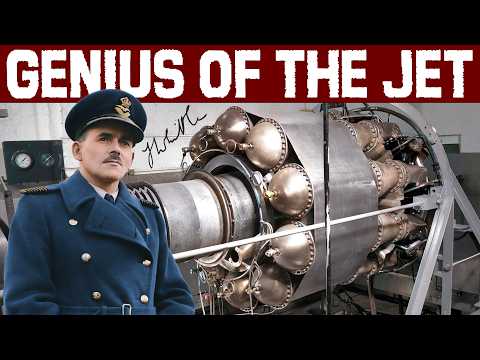
From a young age, Whittle was captivated by aviation. His favorite toy was a metal model of a Bleriot monoplane, and his heroes were the flying aces of World War I. He dreamed of soaring through the skies, but his path was far from clear. When he applied to join the RAF as an apprentice, he was rejected—he was too small. But Whittle was not one to give up. “I stuck to it for six months,” he said, after a kind sergeant gave him a diet and exercise regimen. He grew three inches and tried again.
His persistence paid off, and he was eventually accepted into the RAF College at Cranwell. There, his talent for mathematics and his passion for aircraft modeling caught the attention of his superiors. Despite his lack of athletic prowess, Whittle’s intellectual brilliance earned him a spot as an officer cadet. “I was number six on the graduation list,” he remembered, and when the top student failed due to poor eyesight, Whittle seized the opportunity.
At Cranwell, Whittle’s flying skills quickly became apparent—though not always for the right reasons. “I crashed two or three aircraft,” he admitted with a chuckle. But it was in the classroom that his most groundbreaking idea took shape. In 1928, he wrote a thesis on future developments in aircraft design, focusing on the engine. “I came up with what I now know is the Brea equation,” he said, linking speed, range, and engine efficiency.
His conclusion was radical: to fly at high speeds, aircraft would need to reach altitudes of 50,000 feet, where piston engines and propellers would be useless. “So I started looking for a new type of propulsive engine,” Whittle explained. The idea of a jet engine was born—a single moving part, a shaft with a compressor driven by a turbine. “Why didn’t I think of this before?” he marveled. “It seemed so obvious then.”
But the road ahead was fraught with obstacles. Whittle’s idea was met with indifference from the Air Ministry and the industrial sector. “No one thought it would ever work,” he said. Undeterred, he patented the design and, with the help of a few allies, founded Power Jets Ltd in 1936. “I told my backers the odds of success were 1 in 30,” he confessed.
The first engine was built by British Thomson-Houston in Rugby. On April 12, 1937, it roared to life. “The engine accelerated out of control,” Whittle recalled. “Everyone ran for their lives. I was frozen with terror.” But it worked—self-sustaining for the first time. The jet age had begun.
Yet Britain was slow to grasp what it had. When the Air Ministry finally took an interest, they shackled Whittle with the Official Secrets Act, which meant Power Jets could no longer tell potential investors what they were even working on. “You can’t go to someone and say, ‘Look, we have a very good idea. Can you give us some money? Ah, we can’t tell you what it is, but it’s a very good idea.’ No, we couldn’t do that.” By 1939, Britain had spent a mere £7,000 on the jet engine.
Whittle’s position was precarious. On what was meant to be his last day at Power Jets, he had one final chance to impress a visitor—the Director of Scientific Research. On June 30, 1939, the engine ran for twenty minutes before his eyes, and the man left utterly convinced. “When I dropped him at the station, he spent the whole journey explaining to me the advantages of my own engine. I sat there silently, thinking, ‘Yes, you’re telling me what I already know, my friend.'”
That visit saved the jet engine for Britain. But Germany, unaware of Whittle’s breakthrough, already had a jet aircraft of its own. The Heinkel He 178 was ready just days before the war began. Test pilot Erich Warsitz took off, and the engine performed flawlessly. Ernst Heinkel phoned General Ernst Udet in triumph—only to be told, “Congratulations, but let me sleep. It’s an inconvenient time.”
Back in Britain, Power Jets was forced into a dilapidated foundry at Lutterworth called Ladywood Works. Today, nothing marks that history was made there. In 1939, the team numbered barely six people. “We were very careful to pick only first-class honours men from Cambridge, Oxford, and Imperial College,” Whittle said. They couldn’t advertise what they were building, and in interviews they couldn’t tell candidates what the job involved—though some, he suspected, guessed from the questions.
Whittle’s charisma inspired his new team to attempt the impossible. The noise and cramped space drove him to work nights at Brownsover Hall, a nearby country house. “My memory of him is of someone who was always working,” his son Ian recalled. “Even on a Sunday, he’d sit by the fire with his slide rule, papers everywhere, giving us a little time—but not much.”
As Britain entered its most dangerous phase of the war, the team was ordered to prepare engines for a prototype jet fighter: the F9/40, which we know as the Gloster Meteor. They didn’t know that Germany was already developing twin-engine jet fighters at Messerschmitt and Heinkel. Heinkel had parlayed a single demonstration into a contract for the He 280—a fighter the Nazis wanted within fourteen months.
In Britain, the Air Ministry still funded Whittle inadequately, forcing Power Jets to reuse parts that should have been scrapped. “It was all tied to money,” he said. “We didn’t have the funds for new parts, so we had to patch up damaged ones.” Some continued to insist the Whittle engine would never fly. But by May 1941, it was ready to be installed in Britain’s first jet aircraft—the Gloster E.28/39.
The secret aircraft was moved to Cranwell, where the story of jet flight in Britain would truly begin. The Power Jets team followed, filled with hope. On that same day, a young naval pilot named Eric Brown was forced to land at Cranwell. Today, he is one of the few surviving witnesses to that historic occasion.
“When I landed, I was a little surprised to find so many civilians there,” Brown recalled. “When I went to sign in at the mess and asked what was going on, there seemed to be an air of secrecy about the whole place. Nobody wanted to give me a direct answer.” The team had been out the day before conducting ground taxiing trials. Then, on May 15, the weather seemed unsuitable, so Whittle returned to Lutterworth.
That morning, Brown went to the control tower to check if the weather was good enough for his flight to Codden. It clearly wasn’t. “They asked me to do a weather check for them,” he said. “Anyway, I landed and they asked me to stand by for an additional weather test in the afternoon.” Then a message arrived: the weather was improving. Brown hurried back to Cranwell. That evening, Jerry Sayer made the flight.
A strange-shaped aircraft was wheeled out—well, not strange in shape exactly, but a structure Brown had never seen before, because it had no propeller. An unusual whining noise came from it. It taxied to the end of the runway, and after a pause, it finally took off. “I was absolutely astonished to learn what it was,” Brown said. “I had never heard of a jet aircraft at that stage of my career.”
Various government departments refused to film this remarkable event. Fortunately, an unknown photographer captured it secretly. Gerry Sayer sat at the end of the runway, an officer to his right. He applied the brakes, ran the engine up to full power, then released them and was airborne in about 600 yards. It was an impressive takeoff. He kept it level, then glided her down.
A colleague, Pat Johnson, patted Whittle on the back. “Frank, it flies,” he said. In the tension of the moment, Whittle replied brusquely: “That’s exactly what it was designed to do, isn’t it?” The aircraft landed safely. As soon as it touched down, people swarmed from every side to congratulate the pilot. It was then that Whittle realized something truly extraordinary had happened.
People in the area had never heard that kind of noise before, and it couldn’t be hidden no matter how secret it was. But an officer reportedly asked another: “How does that thing work, John?” John replied: “Oh, it’s simple, mate. It sucks itself along like a Hoover.” Another story claims someone who said he was an eyewitness insisted there was a Merlin engine inside the hollow fuselage with a small propeller, and that he had seen it himself. He was a reliable witness, he claimed.
Everyone headed for the officers’ mess, and Brown followed. There was a lot of merriment in the corner of the room. He asked what it was all about, but no one revealed what was involved—yet it was clear something momentous had occurred. The flight had proved Whittle’s point. Britain’s new jet aircraft was better than anyone realized.
One event confirmed this in particular. The Ministry gave permission to reach 17,000 rpm for a single flight only. At that speed, it achieved 375 or 380 miles per hour. In any case, it was faster than a Spitfire. The news reached London and Winston Churchill. He ordered the production of a thousand Whittle engines. Unfortunately, the E.28 was never going to become a warplane. Hence the disappointment behind the scenes at Cranwell.
“I would have preferred the Meteor to be the one under construction, because it was a fighting aircraft, while the E.28 was merely experimental,” Whittle said. His jet engine had sounded a warning to every piston engine manufacturer—a warning that soon reached their doorsteps. They now demanded their share in a product none of them had invented, and which they had rejected for years. Because of the war, Whittle was forced to share his secrets with them.
All of this placed Power Jets in an increasingly weak commercial position. “We had to accept it because it was wartime,” Whittle explained. “I and many of my team were serving officers, and we had to put national considerations above commercial ones. That dominated my thinking.” Whittle played the patriot, freely handing his knowledge to British aviation companies. Yet they were working flat out building engines for aircraft like the Hurricane and Spitfire.
So, in 1941, Britain turned to the United States—still enjoying peace—for support in manufacturing its jet engine. The Americans had only been briefed on Whittle’s engine earlier that year. Ironically, their top scientists had rejected the idea in 1940, concluding that the gas turbine engine could not be considered a practical application for aircraft. The British government expected to retain the rights to Whittle’s invention and had no intention of handing them to a future competitor—but that is exactly what happened.
The engine was shipped in pieces aboard a B-24 Liberator, the team terrified the pilot might hit the wrong lever and dump them all into the ocean. General Electric was chosen to build it. “Gentlemen, I give you the Whittle engine,” they were told. “Consult among yourselves and reach whatever decision you see fit—as long as you agree to a contract for fifteen engines.”
In America, Whittle was treated like royalty. “It was extremely gratifying to see the work General Electric was doing,” he said. “If I’d had that kind of cooperation a few years earlier, it would have made a huge difference.” But back home, the battles only worsened. Rover was botching the Meteor’s engines so badly that production was nearly cancelled. Rolls-Royce eventually took over, and Ernest Hives told Whittle plainly: “We’re going to be the center of this business, and nothing you can do will stop us.”
By 1944, the Meteor was finally operational—two years later than it should have been. “If the Air Ministry had followed my idea in 1929,” Whittle reflected, “a similar aircraft would have been available at the start of the war. Many lives could have been saved.” When the news finally broke, the press swarmed the house. “I didn’t realize he was someone unusual until January 1944,” his son Ian recalled. “It was like the world exploding around me.”
Yet the man who gave Britain the jet engine was soon pushed aside. Power Jets was nationalized, then stripped of its design rights under pressure from the big manufacturers. Whittle resigned, exhausted and broken in health. In 1948 he was knighted—but no engine maker would hire him. “In many ways, I paid a very heavy price for the work I did,” he admitted.
He lived to see his vision vindicated: the Comet, the Boeing 707, the turbofan—all of it flowing from that single idea. He died in August 1996, and the RAF honored him with a memorial in Westminster Abbey. His ashes were flown to Cranwell and buried in the little churchyard where this story began.
Today, some one and a half billion flights take off every year—cheap, safe, and ordinary—thanks to Frank Whittle. So here is the question I leave with you: if Britain had listened to one stubborn young officer in 1929, how differently might the world have turned out?
Report this article
Select a reason for reporting:






