On the night of April 11th, 1945, a single American soldier crouched in a foxhole on the southern tip of Okinawa and did something no infantryman had ever done in combat. He reached down and flipped a switch. And out across the black ruined ground in front of him, something came alive that not one enemy soldier could see.
Past the wire, Japanese infantry were already crawling toward him through the dark, the way they had crawled toward American lines for three years across the Pacific. They had no idea the rules had just changed.
What that soldier did in the next few minutes became one of the most repeated stories of the secret weapons war. It also buried a lie that took decades to dig back out.
Both are coming. Stay in the dark with me a little longer.
To understand what that soldier was about to do and why it mattered so much, you have to understand what the night had cost before it.
For the Japanese infantryman, darkness was a weapon. Trained, deliberate, doctrinal. When American firepower ruled the daylight—the artillery, the naval guns, the aircraft—the Japanese answer was to come after dark when none of it could find them. They moved supplies at night, reinforced at night, and they infiltrated, small parties slipping between the foxholes to kill sleeping men and vanish before dawn.
A United States Army intelligence report on Guadalcanal, dated 1943, noted that Japanese commanders chose their targets by watching American positions at sunset, then sent their men forward through the valleys and the heavy cover. By Peleliu in the autumn of 1944, a captured document listed five separate kinds of night raiding unit, each one, in the Army’s own translation, extensively trained in infiltration.
For the American rifleman, the result was a particular kind of hell. On Peleliu, Marines could not dig into the coral. They lay in shallow scrapes in the dark and listened. Land crabs fed on the dead between the lines, and the rustling they made in the brush was indistinguishable from a man crawling. The jagged coral threw shadows that an exhausted mind turned into enemy soldiers. So men fired at shapes, at sounds, at nothing. And every shot gave away a position. Every muzzle flash drew an answer. A man who fired at a shadow might kill a crab, or might kill the Marine in the next hole over.
This was the problem no weapon had solved. You could not fight what you could not see. You could throw light into the dark with a flare, but a flare lit you up as surely as it lit the enemy. And a trained infiltrator simply froze, waited for it to burn out, and kept coming.
By the time the Americans reached Okinawa, four years of island fighting had taught them exactly how much the dark could cost. The night was a door the Japanese could walk through, and the Americans could only stand behind it and guess.
What arrived on Okinawa was a key.
If you want to see what that key unlocked in the dark, and the staggering claim the army would make about it afterward, subscribe and stay with it.
First, the weapon itself. It did not look like a weapon that would change anything. It looked like a man carrying a car battery into a foxhole.
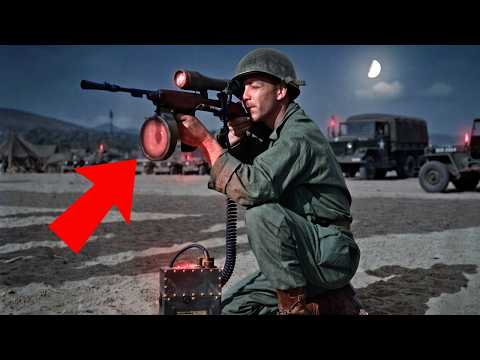
The device had been built at Fort Belvoir, Virginia, by the army’s engineers around an image converter tube developed years earlier by two scientists at the Radio Corporation of America, Vladimir Zworykin and George Morton—the same men whose work was busy inventing television. The army called the finished night sight the sniper scope. Mounted on a stubby .30 caliber carbine, a special variant called the T3, built without iron sights because it would never need them, it became the first infrared weapon ever carried into battle by American infantry.
Back then, the men who hauled it called it Millie, and its handheld cousin, Molly. Today, we’d recognize its grandchildren on the helmet of every soldier who fights at night.
Here is how it beat the dark. A sealed lamp on the carbine threw out a beam of infrared light, invisible to the human eye. That light washed over the ground ahead and bounced back into the telescope, where the converter tube turned it into a glowing green picture. The operator saw everything the beam touched. The enemy saw nothing at all. No flare, no flash—just a man who could suddenly see in the dark.
It was not perfect, and it was not magic. The whole rig—scope, lamp, cable, and a lead-acid battery in a canvas pack—weighed about 27 pounds. And on a good night, it reached only about 65 yards. 65 yards, less than the length of a football field. But on a perimeter at 2:00 in the morning, 65 yards was the difference between a shadow you killed and a knife at your throat.
When the scopes first went ashore with the assault divisions on April 1st, they did not work the way the manuals had promised. Operators complained that they could barely see 30 yards into the black. The image swam. The tubes flickered. For the first three or four nights, the secret weapon was a disappointment.
Then the men learned to use it. Within a week, that same 30 yards had stretched to 65. The green picture sharpened, and the gunners beside them began to understand what it meant to have one.
But before we get back to that foxhole on April 11th, before we find out what the man behind the scope actually saw, you have to understand how these soldiers used it. Because it was nothing like you’d picture.
The men who carried the scopes figured out quickly that they were not snipers. A single operator firing a stubby carbine was not going to win a firefight. The real power of the thing was not in the trigger. It was in the eye.
And so the Americans built their nights around that eye. The standard arrangement was simple and it was deadly. One man with a scope placed between a pair of machine guns, repeated around the entire battalion perimeter. The operator did not shoot. He watched. He saw the green shapes come and he talked the guns onto them, sometimes walking the line of tracer onto a target so the gunners knew exactly where to pour their fire. The machine guns did the killing. They fired into a blackness they could not see into, guided by a man who could.
The infiltrators had no idea.
Picture a four-man Japanese patrol somewhere on the Okinawa line in that first half of April. Experienced men. Quiet. They have done this before on other islands against other Americans and lived. They move the way they were trained to move—low, slow, reading the folds in the ground. To the naked eye of every sentry on that perimeter, they are not there.
To the man with the scope, they are four green figures crossing open ground. He calls it to the nearest automatic rifleman. A short burst. Then nothing. In the morning, four bodies in the grass and not one American who could have told you in the moment that there had been anything out there at all.
It kept happening. One night, a scope operator with the 96th Infantry Division watched an eight-man patrol work its way forward under the cover of a seawall—the kind of hard, obvious cover that had protected infiltrators a hundred times before. The men hugged the wall. They used it exactly as they should have. And the operator watched all eight of them do it and directed the machine gun fire that killed all eight. The cover was perfect. It just didn’t matter anymore.
Then there was the trick with the flares—the clearest proof of how completely the ground had shifted. Some units rigged trip flares and grenades out in front of their positions and set a scope operator behind them in the dark. When a flare went up, the Japanese did precisely what their training told them to do. They froze. They held still in the sudden light and waited for it to die, because movement in a flare’s glow meant death. They had done it for years. It had always worked.
But the American operator wasn’t using the flare to see. He was waiting for it to go out. And the instant the light died and the infiltrators relaxed and began to move again, certain now that the darkness had hidden them, the scope came up and the green picture bloomed and the guns found them in a blackness they thought was theirs.
Everything the Japanese soldier knew about surviving the night had just been turned into a way to die in it.
Which brings us back to April 11th, back to that one soldier in that one foxhole with his eye against the scope. By that night, the 96th Division had been through the meat grinder at Kakazu Ridge, one of the strongest positions on the entire island, and the men on the perimeter were exhausted, raw, and jumpy. Japanese mortars had been pounding the sector. Everyone expected something to come in the dark.
Something did.
A scope operator on the battalion line caught the movement first—an infiltration party feeling its way toward the American positions. He put his eye to the scope. The dark went green. And the shapes were there, more than a handful of them, coming on across the broken ground.
He started calling targets. The machine guns in front of one company opened up into the night. The gunners could see nothing—only the tracer and the operator’s voice telling them where. They fired and they adjusted and they fired again.
When it was over, 25 Japanese soldiers lay dead in front of that single company’s position. On another part of the same perimeter, a second operator was doing the same work, feeding targets to another set of guns. 16 more enemy dead.
41 men, one night, killed by soldiers who, without a strange green picture and a beam of light no one could see, would have been firing blind at sounds—or not firing at all, waiting for the knife in the dark. No American had to leave his hole. No flare gave the position away. And in the morning, the dead were counted out past the wire.
This was real. The Japanese came in the dark because the dark was theirs. And for the first time in the Pacific War, it wasn’t.
But the most important thing the scopes did that spring was not measured in bodies. A Corps of Engineers captain named Omar Patterson went from division to division interviewing the men who used them, and his conclusion was not about kill counts. It was about fear.
Before the scopes, Patterson found, exhausted men fired at every shadow and every noise, wasting ammunition, drawing fire, risking their own. After the scopes, a sentry could identify the source of a sound before he pulled the trigger. The shooting at ghosts stopped. The confidence alone, Patterson wrote, almost justified the entire program.
And the Japanese? As far as the records show, they never figured it out. Patterson reported they seemed to know the Americans were training men to see at night, but had no idea how it was being done. No captured document describes infrared. No countermeasures were taken. They were simply being killed in the dark by something they could not name.
It would be a mistake to read that as failure. These were professional soldiers running a doctrine that had worked for three years. What beat them was not a lack of courage. It was a beam of light outside the range of human sight.
And the weapon that threw it was deeply, almost comically flawed. 27 pounds of scope, cable, and battery. A range of 65 yards on a good night, far less on a bad one. Tubes that cracked and flickered. Batteries that leaked acid and had to be hauled to the rear every morning to recharge—which meant every scope was collected at dawn and carried forward again at dusk in case even one fell into enemy hands.
Then there is the number—the lie promised at the start. For decades it has been said the infrared scopes caused 30% of all Japanese casualties from small arms fire in the first week on Okinawa. It is almost certainly a myth. The figure came from a press event in Indiana in 1946, when the weapon was declassified and its makers wanted the world to know what it had done.
Patterson’s own report, written on Okinawa a year earlier, told a quieter story: about 150 enemy casualties credited to the scopes across the first two weeks. Closer to 3%, not 30. Not the war-winning death ray of the press release—just a handful of devices in a handful of foxholes quietly changing what the night meant.
The scopes did not stay long. Within weeks the Navy was lighting the whole front with star shells every night, illumination that drowned the faint infrared picture and burned out the delicate tubes. One wounded veteran came back to his division a month later to find the scopes gone—collected, crated, and shipped to a depot in the rear. The secret weapon had been beaten not by the Japanese, but by its own side’s flares and its own fragility.
But it had proven something that could not be unproven. Every pair of night vision goggles a soldier wears today, every green image in every modern war, traces back to that 27-pound rig and the men who hunched over it on Okinawa.
Go back to that foxhole on the night of April 11th. A soldier presses his eye to a rubber cup. He switches on a light no enemy can see. And out past the wire, in a darkness that for three years had belonged entirely to the other side, the green shapes come on, certain, as they had always been, that no one was watching.
They were wrong.
So here is my question for you: if a single beam of invisible light could rewrite the rules of the night in 1945, what quiet advantage are we overlooking on today’s battlefields—and who will be the first to flip that switch?
Report this article
Select a reason for reporting:






