He was the architect of the Holocaust, the man who orchestrated the murder of six million Jews. When Heinrich Himmler bit down on a cyanide capsule in May 1945, he left behind four children. You might expect them to live in hiding, to denounce their father, to face some kind of justice. But his favorite daughter spent the next 73 years doing something far worse.
She ran an organization that helped convicted Nazi war criminals escape prosecution and live free. This is the story of what really happened to Heinrich Himmler’s children after the war ended.
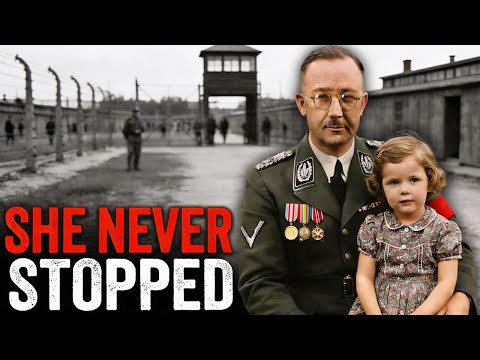
To understand how Gudrun Himmler became what she became, you have to see how she was raised. She wasn’t just Himmler’s daughter. She was his obsession. He called her Pepi, which means little doll in German. Hitler personally gave her chocolates and dolls every new year. She was paraded at Nazi rallies as the ideal Aryan child, blond-haired and blue-eyed, the perfect propaganda image of German purity.
Photographers followed her constantly. Party officials fawned over her. She grew up believing she was royalty in an empire that would last a thousand years. But Himmler didn’t just spoil her. He indoctrinated her. From the earliest age, Gudrun was brought into her father’s world. She attended SS ceremonies. She met the highest-ranking officials in the Reich. She absorbed the ideology the way other children absorbed fairy tales—completely and without question.
Her father wasn’t a monster to her. He was a hero. A great man building a great Germany. And on July 22nd, 1941, when Gudrun was just 12 years old, Himmler took her somewhere that would reveal exactly how deep that indoctrination went. He took her to Dachau concentration camp.
This is what Gudrun wrote in her diary that night: “We saw the gardening work. We saw the pear trees. We saw all the pictures painted by the prisoners. Magnificent. Then we ate. Then everybody got a present. It was lovely.”
Dachau would eventually kill 41,500 people. Prisoners were worked to death, shot, and subjected to horrific medical experiments. The camp had been operating for 8 years by the time Gudrun visited. Bodies were being burned in crematoria. The smell of death hung in the air. To Gudrun, it was a pleasant family outing.
This was not ignorance. This was something more disturbing. A child so thoroughly shaped by her father’s worldview that she could walk through a place of systematic murder and notice only the pear trees and the paintings. The prisoners were not people to her. They were gardeners, background figures in her perfect day.
Some historians point to this diary entry as evidence that Gudrun was simply a child, unable to comprehend what she was seeing. Others argue it reveals something darker—a girl already so steeped in Nazi ideology that Jewish and political prisoners did not register as human beings worthy of her attention. What is undeniable is that this visit did not disturb her. It did not plant seeds of doubt. If anything, it reinforced her belief that her father’s work was noble and good.
But the Nazi fantasy could not last forever. In April 1945, Adolf Hitler discovered something that sent him into a rage. Heinrich Himmler, his loyal Reichsführer SS, the man he had called “the man with the iron heart,” had been secretly negotiating peace with the Allies behind his back. Hitler immediately stripped Himmler of all his positions and ordered his arrest.
The man who had commanded the SS, the Gestapo, and the entire machinery of the Holocaust was now a fugitive in his own collapsing Reich. Himmler fled. He shaved off his distinctive mustache. He wore an eye patch. He carried forged papers identifying him as a sergeant in the secret military police. For two weeks, he moved through the chaos of defeated Germany, hoping to slip through Allied lines and disappear.
On May 20th, British forces stopped him at a checkpoint. The disguise fooled no one. Three days later, during a medical examination, a British doctor ordered him to open his mouth. Himmler bit down on a cyanide capsule hidden in his teeth. Within minutes, the architect of the Holocaust was dead.
That same month, American troops arrested 15-year-old Gudrun and her mother, Margarete, as they fled through northern Italy. They were heading toward the Alps, towards some vague hope of escape. Instead, they found themselves in Allied custody, their names among the most hated in Europe. For the first time in her life, Gudrun faced consequences.
The Allies didn’t know quite what to do with Himmler’s family. Gudrun and her mother were held in detention camps across Italy, France, and Germany for more than a year. They were interrogated repeatedly. Officers wanted to know what they knew about hidden assets, escape networks, and the locations of other Nazi officials. Gudrun gave them nothing useful.
She went on hunger strikes. She refused to weep. When other prisoners cried or showed remorse, she remained stone-faced. According to interrogation reports, she defended her father’s innocence with absolute conviction. The 16-year-old insisted that her father had been a great man, that everything being said about him was Allied propaganda.
When mother and daughter were finally released in November 1946, they returned to a Germany that wanted nothing to do with them. The Himmler name was poison. Their property had been seized and their bank accounts were frozen. The comfortable life of privilege that Gudrun had known since birth was gone completely. She and her mother moved into a cramped apartment in Munich. They survived on a small pension and whatever help they could get from old acquaintances who remembered the family’s former glory.
Gudrun tried to work. She found jobs as a dressmaker, a bookbinder, a tailor—anything that would pay. But the pattern was always the same. She would get hired, someone would discover who she was, and she would be fired immediately. No one wanted Heinrich Himmler’s daughter handling their clothes or their books.
This struggle lasted for years. By the early 1950s, Gudrun had married Wolf-Dietrich Burwitz, a journalist and member of the far-right NPD. She took his surname, hoping it might provide some cover. It helped a little, but not enough. Here’s where the story takes a darker turn.
In 1961, Gudrun found a solution to her employment problems. One so audacious it almost defies belief. She took a job as a secretary for West Germany’s BND, the Bundesnachrichtendienst. This was the country’s primary intelligence agency, their equivalent of the CIA. She was hired under a false name.
Think about what this means. The daughter of the man who built the Nazi security apparatus was now working inside the intelligence service of the democratic government that had replaced her father’s regime. She sat at a desk in the very institution tasked with protecting Germany from the ghosts of its Nazi past.
The BND in the early 1960s was notoriously riddled with former Nazis. The Cold War had created strange bedfellows. West Germany needed experienced intelligence officers, and many of those officers had learned their trade under the Third Reich. Some historians estimate that dozens of former SS members found employment in the agency during this period.
Gudrun stayed hidden there until 1963 when the West German government began purging known Nazi sympathizers from its ranks. She was identified. She was fired. But this dismissal did not shame her into silence or push her toward reflection. It radicalized her further.
After losing her government job, Gudrun threw herself into an organization called Stille Hilfe, which means “Silent Help.” Founded in 1951, Stille Hilfe had an official purpose that sounded almost humanitarian. It claimed to aid imprisoned German soldiers and their families, widows of men who had served, children left fatherless by the war, and soldiers who had been convicted by what the organization called “victor’s justice.”
But its real purpose was far darker. Stille Hilfe existed to help convicted Nazi war criminals avoid punishment and live free. Under Gudrun’s influence, she became one of its most prominent and active members.
The organization provided an entire support network for mass murderers. They funded legal defense for men convicted of Holocaust crimes. They obtained fake medical certificates, claiming that elderly war criminals were too sick to serve their sentences. They arranged housing in sympathetic retirement homes where these men could live out their days in comfort. They funneled over $150,000 annually in donations to support their work.
Their beneficiaries included Klaus Barbie, known as the Butcher of Lyon, who had personally tortured French resistance members and sent Jewish children to their deaths. They helped Anton Malloth, convicted of murdering prisoners at Theresienstadt. They supported dozens of others whose names are less famous, but whose crimes were just as real.
This was not just failing to denounce her father. This was not just refusing to accept what he had done. Gudrun was actively continuing his work—not murdering people herself, but ensuring that those who had escaped justice for murder could remain free. She attended reunions of former SS officers. She gave speeches defending the honor of the Waffen-SS. She insisted until her dying day that her father had been murdered by the British, that the cyanide story was a lie, that the Holocaust itself was exaggerated.
But Gudrun was not Himmler’s only child. While Gudrun lived publicly as what journalists called “the Nazi princess,” three other Himmler children existed, and they took completely different paths.
Gebhard Ludwig von der Aue was technically Himmler’s adopted son. The child of a deceased SS officer whom Himmler had taken in, but Himmler showed him little warmth. While Gudrun received chocolates from Hitler and tours of concentration camps, Gebhard was shipped off to boarding schools and largely ignored. In 1945, at just 16 years old, Gebhard joined the SS in the war’s final months. He was almost immediately captured by Soviet forces.
What followed was a decade of horror in Russian prisoner of war camps—brutal conditions, forced labor, starvation rations. He did not return to Germany until 1955. And then Gebhard simply vanished from history. He never gave interviews. He never joined organizations defending Nazi honor. He never sought attention of any kind. He lived quietly until his death in December 2010, a ghost of the family he had been briefly connected to.
Then there were the illegitimate children—Helge and Nanette-Dorothea. Heinrich Himmler had begun an affair with his secretary Hedwig Potthast in the late 1930s. The relationship produced two children: a son, Helge, born in 1942, and a daughter, Nanette-Dorothea, born in 1944.
Himmler’s wife Margarete knew about them. The arrangement was quietly tolerated within the Nazi hierarchy, where powerful men often maintained multiple families. But after the war, these children disappeared completely. Hedwig took a new name. The children took their stepfather’s surname. They lived in total anonymity for decades—so thoroughly hidden that even extended family members sometimes did not know they existed.
Helge died in 2005 at 63. Nanette-Dorothea died in 2001 at 56. Neither ever spoke publicly about their father. Neither sought recognition or compensation. They chose erasure over acknowledgement, silence over confrontation.
For 80 years, these illegitimate children and their descendants lived in complete anonymity—until December 2025, when the pastor who found his grandfather on Wikipedia stepped forward. Henrik Lehnert, a 47-year-old German pastor in Spain, recognized his grandmother in a documentary photo. “That was my grandmother,” he realized—Hedwig Potthast, Himmler’s mistress. His mother was Nanette-Dorothea.
Henrik went public, rejecting everything his grandfather stood for. He became an anti-fascist activist, warning Europe about the return of Nazi ideology.
Gudrun died in 2018, still denying the Holocaust, still protecting murderers. Henrik chose to speak. Same bloodline, opposite choices. The question isn’t whether evil is inherited—it’s whether it’s chosen.
What would you have done if you discovered such a heritage? Share your thoughts below.
Report this article
Select a reason for reporting:






