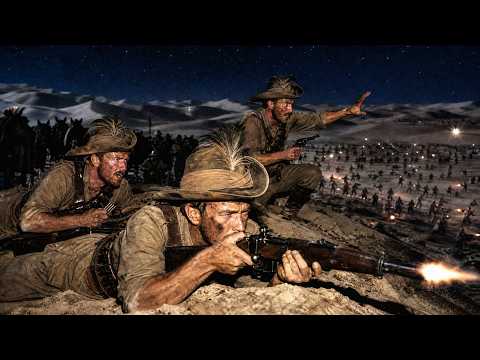
Just before midnight on August 3, 1916, a young Australian light horseman lay on the back slope of a sand dune in the Sinai Desert, his rifle resting on his shoulder. The wind had died, and the desert was utterly still. Then he heard something that made his blood run cold: voices speaking Turkish. Not a patrol. Not a scouting party. A whole army, thousands strong, was moving through the darkness toward his position. Behind him stretched forty kilometers of sand, and beyond that, the Suez Canal—the lifeline of the British Empire. He did what any good sentry would do. He didn’t fire. He didn’t shout. He turned quietly in the sand and crawled back to his section commander with the news.
The word passed down the line in a whisper. Fix bayonets. Wait. The first shots cracked not long before midnight—but they came from the Australians. A platoon on the far southern end of the line saw dark shapes moving toward them and opened fire. In the muzzle flashes, they glimpsed not a raid, but a wall of men. This was the opening blow of the Battle of Romani, and for the next six hours, five hundred Australian light horsemen would face eight thousand Turkish soldiers in the dark, fighting not by holding their ground, but by mastering the hardest maneuver in war: the fighting retreat.
To understand why this patch of barren sand mattered, you have to understand what the Suez Canal meant to the British Empire in 1916. It was not just a waterway. It was the spine of the empire—160 kilometers of water linking Britain to India, to Asia, to the Western Front. Every ship carrying Australian, Indian, and New Zealand soldiers to the trenches passed through it. Every shipment of Indian wheat and Malaysian rubber. Every mailbag from a mother in Adelaide to her son in the mud. Without the canal, everything would have to go the long way around the Cape of Good Hope, adding weeks to every voyage and doubling the cost of every cargo. The Germans knew this. In February 1915, they helped their Turkish allies mount a first attempt to cross the Sinai and cut the canal. That attempt failed—British warships drove the Turks back into the sand. But they didn’t give up.
Throughout 1915 and into 1916, a German officer named Friedrich Kress von Kressenstein, a career soldier from Bavaria attached to the Ottoman Army, worked patiently on a second attempt. He assembled sixteen thousand men, including Ottoman divisions hardened at Gallipoli. He brought German heavy artillery and Austrian mountain guns across the desert on camels and mules. He built water depots and mapped every well in northern Sinai. This time, he would not let the warships drive him off. To the British, the math was simple: if the canal fell, the empire would crack along its longest joint. The problem was that the canal was 160 kilometers long—you couldn’t defend it all forever. You had to push the enemy away, fight him in the desert on ground of your choosing before he got close enough to fire a single shot into the water.
So through the summer of 1916, British engineers pushed a single railway line and a water pipeline east across the Sinai, extending the front line deep into the sand. At the end of that line, where towering dunes broke the flatness of the desert, they built a camp called Romani. It lay about forty kilometers east of the canal—the end of the world, from a soldier’s perspective. Behind it was nothing but desert stretching to Turkish-held Palestine. If the Turks came, they would have to come through Romani. And by late July 1916, everyone at Romani knew they were coming.
The troops chosen to hold the forward line were not infantry. They were cavalry—specifically, the men of the 1st Australian Light Horse Brigade. But these were not cavalry as most people imagine. They carried no lances, no sabers. They rode horses to the battle, then dismounted and fought on foot with rifles. In the concepts of the age, they were mounted infantry. Each soldier carried a rifle, a bayonet, and a cartridge belt. Every fourth man was responsible for holding the reins of four horses behind the firing line while his three mates advanced with their rifles. Their horses were a special Australian breed called the Waler, developed in New South Wales—strong, hardy, medium-sized, built for work in hot, dry climates. A Waler could carry a man and his full equipment for long distances on little water. It could stand in the sun all day without going lame. It didn’t panic easily under fire. In a country built on the backs of sheep and cattle, most rural boys learn to ride before they learn to spell. Now those boys were riding those same tough horses across a desert on the other side of the world.
The men of the 1st Light Horse Brigade had come to Sinai after Gallipoli. They had fought as dismounted infantry on the hills above Anzac Cove in 1915. They had lost many friends there. They left the peninsula when it was evacuated in December and spent the first half of 1916 in camps along the Suez Canal, patrolling the desert and slowly getting used to fighting as cavalry again. When the Turkish threat appeared, they were the natural choice to push to the far edge of the Romani position. They were rural horsemen, veteran fighters—men who could ride ten kilometers, dismount, fight, mount up again, and ride back.
Their commander at Romani was a lean, quiet, patient man named Major General Harry Chauvel. He commanded the Anzac Mounted Division. He had led men at Gallipoli. He was one of the few British Empire officers in 1916 who truly understood how to use mounted troops as a maneuver force. And he had a plan. Chauvel’s plan for the forward line was not to try to stop the Turks. That was impossible. Five hundred men cannot stop eight thousand. What five hundred men could do was buy time. They could see the enemy coming. They could report his direction. They could fight small, stubborn actions that forced the enemy to stop, deploy, and lose the element of surprise. They could bleed the enemy’s time, because Chauvel was keeping reserves in the rear at Romani. And if he could see the direction and strength of the Turkish blow in time, he could bring those reserves onto the flank of the attack at first light and destroy it.
The forward line stretched about five kilometers along the sand dunes south of the main Romani camp. The men were spread thin—in some places, one soldier every twenty or thirty meters. In others, small groups of a section or a troop defended a particular hill. Two regiments held the line. A light horse regiment theoretically numbered about five hundred men, though it was rarely at full strength in the field. That was all that stood between the canal and eight thousand Turks. Two regiments, five hundred rifles, and a line of sand dunes.
They had been on that line in various forms for weeks. They were tired. Water was strictly rationed—every drop had to be railed in from the canal or drawn from limited desert wells. It was August in Sinai. Daytime temperatures exceeded 45 degrees Celsius. At night, the desert cooled rapidly—sometimes by 20 degrees within an hour after sunset—and men who had sweated all day suddenly found themselves shivering. The horses suffered as much as the men. A Waler in the desert needed about thirty liters of water a day to stay in good condition. Under the August 1916 ration, some horse groups received barely fifteen. You could see it in their coats. You could see it in the way they held their heads. Yet again and again, when their men called them from the sand and mounted the saddles, the horses got up. There is a specific piece of Australian folklore honored by every soldier who rode a Waler: a good Waler will die under his rider before he stops. In Sinai in the summer of 1916, that was not folklore. It was fact.
The men spent August 3 as they had spent every day for the past two weeks. They stood to at three in the morning, when the desert was at its coldest, in case of a Turkish attack at dawn. They stood down when full daylight came. They dozed in patches of shade under their blankets when they could. They watered their horses in shifts. They cleaned their rifles obsessively—in the fine sand of the dunes, a rifle bolt could jam in a day if it wasn’t disassembled, wiped, and cleaned. And they waited.
On the evening of August 3, they lay along the sand dunes and waited. Chauvel had told them what to expect. Turkish forces under German command had been under observation by their patrols for days. It was known they had come within striking distance. What was not known was whether the blow would fall tonight, tomorrow, or a week from now. Around eleven o’clock that night, the wind dropped. The desert went completely quiet, and a young light horseman, lying on the back slope of a dune with his rifle on his shoulder, heard something he had never heard before. Voices. Not English, not Arabic, not the tones of the Bedouin traders who sometimes drifted out of the sand. A different sound. Guttural. Staccato. Turkish. He listened hard. He heard the crunch of boots on sand. He heard the light metallic sound of rifles being unslung from shoulders. He heard hissed instructions from officers in a language he did not understand. Then he did what a good sentry does. He didn’t fire. He didn’t shout. He turned in the sand and quietly made his way back to his section commander with the news that the enemy was there.
The word ran down the line in a whisper. They fixed bayonets. They waited. Just before midnight, the first shots rang out. They were not from the Turks. They were from the Australians. A platoon of light horsemen on the far southern end of the line saw dark shapes moving toward them across the sand. The platoon commander gave the order. Half a dozen rifles fired together from behind the parapets into the crowd. The muzzle flashes lit the sand for fractions of a second. The Australians saw men falling. They also saw, in that fleeting moment, that behind those falling men was a wall of other men. This was no raid, no patrol, no reconnaissance. This was an attack. The wall of men opened fire in reply, and over the next few minutes, along the roughly five-hundred-meter span of the forward line, the desert erupted with muzzle flashes, the crack of rifle fire, and the sound of long-range Ottoman Mauser bullets passing in the dark.
To understand what happened next, you must understand the fighting retreat. When a smaller force is attacked by a larger one, the instinct is to run. But there are two ways to move. One is to break and flee—men throw down their equipment, lose contact with their officers, and arrive in the rear as a shattered mob. The other is the ordered withdrawal: some men fire while others move, then those who moved cover the next group. Each dune becomes a brief stronghold before it is abandoned on command. It is the hardest maneuver in war, because it requires a soldier to keep firing at an enemy who is closing in, trusting that his officer will tell him when to go and that the man behind him will hold the next ridge.
The Australian Light Horse had trained for this. Their Walers gave them mobility—hold a piece of ground as long as needed, then run to the horses, ride to the next position, dismount, and fight again. Chauvel had walked the ground himself and chosen the fallback positions in advance. Every squadron commander knew which dune he would retreat to if forced off his first. That preparation was the difference between a withdrawal and a rout.
And so, through the night, the Australians held, fired, inflicted losses, and pulled back by order. They held again, dune by dune. The first savage fight came at a high sand hill called Mount Meredith. The Turks attacked barefoot—their feet, hardened by months of desert marching, gripped the soft sand better than boots. They came in silence, by the thousands, against a handful of Australians on the crest. Vickers machine guns fired five hundred rounds a minute, their tracer rounds drawing red lines down the slope. The Turks pushed on, wave after wave. By three in the morning, they had reached the edge of the hill. The order came: “Retreat.” Half of each section kept firing while the other half ran bent double in the dark to the horses waiting behind the slope. They mounted, rode a few hundred meters north, dismounted, and lay in the sand with rifles aimed back at Mount Meredith. Then the other half withdrew through them. It took discipline of a kind hard to describe—on soft sand, in darkness, with friends still dying on the hill behind you.
By half past three, the whole line south of Mount Meredith was falling back to a long sand ridge the New Zealanders had named Wellington Ridge. The withdrawal was not clean. Turkish infantry, having taken Mount Meredith, surged down the back slope and into the dunes the Australians were retreating through. Small groups were cut off. Some were killed. Some were captured. In the dark, sections lost contact with their squadrons. Yet the line bent, shrank—but never broke. Small acts of leadership held it together: a captain walking his line under fire, telling his men in a calm voice which dune to fall back to next; a sergeant staying with a jammed Vickers gun until a fitter arrived; a corporal taking over a platoon after his officer was hit and simply continuing what the officer had been doing.
Near midnight, one of the most famous incidents of the night occurred. Major Michael Shanahan of the 2nd Light Horse Regiment—a forty-six-year-old builder from Roma, Queensland—was riding his huge chestnut Waler, known to the men as “Bill the Bastard,” along the line. He found four of his men isolated, their horses killed, on foot and about to be surrounded. There was no time for extra horses. There was only Bill. Shanahan told the men to get on. Two climbed on behind and in front of him; two grabbed the stirrups and ran alongside. Then Shanahan turned Bill north and dug in his heels. Bill carried five men through the dunes under fire—two riding, two hanging from the stirrups, Shanahan holding it all together with one hand and his voice. For a horse that had once thrown every man who tried to mount him, it was an act of trust and strength that should not have been possible. But Bill did it. He carried the five back through the dark to safety, then turned and went back into the fight.
Shanahan was later hit in the thigh by a Turkish bullet. He kept riding, kept leading his squadron, until he collapsed forward in the saddle. Bill, who had stood under fire for hours, turned of his own accord and carried his unconscious rider three kilometers back to the veterinary depot. Shanahan lost his leg, was sent home, and was awarded the Distinguished Service Order. He lived until 1964 and rarely spoke of the war. When a relative once asked him about Bill, reminding him that he had called the horse a bastard, he replied: “But Bill was a good bastard.” Bill was never sent home to Australia. Almost no Australian horse returned from the desert war. He spent the rest of his days in Egypt.
Somewhere on the eastern horizon, the sky began to turn gray. Dawn came to Sinai around five in the morning on August 4, 1916. The temperature was still cold. A light breeze blew from the east, and for the first time in six hours, the men in the forward lines could see. What they saw in the growing light changed everything. The desert to their south and east was covered with Turkish infantry—thousands of men in long gray-brown uniforms, scattered across the sand between the folds of the dunes. Some were still advancing; others lay exhausted where they had stopped. They saw the glint of Turkish rifle barrels in the first sunlight. They saw officers with round caps standing on the crests of captured dunes, using binoculars to look toward the British camps. And they saw something else. Behind them, from the direction of Romani, they saw dust—long, low, rolling columns of dust that could mean only one thing: reinforcements.
Chauvel had held his reserves all night, as planned. He had known from the direction of the Turkish attack, from reports from the forward line, and from the sound of the fighting in the dunes exactly where Kressenstein was trying to go. Now he played his hand. At about 4:30 a.m., he pushed the 2nd Light Horse Brigade onto the flank of the battle. As dawn broke, he brought up the New Zealand Mounted Rifles Brigade and the 5th Mounted Brigade, along with British Yeomanry regiments, from positions further back. Between them, they added several thousand fresh mounted troops to the Australian line. The reinforcements did not just plug the gap—they swung south onto the ground the Turks had crossed in the night and began to close on the Turkish flank.
The Turks, who had attacked for six hours on foot in the dark, through sand and under fire, were utterly exhausted. They had achieved most of their objectives, but they had done so six hours behind schedule, with a badly bloodied army. And now, with the sun rising behind them, two fresh mounted brigades were driving into their exposed flank. Kressenstein’s entire plan had assumed his attack would have broken through the ridge line and crawled toward Romani by first light. The Australian forward line had made sure that did not happen. Now the shape of the battle was reversing.
For the Australians who had fought all night, the sight of the reinforcements was something they would remember for the rest of their lives. Some wrote about it in diaries in the days after the battle. They wrote about being pulled back to a rear line with fresh horses and fresh men, about being handed a water bottle they had dreamed of for four hours, about lying down on the sand behind the new line and not being able to move for a while. Some slept where they lay on the back slope of a dune while the shooting continued in front of them, because the body, when it reaches that point, simply stops working.
The fighting continued through the morning. Wellington Ridge was finally secured by the Turks around seven o’clock, six hours later than planned. By then, the light horsemen and New Zealanders were working around their flanks, and infantry from the 52nd British Division at Romani began to move south. By early afternoon, the Turkish attack along the front had stopped. By evening, the Turks were digging in where they stood, hoping the pressure would ease. But it did not ease. Over the following days, the Anzac Mounted Division pursued the retreating Turkish force across the same ground they had crossed. There were rear-guard actions at a place called Bir el Abd on August 9. There was a final Turkish withdrawal to Bir el Abd on the 12th, and then Kressenstein’s entire army fell back east—first to Salmana, then to El Arish, and then out of Sinai entirely.
Now to the accounts. The Turks lost about eight thousand men during the three days of battle and pursuit. Roughly half of those Kressenstein brought across the desert fell killed, wounded, or captured. About four thousand were taken prisoner. Some were captured on the sand dunes above Wellington Ridge, exhausted, without water, and unable to fight any longer. Some threw down their rifles when the light horsemen swung around their flank and raised their hands in surrender. The British Empire side lost about 1,100 men killed, wounded, and missing over the same period. Almost all of these casualties were from the mounted troops. Almost all were Australians or New Zealanders. The infantry divisions in the rear at Romani suffered very few casualties. The men who paid the price to stop the last Turkish advance toward the Suez Canal were mostly the light horsemen and mounted riflemen who had been standing in the sand dunes when the voices came out of the darkness. And within the Light Horse, the 1st Brigade—five hundred men on the forward line—carried the heaviest burden. Some regiments came out of the battle with a third of their men on the casualty list. Whole squadrons were reduced to a handful of survivors.
In the officers’ messes at Romani in the days that followed, seats stayed empty at the tables where friends had sat a week before. The wounded, once moved to the railway station, were sent by hospital trains to base hospitals in Cairo. Some with severe wounds, like Shanahan, completed the journey to hospitals in Alexandria or across the Mediterranean to Malta and then England. Some died on the way. Some, like Shanahan, survived but lost limbs. Others recovered completely and returned to their units in Sinai within weeks. Such was the nature of desert war. Men fell at Romani and returned to the front line, in some cases catching up with the fighting at Rafa and Magdhaba a few months later. The dead were buried where they fell in shallow graves dug in the sand, with small wooden crosses driven into the ground and their names written in indelible pencil. Later, when the front moved east, war graves units came back to recover their remains and bury them in organized cemeteries. The largest is at Kantara on the eastern side of the canal—a quiet, cool place with white headstones under trees, where many of the men who fell in the dunes above Wellington Ridge lie today.
The Turks, meanwhile, had crawled into Sinai believing they could still cut the artery of the British Empire. They returned from their march finally understanding that they could not. There would be no third Turkish attack on the Suez Canal. The canal would never again be seriously threatened for the rest of the war. That door was closed.
When the British Commander-in-Chief in the Middle East, General Sir Archibald Murray, sat down to write his report on the battle, he chose his words carefully. He was a professional soldier. He was not a man given to easy praise. But he wrote of the Australian and New Zealand Mounted Division (Anzac) that they had proven every day that they were an indispensable part of his forces. He wrote of their courage, their steadiness, and their untiring energy throughout the operations. Then he wrote the sentence that has echoed ever since. He wrote that these Anzac forces were the cornerstone of the defense of Egypt. The cornerstone is the stone at the top of the arch. If you remove the cornerstone, the whole arch collapses. It is the most important stone in the building. When a man trained all his adult life in the language of military doctrine describes other troops as a cornerstone, he is saying something very precise. He is saying that without them, the whole thing would have fallen apart.
The British general was not exaggerating. The truth about Romani is that if the forward line had broken on the night of August 3, if the five hundred men had fled instead of retreating dune by dune, the Turkish attack would have hit the main Romani camp in the dark before the reserves were ready, before the New Zealanders arrived, before the British Yeomanry could swing around the flank. The whole position might have collapsed, and behind it there was only forty kilometers of sand, and then the canal. The five hundred did not flee. That is the whole story, in the end. They held. They withdrew when told. They held again. They held again. They withdrew again. And every dune they gave up cost the Turks twenty extra minutes of daylight they could not afford to lose.
The Battle of Romani ended the last Turkish threat to the Suez Canal. It also quietly changed the shape of the entire war in the Middle East. Until Romani, the British were on the defensive. After Romani, they went on the offensive. The railway line and the water pipeline kept moving east. The light horsemen and their New Zealand and British cavalry comrades kept moving with them. Within a year, they would reach the gates of Palestine. And a little over a year after that, another division of Australian light horsemen would make a charge on the walls of a town called Beersheba, and something else would enter the legend. But that is another story.
At the beginning of this story, we started with a sentry on the forward line hearing voices in the darkness of the Sinai desert. We should end the story there too. The sentry did not know, when he heard those voices, that he was hearing the leading edge of an attack by eight thousand men. He did not know that behind him, forty kilometers away, the spine of the British Empire ran through a canal that could be cut in a single night. He did not know that the men on either side of him along the forward line would fight one of the hardest kinds of battle a soldier can fight—a retreat, dune by dune, in the dark, over the next six hours. What he knew was that he had heard voices that were not friendly, and that his section commander needed to be told. So he turned in the sand and quietly carried the news. There the Battle of Romani began. One sentry, and a quiet word passed down the ranks: “Fix bayonets.” Wait. Fire when they come close. Retreat when we tell you. Hold at the next dune. Give it up when ordered. Hold again. Five hundred young rural men from Queensland, New South Wales, Victoria, and Tasmania, on tough Australian horses, on a piece of sand no one in the world cared about except for what lay behind it, stood against eight thousand soldiers all night, and gave the sun time to rise, and gave a general at Romani headquarters time to move his reserves onto the enemy’s flank, and gave the British Empire time to catch its breath. They did not do it by refusing to move, but by moving skillfully, by giving up ground deliberately rather than in panic, and by trusting their officers and each other in a darkness where it was hard to trust anyone. They did it. In short, by mastering the hardest maneuver in war. And when the sun rose over the sand dunes on August 4, 1916, the road to the Suez Canal was closed. Not by a wall, not by a river, not by a fortress, but by five hundred men who never let their line break. And that is why, if you read the records of the Great War in the Middle East, the sentence that keeps coming back is the one Sir Archibald Murray wrote in the days that followed: these Australian and New Zealand forces (Anzac) were the cornerstone of the defense of Egypt. They were, because in the dark, among the sand, at midnight on August 3, they held.
What would you have done, hearing those voices in the dark?
Report this article
Select a reason for reporting:






