It was a machine that could cross mud and snow with ease, its sloped armor deflecting enemy shells like a shield. Yet inside, men suffocated in a cramped steel coffin, blinded by poor visibility and deafened by the roar of the engine. The T-34/76 was a paradox on tracks—a tank that was both a savior and a killer.
Introduced in 1940, the T-34/76 combined sloped armor, wide tracks, and a 76 mm gun into one lethal package. Its 45 mm armor, angled at 60 degrees, gave it effective protection equivalent to 70 mm, making it nearly invulnerable to early German guns. The wide tracks spread its light weight, allowing it to glide over terrain that bogged down other tanks. But behind the steel, a different story unfolded.
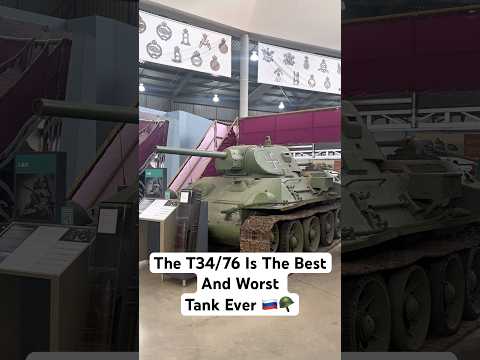
Crews faced a nightmare. Visibility was dreadful, the turret lacked a basket, and the controls were exhausting to operate. Many tanks had no radio at all, forcing commanders to signal with flags. The sloped armor, while brilliant for protection, made the interior extremely cramped. Comfort was non-existent, and casualty rates were high. Men baked in summer, froze in winter, and prayed they wouldn’t need to escape a burning tank—because the hatch was often jammed.
Yet the Soviets didn’t rely on perfection. They relied on numbers. By 1943, tens of thousands of T-34s were rolling off assembly lines, with some factories claiming they could produce one in under three hours. That, along with the lend-lease tanks providing even more numbers, made the Soviet army unstoppable in sheer quantity.
The T-34/76 was a weapon of mass production, a tank designed for a nation that valued quantity over quality. But as the war raged on, the flaws became impossible to ignore. The Germans, with their superior optics and radios, learned to exploit the T-34’s weaknesses. Crews dreaded the cramped conditions, the lack of communication, and the ever-present threat of a fiery death. The tank that was supposed to save them was also the one that could kill them.
Still, the T-34/76 pushed forward, wave after wave, its presence alone enough to break enemy lines. But the question remained: how long could the Soviets sustain this strategy before the human cost became too high?
The answer came not from Moscow but from the front lines, where crews began to modify their tanks in the field. They welded makeshift armor plates onto the turret, scavenged German radios, and cut holes in the hull for better ventilation. Some commanders even ordered the hatches removed entirely, preferring an open top to the risk of being trapped inside. These were not official upgrades—they were survival tactics, born of desperation.
Meanwhile, Soviet engineers worked frantically on a solution. The 76 mm gun, once formidable, was now outmatched by German armor. Panthers and Tigers could shrug off its shells at range, while their own guns tore through the T-34’s sloped plate with frightening ease. The tank that had once been a savior was becoming a liability.
By late 1943, whispers of a new variant spread through the ranks—a T-34 armed with a larger gun, one that could punch through the thickest German steel. Crews waited anxiously, but the factories were already stretched to the breaking point. Every hour spent retooling was an hour without tanks rolling off the line.
The first T-34/85s arrived at the front in early 1944, and the difference was immediate. The new turret was roomier, the gun was devastating, and for the first time, crews had a radio as standard equipment. But the old T-34/76s didn’t disappear—they were pushed into support roles, their crews still enduring the same cramped hell.
For the men inside those older tanks, the war remained a grinding ordeal. They watched the new models roll past with a mix of hope and envy, knowing their own machines were obsolete but still needed. The T-34/76 had done its job—it had bought time, paid for in blood and discomfort.
As the Soviet army advanced westward, the old tanks were often the first to be sent into the breach, their crews knowing they were expendable. The paradox remained: the tank that had saved the nation was now being used as a sacrificial tool.
But the war was far from over, and the men in those outdated machines still had battles to fight—and sacrifices to make.
Among those men was Sergeant Alexei Volkov, commander of a battered T-34/76 named Last Hope. His tank had survived three winters, two engine replacements, and more close calls than he cared to count. The paint was scorched, the fenders were dented, and the radio—a scavenged German set—crackled with static more often than it worked. But Volkov trusted his crew, and they trusted him.
They had been assigned to a rear-guard action near the Vistula, covering the withdrawal of a supply column. It was the kind of mission old T-34s were given now—dirty, dangerous, and thankless. The driver, a wiry Siberian named Dmitri, joked that at least the tank couldn’t get any uglier. The gunner, Yuri, didn’t laugh. He was busy counting shells. They had twelve armor-piercing rounds and a handful of high explosive. Not enough for a real fight, but enough to make a stand.
The morning fog was thick when the first German engine growled in the distance. Volkov peered through the periscope, its glass scratched and cloudy. He saw shapes—boxy, angular, moving with the confidence of predators. Panthers. At least three of them.
His instinct screamed to retreat, but the supply column was still exposed on the road behind them. He keyed the makeshift radio and ordered the driver to angle the hull, presenting the sloped front plate to the enemy. Every degree mattered now.
The first shot came from the lead Panther, a bright flash in the fog. The shell screamed past the turret, missing by inches. Yuri didn’t wait for the order—he fired, and the 76 mm gun roared. The round struck the Panther’s mantlet and ricocheted harmlessly into the sky. Volkov felt his stomach drop.
“Reload! Faster!” he shouted, though the loader, a boy barely eighteen named Pavel, was already slamming another shell into the breech. The cramped turret made every movement a struggle—elbows banged against steel, knees scraped on spent casings, and the stench of sweat and cordite filled the air.
The second Panther fired. This time the shell struck the hull, and the entire tank rang like a bell. Volkov tasted blood—he had bitten his tongue. The armor held, but the impact threw Pavel against the breech, dazing him. “Pavel! Wake up! We need you!”
The boy shook his head, blinked, and grabbed another shell. Yuri fired again, and this time the round found its mark—the Panther’s turret ring. Smoke billowed from the German tank as it ground to a halt. One down.
But the other two were already flanking, their long guns tracking the Last Hope. Volkov knew the math. Twelve rounds, two Panthers, and no room for error. He ordered Dmitri to reverse into a shallow ditch, using the terrain to hide the lower hull. It was a desperate gamble—but desperation was all they had left.
The ditch was shallow, barely enough to hide the tracks, but it would have to do. The remaining Panthers slowed, cautious now, their commanders likely wary of an ambush. Volkov watched them through the cloudy periscope, his heart hammering against his ribs. Two predators, circling, waiting for the kill.
He keyed the radio and whispered into the static. “Yuri. Target the one on the left. Aim for the hull, not the turret. We don’t have the punch for a frontal turret hit.” Yuri nodded, his face pale but steady. Pavel loaded the round with shaking hands.
The first Panther inched forward, exposing its side as it maneuvered around a wrecked truck. Yuri fired. The shell struck the hull below the turret, and flames licked out of the engine deck. The Panther stopped dead, its crew bailing out through the hatches. Two down.
But the third had found them. Its long 75 mm gun swung toward the ditch, and Volkov knew they had seconds at most. “Dmitri! Forward! Ram it!” he screamed. The driver didn’t hesitate—he slammed the throttle, and the Last Hope lurched out of the ditch, engine roaring.
The Panther fired, but the shot went wide as the T-34 surged toward it. The German commander tried to reverse, but the ground was soft, and the heavy tank bogged down. The Last Hope slammed into the Panther’s side at full speed. The impact threw Volkov against the turret wall, stars exploding behind his eyes.
When he came to, the Panther was on its side, tracks spinning uselessly. The Last Hope‘s front plate was crumpled, and the engine coughed black smoke. But they were alive. Pavel was crying, Yuri was laughing, and Dmitri was already climbing out to check the damage. They had held the line.
The supply column escaped that day, though no one would ever write about it. The Last Hope was towed back to a repair depot and declared beyond saving. Volkov and his crew were reassigned to a new T-34/85, sleeker and deadlier. But Volkov never forgot the old tank—the cramped, blind, exhausting coffin that had carried them through hell.
“She wasn’t perfect,” he told his new crew on the first day. “But she brought us home.” The war moved on, and the T-34/76 faded into history, remembered as both a savior and a killer. Yet for the men who rode them, the paradox was simple: it was the worst tank they ever loved.
What would you have done in Volkov’s place—retreat, or make that final, desperate charge?
Report this article
Select a reason for reporting:






