They were battle-hardened soldiers, fresh from the carnage of the American Civil War, now united by a single, burning goal: to strike a blow for Irish freedom. But their target wasn’t Ireland—it was Canada. In the early hours of June 1, 1866, under the cover of darkness, nearly a thousand men boarded barges on the Niagara River. Their mission: invade British North America and hold it hostage until Britain withdrew from Ireland. It was a plan so audacious it seemed doomed from the start—yet it would ignite a fire that reshaped a continent.
The Fenian Brotherhood, founded in 1858 by Irish immigrants in the United States, had long dreamed of liberating their homeland from British rule. Many of its members had fought in the Union Army, and now they sought to use their military expertise for a new cause. Their leader, John O’Mahony, a veteran of the failed 1848 uprising, envisioned a bold strike: invade Canada, pressure Britain, and perhaps even spark a war between the US and Britain. But after an aborted attempt to seize Campobello Island in April 1866, leadership passed to two more Civil War veterans—Colonel William Roberts and General Thomas Sweeney—who devised an even more ambitious four-pronged assault.
Sweeney’s plan called for diversionary attacks to draw British and Canadian troops away from the main targets: Niagara and Quebec. The largest force, 3,000 men, would cross at Buffalo under 32-year-old Colonel John O’Neil, a red-haired Irish immigrant and Civil War veteran. O’Neil’s men would seize Fort Erie, then push toward the Welland Canal and Toronto. Meanwhile, another army would invade from Vermont, hoping to rally French-Canadian Catholics to their side. It was a gamble of staggering proportions, and the Fenians believed the US government might even recognize their new Canadian administration. But as O’Neil’s men stormed Fort Erie with a wild cry and unfurled a green Irish flag, they had no idea that their grand invasion was already unraveling.
O’Neil issued a proclamation to the people of Canada: “We come among you as foes of British rule in Ireland… our war is with the armed powers of England until Ireland is free.” But his hopes of reinforcement were dashed when the USS Michigan, a US gunboat, appeared on the river with orders to prevent further crossings. O’Neil was on his own. Worse, informers had alerted both American and Canadian authorities, and the Canadian population—even Irish Canadians—was outraged. Thomas D’Arcy McGee, a former Young Irelander, warned the Fenians they were not welcome. The Canadian response was swift: thousands of militia were called out, and within 24 hours, the Queen’s Own Rifles of Toronto had marched to Fort Erie.
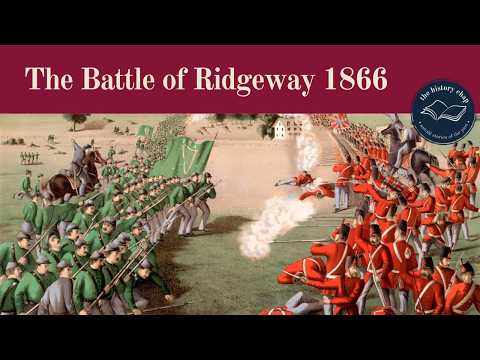
Under the command of Lieutenant Colonel Alfred Booker, a 42-year-old English-born merchant with 15 years of militia experience but no combat record, the Canadians advanced toward Ridgeway. Booker’s force of 880 men—mostly Canadian militia—was confident but untested. O’Neil, meanwhile, had broken camp at 3 a.m. and lay in wait. As Booker’s column marched along a road flanked by tall corn, the Fenian skirmishers opened fire. The Canadians rushed toward the lone Irish position, but the veterans pulled back, drawing the militia into a deadly ambush. Over 600 Fenians opened fire from the ridge and woods, and the firefight turned fierce.
Booker, seeing horsemen in the distance, mistakenly believed he faced a cavalry charge and ordered his men into a square—only to realize there was no cavalry. His men, now bunched together, became easy targets for Fenian marksmen. The order to retire didn’t reach the right flank, and as troops fell back, confusion spread. What should have been a disciplined withdrawal became a chaotic flight. The Fenians pursued for a quarter mile until O’Neil recalled them. The Battle of Ridgeway lasted just 20 minutes. The Canadians lost 23 dead and 30 wounded; the Fenians, 6 dead and 15 wounded. But O’Neil, believing British regulars were approaching from his rear, ordered a retreat to Fort Erie.
Despite the victory, O’Neil’s position was precarious. The USS Michigan still blocked reinforcements, and Colonel Peacock’s regulars were closing in. Trapped in the toe of the Niagara Peninsula, O’Neil ordered the destruction of his ammunition dumps and tried to flee across the river. In the haste, 32 men on picket duty were left behind and captured. O’Neil’s flotilla was intercepted by the USS Michigan; shots were fired, five Fenians killed, and O’Neil and his men arrested. The invasion had lasted just 48 hours and advanced only 8 miles into Canada. But it wasn’t over—on the night of June 6-7, the fourth prong crossed from Vermont, planted a green flag at Pigeon Hill, and retreated 24 hours later.
The aftermath was swift. O’Neil, Roberts, and Sweeney were briefly arrested in the US before being released. In Canada, 80 captured Fenians faced an uncertain future, though most were acquitted or quietly released. Colonel Booker demanded a board of inquiry, which cleared him of misconduct, but his reputation was stained; he resigned and died four years later. Meanwhile, Captain William Dillon Otter, who had fought at Ridgeway, would go on to become Canada’s first homegrown general. The Fenian raids had failed to free Ireland, but they accelerated the formation of the Dominion of Canada in 1867. And for O’Neil, the fight wasn’t over—he would try again in 1870, with even less success. But that is a story for another time.
Yet the story of the Fenian invasions did not end with the scattered arrests of June 1866. In the years that followed, the movement splintered and radicalized, its ranks divided between those who still believed in armed invasion and those who now saw politics as the only path forward. O’Mahony, sidelined but not silenced, watched from New York as younger, more impatient men took up the banner he had once carried.
For the British authorities in Canada, however, the raids had exposed something far more dangerous than a few thousand Irish veterans: the colony’s near-total lack of military preparedness. The Canadian militia had been brave but badly trained, poorly equipped, and led by officers who had never heard a shot fired in anger. The Battle of Ridgeway became a rallying cry—not for Irish freedom, but for Canadian self-reliance.
Newspapers across the province demanded reform. Drill halls were built, uniforms standardized, and a proper military college proposed. The invasion had done what decades of polite debate could not: it convinced the scattered colonies of British North America that they could no longer afford to stand alone.
But the Fenians were not finished. Across the Atlantic, a new generation of Irish revolutionaries watched the raid with fascination. Among them was a young man named Jeremiah O’Donovan Rossa, whose fiery speeches in Dublin would soon earn him a prison cell. The Fenian Brotherhood’s American wing had shown that Irishmen could organize, arm, and strike—even if the blow had fallen in the wrong place.
In 1867, the movement tried again—this time in Ireland itself. A rising was planned, weapons smuggled, and contacts made with sympathetic soldiers in the British Army. But informers had infiltrated the ranks, and the uprising collapsed before it began. The leaders were arrested, and three were hanged in Manchester, becoming martyrs whose funerals drew thousands into the streets. The Fenian dream of liberation had not died; it had merely changed shape.
Back in North America, the raids left a bitter legacy on both sides of the border. In Canada, Irish Catholics found themselves viewed with suspicion, their loyalty questioned by neighbors who could not forget the green flag raised at Fort Erie. In the United States, the Fenian veterans returned to civilian life, many of them broken in health, their pensions from the Civil War delayed or denied.
Yet the movement’s influence rippled outward in ways no one could have predicted. The raid had exposed the fragility of British rule in North America, and it had given Canadian nationalists a powerful argument for confederation. When the Dominion of Canada was proclaimed on July 1, 1867, the Fenian threat was cited in the very debates that shaped the new nation’s constitution.
For O’Neil, the man who had won the only Fenian victory, the years after Ridgeway were restless and unquiet. He returned to the United States, drifted between jobs, and never quite escaped the shadow of that June morning when he had stood on Canadian soil with a green flag in his hand. His second attempt, in 1870, was a farce—a handful of men, a few shots fired across the border, and another arrest.
But history has a curious way of redeeming its failures. In the decades that followed, the Fenian raids were remembered less for what they achieved than for what they set in motion. The Irish question would not be settled by invasion, but the pressure applied by men like O’Neil—however clumsy, however doomed—helped keep Ireland’s cause alive in the minds of the world.
And in Canada, the legend of Ridgeway became something else entirely: a founding myth. The militia who fled in confusion that day would be remembered as citizen-soldiers who had answered the call of duty, and the battle would be taught to schoolchildren as a warning that freedom must be defended. The Fenian threat faded, but the nation it had inadvertently helped create endured.
O’Neil himself faded into the American West, a restless veteran whose greatest victory was already behind him. He died in Nebraska in 1878, far from the green fields of Ireland and the limestone ridge where his men had briefly known glory. His obituary was modest, his grave unmarked—a quiet end for a man who had once dreamed of toppling an empire.
The Fenian Brotherhood itself withered, torn by faction and betrayed by informers. Yet its spirit did not die. In 1916, when a new generation of Irish rebels seized the Dublin General Post Office and proclaimed a republic, they carried forward a torch first lit by those Civil War veterans on the Niagara frontier. The Easter Rising failed, but it sparked a war of independence that finally broke Britain’s grip.
And in Canada, the legacy was equally profound. The fear of Fenian invasion had forged a nation from scattered colonies, and the citizen-soldiers who marched to Ridgeway became the ancestors of a proud military tradition. What began as a bold strike for Irish freedom had, in the end, helped birth two nations—one in the fires of revolution, the other in the quiet certainty of self-government.
History rarely follows the plans of men. The Fenians sought to free Ireland and failed. But in their failure, they set in motion forces they could never have imagined—and left a mark on two continents that endures to this day.
So what do you think—were the Fenian raids a noble failure, or a reckless folly that changed the world by accident? Share your thoughts in the comments below.
Report this article
Select a reason for reporting:






