November 10, 1943. 6:30 AM. The mountains north of Mignano, Italy. First Lieutenant Maurice Britt crouched behind a rock on Monte Rotondo as roughly 100 German soldiers charged uphill through the fog. He was 24 years old. Three years earlier, he had been catching touchdown passes for the Detroit Lions. Now he commanded a rifle company ground down to 55 men after two days of continuous combat.
The Germans wanted this mountain back. They were coming to take it. Britt had a carbine, a pile of grenades, and no intention of giving up a single yard. He stood up. He moved forward toward the Germans, not away from them. The first shots cracked off the rocks around him. He raised his carbine and started firing.
But before we get to what happened on that mountain, you need to understand who Maurice Britt was before the war—because the man who held Monte Rotondo was not the man anyone expected him to be.
Maurice Lee Britt was born on June 29, 1919, in Carlisle, Arkansas, a small farming community in Lonoke County. His father worked the land. His mother raised the family. Maurice grew up in the kind of poverty that was ordinary in rural Arkansas during the 1920s. Cotton country, flat roads and empty fields, churches and general stores and not much else.
The family eventually moved to Lonoke, where Maurice attended public school. He was tall for his age, awkward in the way that boys who grew too fast are always awkward, and he had unusually large feet. At a local fair, he won a pair of size 13 shoes. The other kids started calling him Footsie. The nickname stuck for the rest of his life. It followed him from the schoolyard to the football field, from the football field to the battlefield, from the battlefield to the governor’s mansion.
At Lonoke High School, Britt became the kind of small-town athlete that people talked about for decades. He was captain of the football team, captain of the basketball team, captain of the track team. He was class president. He was elected valedictorian. He was the boy who was good at everything, the one the teachers pointed to when they wanted to show the other kids what was possible.
He graduated on June 5, 1937, and enrolled at the University of Arkansas on an athletic scholarship that covered both football and basketball. At Arkansas, Britt played end on the Razorbacks football team. He stood 6 ft 4 in tall and weighed 210 lb. He was fast for a man that size, with soft hands and a violent streak on the defensive side of the ball. He could outrun defensive backs on go routes and flatten running backs on sweeps.
He earned varsity letters in both football and basketball. He captained the football squad. He was named twice All-American honorable mention, recognized nationally as one of the best ends in the college game. He joined the Sigma Chi fraternity. He worked as sports editor of the student newspaper, the Arkansas Traveler. He completed the Reserve Officers Training Corps program and was commissioned as a second lieutenant of infantry in the United States Army Reserve.
He was, in every way that mattered, a man being prepared for two different futures at once. He just did not know which one would come first.
On June 8, 1941, he married Nancy Louise Mitchell of Fort Smith. He graduated with a Bachelor of Arts in Journalism the next day. Marriage one day, diploma the next. He was 21 years old, and the world was wide open.
The Detroit Lions selected Britt in the 13th round of the 1941 NFL Draft, 115th overall. He signed for $150 a game. That was decent money in 1941, but it was not a fortune. Professional football in the early 1940s was not the billion-dollar industry it would become. Players held second jobs. They drove their own cars to games. They shared hotel rooms on road trips.
Britt was a backup end. He appeared in nine games during the 1941 season. He practiced every day, played when the coaches called his number, and waited for his chance. His one and only NFL reception came on November 16, 1941, when he caught a 45-yard touchdown pass from wingback Dick Booth in the fourth quarter against the Philadelphia Eagles at Briggs Stadium in Detroit. The catch gave Detroit a 21 to 17 victory. The crowd roared. Britt jogged back to the sideline. For a moment, he was a professional athlete who had just made the biggest play of his career.
He had no idea that this was the last meaningful catch he would ever make. That the hands that caught that football would within two years be throwing grenades at German soldiers on a mountain in Italy.
His teammates that season included Byron White, who would later become a justice of the United States Supreme Court, and Steve Belichick, a rookie fullback who had joined the Lions as equipment manager before head coach Bill Edwards put him on the active roster. Belichick’s son Bill, not yet born, would later coach the New England Patriots to six Super Bowl titles.
The Lions finished four wins, six losses, and one tie. It was a forgettable season for a forgettable team. But the men on that roster would scatter to every corner of the war. Some would fight in Europe. Some would fight in the Pacific. Some would not come back.
The Lions season ended on November 30, 1941, with a 21 to 3 home victory over the Chicago Cardinals. Britt packed his car and drove home to Arkansas that night. His call-up to active duty had already been ordered as part of the pre-war mobilization build-up, with a partial deferment so he could finish the football season.
One week after his last game, on December 7, the Japanese bombed Pearl Harbor. America was at war. Football was over. Everything was over. Everything except what came next.
Britt reported for active duty at Camp Joseph T. Robinson in North Little Rock in early December 1941 under orders issued before Pearl Harbor. He was assigned to Company L, 3rd Battalion, 30th Infantry Regiment, 3rd Infantry Division. The 3rd Division was known as the Marne Division. It had earned the nickname Rock of the Marne after holding the line against a German advance at the Second Battle of the Marne in France during World War I. The 30th Infantry Regiment, Britt’s own unit, had been one of the regiments on that line 25 years earlier. Now the division was preparing for another war against another enemy on another continent.
They trained at Fort Lewis in Washington, Fort Ord in California, and Camp Pickett in Virginia. Britt was a platoon leader. He was good at it. The same instincts that made him a football captain—the ability to read a developing situation, to make fast decisions under pressure, to lead men who were scared and make them believe they could win—those instincts translated directly to infantry command. Football had taught him something that officer candidate school could not. It taught him how to stay calm when everything around him was chaos.
On October 23, 1942, the 3rd Division embarked for North Africa. Britt was about to fight the first of four amphibious assaults in less than two years. Most soldiers in World War II never made a single amphibious landing. Many who did make one never survived to make another. Britt would make four.
If you want to know what Footsie Britt did when he hit those beaches, please like this video. Every like pushes this story to someone who has never heard the name Maurice Britt, and this man deserves to be heard. Please subscribe.
On November 8, 1942, Britt landed near Casablanca in French Morocco as part of Operation Torch. The Western Task Force was under the overall command of Major General George S. Patton Jr. This was the first time American soldiers had fought in the European and North African theaters. Everything was new. The equipment, the tactics, the terrain, the enemy.
Britt’s 30th Infantry helped secure the 3rd Division’s left flank and silenced a French coastal battery at Fort Blondin that had been firing on Allied ships offshore. Casablanca fell by November 11. The fighting was sharp but brief. Britt performed well under fire for the first time. His superiors noticed. The football player could fight.
In January 1943, the 3rd Battalion of the 30th Infantry drew an unusual assignment. They were selected to provide personal guard duty for President Franklin D. Roosevelt and Prime Minister Winston Churchill during the Casablanca Conference. The conference lasted from January 14 to January 24. For 10 days, two of the most powerful leaders in the world sat in a hotel compound in North Africa planning the next phase of the war against Nazi Germany, debating the invasion of Sicily, committing to the demand for unconditional surrender—and a former backup end from the Detroit Lions was standing guard outside the door.
The war had a way of putting ordinary men in extraordinary places and extraordinary men in places they never imagined. Britt never said much about the assignment afterward. It was guard duty. You stood where they told you to stand. You watched what they told you to watch. But very few soldiers in any war can say they personally guarded the President of the United States and the Prime Minister of Great Britain in the same week.
The division then moved to Bizerte, Tunisia, to train for the invasion of Sicily. The men drilled on amphibious techniques, practiced assault landings, and waited in the North African heat. On July 10, 1943, Britt landed on the southern coast of Sicily in Operation Husky, his second amphibious assault. The beaches were hot, and the resistance was scattered but dangerous. Inland, the real fighting began.
The 3rd Battalion then executed one of the longest forced foot marches in modern American military history. Under General Lucian K. Truscott’s punishing pace, they covered 54 miles in 33 hours, pushing from the landing beaches near Gela all the way to Palermo on the northern coast. Truscott called his pace the Truscott trot. It was faster than a walk and slower than a run, sustained over distances that would break most formations. The men had a different name for it. They called it hell.
Their feet blistered, their legs cramped. They carried full packs, rifles, ammunition, and water in the Sicilian summer heat, but they did not stop. Palermo fell on July 22. The division continued east toward Messina. Sicily was secured by mid-August.
On September 18, 1943, nine days after the initial Allied assault at Salerno, Britt came ashore on the Italian mainland with the 3rd Division as reinforcements. His third amphibious assault in less than a year. The main invasion, Operation Avalanche, had begun on September 9 with the 36th Infantry Division and British forces leading the attack. The 3rd Division was held in reserve and landed after the beachhead was secured.
The fighting inland was immediate and violent. Shortly after the landing, Britt’s company commander was wounded and evacuated. Britt assumed command of Company L. He was now responsible for roughly 180 men. He was 24 years old. He had been in the army for less than two years. He had never commanded a company before. Now, he was leading one in combat.
Near Acerno, roughly 10 miles inland from Salerno, Britt led an assault that destroyed a German machine gun position that had been pinning down his company’s advance. The machine gun was dug in on a ridge with clear fields of fire across the approach route. Every time his men tried to move forward, the gun opened up and drove them back to cover. Britt studied the position, identified a blind spot in the gun crew’s field of vision, and flanked the position with a small team. They closed the distance through brush and rocky terrain, then hit the position hard and fast. The machine gun was destroyed.
Britt earned the Silver Star and his first Purple Heart for this action. The wound was not serious enough to evacuate him. He stayed with his company.
The advance continued north toward Naples. The fighting was constant. The terrain was brutal. Italy was not the soft underbelly of Europe that Allied planners had promised. It was a grinding, bloody slog through mountains and rain and mud. Every ridge had a German machine gun on it. Every valley was a kill zone. Every river crossing was contested. The weather turned cold and wet. The roads turned to mud. Vehicles bogged down. Supplies ran short. The infantry kept moving because infantry always keeps moving.
In late October, near Pietravairano, during the assault of Monte San Nicola, Britt saw a wounded soldier lying in the open under enemy fire. Nobody else was moving to help the man. Britt ran into the open, grabbed the wounded soldier, and dragged him to cover. He earned the Bronze Star Medal with a V device for valor.
He crossed the Volturno River with his company. He kept his men alive. He kept them fighting. The men of Company L trusted him. He had a calm way about him under fire that made soldiers believe they were going to survive this. They called him Footsie, the same nickname from those oversized shoes in Lonoke. It made him seem human, approachable, like somebody’s brother or neighbor from back home, rather than an officer reading from a manual. When he said hold this position, the men held it. When he said follow me, the men followed.
By early November 1943, the Allied advance in Italy had stalled. The dream of a quick march to Rome had died in the mud of the Italian mountains. The Fifth Army, under Lieutenant General Mark Clark, was pushing toward the Mignano Gap. Every mile had been paid for in blood. Every town, every ridge, every river crossing had been contested. The Germans were fighting a masterful defensive campaign, trading ground slowly, making the Allies pay for every yard, then falling back to the next prepared position. The Italian campaign was becoming exactly what the Germans wanted it to be: a meat grinder that chewed up Allied divisions while buying time to strengthen defenses elsewhere.
The Mignano Gap was the next obstacle. This was a six-mile-long mountain pass on Highway 6, the Via Casilina, the best road from Naples to Rome, and the gateway to the Liri Valley and the road to Cassino. The Germans knew the importance of this pass better than anyone. They had fortified the gap as part of the Bernhard Line, an outlying defensive belt designed to slow the Allied advance and protect the Gustav Line further south.
Two peaks flanked the highway and dominated the landscape. Monte Lungo at 343 meters and Monte Rotondo at roughly 350 meters. Both mountains overlooked the road. American soldiers called the highway through the gap Death Valley. Nothing moved on that road without German observers spotting it from the heights and calling in artillery. Trucks burned on the roadside. Ambulances were hit. Supply convoys ran the gauntlet at night with headlights off and still took casualties. Whoever controlled the mountains controlled the road. Whoever controlled the road controlled the advance on Rome.
The German side of the Mignano Gap was held by elements of the 3rd Panzer Grenadier Division. These were not conscripts or rear echelon troops. These were experienced, well-equipped, battle-hardened soldiers who had been fighting in Italy for months. They knew every fold in the terrain. They had dug fighting positions into the rock. They had pre-registered their artillery and mortars on every approach route, every ravine, and every trail. Their machine guns had interlocking fields of fire. Taking the mountains flanking the gap would cost blood. Holding them afterward would cost more.
General Truscott, commanding the 3rd Division, sent the 30th Infantry through the 45th Division’s sector to attack Monte Rotondo from the east on November 7 and 8. Under cover of artillery from eight battalions, the barrage shook the mountain. Shells blasted craters in the rocky soil. Smoke and dust hung in the fog. The 3rd Battalion pushed to the crest through fog and medium resistance on the morning of November 8. They took the mountain, but taking a mountain is only half the problem. The other half is keeping it.
The Germans immediately began planning to take it back. For two days, they probed Britt’s positions with small attacks, testing the American defenses, looking for weak points, measuring the response. Artillery hammered the mountain top day and night. Mortar rounds walked across the American positions. Snipers picked off exposed soldiers. The weather was cold and wet. Rain turned the rocky ground to mud. The men dug in as best they could among the rocks and scrub. Sleep was impossible with shells landing every few minutes. Hot food was a memory. Ammunition had to be hand-carried up the mountain on the backs of soldiers because vehicles could not reach the crest. Company L lost men every day to shrapnel, sniper fire, and the cold.
By the morning of November 10, Britt’s company had been reduced from its full strength of roughly 180 men to approximately 55 effective soldiers. They were exhausted, cold, hungry, and running low on everything except determination.
At approximately 06:30 hours on November 10, 1943, the Germans launched their full-scale counterattack. Roughly 100 soldiers from the 3rd Panzer Grenadier Division advanced up the slope of Monte Rotondo in a coordinated assault. They came with machine guns, rifles, grenades, and mortars. Supporting fire from the valley below covered their advance. They intended to retake the mountain and push the Americans off the high ground. If they succeeded, the 3rd Battalion would be cut off and isolated. Company L would be destroyed. The entire American position in the Mignano Gap would be compromised. The road to Rome would remain closed.
Britt did not wait for the attack to reach his lines. He did not hunker down behind cover and direct fire from safety. He moved forward. He grabbed his carbine and as many fragmentation grenades as he could carry. He positioned himself in front of his men, between them and the advancing Germans, and he started fighting.
The range closed fast. Within minutes, Britt was exchanging fire with German soldiers at ranges that made the fighting almost personal. At points during the battle, the distance between Britt and the nearest German was only 15 yards—close enough to see their faces through the fog, close enough to hear them shouting orders to each other. Close enough that a thrown grenade could reach either side.
He fired his M1 carbine until the magazine was empty. He slapped in a fresh one. He fired again. The Medal of Honor citation records that he fired five magazines of carbine ammunition. The M1 carbine carried 15 rounds per magazine. That is roughly 75 rounds of .30 carbine fired as fast as he could aim and pull the trigger. When the carbine ran dry, he picked up an M1 Garand rifle from a wounded soldier nearby and fired that, too, expending an undetermined amount of additional .30 caliber ammunition from a weapon that was not even his.
When the rifles were empty or jammed or too slow, he threw grenades. He threw them at machine gun positions. He threw them at clusters of advancing soldiers. He threw them at any target that presented itself. He pulled the pin and threw, the safety lever flying free as each grenade left his hand, the fuse burning for 4 and 1/2 seconds before detonation. Again and again, he ran from position to position, picking up grenades from supply caches and from wounded men who could no longer throw them. He threw them over rocks and around corners and down the slope at soldiers who were climbing toward him.
A bullet pierced his side. He felt the impact. He looked down. Blood was spreading across his uniform. He kept fighting. His canteen was shattered by a round that passed clean through it. Water and blood soaked together into his shirt. His field glasses were destroyed by another hit. Grenade fragments peppered his chest, his face, and his hands. Shrapnel embedded in his skin. Blood ran down his arms and dripped off his fingers. He ignored all of it. The Germans were still coming. His men were still behind him. As long as both of those things were true, he was not stopping.
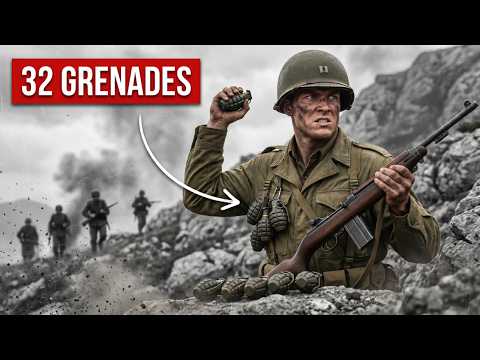
Britt personally killed five German soldiers that morning, confirmed kills. He wiped out an entire German machine gun crew by himself—the gunner, the loader, all of them. He wounded an unknown number of others. He threw 32 fragmentation grenades. Thirty-two. Each one pulled, armed, and thrown at a target while under direct fire from roughly 100 enemy soldiers who were trying to kill him. Not 32 grenades thrown from behind cover at a safe distance. 32 grenades thrown while standing in the open, bleeding from multiple wounds, with bullets cracking past his head and shrapnel slicing the air around him.
His regimental commander, Lieutenant Colonel Lionel C. McGarr, later told a reporter from the Detroit Free Press what he witnessed. Britt fired his rifle at them. He threw grenades, and at the finish McGarr believed he was even throwing rocks. The headline read, “Nazis thrown for loss. Footsie Britt, ex-Lion, kills 11 Germans in Italy.”
The counterattack broke. The Germans could not push through. They fell back down the slope, dragging their wounded where they could, leaving their dead where they fell. Britt’s 55 men, led by a bleeding football player with an empty carbine and no grenades left, had held Monte Rotondo against 100 German soldiers from one of the best divisions in the German army. The position was secure. Four German soldiers were captured, two of them wounded. Several American soldiers who had been taken prisoner during the initial chaos of the attack were freed because of Britt’s actions. Men who would have died as prisoners of war walked back to friendly lines because one officer refused to stop fighting.
The significance of holding Monte Rotondo cannot be overstated. If the Germans had retaken the mountain, they would have regained observation over Highway 6. Every American vehicle, every supply truck, every ambulance moving through the Mignano Gap would have been exposed to directed artillery fire from the heights. The Third Battalion would have been isolated on the surrounding high ground. The American timetable for breaking through the Bernhardt Line would have been set back by weeks. Britt’s stand on that mountain was not just an act of individual courage. It was a tactical victory that kept the entire divisional offensive on schedule.
When the firing stopped, soldiers looked at their company commander. He was covered in blood. His uniform was torn in a dozen places. His canteen had a bullet hole through it. His shirt was soaked red. A soldier asked if he wanted to go to the field hospital. Britt’s answer was no. He said he had to stay on the hill and help his boys. He refused medical attention until his battalion commander directly ordered him to report to a battalion aid station. Only then did he leave the position. And even then, he walked out under his own power.
Eyewitnesses described what they saw in statements collected for the Medal of Honor recommendation. One soldier reported seeing Britt run from side to side of a machine gun position, firing at every sight of Germans, completely exposed. He saw Britt run out of ammunition and start picking up hand grenades, disregarding enemy gunfire all around him. Another witness said he saw Britt throw 10 to 12 grenades with German fire coming back the whole time. They thought they were going to be overrun. They thought it was finished. But always, the witness said, he saw Lieutenant Britt out in front of everyone else. He called him a one-man army.
For his actions on November 10, 1943, First Lieutenant Maurice Britt received the Medal of Honor, the highest military decoration in the United States. The award was published in War Department General Orders No. 23, dated March 24, 1944. He also received the British Military Cross, the Italian Medal of Military Valor, a battlefield promotion to captain, and his second Purple Heart. All for a single morning on a single mountain in Italy. All earned by a man who three years earlier had been catching passes for $150 a game.
But the war was not finished with Footsie Britt. Not yet. Not by a long way.
On January 22, 1944, Britt led Company L ashore at Anzio—his fourth amphibious assault in fourteen months. The next morning, he stood up in plain view of German machine guns and did jumping jacks, deliberately drawing fire to expose their positions. His men called the intersection “Britt’s Junction.” Then, on February 12, a German tank shell tore through a farmhouse wall and took his right arm below the elbow.
He came home with the Medal of Honor, the Distinguished Service Cross, the Silver Star, and the Bronze Star—the first American soldier of World War II to earn all four. He built businesses, raised three children, and served two terms as lieutenant governor of Arkansas. At the 1948 dedication of War Memorial Stadium, he told the crowd that “wars can be prevented just as easily as they are provoked.”
Maurice “Footsie” Britt died in 1995, at seventy-six. A marker still stands on Monte Rotondo where he threw thirty-two grenades and refused to leave his men.
So here’s the question: if a one-armed former football player could come home and build a life that big, what’s stopping the rest of us?
Report this article
Select a reason for reporting:






