The year 1945 began with the German Army in full retreat, Soviet victories mounting with each passing day as the Red Army pushed the invaders back toward the heart of the Third Reich. By the end of March, the Vistula Army Group—the last major German force on the Eastern Front—was a shadow of its former self, filled with inexperienced training units, some soldiers so young their rations included sweets instead of tobacco. They were ordered to hold their positions at all costs, terrified of retreating, which almost certainly meant immediate execution. Many chose to bury themselves in foxholes or bunkers, hoping the Soviet attackers would give them a chance to surrender rather than burn them alive with flamethrowers or tear them apart with grenades.
But Stalin’s orders were clear: no mercy for the fascists who had betrayed the Soviet Union and subjected Stalingrad and Leningrad to merciless sieges. Facing these young, inexperienced Germans were the troops of Marshal Georgy Zhukov, the mastermind behind the epic Soviet victory at Kursk. By early 1945, Zhukov commanded an unstoppable army that would not stop until it reached Berlin.
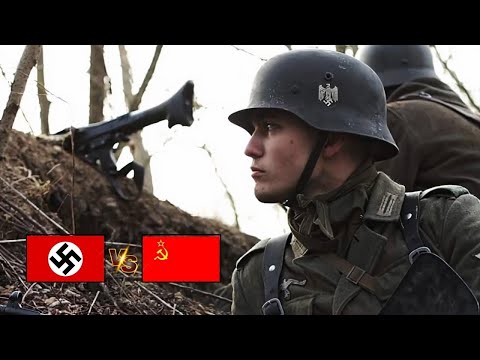
By early April, the atmosphere among the Vistula Army Group was a mixture of terror, foreboding, and despair as the Russians prepared to advance on the Oder River. Along the fronts of the Oder and Neisse, troops awaited the largest concentration of firepower ever gathered by the Red Army. The First Belorussian Front under Zhukov and the First Ukrainian Front under General Konev were preparing to attack the German forces defending positions east of Berlin. For the assault, the Red Army assembled approximately 2.5 million men, supported by 41,600 pieces of artillery and heavy mortars, as well as 6,250 tanks and self-propelled guns.
On April 9, 1945, Königsberg in East Prussia fell into Soviet hands, allowing the Second Belorussian Front under Marshal Konstantin Rokossovsky to move to the eastern bank of the Oder. During the first two weeks of April, the Soviets carried out the fastest troop redeployment of the entire war. They were ready for the final assault.
Both sides were fighting with all their might. The Germans because it was their last chance to keep the Reich alive; the Russians because they were so close to reaching their goal of getting to Berlin before the Americans and the British. The memory of Stalingrad and Leningrad was still fresh, and they harbored a special hatred for all Nazi soldiers. It soon became clear to every German that surrendering or falling into captivity was not an option—both meant certain death.
But while the Soviets had Zhukov, the Vistula Army Group was led by an experienced veteran of World War I, General Gotthard Heinrici. Heinrici had received military training since 1905 when he was 19 years old. Decorated during World War I, he later rose to Colonel and in 1938 to Major General. It was not the first time Heinrici faced Zhukov—they had already measured forces during the Battle of Kursk in 1943. During the German retreat, Heinrici became famous for refusing to follow Hitler’s orders to scorch everything in his path, including fields and civilian homes. This insubordination was punished with forced leave ordered by Hermann Göring. However, in 1944, after only eight months out of service, Heinrici was called back to fight for the Third Reich. This time, failure was not an option.
Given the proximity of defeat, the Germans had good reason to fear that their soldiers would desert or surrender at the first opportunity. The Vistula Army Group issued orders signed by Heinrici stating that men from the same region should be separated, as it was believed that soldiers were more likely to betray strangers who tried to desert. Several German commanders of the Fourth Panzer Army facing the First Ukrainian Front under Konev confiscated white handkerchiefs to prevent their men from using them as a signal of surrender. In some cases, soldiers caught attempting to desert were forced to dig trenches in no man’s land. Many longed to slip away into the dense forests to surrender out of sight, hoping to avoid having their families punished according to Hitler’s orders.
The German company commanders tried almost every means to persuade their soldiers to resist, but most of the young recruits—poorly trained and freshly sent to the front—were not easy to convince. They just wanted to survive, and with every inch the Soviets advanced, the prospects of doing so diminished.
On the Seelow Heights, aside from some machine-gun attacks, there was an apparent calm just before the storm. German soldiers returning from the front line inspected and cleaned their weapons, ate, and took care of themselves. Some sat down to write home, just in case the campaign mail service resumed. For many, their homes were already occupied by the enemy, and others had no idea where their families were.
To make matters worse for the Germans, the Soviets were in a hurry. The race for Berlin had begun, and they didn’t want to miss the opportunity to be the glorious nation that would finally defeat the Nazis. The plan was to launch the offensive on April 16 and take Berlin by April 22—Lenin’s birthday. The operation was not a bad plan. The problem was that the main bridgehead captured by the First Belorussian Front was right below the best defensive position in the entire region: the Seelow Heights. Later, Zhukov would admit that he had underestimated the strength of this position.
The tasks facing the general staffs of the two main fronts involved in the operation were enormous. Russian gauge railroads had been quickly laid across Poland, and temporary bridges had been built over the Vistula River to transport the millions of tons of supplies needed, including artillery shells, rockets, ammunition, fuel, and food. These supplies, combined with the millions of soldiers on the battlefield, meant that the Germans were about to face the perfect storm.
The battle of the Seelow Heights—the final charge to Berlin—was about to begin.
The Red Army tried to conceal the enormous attack about to unfold on the Oder and Neisse fronts, but this was nearly impossible due to the scale of the forces mobilized. Soviet troops numbered 2.5 million men, supported by 41,600 pieces of artillery and heavy mortars, as well as 6,250 tanks and self-propelled guns, in addition to four air armies. It was the largest concentration of firepower ever assembled.
Meanwhile, the main Soviet generals held meetings to meticulously prepare for the attack. It was decided that the First Belorussian Front under Zhukov and the First Ukrainian Front under Ivan Konev would attack on April 16. To the north, the Second Belorussian Front under Konstantin Rokossovsky would cross the lower Oder on April 14.
A combat reconnaissance was launched from the Küstrin bridgehead to test the strength of the German forces. It was a great success for the Red Army: Vasily Chuikov’s Eighth Guards Army managed to push back the 20th Panzer Grenadier Division of Major General Georg Scholze by 2 to 5 kilometers in some sectors. Reports from the Funker claim that on that day Hitler was so furious that he ordered all members of the division to be stripped of their decorations until they earned them back in combat.
This expansion of the bridgehead also facilitated the buildup of forces. That night, the First Guards Tank Army began moving its brigades across the Oder River under the cover of darkness. Throughout the night, there was a constant flow of tanks, artillery pieces, trucks loaded with ammunition, and columns of soldiers. Soviet loudspeakers blasted music at high volume and propaganda exhortations in an attempt to cover the sound of tank engines. But the Germans knew what was happening, and they were terrified.
Throughout April 15, Red Army soldiers carefully observed the German positions to ensure that no last-minute reinforcements arrived and no strategic changes took place. Large chunks of ice continued to float down the Oder River along with branches and debris caught in the remains of a destroyed railway bridge. In the pine forests on the eastern bank, cut branches camouflaged thousands of armored vehicles and artillery pieces.
Although the Soviet commanders had no doubt that they would break through, they were extremely nervous about the possibility of the American and British armies reaching Berlin first. Such a scenario would not only be a humiliation but something even worse: Berlin belonged to the Soviet Union, both by the right of conquest and by the right of suffering. Each army commander had been warned that Stalin, their Supreme Commander, was eagerly waiting in the Kremlin for good news from the front. Only Zhukov, Konev, and a few of their closest collaborators knew that the entire strategy for the operation on Berlin was designed to encircle the city first and thus deter the Americans and British from entering it.
An officer of the Grossdeutschland Guards Regiment, tasked with leading an improvised battalion, was able to observe that many of his young subordinates showed little willingness to fight in the name of National Socialism. Some even longed to be injured in order to be evacuated to a field hospital. The fear of immediate execution for disobedience kept them in their positions, subjected to mechanical discipline and without any real conviction.
The discouragement within the German lines became evident when a Soviet loudspeaker began broadcasting messages from the positions of the Red Army. To the dismay of their superiors, numerous soldiers responded by shouting questions to the Soviets, showing an unusual interest in the living conditions behind enemy lines. The main concerns of the German fighters centered around their fate in the event of surrender: they wanted to know if they would be sent to Siberia and what treatment the civilians were receiving in the areas of Germany occupied by Soviet troops. These doubts reflected the growing skepticism about the cause they were supposedly defending and the desperation of a conflict that for many of them was already lost.
The German officers in charge of the companies employed multiple strategies to convince their men to continue fighting. Some resorted to propaganda, informing them of the death of Franklin D. Roosevelt on the night of April 14, assuring them that this meant the end of the American armored attacks. Additionally, they tried to persuade them with the idea that relations between the Western Allies and the Soviet Union were so deteriorated that the British and Americans would soon ally with Germany to stop the advance of the Red Army.
The reservists of the 39th Security Division, positioned near Cottbus, were surprised when members of the 30th January SS Division approached them with speeches linking Roosevelt’s death to a supposed miracle that they claimed had saved Frederick the Great. They attempted to present this event as a divine sign, but their words failed to inspire the soldiers or alter their hopelessness.
Despite the collapse of morale in many units, some German fighters still clung to the idea of a major counteroffensive on April 20, Hitler’s birthday. Rumors circulated about the imminent use of miracle weapons that would change the course of the war—a hope that, although unfounded, sustained the resistance of the last loyalists to the regime.
Some officers, consumed by anger and resentment, resorted to extreme tactics to inflame the fighting spirit of the veterans, reminding them of the horrors they had experienced on the Eastern Front and the terrible consequences the arrival of the Red Army in Berlin would have. In a letter to his wife, a senior lieutenant expressed the deep hatred that had taken root among the troops: “You can’t imagine the level of fury that hangs in the air here. I swear we will settle the score. Those heartless ones who have violated women and children are going to face something they’ve never experienced. The brutality of those beasts is unbelievable. We have made a solemn vow: each one of us will kill at least ten Bolsheviks. May God give us the strength to carry it out.”
The fear of the Soviet advance was used by commanders as a tool to stoke the soldiers’ desire for revenge, many of whom were already on the brink of despair. The brutal propaganda and the desperate need to hold on to something that justified the fight made hatred the last resort to maintain morale in a war that was practically lost.
From his forward position at the Reitwein outpost, General Vasily Chuikov, commander of the Eighth Guards Army, had a privileged view of the Oder Brook and the Seelow escarpment. However, he did not like the presence of Marshal Georgy Zhukov, who had decided to join him to witness the initial bombardment and the first assault. Irritated, Chuikov sent his staff officer, Captain Mar Reko, to guide the Marshal and his entourage to the position. The relationship between the two commanders was marked by rivalry: Chuikov believed that his army had not received the recognition it deserved for its role in Stalingrad, while Zhukov took all the glory. Additionally, recent comments by Zhukov about the delay in taking Poznań had irritated Chuikov, who had in turn criticized the slow offensive toward Berlin in February. The tension became evident when Zhukov’s convoy arrived with headlights on, exposing their position from a great distance.
Meanwhile, in the trenches of the Oder Brook, Soviet soldiers were preparing for the imminent offensive. Hot soup and vodka were served while the campaign phones rang incessantly and messengers ran back and forth. In Chuikov’s bunker, Zhukov’s entourage tried to kill time by drinking tea served by a soldier named Margo. The wait seemed endless.
General Kazakov had deployed 8,983 pieces of artillery with a density of 270 guns per kilometer, in addition to heavy howitzers and the feared Katyusha rocket launchers, with a reserve of 7 million shells. The First Belorussian Front began the bombardment with more than 1.2 million shots on the first day. The overwhelming firepower led Zhukov to underestimate the difficulty of the offensive, not foreseeing the resistance that the Germans would still offer in their last bastion before Berlin.
Zhukov usually personally inspected the front line before launching a major offensive, as he preferred to assess the terrain firsthand. However, on this occasion, he primarily relied on the images captured by reconnaissance teams, largely influenced by the urgency of the situation.
Under the cover of night on April 15, most of the advanced German units had been withdrawn to a second defensive line just before the expected Russian bombardment. In this defensive line, the troops had entrenched themselves deeply. Dozens of MG42 machine-gun nests were buried in the newly built fortifications to slow the attacking infantry. The MG42 was considered by German soldiers as a formidable weapon and likely the best machine gun of World War II. As long as the gunners could keep their machine guns functioning, they were perfectly capable of holding off an attacking force many times their size. Additionally, just a few well-placed, well-hidden, and well-supplied MG42s were enough to delay an entire enemy regiment for hours across a front of five or six miles.
Along with the various MG42 machine-gun positions, there was a varied arsenal of anti-tank guns such as the 5 cm Pak 38, 7.5 cm Pak 40, 8.8 cm Pak 43, and the deadly 8.8 cm Flak anti-aircraft guns used both against ground and air targets. These weapons formed the backbone of the defense against the overwhelming number of Soviet armored vehicles and would play a crucial role in the final weeks of the war despite the progressively dwindling ammunition supplies.
In this second line, the soldiers waited for the Russians to arrive. Across the entire front, scattered between the Third and Ninth Armies, they had fewer than 700 tanks and self-propelled guns. The heaviest division, the 25th Panzer, had only 79 such vehicles; the smallest unit had just two. The artillery was not in better shape, with only 744 pieces available. Ammunition and fuel supplies were in critical condition, and in some units the reserves had almost completely disappeared.
Facing the main Soviet attack was the 56th Panzer Corps under the command of General Karl Weidling, known among his close associates as “Smasher Carl.” Weidling had been given the nearly impossible task of preventing the main front from being broken in the area.
The final battle before Berlin began at dawn on April 16, 1945, just 50 kilometers east of the German capital. Over the swollen Oder River, red flares erupted in the night sky, signaling the start of a massive artillery bombardment. For almost an hour, a storm of fire and smoke shook the German front. The thunder of thousands of guns, mortars, and the feared Katyusha rocket launchers turned the night into a hell of fire and explosions. According to witnesses, never before in the war had such a bombardment been witnessed.
The artillery units under General Kazakov’s command operated tirelessly, maintaining an unrelenting pace in the attack. The entire area was illuminated by the glow of thousands and thousands of shots. A Soviet officer would recall amid the battle’s chaos: “A deafening roar made everything around us shake. It’s often assumed that artillerymen are used to these sounds, but even I wished I had earplugs. I felt like my eardrums were about to burst.” The noise was so overwhelming that the soldiers had to remember to keep their mouths open to prevent the pressure from bursting their eardrums.
At the explosion of the first artillery barrage, some German recruits woke up startled in their trenches, convinced that it was another “morning concert”—the term they used to refer to Soviet harassment fire at dawn. However, the veterans of the Eastern Front, with their developed instinct and intuition gained from years of combat, immediately understood that this was the beginning of the great offensive. The non-commissioned officers began shouting desperate orders for the men to deploy immediately to their positions: “Alarm! To the positions! Immediately!”
The survivors would always remember the anguish that pressed on their chest and the dryness in their mouths. They murmured to themselves: “This time we’re finished.”
The few soldiers who remained trapped in the trenches hit by the artillery and managed to survive described the bombardment with words like “hell” or “earthquake.” Many were left completely deaf due to the brutality of the explosions. “In a matter of seconds, my ten comrades died,” recalled Gerhard Wagner from the 27th Parachute Regiment. When he regained consciousness, he was wounded in the smoldering crater of a shell; he could barely crawl to the second line. Most were not so lucky. The trenches were crushed, burying both the living and the dead alike. Even decades later, the remains of the fallen continued to emerge from the earth, disturbed by the passage of time.
Those in the rear felt the ground tremble beneath their feet and hurried to take their binoculars or use the periscopes in the trenches. From inside his Tiger tank, the commander of the 50th Heavy Panzer Battalion scanned the horizon through the periscope and was horrified. “The entire sky to the east was burning,” he described. Another witness spoke of farms and villages consumed by fire, clouds of smoke spreading as far as the eye could see. At the headquarters, a military chaplain, paralyzed by terror at the apocalyptic scene, found no more appropriate words than a scream of despair: “My God, those bastards are here!”
In the midst of the mud, smoke, and gloom, the Soviet assault began. Thousands of Zhukov’s soldiers were thrown to the front, stumbling as they advanced under fire. The artillery continued its destructive work, punishing the enemy positions just ahead of them and clearing the way for the attack. However, when the Red Army broke through toward the Seelow Heights at dawn on April 16, the Germans were already prepared. From the top of the ridge, batteries of Flak guns, hurriedly moved from the Western Front, unleashed a hail of fire on the Soviet troops. For hours, the shells and intense artillery fire swept through the waves of attackers, slowing their advance and sowing chaos among their ranks.
As the battle intensified, the German resistance proved to be much stronger than anticipated. By stopping the first Soviet attack, Heinrici’s forces achieved something that few generals could have accomplished under the same conditions. They had far fewer men and supplies than the Russians. The Red Army knew this and, instead of resorting to sophisticated war strategies, opted to use brute force.
Even so, the Russians needed to cross the Oder River to reach the Seelow Heights. This was not easy, as only the Küstrin bridge remained standing. While most of the Red Army troops had to cross by boat, the First Polish Army had to cross the Oder under enemy fire. Their vanguard battalions used amphibious vehicles—American boats operated by young female soldiers—but most of the troops crossed in regular boats. The casualties during the crossing were high; many assault boats had leaks and some sank, causing heavy losses. The German resistance was also fierce: when a battalion from the 12th Guards Rifle Division tried to cross, only eight men managed to reach the western bank of the Oder.
Once on the other side, the Red Army reorganized and waited. When the colored flares lit up the cloudy sky, the Soviet riflemen rose from the ground to advance. Zhukov, a general known for his brutality, sent the infantry through minefields that had to be cleared before his tank armies could advance. For him, it was preferable to lose a few riflemen than a single tank.
The young German recruits and soldiers in training were paralyzed by panic due to the bombing and the searchlights. Only the veteran soldiers were preparing to open fire, but the problem was identifying a target in the thick river fog mixed with smoke and dust suspended by the explosions of the shells. The defenders could hear the Russians calling to each other as they advanced, but it was impossible to see them. They also heard in the distance the roar of Soviet tank engines struggling to move forward; even the wide tracks of the T-34 had difficulty moving through the mud of the flooded plain. The terrain was so shattered by the massive bombing that the Soviet anti-tank guns and division artillery had a hard time keeping up with the infantry. This was especially true for the Katyusha rocket launchers mounted on trucks. However, the guards mortar regiments who operated the Katyushas watched with satisfaction as the first German prisoners were sent to the rear.
Enormous vehicle traffic jams formed in the mud, waiting for Chuikov’s Eighth Guards Army to achieve a breakthrough on the front. But the advance that morning had been extremely slow. Zhukov, from his observation post, was beginning to lose patience, throwing insults and threatening to demote the commanders. He had a violent argument with General Chuikov in front of the staff officers, as the Eighth Guards Army was stuck at the Oder Bridge just below the escarpment.
By noon, a more desperate Zhukov—undoubtedly fearing his next radio conversation with Stalin—decided to change his operational plan. The tank armies were not to advance until the infantry had broken the German defensive line and reached the Seelow Heights, but he could not wait any longer. Chuikov was horrified at the chaos this would generate, but Zhukov remained firm. At 3:00 p.m., he called Moscow to speak with Stalin. Stalin listened to his report and reprimanded him for underestimating the enemy but still accepted his change of plans. However, everything depended on the results; if he failed, a grim future might await him in the motherland.
In the afternoon, Katukov was ordered to attack with the First Guards Tank Army toward Seelow, while Bogdanov’s Second Guards Tank Army was ordered to advance toward the Neuhardenberg sector. However, this premature tank movement meant that the close support artillery—which the rifle divisions had been demanding to neutralize the German fortifications—could not advance due to the condition of the terrain. As Chuikov had predicted, chaos ensued, with thousands of armored vehicles piled up at the bridgehead. Coordinating the different formations and units became a nightmare for the traffic officers.
On the Soviet right flank, Bogdanov’s tanks suffered heavy losses due to the 88 mm guns entrenched in Neuhardenberg as well as fierce counterattacks by small groups armed with Panzerfausts. The vanguard brigades of Katukov on the left flank were in for one of the worst surprises as they advanced along a road southeast of Seelow: a devastating armored battle began when they encountered the fearsome Tigers of SS Panzer Battalion 502, which held the defensive line. The Soviet tank brigades became trapped in deep trenches and suffered heavy casualties.
Finally, the vanguard brigades of the tank armies managed to reach the base of the Seelow Heights and began the ascent. The engines roared with effort; in many places the slope was so steep that the tank commanders had to find alternative routes. This frequently led them to accidentally run into German strong points, where they became easy targets for the powerful Panzerfausts and 88 mm gunfire.
The intensity of the bombardment was so enormous that in the eastern suburbs of Berlin, 60 kilometers from the battlefield, the effect was similar to a small earthquake. The houses trembled, pictures fell from the walls, and the telephone bells rang by themselves. The Russians were arriving.
The battle of the Seelow Heights was undoubtedly not one of Marshal Georgy Zhukov’s brightest moments. Although the strategy and execution of the offensive left much to be desired, the courage, resilience, and sacrifice of the soldiers and officers of the Red Army were unquestionable. However, this true heroism—far from the idealized version that Soviet propaganda would later adopt—failed to soften the indifference of the high command and political leadership. Evidence of this was the coldness with which commanders referred to casualties in their communications; phrases like “how many matches have been used” or “how many pencils have been sharpened” were used to disguise the number of soldiers who had fallen in battle.
On the German side, General Gotthard Heinrici, commander of the Vistula Army Group, and General Theodor Busse did everything they could to face the Soviet offensive under adverse conditions. The survivors of the battle still remember them with gratitude for ordering the withdrawal of most of the troops from the most exposed positions just before the devastating initial bombardment, thus saving thousands of lives.
However, within the German Army there were still officers who maintained their loyalty to Adolf Hitler. On the night of April 16, Colonel Hans-Oscar Wöhlermann, in charge of the artillery of the V Panzer Corps, visited his superior General Helmuth Weidling in Wulkow, northwest of Müncheberg. Their headquarters was set up in a country house barely lit by the dim light of a candle. Weidling, who had lost all confidence in Hitler’s direction of the war, openly expressed his dissatisfaction. Wöhlermann, observing him through his monocle, was shocked by his words. “I felt a deep desolation,” he would later write, “realizing that even a soldier as bold and stubborn as him—our old hard bone of Pomerania—had lost faith in our supreme leader.”
Their conversation was abruptly interrupted by intense shelling. Soon after, alarming reports arrived: a gap had opened between their positions and the 11th SS Panzer Corps, which was defending their right flank. At the same time, another breach was reported on the left wing, threatening the connection with the 10th Corps of General Berlin. The much-touted wall that Joseph Goebbels had spoken of, intended to halt the Red Army’s advance, was beginning to crumble rapidly, marking the beginning of the end of the German resistance on the Eastern Front.
That night must have been one of the most difficult in Georgy Zhukov’s career. Not only was the entire Red Army watching expectantly at the Seelow Heights, but the most crucial thing was that the Kremlin was also watching. Despite the overwhelming numerical and firepower superiority, the offensive had not managed to completely break the German defenses, delaying the most important strategic objective: the capture of Berlin on the sixth day of the operation. Although a rifle regiment from Vasily Chuikov had managed to reach the suburbs of Seelow and some armored units from Mikhail Katukov were approaching the summit, in certain sectors the advance was not as expected. For Joseph Stalin, these partial successes were not enough.
Apparently calm during the conversation he had held with Zhukov earlier that afternoon, his reaction changed drastically when the Marshal contacted him by radio shortly before midnight to inform him that the heights had still not been secured. Stalin’s fury was immediate. Not only did he consider the situation unacceptable, but he also directly blamed Zhukov for deviating from the original plan set by the Stavka. With a sharp voice, he posed a question that rather than a mere inquiry was a demand: “Are you completely sure that tomorrow you will be able to take the Seelow line? Tomorrow—April 17—before the end of the day?”
Zhukov responded, struggling to maintain his composure: “We will have broken the defense of the Seelow Heights. The more troops the enemy concentrates there, the easier it will be for us to advance on Berlin. It’s always easier to annihilate an army in the open field than in a fortified city.”
Stalin didn’t seem convinced. His concern wasn’t only with the German forces east of the capital but also with the possibility that the Americans would advance from the southwest and reach Berlin before the Soviets. “We are considering ordering Konev to deploy Rybalko and Lelyushenko’s armored armies towards Berlin from the south, while Rokossovsky must accelerate his advance to attack from the north without delay.” With a curt “Do svidaniya,” Stalin hung up.
Soon after, General Malinin, Zhukov’s chief of staff, realized that Stalin had already given the order to Ivan Konev to send his armored forces toward Berlin’s southern flank. The race to see who would reach the German capital first was on.
After the two tense telephone conversations with Stalin on the night of April 16, the rivalry between Zhukov and Konev intensified even more. Stalin had stoked the competition between the two, and neither was willing to give up ground. Zhukov, despite the setback at the Seelow Heights, remained convinced that the conquest of Berlin was his rightful prize.
On April 17, the gray sky and drizzle gave way to more favorable conditions, allowing the Ilyushin Il-2 Sturmovik bombers to attack the remaining German positions in Seelow with greater precision. Throughout the Oder Brook and up to the escarpment, villages, towns, and farms burned uncontrollably. Soviet artillery and aviation bombarded any structure that could house an enemy command post. In the fields and villages, the air was filled with an unbearable stench—a mix of human flesh and charred livestock. In many farms, animals trapped in the fires died of suffocation or were incinerated with no chance of escape.
Behind the German lines, the field hospitals were overwhelmed. Doctors struggled to attend to the growing number of wounded. In those moments, an abdominal injury was practically a death sentence, as any prolonged surgical intervention was impossible. The priority was to treat those who could still hold a weapon and return to the front. To achieve this, special officers were assigned to medical centers with a clear mission: identify the injured capable of continuing to fight and send them armed back to the trenches.
The Feldgendarmerie set up improvised checkpoints to capture stragglers—both soldiers fit to keep fighting and those with minor injuries who could still be sent to the front. Once a considerable group was gathered, they were formed into makeshift units and sent back to the front lines. Known as “leash dogs,” they were also nicknamed “Heldenklau” (hero snatchers) by the soldiers themselves, since although they did not fight, they made sure to catch anyone trying to retreat. Their relentless rigor sometimes led them to arrest soldiers who were actually trying to rejoin their battalions. As a result, these soldiers were often placed in companies made up of other stragglers and Hitler Youth adolescents—some as young as 15 or 16—lacking proper equipment. Smaller helmets were designed for them, though they were insufficient for everyone. The youngest, with pale and tense faces, were barely visible under the oversized helmets that fell over their ears.
On one occasion, a sapper platoon from the Third Shock Army was clearing a minefield when a group of German soldiers emerged from a trench with the intention of surrendering. Just at that moment, a young man appeared from a nearby bunker wearing a long trench coat and a cap. He fired a burst with his submachine gun, but when he saw that no one fell, he dropped the weapon and started crying, shouting desperately: “Hitler kaput! Stalin gut!” Captain Sanych Villy recalled: “I couldn’t help but laugh, and I gave him a single punch in the face. Poor kids—I felt so sorry for them.”
The most fanatical members of the Hitler Youth were often those who had lost their homes and families to the Red Army in the East. For them, the only honorable way out seemed to be to die in battle, taking as many Bolsheviks as possible with them, driven by hatred and a desire for revenge.
Despite the relentless pressure from the Red Army, the combat capability of the German Army had not completely collapsed—something that Zhukov and his troops discovered at a high cost. On April 17, after an intense artillery bombardment and air attacks, Katukov’s and Bogdanov’s armored armies launched a new offensive, hoping to finally break through the enemy lines. However, the advance did not produce the results that the Marshal had assured Stalin. The German defenders, entrenched in strategic positions, offered fierce resistance. The 88 mm anti-aircraft batteries, used with great effectiveness against Soviet tanks, along with infantry equipped with anti-tank grenade launchers, managed to inflict heavy losses on the attacking forces. Many Soviet tanks were immobilized before reaching their objectives, proving that the battle for the Seelow Heights was still far from resolved.
In the government district of Berlin, uncertainty ruled. On April 17, no one had a concrete plan beyond issuing proclamations filled with patriotic fervor and launching new threats of execution. Among the orders issued that day, Heinrich Himmler sent a communiqué to all military commanders emphasizing that no German city could surrender without a fight: “Every village and every city, regardless of its size, must be defended with all available resources. Any German who fails to fulfill this sacred duty will lose their honor and their life.” However, the reality on the front lines was far from the regime’s rhetoric. Artillery barely had ammunition, many tanks were abandoned due to a lack of fuel, and soldiers fought with hunger and exhaustion. While Berlin issued orders for total resistance, the actual ability to sustain the defense was rapidly crumbling.
Even in the face of imminent destruction, the bureaucratic machinery of the Nazi regime remained unchanged, showing no sign of adapting to the reality of collapse. A clear example occurred in the small town of Woltersdorf, south of Reichsstraße 1—one of the main routes to Berlin. That very day, the town was overwhelmed by a wave of desperate refugees fleeing the Soviet advance. Despite the critical situation, local authorities continued to enforce strict evacuation restrictions. Only those considered unemployed or unfit to serve in the Volkssturm could leave the area, and only if they had an official document confirming they had a place to stay in another city. Furthermore, every request had to be approved by the Ortsgruppenleiter, the head of the Nazi district, making escape even more difficult.
However, the attitude of the population was far from the fanaticism the regime had expected. Local resistance was weak and demotivated. In fact, the Volkssturm emergency squad—composed of inexperienced and poorly armed recruits—even requested to be relieved of their duties, exposing the lack of will to continue fighting in a war already lost.
The forces of Konev advanced rapidly and were already less than 80 kilometers southwest of the OKH and OKW headquarters in Zossen. However, neither the Fourth Panzer Army nor Army Group Center under the command of Field Marshal Schörner had reported the magnitude of the crossing of the Spree River by the Soviet Third and Fourth Guards Tank Armies, nor the lack of available reserves to contain them. Meanwhile, the German High Command remained focused on the battle for the Seelow Heights.
Under Soviet pressure, General Heinrici ordered the deployment of his army group’s last reserves. The III SS Panzer Corps (Germanic) was sent in support of Busse’s Ninth Army, which was fighting under critical conditions. The 11th SS Nordland Division—composed of Scandinavian volunteers and commanded by Brigadeführer Joachim Ziegler—received orders on April 17 to move south of Seelow with its 50 armored vehicles and the Danmark and Norge regiments. This unit, evacuated from Courland after suffering 15,000 casualties that year, was preparing for a new battle on the Oder. Simultaneously, Heinrici sent the SS Netherlands Division further south, assigned to the V SS Mountain Corps, with orders to move toward Frankfurt an der Oder and Müllrose.
Tensions between the SS and the Wehrmacht were evident. Himmler was furious that Heinrici had redistributed his divisions without consultation, weakening Steiner’s corps. Furthermore, the Nordland Division, reluctant to come under regular army command, delayed its integration into the new formation, reflecting the growing chaos within German forces in the war’s final days.
On April 18, dawn brought a sky tinged red over the Seelow Heights—a harbinger of a day of intense fighting. The roar of tank engines and the clatter of tracks advancing over the terrain soon filled the air. The Soviet air offensive quickly intensified, with waves of Sturmoviks diving to attack the SS Nordland Division’s column before it could reach the front. The Panzer Grenadiers, traveling in open trucks, were exposed to the bombardment, enduring a rain of earth and shrapnel. Meanwhile, Brigadeführer Ziegler hurried to inform General Weidling that his division was delayed because their vehicles had run out of fuel. Weidling, desperate to reinforce his defense, received the news with fury, fully aware that the situation at Seelow was deteriorating with every passing minute.
On April 19, 1945, the German Ninth Army began to collapse in different directions, just as General Theodor Busse had feared. With the capture of Reichenberg by the Red Army and the Soviet advance toward Neuhardenberg, German forces were forced to retreat. The CI Corps moved toward Eberswalde, Helmuth Weidling’s V Panzer Corps withdrew toward Berlin, and the XI SS Panzer Corps moved toward Fürstenwalde, with the Kurmark Division barely retaining a dozen Panther tanks.
That same day, the First Guards Tank Army and the Eighth Guards Army advanced from Seelow along Reichsstraße 1 toward Müncheberg. The remnants of the 9th Parachute Division, reorganized just a day earlier, once again fled in panic, shouting: “The Russians are coming!” The SS Nordland Division, which had finally reached the front, managed to regroup some of these paratroopers and led an initially successful counterattack. However, the retreat quickly turned into chaos, with German troops and civilian refugees mixed into a disorganized column. While officers tried to maintain order with shouts and threats, along the road the Feldgendarmerie and SS units executed suspected deserters without any formal record, hanging some of the condemned from trees.
The Hitler Youth was no exception to this brutal repression. It is estimated that between 10,000 and 25,000 German soldiers were executed for cowardice in 1945. Ironically, while the SS punished deserters, many of its own units received orders to withdraw toward Schleswig-Holstein near the Danish border, far from the Soviet front. However, they were unaware that on that same day, the British Second Army had reached the Elbe River, further sealing the fate of the Third Reich.
On April 19, 1945, the day dawned with clear skies, allowing the Soviet Air Force to operate with precision over the battlefield. Every time the Sturmoviks attacked, soldiers and civilians threw themselves into ditches to avoid being hit. In nearby villages, terrified women and girls begged German soldiers to take them along. Meanwhile, the situation at the front was rapidly deteriorating. What remained of the X Corps battalions was retreating in disarray toward Bernau, north of Berlin, after losing more than three-quarters of their troops. The soldiers, exhausted and starving, could barely stand, and many fell into deep sleep whenever they rested, only to be kicked awake by their officers. Communication was non-existent, with radios and field telephones abandoned, and defensive lines were practically unrecognizable despite officers’ desperate attempts to reorganize the stragglers.
With the collapse at the Oder, General Heinrici focused his attention on the last defensive line between the Baltic and the Hohenzollern Canal. Meanwhile, von Mannteufel, flying over the area in a reconnaissance plane, could clearly see the Soviet preparations. That same night, Marshal Rokossovsky informed Stalin that his offensive would begin at dawn on April 20, preceded by an intense bombardment. Although Stalin had initially downplayed the importance of Rokossovsky’s Second Belorussian Front, the urgency to ensure Berlin’s fall led him to change his stance, pressing for his troops—newly arrived from Danzig and the Vistula—to accelerate their deployment and tighten the encirclement of the Reich capital.
By April 20, Rokossovsky’s guns thundered across the lower Oder, and the encirclement of Berlin tightened like a noose. Heinrici’s last reserves bled white; Weidling’s corps fell back into the city’s burning streets. “The Führer’s orders are clear—hold at all costs,” Busse was told, sealing the Ninth Army’s doom.
On April 25, Soviet troops met at Torgau on the Elbe, splitting Hitler’s Reich in two. Berlin was fully surrounded. In the Führerbunker, Hitler raged about Steiner’s phantom counterattack, but Steiner had nothing left—fewer than 5,000 men, mostly Hitler Youth, armed with little more than rifles.
By May 2, Berlin surrendered. The Swastika fell from the Reichstag. The war in Europe would end within days. The Seelow Heights had been the last shield—and it had shattered. But at what cost? A million casualties in April alone. The deadliest conflict in history had claimed its final, terrible harvest.
Was the brutal cost of taking Berlin—and the race between Zhukov and Konev—justified by the defeat of Nazism? Or did ambition and rivalry needlessly multiply the slaughter? Share your thoughts below.
Report this article
Select a reason for reporting:






