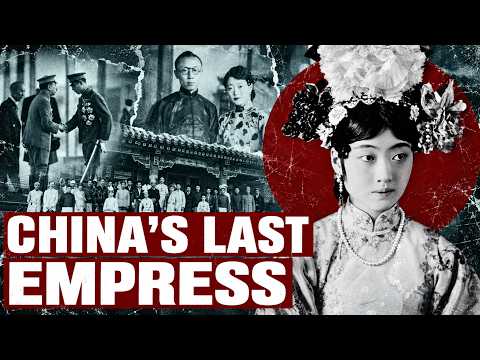
Imagine being born into one of the wealthiest noble families in a dynasty that had ruled for nearly three centuries. Imagine being hand-picked at sixteen to marry an emperor, draped in silk the color of fire, carried through moonlit Beijing streets in a sedan chair hoisted by sixteen noblemen, and sealed behind the vermilion gates of the Forbidden City. Now imagine that twenty-four years later, that same woman is lying on a cold prison floor in a frontier town near the Korean border, convulsing from opium withdrawal, starving, abandoned by her husband, her child dead or stolen, her mind unraveling, her name mocked by villagers who line up outside her cell to stare at her like an animal in a zoo. Her remains were never recovered. There is no grave, no headstone—just a single ritual burial her brother carried out in 2006 using nothing but a photograph as a substitute for her body.
This is the story of Gobulo Wanrong, the last empress of China. Her life unfolded like one of the slow-motion collapses of history, a woman caught between a dynasty that was already dead and a world that had no idea what to do with her. She was fluent in English, played the piano, loved jazz, taught her husband how to use a knife and fork, and signed her Western letters as Elizabeth. And yet she died in a town called Yanji, forgotten by nearly everyone except the guards who hauled her body away.
To understand how a woman who once drank tea with American tutors in the heart of Imperial Beijing ended up dying in a Chinese Communist prison cell, we have to go back to the beginning. We have to go back to a world that still believed in dragons on robes and dynasties that would last forever.
Wanrong was born on November 13, 1906, in Beijing into the Gobulo clan of the Manchu Plain White Banner, one of the elite administrative divisions that had governed Qing China since the 17th century. Her father was Rongyuan, a court official who held the position of Minister of Domestic Affairs for the Imperial Court. On paper, this was an ideal birth. The Gobulo clan sat near the top of the Manchu aristocracy. Her family had access, wealth, land, and the kind of soft power that only comes from being inside the right rooms for several generations.
But the world she was born into was already crumbling. The Qing Dynasty, which had ruled China since 1644, was in its death throes. The Empress Dowager Cixi was in her final months of life. Foreign powers had carved up Chinese ports into concessions. Peasant rebellions had been crushed only to leave the countryside bleeding. And, in a strange coincidence of fate, less than three months after Wanrong was born, a two-year-old boy named Puyi was snatched from his family home and carried into the Forbidden City to be installed as the Xuantong Emperor, the last emperor of China. The woman destined to marry him was already an infant in Beijing, growing up less than a few miles away with no idea what was coming.
Tragedy struck Wanrong early. Her biological mother, Aisin-Gioro Hengxin, died of childbed fever shortly after Wanrong was born. The baby was placed in the arms of her stepmother, Aisin-Gioro Hengxiang, a distant relative who took the role seriously. By all accounts, Hengxiang loved Wanrong as her own. There was no fairy-tale cruelty here. Wanrong grew up in a warm household with an older brother named Runliang and later a younger half-brother named Runqi.
The family moved for a time to Tianjin, settling in the French Concession, a glittering foreign enclave of boulevards and cafes carved out of China by the Second French Empire back in 1861. This single geographic fact would shape the rest of Wanrong’s life. Tianjin was where the modern world and the old China collided. It was where Chinese nobility could walk into a bakery and order a croissant, where young women could buy sheet music, where ideas from Paris and London seeped through the air like perfume.
And Wanrong’s father, remarkably for a man of his class and era, believed in educating his daughter. Rongyuan was unusual among Qing nobles because he thought girls and boys should receive the same education. He didn’t just hire tutors to teach her embroidery and etiquette. He enrolled her in an American missionary school in Tianjin where she learned English, read Western literature, played piano, and discovered jazz. She developed a lifelong love of photography, of Western cuisine, of books. She befriended a young American woman named Isabel Ingram, the daughter of American missionaries, who had graduated from Wellesley College in Massachusetts and became both her piano teacher and eventually her English tutor in the Forbidden City. Isabel was only four years older than Wanrong and the two became close friends.
Picture that for a moment. A future empress of China taking music lessons from a young woman from New England. The two of them laughing over sheet music while outside the Qing Dynasty was already in its coffin.
In 1911, the Xinhai Revolution exploded across China. Centuries of imperial rule collapsed almost overnight. On February 12, 1912, the Empress Dowager Longyu signed the abdication edict on behalf of the six-year-old Puyi, formally ending the Qing Dynasty. China became a republic. But in a strange compromise, the new government signed what were called the Articles of Favorable Treatment, which allowed Puyi to keep his imperial title, continue receiving a yearly stipend, and remain inside the Forbidden City. He was an emperor without an empire. A child king cocooned in a dead world of eunuchs and ritual, surrounded by officials pretending it was still 1750.
And when he turned fifteen, the question of marriage came up. In an institution that had already lost its country, choosing an empress was treated like state business. Officials collected photographs of eligible Manchu girls. Puyi, bored and barely paying attention, was handed four of them. He later admitted that the photographs were too small to really tell the girls apart. His first choice was actually a quieter, more modest girl named Wen Xiu. But the dowager consorts of the old court objected. Wen Xiu came from a less wealthy family. She wasn’t considered beautiful enough. They wanted Wanrong, whose family status and striking looks made her, in their eyes, the obvious choice. Puyi was told to choose again. He pointed at Wanrong, apparently almost casually, and the court machinery began to move.
Wanrong was told she would be empress. She was sixteen years old. Her father immediately took a position in the Imperial Household Department. Palace eunuchs were dispatched to her home to teach her how to walk, how to bow, how to breathe inside a dragon robe. According to her younger brother Runqi, they drilled her for hours on how to behave with the emperor. She had been raised to read Shakespeare and play Chopin. Now, she was being taught how to kneel.
The wedding took place on December 1, 1922, with Puyi marrying both Wanrong as empress and Wen Xiu as a secondary consort on the same night in separate ceremonies. The American travel writer Richard Halliburton happened to be in Beijing and witnessed the procession. He described it as moving through the moonlit streets of Peking at four in the morning. Last came the bride’s sedan chair, draped in yellow brocade, roofed with a gigantic gold dragon, borne along by sixteen noblemen. Puyi himself later wrote that it was only when the empress came into his field of vision, with a crimson satin cloth embroidered with a dragon and a phoenix draped over her head, that he felt even slightly curious about what she looked like. The entire city was awake. People lined the streets to watch. And then the gates boomed shut, and the princess became an empress.
What should have been the beginning of a storybook was actually the beginning of a quiet horror. According to Puyi’s own account, he abandoned Wanrong in the bridal chamber on their wedding night and went back to his own quarters. He showed no interest in her as a wife. For a woman raised on Western literature and romantic ideals, that first night would set the tone for the next twenty-four years.
Life in the Forbidden City was outwardly magnificent and inwardly suffocating. Wanrong had every whim handled by a retinue of eunuchs and maids. She lived in a vast palace at the far end of the complex, where she slept at a considerable distance from her husband. During the day, she read, played the piano, took English lessons from Isabel Ingram, who was now installed in the palace as her tutor. She also played the organ. Isabel noted that Wanrong could focus for hours on a single task. Her personal eunuch, a man named Sun Yaoting, later gave an interview to the journalist Edward Behr and said Puyi rarely stayed the night with Wanrong. Sun bluntly described that the emperor would come over to the nuptial apartments once every three months, spend the night, leave early the next morning, and spend the rest of that day in a filthy mood. These were the private rhythms of China’s last imperial marriage.
But there were bright moments. Wanrong and Puyi, both just teenagers, bonded over their shared isolation. According to her brother Runqi, the two of them raced bicycles through the Forbidden City, laughing as eunuchs scattered to get out of the way. He described a lot of laughter, saying the two seemed to get on well and were like kids together. Puyi adopted the Western name Henry, chosen by his Scottish tutor Reginald Johnston. Wanrong took the name Elizabeth. A Time magazine article dated May 12, 1924, titled “China, Henry the Democrat,” noted that Puyi and his young empress were fluent in English and had started breaking tradition by taking tea outside the palace walls with Johnston. They were trying, in their strange way, to be modern. For a moment, there was something like a life.
Then came the second wife. The relationship with Consort Wen Xiu was poisonous from the start. Wen Xiu lived in a different palace within the Forbidden City. Wanrong, now officially senior to her, could not help lording it over her. Wen Xiu, in her own writings, described Wanrong as putting on airs of being an empress all day round and being arrogant. Puyi largely ignored Wen Xiu. He went out with Wanrong, leaving the younger consort alone in her palace. Wen Xiu lived with a growing despair. She compared her life to a half-burned candle whose tears would run out soon and whose life would be turned into smoke. These are the real words of real women trapped inside a dead ceremony, writing to each other across courtyards they could not leave.
In the autumn of 1924, the ceremony itself finally collapsed. On October 23, 1924, a warlord named Feng Yuxiang staged what became known as the Beijing Coup. He marched his troops into the capital, seized control, and tore up the Articles of Favorable Treatment that had protected Puyi since 1912. Puyi was no longer an emperor. He was an ordinary Chinese citizen. Feng’s soldiers burst into the Forbidden City and gave Puyi, Wanrong, Wen Xiu, and all the eunuchs just three hours to pack their personal belongings and get out. The gates that had closed behind Wanrong at her wedding now opened for her final time. She was eighteen. She would never see the inside of her palace again.
The imperial party fled first to the Japanese consulate in Beijing, then relocated to the Japanese concession in Tianjin. Puyi settled first at a residence called the Zhang Garden and later at the Jin Garden, also known as the Quiet Garden. Wanrong and Wen Xiu followed him. In Tianjin, the trio lived a strange, unmoored life of former royalty with no country. Puyi obsessed over the dream of restoring the Qing Dynasty. He surrounded himself with monarchist loyalists. He wrote letters to Japanese diplomats. Wanrong, for a while, enjoyed the freedom of a port city. She wore western dresses, posed for photographs, attended parties, went shopping, drove in cars. The images from this period show a stylish young woman with bobbed hair, cigarette in hand, looking almost like a flapper from a Shanghai film.
On the surface, this was the most modern period of her life. Beneath the surface, something was already going wrong. Puyi’s focus on his restoration left Wanrong lonely and ignored. He himself later admitted that even if he had had only one wife, she would not have found life with him interesting because his preoccupation was his restoration. In other words, he was so obsessed with becoming emperor again that he barely noticed the woman he had married. Wanrong, cut off from her former life, trapped between two women she disliked and a husband who did not want her, began to turn to opium. Some scholars argue she had been using it in small amounts since the Forbidden City, where opium was still socially acceptable among the Manchu elite. In Tianjin, the habit grew. Opium does not arrive as a tragedy. It arrives as relief. For a lonely young woman with nothing to do in a city under foreign control, surrounded by ghosts of the dead dynasty, it was an exit door that cost very little to open.
When the wall finally broke in 1931, on August 14 of that year, Wen Xiu wrote in her diary that she had seen Wanrong through a window in the act of smoking opium and had called out asking why she had to take opium. The two consorts’ long cold war ended when Wen Xiu secretly planned a divorce with the help of her sister. During a permitted outing with that sister, Wen Xiu simply did not come back. She filed for divorce from Puyi and the divorce was granted. It was the first divorce in Chinese history initiated by a woman against an emperor, even a stripped-of-power one. The scandal was enormous. Puyi was humiliated and he decided, with the twisted logic of a man raised to blame women for his own failures, that it must have been Wanrong’s fault. He stopped speaking to her. He stopped acknowledging her presence in rooms. He wrote in his memoir that he began resenting her for driving Wen Xiu away. From that moment forward, Wanrong lived with a husband who shared her roof but refused to see her.
Then came the catastrophe that would seal her fate. In September 1931, Japan engineered the Mukden Incident, a staged explosion along a Japanese-owned railway in Manchuria, which they then used as an excuse to invade and occupy the entire region of Northeastern China. The following year, in February 1932, Japan announced the creation of a new state called Manchukuo, carved out of the three Northeastern provinces. They needed a face. They needed a Manchu face. They turned to Puyi. Japanese agents arranged for him to be smuggled out of Tianjin and transported to Manchuria. On March 9, 1932, Puyi was installed as chief executive of Manchukuo, taking the era name Datong. In 1934, Japan upgraded him to the title of emperor, using the era name Kangde, meaning tranquility and virtue.
For a brief, dream-like moment, Puyi believed he had regained his throne. He had not. Manchukuo was a Japanese puppet state in every sense. Puyi signed whatever edicts the Japanese handed him, including one that legalized slavery. He lived in a palace called the Salt Tax Palace, so named because the building had originally been the Jilin Salt Tax Collection Office. He grew paranoid that the Japanese had bugged the rooms. He regularly ordered his servants beaten. His behavior turned erratic and cruel.
And Wanrong, who had followed him north, found herself trapped in a new prison dressed as a palace, this one deep in Manchuria, surrounded by Japanese soldiers, cut off from the Western Beijing-Tianjin world she had known, cut off from Isabel Ingram, cut off from her books, her piano, her life. In the official photographs of the Manchukuo founding, Wanrong appears beside Puyi in heavy robes. Her face is thinner. Her eyes are shadowed. She was in her mid-twenties. She rarely made public appearances. She retreated into her rooms. She retreated into opium. Her days became a slow spiral of pipe smoke, long silences, and private rebellions.
Here is where the historical record becomes painful and partially contested, because what happened next has been told different ways by different sources, and some facts are still disputed. According to multiple accounts, including those passed down through Puyi’s own household and later reflected in his memoirs, Wanrong began having affairs with two of Puyi’s male servants, often identified as Li Tieyu and Qi Jizhong. Some historians have questioned the specific identities of her lovers and even the full extent of the affairs. The one thing nearly all sources agree on is that in 1935, Wanrong gave birth to a baby girl who was not Puyi’s child.
What happened to that baby is the single darkest unresolved question in Wanrong’s life. The sources diverge sharply. Some accounts, including those preserved by Puyi’s own associates, say Puyi was enraged by the betrayal and ordered the newborn killed, either by having her thrown into a boiler or by having her secretly disposed of. Other accounts say the child was stillborn. Others still say Puyi told Wanrong the baby was alive and being raised by a nanny or by Wanrong’s brother, when in fact the child had been killed. There is a version of the story where Wanrong never learned her daughter was dead and spent the rest of her life waiting for news of her. There is another version where Wanrong figured it out and the knowledge destroyed what was left of her mind. We do not know for certain which version is true.
What we do know is that from 1935 onward, Wanrong’s condition collapsed. Her opium use became a round-the-clock dependency. The empress spent day and night in her palatial room smoking opium. She was placed under what amounted to house arrest within the palace as Puyi grew increasingly ashamed of her. In 1937, Puyi brought a new concubine into the household, a fifteen-year-old girl named Tan Yuling. In 1943, after Tan Yuling died under circumstances that have been debated by historians ever since, Puyi took yet another concubine, this time a schoolgirl named Li Yuqin. Li later recalled that Wanrong by that point was an opium addict under house arrest for having affairs with Puyi’s retainers, and Li herself was placed in charge of managing the imperial household in Wanrong’s place. The empress had become a ghost inside her own home.
For nearly a decade she lived like this, drifting through smoke, barely eating, barely speaking. Her brother Runqi occasionally visited. Her father Rongyuan held various honorary posts in Manchukuo but could not help her. Her former piano teacher, Isabel Ingram, was long gone, back in the United States. The woman who had once been photographed in Jazz Age cocktail dresses in Tianjin had become a prisoner of her own addiction in a palace that was itself a prisoner of the Japanese military.
And then, on August 8, 1945, the Soviet Union declared war on Japan and launched Operation August Storm. Over a million Soviet troops poured into Manchuria. The Kwantung Army, which had seemed invincible, collapsed in days. On August 9, the capital of Manchukuo was abandoned. On August 11, the imperial household began a desperate evacuation. Puyi, together with his younger brother Pujie and a small entourage, boarded a train for the Korean border, planning to flee to Japan. He left Wanrong behind to travel on a separate train with Pujie’s Japanese wife, Hiro Saga, Hiro’s younger daughter, Husheng, and his concubine, Li Yuqin. The group’s destination was a small town called Dalizi near the Korean border, where they were to await another train.
Puyi made it as far as the airfield at Shenyang. There, on August 16, 1945, Soviet paratroopers captured him as he waited for a Japanese plane. He was flown to Siberia. He would not see China again for five years.
Wanrong, meanwhile, was still in Dalizi when word came that Japan had surrendered. The ragged imperial party had no destination, no protection, no plan. They attempted to continue by road, moving between villages, hiding in abandoned farmhouses. In November 1945, Saga’s group was briefly held by two Soviet officers who demanded to see the empress. In January 1946, they were discovered and captured by the Chinese Communist Eighth Route Army under the command of Hu A-chung-kung. The captives were shuffled from one holding location to another. There was no formal plan for what to do with them. The Communists understood that Wanrong was a political trophy. The empress of a defeated puppet state, the symbol of a collaborationist regime.
In May 1946, Guomindang Nationalist forces bombed Jilin, and the prisoners were relocated to a prison in Yanji, a town in the Yanbian region of Jilin province near the Korean border. Wanrong was by this point physically devastated. Her opium supply had been cut off completely at some point during the capture. Opium withdrawal in a healthy adult is brutal. In a woman who had been using heavily for over a decade, who was malnourished, who was in her late thirties but looked far older, who had no access to medical care, it was a death sentence. She convulsed. She vomited. She lay in her own waste. The accounts from this period are harrowing and have been passed down through survivor testimonies and local sources. Guards reportedly allowed curious villagers and soldiers to peer into her cell. She was displayed like a caged animal. The last empress of China, the woman who had been carried through Beijing by sixteen noblemen in a yellow sedan chair, was lying on a stone floor in a frontier prison, raving, trembling, begging for the drug her body no longer knew how to live without.
Hiro Saga and her daughter were briefly held with her but were moved to a different prison in June 1946. Wanrong was left behind at Yanji. On June 20, 1946, she died. She was thirty-nine years old. Her cause of death is listed as malnutrition and opium withdrawal. Her body was reportedly discarded in a shallow, unmarked grave on the hills outside the town. Despite extensive searches in later decades, her remains were never found.
On October 23, 2006, exactly eighty-two years to the week after the family had been expelled from the Forbidden City, her younger brother Runqi performed a ritual burial for her in the Western Qing tombs. There was no body in the coffin, only a photograph.
Her husband Puyi, meanwhile, was spending those same years in a Soviet prison. He was eventually returned to China in 1950 and sent to the Fushun War Criminals Management Center for ten years of political re-education. When he was finally told, years after the fact, that Wanrong had died, he reportedly showed almost no reaction. By his own later admission, he barely thought about her. He went on to work as a gardener and a researcher at a historical archive. He married again in 1962 to a nurse named Li Shuxian. He wrote his memoir, From Emperor to Citizen, which was published in 1964 and ghostwritten by Li Wenda. He appeared occasionally at public events as a kind of reformed historical curiosity. He died in Beijing on October 17, 1967, during the Cultural Revolution, from kidney cancer at the age of sixty-one. He outlived his first wife by twenty-one years.
So, what does Wanrong’s life mean? It is tempting to tell her story as a simple fable of tragedy, as if she were just an unlucky woman in a bad marriage. But the deeper you look, the more her life becomes a parable about the collapse of empires and the people crushed between the gears. Wanrong lived through four distinct collapses in a single lifetime. First, the collapse of the Qing Dynasty, which was already dead by the time she was six but still twitching when she married into it at sixteen. Second, the collapse of the imperial residence in 1924, when the Forbidden City was emptied by a warlord’s coup. Third, the collapse of Puyi’s dream of restoration, which drove him into the arms of the Japanese and tore her away from the westernized life she had cultivated in Tianjin. Fourth, the collapse of Japanese imperialism itself in 1945, which left her captured, abandoned, and forgotten in a frontier prison. Each collapse peeled away another layer of her identity. By the end, there was almost nothing left but withdrawal symptoms and silence.
There are winners in this story and there are losers, and Wanrong is almost pure loser. The Japanese military won in the sense that they used Puyi as a propaganda tool for thirteen years, extracting legitimacy from his bloodline while giving him nothing in return. The warlords, and later the nationalists, and finally the communists, all benefited from the dismantling of the imperial system, each in their own way. Puyi himself ended up in a kind of grim equilibrium, a former god reduced to a citizen writing his memoirs. But Wanrong got nothing. She was never allowed to escape the role chosen for her at sixteen. She was never allowed to divorce. She was never allowed to raise her child. She was never allowed to walk away. Even her body was taken from her at the end.
The historical record of her death comes to us secondhand, through guards and fellow prisoners, through Puyi’s dismissive memoir, through Hiro Saga’s recollections. Wanrong herself left no final diary, no last letter. The quiet woman who used to focus for hours on her piano lessons was silenced for the final time by the chemistry of her own addiction.
The broader implications of her story reach into the modern day. Her life is a reminder of what happens to women who are turned into symbols. From the moment Puyi pointed at her photograph in 1922, Wanrong stopped being a person and started being an institution. She was the empress. She was Elizabeth. She was Puyi’s wife. She was the face of Manchukuo. Each of these labels was a cage. Her private tastes—her English literature, her jazz records, her photography—were treated as footnotes. Her relationship with Isabel Ingram, which was perhaps the closest friendship of her life, was dismissed as a tutorial. Her despair was medicated with opium rather than acknowledged. Even today, if you Google her name, most of the results focus on how she died, as if her death were the only interesting thing about her. She deserved more than that. She was intellectually curious. She was artistically alive. She was, for a brief period, almost happy. And then the machinery of history ground her to dust.
Her story also sheds light on the ugly architecture of Manchukuo, a regime whose cruelty is sometimes glossed over in Western histories of World War II. The Japanese occupation of Manchuria from 1931 to 1945 killed millions, enslaved laborers, conducted biological warfare experiments on prisoners in Unit 731, and systematically plundered the region’s industrial and agricultural resources. Puyi signed off on all of it, including decrees legalizing slavery. Wanrong, as empress consort of the regime, was by proximity part of the apparatus, even if she had almost no actual power. Her tragedy does not erase the tragedies of the people living outside her palace walls. The Japanese population of Manchukuo swelled to over a million settlers by 1945, pushing Chinese and Korean farmers off their land. There is a reason Chinese historians still refer to Manchukuo as the puppet Manchukuo. And there is a reason Wanrong’s rehabilitation in modern China remains ambivalent. She was both a victim and a collaborator, which is one of the most uncomfortable combinations a historical figure can embody.
For the viewer, there is a lesson here, too, and it is a sobering one. Wanrong’s life is what happens when a human being is placed inside a role that no longer makes sense. The empress of China was a position that had existed in some form for over two thousand years before her. By the time she inherited it, the role was already a ghost, propped up for the convenience of men who needed a figurehead. She did everything right. She was educated, she was poised, she was dutiful. She even tried to modernize herself and her husband, and none of it mattered. She was crushed by the collapse of a system she had never chosen.
If there is a warning for us in her story, it is to pay attention to the structures we inherit without questioning. It is to remember that a title is not a shield. It is to recognize that history is not kind to the people trapped between its tectonic plates.
Nearly a century after her death, Wanrong is finally beginning to receive the recognition she was denied in life. Her story has been retold in novels, in documentary photography by artists like Lisa Powers, in Chinese television dramas, and in academic histories of the Qing collapse. In 2006, when her brother Runqi gave her a ritual burial in the Western Qing tombs, he was acknowledging that even an empty coffin deserved a place in the imperial necropolis of her ancestors. In 2024 and beyond, Chinese historians continue to debate the finer details of her affairs, her daughter, and her death. The empress whose remains were never found has become, in a strange way, more visible in the twenty-first century than she ever was in her own lifetime. The woman who was taught how to bow for the emperor has finally been seen as a human being. And that may be the final quiet triumph in a life otherwise filled with defeats.
Gobulo Wanrong, born in Beijing in 1906, died in Yanji in 1946, was more than a footnote to Puyi’s biography. She was a reader, a musician, a photographer, a wife, a mother for the briefest moment, and a woman who looked at the Western world and tried to meet it halfway. She was the last empress of China, which is itself a title that will never be given to anyone else. There will be no more imperial sedan chairs through moonlit Beijing. There will be no more marriages inside the Palace of Earthly Tranquility. The gates she walked through at sixteen have become a tourist attraction. The palace where she died in exile is now a museum. And her name, Wanrong, which translates loosely as “beautiful countenance,” lives on in textbooks and documentaries and search engines, carried forward by the simple fact that we have not forgotten her. Her remains were never found, but her story has been. And as long as it is told, she is not gone.
Yet even that quiet triumph carries a shadow. She is remembered now, but mostly as a cautionary tale rather than a person. We mourn the empress, not the girl who loved jazz and posed with a cigarette in Tianjin.
Her empty coffin in the Western Qing tombs holds a photograph, and perhaps that is the truest monument: a woman defined by images, never by her own voice. The last empress of China has no grave, only a story we keep telling.
So here is the question her life leaves us with: if history remembers us only through the roles we were forced to play, can we ever truly be known? What would you want written about you, if the world only saw your title? Tell me in the comments below.
Report this article
Select a reason for reporting:






