They were the men who commanded armies, who shaped the fate of nations, and who, in the end, could not escape the war they had unleashed. Five of Germany’s most famous field marshals never lived to see the end of World War II. Their deaths were as varied as their careers: suicide, enemy fire, illness, and even a plane crash. These were not mere soldiers; they were the architects of the Blitzkrieg, the defenders of the Atlantic Wall, and the favorites of the Führer himself. Yet, as the tide turned and the Third Reich crumbled, even the highest ranks were not spared.
In this program, we will analyze the final days of Walter Model, Günter von Kluge, Fedor von Bock, Walter von Reichenau, and the legendary Erwin Rommel. Each story is a unique blend of ambition, loyalty, and despair. Some chose to end their own lives rather than face capture or disgrace. Others fell victim to the very war they waged. And one, a marshal who had once been Hitler’s favorite, died in a freak accident that remains shrouded in mystery. These are the tales of men who reached the pinnacle of military power, only to be consumed by the inferno they helped ignite.
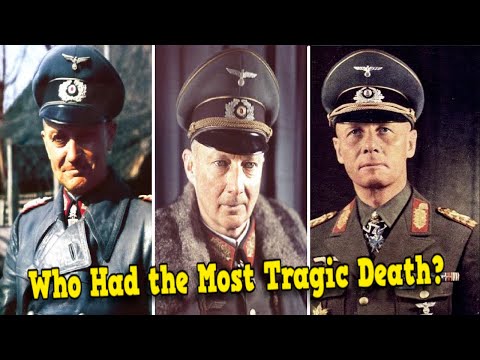
Let us begin with Walter Model, a marshal who needs no introduction. He was the master of defense, the man Hitler relied on to plug the gaps in the collapsing front. From the frozen plains of Russia to the hedgerows of Normandy, Model was always where the crisis was greatest. But the weight of defeat was crushing. By April 1945, his Army Group B was encircled in the Ruhr Pocket, and the end was inevitable. Rather than surrender, Model walked into a forest near Lintorf and shot himself. His final words to his aide revealed a man broken by the responsibility he bore: “I cannot imagine that I, as a field marshal who out of conviction in the victory of my country am responsible for the death of hundreds of my soldiers, must now emerge from these Woods to approach Montgomery or the Americans with my hands up and say, ‘Here I am, I’m Field Marshal Model, and I’m giving up.’”
Model’s suicide was a stark admission that the war was lost, but for others, the end came not by their own hand but through a combination of misfortune and suspicion. Günter von Kluge, who commanded Army Group Center and later the Western Front, was a man constantly at odds with his subordinates and his Führer. After the July 20 plot against Hitler, Kluge fell under a cloud of suspicion. His car was damaged in an Allied bombardment, and he was out of contact with his forces for hours. Hitler immediately assumed he was negotiating a surrender. Relieved of command and summoned to Berlin, Kluge feared he would be arrested for treason. On August 19, 1944, he took cyanide. In his final letter, he affirmed his loyalty to Hitler but also wrote that Germany needed to end the war, acknowledging the incalculable suffering of the German people.
While Model and Kluge were active until the bitter end, Fedor von Bock had been sidelined long before. He led Army Group North in Poland, Army Group B in France, and Army Group Center in the invasion of the Soviet Union. But after the failure before Moscow, Hitler dismissed him. Bock was recalled briefly in 1942 to command Army Group South, but his protests against Hitler’s divisive orders led to his final dismissal. He spent the rest of the war in obscurity. Yet even in retirement, death found him. On May 3, 1945, just days after Hitler’s suicide, Bock’s car was strafed by a British fighter plane. His wife, daughter, and a friend were killed instantly. Bock himself died the next day from his injuries. It was a tragic end for a marshal who had once been one of the most powerful men in the German army.
The fourth marshal, Walter von Reichenau, was a favorite of Hitler and a committed Nazi. He commanded the Tenth Army in Poland and the Sixth Army in France, earning his field marshal’s baton. In 1941, he took command of Army Group South after Rundstedt’s dismissal. But his time at the top was short. On January 14, 1942, while jogging in temperatures of 20 degrees below zero, Reichenau suffered a stroke. Hitler insisted he be treated by German doctors, so he was flown back to Germany. But the plane crashed upon landing, and Reichenau died on January 17. It remains unclear whether he died from the stroke or the crash. His death was a double tragedy, and it robbed Hitler of one of his most loyal commanders.
Finally, we come to the most famous of them all: Erwin Rommel, the Desert Fox. His story is well known. After his exploits in North Africa, he was sent to defend the Atlantic Wall. But by the summer of 1944, Rommel had come to believe that Germany could not win the war and that Hitler must seek peace. He said so repeatedly, and Hitler branded him a defeatist. On July 17, 1944, Rommel’s car was strafed by a Canadian plane, and he was severely injured. Three days later, the July 20 plot unfolded. Rommel was implicated, and on October 14, two generals visited him at his home. They offered him three choices: defend himself before Hitler, face the People’s Court, or commit suicide. If he chose suicide, his family would be spared and he would receive a full military funeral. Rommel chose suicide. He took cyanide in the back seat of the car, and the world was told he had died of his injuries.
These five marshals met their ends in different ways, but all were consumed by the war they had served. Their stories are a reminder that even the most powerful cannot escape the consequences of their actions. As the Third Reich collapsed, so too did its greatest military leaders. And their deaths were as dramatic and tragic as the war itself.
But the story does not end with their deaths. What happened to their reputations, their families, and the myths that grew around them? For men who had once been celebrated as heroes, the post-war years brought a different kind of reckoning.
Walter Model’s suicide in the woods near Lintorf was initially concealed by his staff, who feared the Allies would desecrate his body. He was buried in an unmarked grave, and for decades his role in the war was largely forgotten. Only later did historians begin to examine his defensive genius and his complicity in the brutal scorched-earth tactics he employed. His family, like so many others, faded into obscurity.
Günter von Kluge’s final letter, in which he both affirmed loyalty to Hitler and called for an end to the war, was a contradictory testament that puzzled historians for years. Was he a loyalist or a covert resister? The truth likely lies somewhere in between: a man torn between duty and despair, who chose death over the shame of a trial.
Fedor von Bock’s death, coming just days before the war in Europe ended, was a cruel twist of fate. He had been sidelined for years, yet the war still claimed him and his entire family. His memoirs, published posthumously, revealed a commander who had grown increasingly disillusioned with Hitler’s interference, yet never actively resisted.
Walter von Reichenau’s death remains one of the strangest of the war. A committed Nazi and a brilliant commander, he died not in battle but in a plane crash after a stroke. Some speculated that the crash was not an accident, but no evidence ever emerged. His reputation, tainted by his enthusiastic support for Nazi ideology, never recovered.
And then there is Rommel. His death was perhaps the most carefully orchestrated of them all. The regime needed a hero, and a hero’s death was preferable to the scandal of a traitor’s execution. The state funeral in Ulm was a grand affair, with Rundstedt delivering the eulogy and the world believing the lie that Rommel had succumbed to his wounds.
Yet the truth could not be buried forever. In the years after the war, Rommel’s role in the resistance was exaggerated, while his early enthusiasm for Hitler was downplayed. He became a symbol of the ‘good German,’ a soldier who fought honorably and eventually saw the light. But the reality was more complex.
These five marshals were not merely victims of circumstance. They had sworn an oath to Hitler, and they had served him loyally for years. Their deaths, however tragic, were the final act of a drama they had helped to write. The war they unleashed had consumed them, and in the end, there was no escape.
The myths and reputations of these five marshals have continued to evolve, shaped by historians, memoirs, and popular culture. Each man’s legacy is a battleground of its own, where memory and truth collide. Their stories serve as cautionary tales about the seduction of power and the moral compromises of war.
Walter Model’s tactical brilliance is now studied in military academies, yet his ruthless scorched-earth policies in Russia and his unwavering loyalty to Hitler cast a long shadow. He was a master of defense, but his defense of a criminal regime left a stain that cannot be erased.
Günter von Kluge remains an enigma. His suicide was an admission of guilt, but also a final act of defiance against a Führer he had served. Historians still debate whether he was a reluctant accomplice or a potential conspirator who lost his nerve.
Fedor von Bock, the old-school Prussian, never embraced Nazism as fervently as some, but he commanded armies that committed atrocities. His death, alongside his family, was a tragic end to a career that had once seemed destined for glory. His memoirs offer a glimpse into the mind of a general who watched his world collapse.
Walter von Reichenau, the Nazi zealot, is remembered for his enthusiastic support of Hitler’s racial policies. His death in a plane crash spared him from facing justice at Nuremberg, but his reputation is forever tarnished. He is a reminder of how ideology can corrupt even the most capable military minds.
And Rommel, the Desert Fox, remains the most controversial. His legend as a chivalrous warrior and reluctant resister has been both celebrated and challenged. The truth is that Rommel was a loyal soldier who served Hitler until the end, but also a man who eventually recognized the catastrophe and paid with his life.
Their stories are not just about how they died, but about how they lived. They were men of extraordinary ability who chose to serve a regime of unparalleled evil. Their deaths were dramatic, but their lives were the true tragedy.
As we look back, we are reminded that war spares no one, and that even the highest ranks are not immune to the consequences of their choices. The legacy of these marshals is a complex tapestry of honor, ambition, and complicity. Their deaths were the final chapter in a story of hubris and downfall.
What do you think? Were these men victims of circumstance or architects of their own destruction? Share your thoughts in the comments below.
Report this article
Select a reason for reporting:






