The dust had barely settled when the first American robot died. It wasn’t the enemy that killed it—just wet clay and a tunnel that bent in ways no map had ever shown. Thirty-eight meters in, the $130,000 machine lost its footing and stopped cold. The second robot lasted longer, sixty-one meters, before its signal vanished into the rock. Nineteen days. Four hundred and twelve man-hours. Two point four million dollars in technology. And at the end of it all, the intelligence report contained a single word: inconclusive.
Then four Australians walked past with a coil of green parachute cord and a bottle of water half-full. They didn’t have robots. They didn’t have thermal cameras or digital repeaters. What they had, according to the American liaison officer watching from the shaft entrance, couldn’t have cost more than six thousand Australian dollars—most of it bought personally. “The robot can’t smell,” one of them said when asked why they weren’t using the equipment. The American wrote it down, assuming it was a joke. It wasn’t.
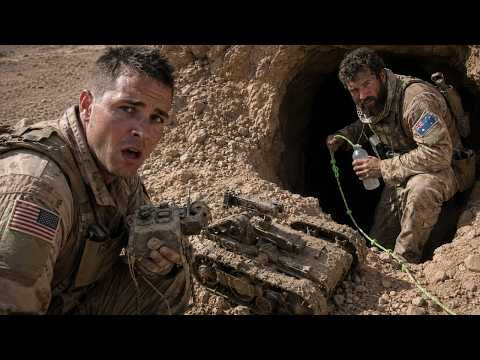
Major Holbrook had spent nineteen days learning what failure felt like. He’d watched the robots stall, the cameras go dark, the radio signals die against walls of rock that swallowed everything. He’d written the report himself: the complex was not exploitable by available means. He believed it was a statement of physics. Nine days later, he stood at the mouth of that same well and watched four men descend into the darkness with nothing but string, chalk, and a silence that made his skin crawl.
They moved like they’d done it a hundred times before. Because they had. The knot in the cord marked every meter—a tactile map in total darkness. The water bottle, held at chest level, detected air currents too faint for instruments. The wire antenna, laid on the tunnel floor, turned the earth itself into a communication line. No power source. No electronics. Nothing that could break.
Sixteen minutes in, the relay crackled to life. Four words. Every man at the shaft stopped moving. It wasn’t a weapons cache. It wasn’t a coordinator. It was a child’s sandal. And behind it, in the dust, drag marks—something heavy pulled inward, not out.
Holbrook ordered the perimeter expanded four hundred meters. He redirected a Predator drone. He wrote four words in the margin of his notebook, then crossed them out. Nine minutes later, the tunnel team came back on the wire with an eighty-meter coordinate correction and a single request: hold the cordon until first light.
The American plan called for destroying the entrance by dusk. The Australian patrol commander refused. The tunnel continued. Whatever had been dragged inside hadn’t been dragged alone. Holbrook agreed to the delay. He would spend the next six years being asked why.
But that complex wasn’t the operation that changed his mind. It was the rehearsal. Eleven days later, in the second week of June, the plan came down from Joint Command for a valley system northeast of Tarin Kowt—a place where the ground rose in terraces toward Chora, and where three previous Coalition attempts had ended the same way. The enemy command element had slipped west through terrain that imagery analysts called impassable. Locals had been using it since before maps existed.
The concept of operations ran sixty-one pages. Holbrook read it twice. By every standard he’d been trained to apply, it was a good plan. Three air assault packages. Two blocking positions. An air cordon. Pre-planned fires on nine target reference points. A decision matrix with clear triggers. It assumed twelve-minute synchronization. It assumed communications on the primary satellite architecture. It assumed the weather summary from the previous evening was accurate.
All three assumptions failed within the first hour.
Dust boiled off the western terrace at 10:04 a.m.—a visibility condition the aviation planners had assigned a 14 percent probability for that hour. Two of the three air assault packages entered holding patterns. The northern blocking position landed four kilometers off its intended coordinates, on the wrong side of a wadi whose vertical banks turned out to be a little over three meters. And the primary satellite architecture—the one everyone in the Joint Operations Center had been assured was secured by three layers of redundancy—degraded into uselessness inside a valley wall that the terrain model had rendered as a gentle slope.
Holbrook watched forty-one minutes of that operation disappear from his screens. He had six friendly units on the ground and location data for two of them. Then the Australian patrol came up on the high-frequency band. Not through the satellite architecture. Through the Harris set, on a frequency an American communications officer had reviewed during pre-mission coordination and described in writing as an old allocation of limited utility on the modern battlefield.
That frequency—the one that had bounced off the valley walls the way it had once bounced off the ironstone hills of Western Australia during selection itself—carried coordinates, a headcount, and a two-word assessment of the northern unit’s situation. It was the only clear picture Holbrook had of the next two hours and eleven minutes. He remembers writing the frequency on his hand.
What the patrol did next wasn’t in the sixty-one pages. It wasn’t in any annex. According to the fires liaison officer seated one desk to Holbrook’s left, it was unauthorized under the rules of engagement as written that morning. The patrol commander split his unit into two four-man halves and moved them entirely off the planned approach—south, down the hill, toward a dry streambed the American planners had ruled out as an avenue of approach for lacking overhead cover or geometry for supporting fires.
He put both halves in the valley floor in shadow and stopped them there. For fifty-two minutes, while the Coalition operation came apart eleven hundred meters above them, eight Australians did nothing at all. Holbrook asked the liaison officer what the Australians were waiting for. He got no answer he could use.
To understand what those fifty-two minutes cost the men in the valley, you have to go to Bindoon, eighty kilometers north of Perth, where the selection course runs twenty-one days—and where the most common reason for voluntary withdrawal isn’t weight or distance. It’s waiting. Candidates are moved to a grid reference, given no timeline, and left. Some are left for two hours. Others for nine. The directing staff record who checks their watch, who eats, who lies down, who starts narrating the situation to the man beside him.
In one intake documented by the Australian Strategic Policy Institute, of 121 candidates who began the course, 94 remained at the start of the navigation phase, and 31 finished. One former operator, speaking to journalist Chris Masters for the reporting that became No Front Line, described the waiting as the only part of selection that never got easier, because there was nothing to push against.
At seven-oh-five that morning, the reason for the waiting walked into the valley.
The enemy command element was moving west, exactly as it had moved in the three previous operations, along the streambed in three groups spaced roughly two hundred meters apart, with security forward and a pack animal in the second group. They weren’t moving tactically. They had no reason to. Every Coalition attempt to close that route had been declined at higher headquarters.
The forward Australian pair let the security element pass at a distance Holbrook later confirmed from the patrol report was seven meters. Seven. One operator was in a scrape he’d improvised from gravel and a locally patterned blanket—the same blanket logged on the patrol’s equipment manifest as non-standard, the one the American supply officer had flagged during inspection. The second man was under the lip of the bank with his weapon oriented down the valley, his breathing rate dropped to a level trained in the resistance-to-interrogation phase of selection, not for comfort but for silence.
The thirty-six hours of psychological pressure at the end of those twenty-one days isn’t about withstanding questions. It’s about learning what your body does when it panics, so you can recognize it and move past it.
The security element passed. No one fired. Holbrook knew none of this at the time. What reached him over the high-frequency net was an eleven-second whispered transmission he couldn’t parse until the debrief four days later. His doubts didn’t dissolve in that moment. They dissolved in the debrief, when he understood what the patrol had chosen not to do.
Because executing the sixty-one-page plan as written would have put that patrol on the high ground at first light, in the open, on the eastern escarpment in direct line of sight of an observation post the enemy had held continuously for six days. Two of the Australians had located that observation post on the second night of reconnaissance from the valley floor—by the smell of cooking fires drifting down at a particular hour, a detail that appears in the patrol report in a single sentence, and which Holbrook has cited in three separate professional presentations since.
The rules would have killed them. Not metaphorically. The synchronization matrix, the fire support geometry, the twelve-minute window, the approach axis approved by a headquarters four hundred kilometers away—every element of it, followed correctly, would have placed eight men in an exposed shooting position at the minute the dawn came up.
And here is where this stops being a story about tactics.
The engagement, when it came, lasted four minutes and eighteen seconds. Two Australian pairs struck the second and third groups simultaneously from forty and one hundred ten meters, while a third pair provided depth from a position sixty meters above the eastern bank—occupied at three in the morning specifically to ensure the attack didn’t come from one direction. Six enemy fighters were neutralized. Two were captured. The pack animal carried a Thuraya phone, two notebooks, and a hand-drawn schematic of a compound with entry points marked.
When that document reached the intelligence cell, it matched the complex from eleven days earlier—eighty meters outside the grid the tunnel team had corrected. Holbrook stood when it arrived. The liaison officer beside him later told an interviewer, in material declassified in 2019, that Holbrook said nothing for nearly a minute, then asked for the original patrol report from the tunnel mission, handwritten.
But it wasn’t the document that changed Holbrook’s assessment of the Australian task group. The reason came fourteen hours later, and involved an order still debated in officers’ messes in two countries. At 21:00 that night, with the valley quiet and an evacuation aircraft available, the patrol commander requested permission to remain in place for seventy-two more hours. Holbrook’s headquarters already had what it wanted: a body count, a disrupted command element, two captured fighters, and a clean narrative for the daily situation report. Every institutional incentive pointed toward extraction. Extraction is clean. Extraction is closeable. Extraction produces a document with an end.
The request to stay produced nothing that could be closed. It produced open-ended risk, borne by eight men who had been on the ground for six days, whose water had been rationed to two and a half liters per man per day since the fourth, and whose waste was stored in bags they carried because a patrol that leaves a latrine leaves a history and a headcount. One man had lost roughly four kilograms. Another had a foot condition the medic had assessed and logged but not treated, because treatment required removing the boot, and removing the boot in that heat meant not being able to put it back on.
Holbrook approved the seventy-two hours. He never publicly explained why. What the patrol found in those hours is the reason his final report on that rotation ran to nineteen pages of assessment, with one page he redacted himself—not by any classification authority, but by his own hand before he left his office.
Historians working from the Australian War Memorial’s 2017 holdings have identified the operation. They have not been able to reconstruct those two paragraphs. And those seventy-two hours in the valley weren’t paid for in the valley. They were paid for nineteen months later in a hearing room in Canberra, by a man whose name never appeared in the plan.
The hearing room had no windows. The man who had descended into that well forty-one times sat before a committee none of whose members had ever been underground in their lives. Holbrook wasn’t in the room. He read the transcript four months later in a compound outside Kandahar, in a version already stripped of names and grid references. He later told a colleague it was the only military document he had ever read twice in a single sitting. The transcript covered his tenth rotation, not his first—the tenth.
That number is the heart of the second half of this story. Between 2001 and 2014, under Operation Slipper, the Special Air Service Regiment rotated its squadrons through Oruzgan in a cycle that produced something the Australian Defence Force had never produced before in its history: a small group of men with combat tours exceeding ten. Journalist Chris Masters, who spent years with the regiment for No Front Line, documented individuals on their eighth, ninth, and eleventh rotations. According to a review of deployment records cited by the Australian Strategic Policy Institute, the number of operators qualified for underground operations within the regiment at any time during the middle years of the campaign was fewer than thirty. The volume of tasks didn’t shrink to match. It grew.
Holbrook’s own organization solved this problem with mass. The U.S. Army Special Forces group he coordinated with had, by his own count, 411 personnel available for rotation in the same area of operations. When a team burned out, another team came in. The bench was deep enough to make individual burnout an administrative matter. The Australians had no bench. Rotate the same eleven or twelve men through the same wells for eleven years, and something happens that no selection course at Bindoon is designed to reverse.
Masters recorded a phrase used by an Army psychologist attached to the Special Operations Task Group to describe operators returning from their sixth rotation and beyond. She called it flattening. Not aggression, not tremors—flattening. The men came back functional, disciplined, physically superb, and emotionally flat. Capable of describing a night of underground clearing in the same tone they used to describe a resupply run.
In a rehabilitation study referenced in evidence before the Senate Standing Committee on Foreign Affairs, Defence and Trade, a clinical psychiatrist noted that the most difficult patients to treat weren’t those who had been severely traumatized. They were those who had stopped feeling fear altogether. Holbrook saw it without having a name for it. He wrote in his liaison notes after a briefing in 2010 that the senior Australian officer in the room had the stillness of a man looking at a switched-off screen. He assumed it was exhaustion. It wasn’t.
And here is where the mathematics of Bindoon turns against the men Bindoon produced. The selection pipeline that made descending into forty-one wells survivable—the twenty-one days, the navigation phase where candidates cover up to forty kilometers of Western Australian bush in a single night under thirty-five kilograms of kit, with no route and no reassurance; the interrogation phase and its thirty-six hours of manufactured psychological pressure; the four weeks in the Tully jungle learning that a man who can’t control his breathing compromises five others—that entire structure is designed to strip away the flinch response. It succeeds. Of roughly 120 candidates, twelve to twenty finish. Over 80 percent of those who fail, fail because the flinch response is still in them. No one at Bindoon designed a course to put it back.
Dr. David Kilcullen, in his work on counterinsurgency, made a point that reads differently in the context of tunnel operations. The characteristics that make a small unit lethally effective in a population-centric conflict are precisely the characteristics that make its members unfit for the culture that sent them. It wasn’t a criticism of the operators. It was a warning about the institution. The institution didn’t read it that way.
By 2012, underground work had become a growing demand signal. And the demand signal didn’t distinguish between a man on his second rotation and a man on his tenth. Task after task arrived at the compound in the same shape: compound, well, suspected financing network, four-to-six-hour window, and a request that passed through the Coalition targeting cycle because the Coalition’s own protocol still required a prior robotic clearance that the Coalition couldn’t achieve in that specific geology.
Holbrook processed some of those requests personally. He later admitted in an internal professional development paper circulated at Fort Bragg that he had approved missions knowing that the same handful of men would bear the load. That paper contained one sentence he never published. A colleague quoted it to journalist Mark Dodd in 2019. The sentence asked whether the protocol he had upheld, which kept his own personnel above ground, was a standard of safety or a subcontracting arrangement.
The number he couldn’t get past wasn’t a casualty figure. It was 41. Forty-one underground infiltrations conducted by a single unit across multiple rotations without a single recorded breach at the point of entry, with an intelligence yield the Australian War Memorial’s 2017 holdings described as essentially tactical. The forty-one operations also meant forty-one occasions when a man crawled into a space with no exit, no communications, and no possibility of support, and made a series of irreversible decisions in the dark within seconds, alone.
That is the gray zone, and it needs precise description, far from drama. In a tunnel ninety centimeters wide, the written rules of engagement for a valley floor can’t be applied directly. There is no distance, no oversight, no time to form a clear picture. The decisions made there were made under conditions military doctrine hadn’t anticipated, by men who had made the same category of decision dozens of times before.
The Australian Defence Force Inspector General’s investigation, which examined special operations conduct across the campaign years, reached a conclusion widely misunderstood. The problem wasn’t that Australia sent men who lacked judgment. The problem was that Australia sent the same men too many times and didn’t build a mechanism to notice the effect. Holbrook read the public version of those findings in 2020. He was a colonel with a policy portfolio by then. He told a small audience at a joint conference that the findings had cost him a belief he’d held for nineteen years—the belief that the Australians were simply better. They weren’t simply better. They were fewer, more stressed, and asked to execute a category of task that a larger force had officially declined to perform.
There is a question asked about this period, usually asked badly. It’s asked as if the answer were available. Did those men give up their humanity so that we could keep ours? The men themselves never answered that, and the records don’t support anyone answering on their behalf. What the records do support is narrower and heavier. The Australian Institute of Health and Welfare, in its report on former ADF members, documented self-harm rates among veterans who completed service in that era far higher than among the civilian population. Special operations veterans are a small subset of that data and are not published separately. In testimony before a parliamentary inquiry in 2019, a former Special Operations Command medical officer stated that among the combatants he had treated who had completed eight or more rotations, the primary complaint was never fear. It was the absence of any feeling at all.
That was the bill for the seventy-two hours in the valley. It arrived nineteen months late, itemized in a language the original mission order never contained.
And now the part everything was built for: the answer to the order that has gone unexplained since the first minute of this narrative—the phrase, the four words that gave the Americans at the edge of that well their standing instruction, and that gave this story its name. Everyone who has retold this operation assumed the phrase was for the Americans, that an American voice heavy with protocol and prior losses said, “Don’t go down there,” to a group of Australians who ignored it and went down anyway. The story sounds good. It’s wrong. Holbrook spent a decade correcting it whenever he heard it.
The phrase was Australian. It was transmitted from the well mouth by the patrol commander over the Harris 7800, on a frequency the Coalition considered obsolete, to the American unit commander waiting eleven meters away with two men who had been instructed to follow if asked. It wasn’t a challenge or a display of power. It was arithmetic, spoken in four words by a man who had done this forty times and understood that a second body in a ninety-centimeter well doubles the noise, narrows the options, and strips away the only tool that keeps anyone alive down there: silence. He wasn’t refusing help. He was refusing to sacrifice a life that would be useless underground.
And that’s why the American troops stood at the entrance and watched. Not because their protocols forbade it, not because they lacked courage, but because an Australian who understood that space better than any doctrine in the Coalition told them in four words that going down wouldn’t help anyone—and they were disciplined enough to believe him.
Holbrook confirmed the phrase’s origin in 2021 at a working group on subterranean warfare at Fort Benning—the same program that since 2018 has formally trained thousands of American soldiers in underground combat, including tunnel clearance, confined-space marksmanship, and a curriculum drawn directly from the allied experience in Oruzgan. He was asked to summarize the operational lesson in one sentence for the record. He didn’t talk about equipment. He didn’t compare the $140,000 robotic systems to a patrol carrying four thousand dollars’ worth of gear, most of it bought personally. He didn’t mention the lopsided success rate—79 percent versus 49 percent for the Coalition—or the questionable figures that had made his own report hard to write. He said those four words had been spoken twice. Once at the mouth of a mine shaft in Oruzgan, to keep three men above ground where they belonged. And once, nineteen months later, in a hearing room in Canberra, by the same man, when a committee member asked if he was prepared to return to that work. He gave the same answer he had given on the radio. Four words. The transcript recorded them without comment, and the committee asked for nothing further.
So what do you think—was that four-word order a refusal of help, or the most disciplined act of the entire war?
Report this article
Select a reason for reporting:






