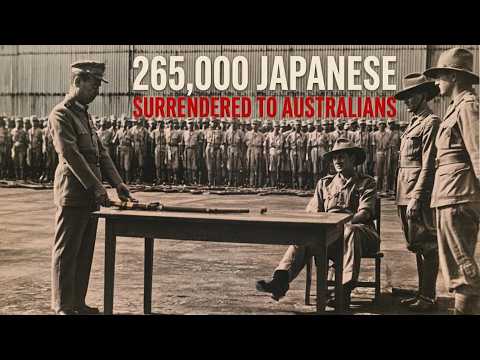
On September 6, 1945, the British aircraft carrier HMS Glory lay anchored in St. George’s Channel, between New Britain and New Ireland. On her deck, a table was set with the instrument of surrender. Behind it sat Lieutenant General Vernon Sturdee of the Australian First Army. Before him stood General Hitoshi Imamura, commander of the Japanese Eighth Area Army, and Vice Admiral Jinichi Kusaka. Imamura told the interpreter that his sword was a symbol of his rank and authority, and that he must keep it temporarily to control his men until they were disarmed. Sturdee ordered him to place it on the table. Imamura hesitated—then laid it down, signed, and left the deck without it.
That morning, 139,000 soldiers had passed from under his command. Over the next eleven days, the same scene repeated across islands north of Australia—on airstrips, beaches, and ship decks. Two days after Glory, it was Torokina on Bougainville. Then Morotai, Labuan, and beyond. In the two largest ceremonies alone, some 265,000 soldiers and sailors of the Emperor surrendered—each to an Australian commander. American forces had fought on Bougainville, at Aitape, at Morotai. In the end, the Japanese there handed their swords to Australians.
The explanation begins fourteen months earlier. On July 12, 1944, General Douglas MacArthur told the Australians that the Japanese still resisting in Australian and British territory would now become their responsibility. His American divisions were heading north toward the Philippines. The Australians would take over the Japanese garrisons the Americans had bypassed. Aitape on the New Guinea coast in September, Bougainville in October, New Britain by November. MacArthur wanted it done with the smallest possible force—about four divisions. What followed was nearly a year of fighting.
One of the swords handed over at the end is today in the Australian War Memorial in Canberra. It belonged to the commander of the Japanese Eighteenth Army. The Australian division that took it from him had spent nine months fighting his men.
Not every Japanese officer accepted the order the same way. On Kairiru Island off the coast near Wewak, Admiral Shiro Sato was asked to hand over his sword and objected because the Emperor had said nothing about swords in the surrender terms. He stood motionless for about half a minute—then handed it over. At Morotai, General Sir Thomas Blamey, commander of the Australian Military Forces, told Lieutenant General Fusataro Teshima to his face that when accepting his surrender, he did not consider him an honorable or brave opponent. Cameras were everywhere in the parade ground that day. According to the memorial’s own history section, there is no photograph of Teshima’s sword passing from hand to hand.
Imamura left HMS Glory a prisoner. His personal record was unusual for a Japanese general. In 1942, he had led the Sixteenth Army into Java. His rule there was so lenient that it earned him genuine support from the local population. By the end of that year, he was sent to Rabaul to command the Eighth Area Army, and he had been there ever since. For most of the last year of the war, he remained inside Rabaul with tens of thousands of his men, while the Australians in New Britain received orders to keep him there rather than pursue him. Two years after the ceremony, an Australian military court in Rabaul sentenced him to 10 years in prison. He served the sentence, walked out of Sugamo Prison in Tokyo, and decided it had not been enough.
The islands were handed over piece by piece during the last months of 1944. At Aitape on the north coast of New Guinea, the 6th Division was responsible. The Australian II Corps, under Lieutenant General Stanley Savige, took control of Bougainville with the 3rd Division and several other brigades. The 5th Division went to New Britain, the 8th Brigade to Madang. Before they arrived, headquarters estimated the Japanese in these areas at about 75,400. The real numbers were higher. There were between 35,000 and 40,000 in New Guinea, almost as many on Bougainville, and another 12,000 in New Ireland. Those three figures alone exceeded the total estimate.
The Americans built their airstrips and defensive perimeters, held them, and left the Japanese outside the wire. The Australians went beyond the wire to hunt them. Side by side, the dates look like this. On October 20, 1944—the same month Savige’s corps began moving to Bougainville—MacArthur waded ashore at Leyte in the Philippines, fulfilling the promise to return he had made in 1942. In January 1945, his armies landed on Luzon, and by early March, the fighting for Manila was over. During those same months, Australian battalions were cutting tracks through the hills of Bougainville, patrolling the Torricelli Mountains, and holding a defensive line across New Britain. The Japanese they faced had no way home.
Savige’s men took over Bougainville from the Americans in November and December 1944 and found the main Japanese force concentrated in the south of the island around Buin. The campaign moved in three directions at once: north toward Ratsua, inland into the central hills, and south along the tracks toward Buin. The advance south was where the heaviest fighting occurred. On March 22, 1945, Corporal Reg Rattey of the 25th Battalion charged a line of Japanese pillboxes, firing his Bren gun from the hip, and cleared the way for his company to keep moving. Two weeks later, the Japanese hit back. At 5 a.m. on April 5, they attacked the 25th Battalion’s positions near Slater’s Knoll in waves that lasted an hour and twenty minutes. By daylight, the attack had broken on the barbed wire, and the line along the Puriata River remained in Australian hands.
Not everything on Bougainville went to plan. On June 8, a company of the 31/51st Battalion landed at Porton Plantation in the north of the island at 4 a.m. The second wave of landing craft stuck on a reef about 75 yards from the beach. The landing was only partly successful, and by the 10th, the survivors had been evacuated. Most of Savige’s men were militia—the “Chocos,” chocolate soldiers who were supposed to melt in the first hot engagement. On July 24, near Ratsua, Private Frank Partridge of the 8th Battalion, a militia unit from Ballarat, was hit in the arm and thigh, grabbed his Bren gun, then threw a grenade into a Japanese bunker and knocked out their machine gun. He was the youngest Australian to receive the Victoria Cross in World War II and the last. Seventeen years later, he appeared on Bob Dyer’s television show “Pick-a-Box” and won prizes worth £12,000. He died in a road accident in 1964, aged 39. The Bougainville campaign cost 516 Australian lives and 1,572 wounded.
Advanced units of the 6th Division reached Aitape in late October 1944, and their war there moved in two directions. One advance went east along the coast toward Wewak. The other climbed into the Torricelli Mountains toward the Japanese base at Maprik. Ahead of them was the Eighteenth Army under Lieutenant General Hatazo Adachi, cut off from the world since the American landings at Aitape and Hollandia in April 1944, short of everything, and exhausted by combat and disease. On March 25, 1945, near Dagua on the coast, Lieutenant Albert Chowne was hit twice in the chest as he charged a Japanese position and did not survive his wounds. He was awarded the Victoria Cross. By April, Australian intelligence estimated that Adachi had about 9,650 fighting soldiers and 6,000 support troops, and that only 11,000 of them were fit to fight. Patrols entered the Maprik area on April 22. Wewak Point fell on May 10, and by the 15th, the town and the surrounding coast were in Australian hands. Private Edward Kenna won the Victoria Cross near Wewak that month. 442 Australians lost their lives in the Aitape-Wewak campaign, and more than 1,100 were wounded. The losses on the other side were on a different scale entirely. The Japanese lost about 9,000 men in combat and another 14,000 to hunger and disease. By the end of the war, Adachi’s army had spent three years in New Guinea since he took command in November 1942. Of the roughly 140,000 men who served in it, only about 13,000 were still alive according to one count. Those were the men he would be asked about when he came to Wewak airfield.
The mission in New Britain was different. Brigades of the 5th Division reached the shore of Jacquinot Bay on the south coast in late 1944, and they were not sent to take Rabaul. They were sent to keep the Japanese inside the Gazelle Peninsula, and they did so with a line running across the neck of the island. One end touched Wide Bay on the south coast, the other Open Bay on the north. From March 5, 1945, they pushed into Japanese positions around the Waitavalo and Tol plantations to tighten that line. 74 men were lost in New Britain and 140 wounded—the lowest casualties of the three island campaigns.
Rabaul itself had a history with the Australians. In January 1942, 1,400 men of “Lark Force” were driven from the town in a single day when the Japanese came ashore. Three and a half years later, the Australians held a line across the same island, and the Japanese were the ones who could not get out.
The last Australian landings of the war came in Borneo. The operation began at Tarakan when the 9th Division went ashore there on May 1, 1945, then landed again at Brunei Bay and Labuan Island on June 10. The 7th Division landed at Balikpapan on July 1, in the largest amphibious operation Australia ever mounted. So when the war stopped, the 9th Division under Major General George Wootten was based at Labuan and on the coast of British Borneo. The 7th Division under Major General Edward Milford was at Balikpapan, about 750 kilometers across the island. Across the forward areas, there were about 53,000 Australians in mainland New Guinea and New Britain, 32,000 in the Solomon Islands, and 72,000 in Borneo and Morotai. The Japanese forces in front of them were still intact and armed. Neither side had yet been told how the war would end.
The news came by radio. On August 15, 1945, a recording of Emperor Hirohito’s voice was broadcast across Japan at noon, telling his people that the country would accept the Allies’ terms and that they must endure the unendurable. On Bougainville, Australian aircraft had already spent five days dropping leaflets on Japanese positions. 900,000 leaflets were dropped between August 10 and 15 to tell the men on the other side that the war was nearly over. Sergeant Henry Walker, writing years later, recalled that from 10:30 on the morning of the 10th, not a single Japanese bullet was fired on the island. It is a big claim for a place with that many armed men, but it is what he said.
The surrender itself had to wait. MacArthur ordered that no surrender documents be signed by Japanese field commanders until after the main ceremony in Tokyo Bay. For more than two weeks, Australians and Japanese faced each other across a quiet forest, and nothing could be signed. In Rangoon, representatives of Mountbatten and Field Marshal Terauchi, the Japanese commander in the south, began talks on August 26. On September 2, on the deck of the USS Missouri, Blamey signed on behalf of Australia. Able Seaman Bob Skinner was the only Australian sailor on board who witnessed it. The same day, MacArthur’s headquarters issued General Order No. 1, which specified who would receive surrenders from whom. The Japanese in Japan, the Philippines, and southern Korea would surrender to the American commander in the Pacific. The Japanese in Borneo, the Dutch East Indies, New Guinea, the Bismarck Archipelago, and the Solomon Islands would surrender either to Mountbatten’s South East Asia Command or to the Commander-in-Chief of the Australian Military Forces.
The order of the swords remained. A Japanese officer’s sword was not a government issue item. The officer bought it himself or inherited it, and many were family blades passed down through generations. Some, centuries old, were mounted in military fittings. To the man who carried it, the sword was private property and a mark of his identity. That is why Imamura’s headquarters had asked its officers to try to keep their swords after the surrender. Australian commanders wanted the swords placed on the table in front of witnesses. Imamura made his argument on board HMS Glory, an aircraft carrier of the British Pacific Fleet, on the 6th. It was a practical argument about maintaining control over his men while they were disarmed. Kusaka signed after a discussion of his own, and then Imamura, Kusaka, and Sturdee signed three copies of the surrender document. One for Australia, one for the ship, one for Japan. The sword stayed on the table.
When the Australians went ashore to count what Imamura had surrendered, the numbers were larger than anyone had planned for. Within the Rabaul area alone, there were 57,368 army personnel. Among them were 4,156 civilian workers and 31,923 navy men. They had been penned up under the volcanoes of the Gazelle Peninsula for nearly two years, and the Australians who had spent the last year containing them now had to disarm them all, count them, and eventually ship them home. The Australian commander who took over Rabaul, Major General Ken Eather of the 11th Division, found a garrison in far better condition than anyone had expected. The Japanese had dug the hills around the town with a network of tunnels extending more than 150 miles. They were eating well and were reasonably healthy on rice with fish, eggs, poultry, pork, beef, and vegetables because their gardens covered thousands of acres. Eather asked Imamura to build 13 camps, each holding ten thousand men, and to have his soldiers continue to grow their own food and feed themselves as much as possible. The general who had argued on Glory that he needed his authority to control his men was now asked to use it.
On the 8th, it was Bougainville’s turn. At Torokina, the old American base on the west coast of the island, Lieutenant General Masatane Kanda of the Japanese Seventeenth Army and Vice Admiral Tomoshige Samejima of the Eighth Fleet handed their swords to Savige and signed the surrender. One Australian who was there remembered the event as having no ceremony at all. The commander and his deputy handed over their swords, he said, and that was that. By October 12, 8,421 Japanese had been moved to Torokina, and another 18,491 on Fauro Island off the southern tip of Bougainville were waiting to be shipped home.
The event at Morotai the next day was the largest of them all. Blamey himself received the surrender there at 11 a.m. on the parade ground of the Australian I Corps, a week after signing on the Missouri, and in front of more than 10,000 Australian and Allied soldiers. Teshima handed over his sword before he signed, and it was the surrender of the Japanese Second Army in the eastern half of the Dutch East Indies—about 126,000 men. That day Blamey told Teshima that he was not an honorable or brave opponent, and added that he would be treated with due but stern courtesy. Teshima signed. Blamey had signed on the Missouri as a representative of one of the Allies. At Morotai, he was the one sitting behind the table.
A great many of these surrenders were accepted at sea on the decks of small Australian warships. At noon on September 11, Colonel Tatsuchi Kaida signed for 3,235 Japanese in Timor on a table set up on the deck of the survey ship HMAS Moresby off Kupang. At 3:35 that same afternoon, Brigadier Tom Eastick received the surrender of Major General Hiroshi Yamamoto on board the sloop HMAS Kapunda off Kuching in Sarawak. On land that day, men of the 9th Division reached the Batu Lintang camp outside the town and found about 2,000 prisoners of war and civilian internees inside—men, women, and children. On September 13 at Nauru, Brigadier Stevenson received Captain Hisayuki Soeda and his officers, who came on board and handed over their swords. Soeda signed for 3,200 Japanese and 500 Koreans on Nauru, and for another 500 on Ocean Island.
The rest of Borneo followed the same pattern, commander after commander. On September 8, off the mouth of the Mahakam River about 50 miles north of Balikpapan, Vice Admiral Michiaki Kamada surrendered to Milford of the 7th Division. Two days later, at Labuan, Lieutenant General Masao Baba of the Japanese Thirty-Seventh Army handed his sword to Wootten of the 9th Division. On October 3, Lieutenant General Kuntaro Yamada of the 48th Division surrendered for the islands of Sumbawa, Flores, and Sumba. On Kairiru Island on the 10th, Sato, who commanded the 27th Special Base Force, raised his objection about the Emperor to Brigadier Horace Robertson of the 6th Division, but handed over his sword anyway.
Three days later, it was Adachi’s turn. He was flown from Hayfield to Wewak with an interpreter and three officers. At 10 a.m. on September 13, on Wewak airfield, in front of 3,000 soldiers from all units of the 6th Division, he signed the surrender document and handed over his sword. It is the sword now in Canberra—a standard army sword with gilded brass fittings decorated with cherry blossoms and a plain blade with no maker’s name on the tang. By October, 12,122 of his men had been moved to Muschu Island off Wewak to wait for ships. The Eighteenth Army’s report later complained that Australian rations there were limited to 1,300 to 1,500 calories a day. More than 1,000 of Adachi’s men lost their lives during the march to the coast or on the island.
Not every Australian officer wanted the surrender to be simple. On September 17, at Banjarmasin in South Borneo, Lieutenant Colonel Murray Robson ordered Major General Mikio Uno to place his sword on the ground in front of him. It was meant as an insult, and Uno understood it. He refused twice. The interpreter, Arthur Papadopoulos, said one Japanese word to him: “jonshi”—which carries the sense of submitting and rising above personal humiliation. Uno put his sword on the ground.
Eleven days earlier, on board Glory, Imamura had been allowed to argue his case on the table. Some swords went to men for whom no one had planned any ceremony at all. In a prison camp at Naoetsu in Japan, the commander, Second Lieutenant Yoshio Nakanishi, handed his sword to one of his prisoners, Lieutenant Keith Goddard. The camp held 301 prisoners of war, 55 of them Australians.
Where the swords went after that is a longer story. Some generals’ swords are in museums now, like Adachi’s in Canberra. In occupied Japan, the British Commonwealth Occupation Force, of which Australians were a part, was ordered to confiscate weapons from Japanese homes, and there are photographs of rooms at bases stacked to the ceiling with confiscated swords. Some were distributed to troops as souvenirs, and some came with them to Australia. One of the finest went somewhere else entirely. Field Marshal Terauchi presented two swords to Mountbatten at the end of November 1945. Mountbatten kept the long one. The short one, made by a smith named Yasumitsu in 1413, went to King George VI and was used to cut Princess Elizabeth’s wedding cake in November 1947. Other swords went back to Japan. In 2005, the family of an Australian veteran handed over a sword in Karratha. The scabbard still bore the name of the sergeant who had carried it, and it was returned to his son. If there is a Japanese sword hanging on a wall or in a closet in your family, it is worth knowing what is written on the scabbard.
None of this was a Japanese choice to surrender to Australians. The areas were set in General Order No. 1, and even that order left the southern islands divided between Mountbatten’s command and the Australians. The figure of about 265,000 comes from adding the two largest ceremonies on Glory and at Morotai. The official history’s count, taken from Japanese headquarters by October 1945 and including civilians, Taiwanese, and auxiliary forces, is much higher. It indicates about 190,000 in the area administered from Morotai, about 150,000 in the First Army area, and a total of 344,038. Nor does the memorial claim that the fighting that preceded it was necessary. Its own report says there is no disputing that Australian soldiers in 1944 and 1945 were fighting and losing their lives in places where there was nothing to hasten a Japanese surrender. More than a thousand of them did not return home from the three island campaigns alone. The men came home long before most of those swords reached the museum.
The Eighteenth Army began leaving on November 27, 1945, when 1,130 men sailed on the old cruiser Kashima, and the last of them reached Japan on March 6, 1946. At Rabaul, the first ship in was the aircraft carrier Katsuragi, which carried 2,658 men on February 28. Thirty-seven ships followed, loaded with numbers ranging from 500 to more than 4,500 men at a time, until 90,909 individuals had departed. Imamura did not go with them. He stayed behind for the trials, and they took years. Australia held nearly 300 war crimes trials after the surrender, charging 924 Japanese military personnel, of whom 644 were convicted. The courts sat at Morotai, Wewak, Labuan, Rabaul, Darwin, Singapore, Hong Kong, and Manus Island, where the Australian government also kept a prison for the men it had convicted. By 1953, every Japanese prisoner held in Australian camps had been returned to Japan to finish his sentence there. Adachi was sentenced to life imprisonment in July 1947.
Imamura was one of the men who passed through that system. He was tried before an Australian military court at Rabaul in May 1947 and sentenced to 10 years. A Dutch court also tried him and acquitted him. When he learned that the men who had served under him were being held in the Australian prison on Manus Island, he asked to serve his sentence there with them, and his request was approved. He was released from Sugamo Prison in Tokyo in January 1954. By then, he had decided that 10 years was less than he deserved for what had been done under his command. He built a small hut in the garden of his Tokyo home, shut himself inside, and lived there until his death in October 1968.
Adachi’s war ended not in a courtroom but on a plane home. He died in Tokyo in 1947, just months after his life sentence began, a broken man who had asked only to be judged by the men he had led. Some of his soldiers wrote to the Australian authorities asking that his sword be returned to his family. The request was refused.
In Canberra, the sword still rests in its case. A plain blade, no maker’s name, gilded cherry blossoms on the brass. It is one of thousands that crossed the sea in the hands of victors, and one of the few that stayed in a museum instead of a hallway.
The men who took those swords are almost all gone now. Their children inherit the scabbards, the names, the questions no one thought to ask while the veterans were still alive. What was written on the tang, and who carried it first?
If a Japanese sword hangs on your wall, do you know whose hand last held it—and would you return it if you could?
Report this article
Select a reason for reporting:






