They stormed the beaches of Normandy, survived the frozen hell of Bastogne, and helped bring down the Third Reich. But when the guns fell silent, what became of the legendary men of Easy Company? The acclaimed series Band of Brothers gave us a glimpse of their post-war lives in its final episode, but the truth is far more complex—and in some cases, shockingly different from what was portrayed on screen.
From Joseph Liebgott’s secret disappearance to Albert Blithe’s misreported death, the real fates of these heroes have been obscured by myth and error. Some returned home to quiet lives, while others battled demons that followed them from the front lines. Their stories of love, loss, and resilience are as gripping as any battle they fought.
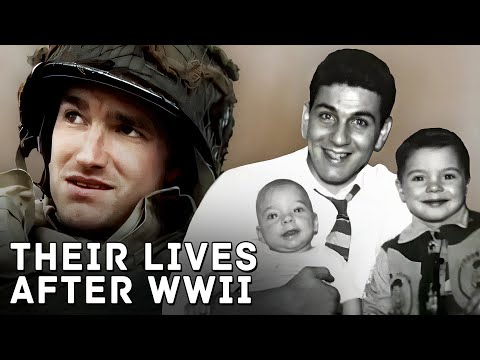
Take Joseph Liebgott, for instance. The series claims he returned to San Francisco and drove a cab—but that’s only half the story. After the war, Liebgott vanished for two years, leaving his family desperate with worry. They later discovered he was living near Yuma, California, struggling to readjust to civilian life. It was a pattern repeated across Easy Company: men who had faced death daily now faced the silence of peace.
Wild Bill Guarnere lost a leg at Bastogne, but he didn’t lose his spirit. He married his sweetheart before the war ended and raised two sons, though his wooden prosthetic leg made finding work a challenge. “Very few people were going to hire an amputee,” he later wrote. Undeterred, he built houses for twenty years, even climbing scaffolding despite his disability. His legacy? Not just buildings, but the reunions he organized that kept Easy Company together for decades.
Don Malarkey served more time on the front lines than any other member of Easy Company. He returned home, married his college sweetheart, and built a successful career in real estate. But the war never truly left him. “I don’t know how Irene took it,” he wrote of his wife, “my waking up in the middle of the night with the nightmares.” It wasn’t until he reached out to his old comrades that he began to quiet the echoes of battle.
Then there’s Albert Blithe—perhaps the most egregious error in the series. Portrayed as a coward who died in 1948, Blithe actually recovered from his wound, fought in Korea, and rose to the rank of master sergeant. He struggled with PTSD and alcoholism, dying in 1967 from complications of surgery. The series never corrected this injustice.
And who could forget Ronald Speirs? He married an Englishwoman just two weeks before D-Day, only to lose her to her former sweetheart who returned from a POW camp alive. Speirs returned home alone with a broken heart, but he remained friends with his ex-wife and devoted to their son. He stayed in the army, served in Korea, and retired a lieutenant colonel.
These men—and others like Carwood Lipton, Shifty Powers, and Buck Compton—went on to become executives, lawyers, mailmen, and mechanics. They built families, businesses, and communities. Yet the war shaped them forever, a shadow that lingered even in the brightest moments of peace.
As we delve into their individual stories, we uncover not just what happened to these heroes, but what it cost them to become heroes in the first place. Their post-war lives were not just epilogues—they were new battles, fought in silence and often alone.
And some stories, like that of David Kenyon Webster, ended in mystery. The Harvard-educated writer vanished while shark fishing off the California coast in 1961, his boat found empty, his body never recovered. His wartime memoir, published decades after his death, remains one of the most authentic accounts of Easy Company.
These are the stories that Band of Brothers didn’t tell—or told wrong. They are stories of courage beyond the battlefield, of wounds that never healed, and of lives that continued long after the cameras stopped rolling.
Lewis Nixon’s story is one of the most poignant. He returned to the family business, Nixon Nitration Works, but his struggles with alcohol continued. Two marriages had already failed before he met Grace Umez, a woman who finally brought him peace. They married in 1969 and traveled the world together, sharing a love of animals that included an odd menagerie—a cat named Anubis, a one-eyed dog called Nicholas, and a rabbit named Peter.
Nixon remained close friends with Dick Winters until the end. He died of complications from diabetes in 1995, leaving behind a legacy not of his demons, but of the friendship that anchored him through the darkest times.
Dick Winters, the quiet leader who inspired the series, accepted Nixon’s job offer at Nixon Nitration Works after the war. It was while waiting for his train to work that he met Ethel, the woman who would become his wife. They married after just a few months of dating—a whirlwind romance that lasted a lifetime.
Winters was called up for Korea and trained Rangers, but when given the choice on the eve of shipping out, he declined. He’d had enough of war. Instead, he bought a small farm in Pennsylvania, raised two children, and started a successful livestock feed business. It was there he found the peace he’d promised himself on D-Day. He died from Parkinson’s disease in 2011 at age 92.
Carwood Lipton, the glue that held Easy Company together, returned to Marshall College on the GI Bill. He majored in physics and built a career in the glass industry, eventually becoming an executive with Owens Illinois, overseeing operations across America, Spain, London, South Africa, and Switzerland.
Tragedy struck when his wife Joanne died of a heart attack in 1975 at just 50 years old. He remarried the following year to a widow named Marie, whose late husband had been one of his close friends. It was Lipton who suggested the title Band of Brothers, drawing from Shakespeare’s Henry V. He passed away from pulmonary fibrosis in 2001 at age 81.
Shifty Powers, the soft-spoken sniper, never sought glory. After the war, he worked as a machinist and married his wife Dorothy, with whom he shared 60 years and two children. In his later years, he reflected on what mattered most: “Success is those happy times with family, being able to go fishing and hunting, and just getting out in the woods and enjoying yourself.” He died of lung cancer in 2009.
Bull Randleman, the giant of a man, became a service manager for a Caterpillar equipment dealer and later a construction superintendent in Louisiana. He married his wife Vera in 1947 and raised two children. He died in 2003 at age 82, but not before leaving behind a simple testament: “Aside from my wife and children, it’s probably the most important thing that I’ll ever do in my life”—referring to his service with Easy Company.
Frank Perconte, the man who took a bullet in the buttocks, returned to his hometown of Joliet, Illinois, and walked a mail route for 33 years. The people on his route never knew a war hero was delivering their letters. In his later years, when his wife Evelyn developed Alzheimer’s, he visited her every day, combing her hair and taking home her laundry. He lived to be 96.
Buck Compton, the baseball star turned prosecutor, prosecuted Sirhan Sirhan for the murder of Robert Kennedy and was later appointed to the California Courts of Appeal by Governor Ronald Reagan. He retired in 1990 and lived out his days in Washington state. He died of a heart attack in 2012, survived by his two daughters and four grandchildren.
Doc Roe, the angel of Easy Company, ran a construction business after the war. He and his English wife Vera had three children, including a daughter named Maxine—a nod to the fake name Vera had given him when they first met. They divorced after 27 years, but Roe remarried and lived quietly until his death from lung cancer in 1998.
George Luz, the company jokester, became a handyman in Providence, Rhode Island. He married his childhood friend’s sister, Delvina, and raised three children. In 1998, a massive industrial clothes dryer—weighing over 7,000 pounds—fell on him at work, killing him instantly. He was 77. As his son later said, “Everybody who knew my dad loved him.”
These men returned to ordinary lives, but they were never ordinary. They carried the weight of war into peace, some finding solace, others struggling in silence. Their stories remind us that heroism doesn’t end when the fighting stops—it simply changes form.
Their stories remind us that heroism doesn’t end when the fighting stops—it simply changes form. Yet for every veteran who found peace, there were those who never made it home. The men of Easy Company who fell in battle never had the chance to build families, pursue careers, or grow old. Their lives were cut short far too soon, leaving behind grieving families and a nation forever in their debt.
As we reflect on the fates of these remarkable men, we are reminded of the cost of freedom. They were ordinary men who did extraordinary things, and their legacy lives on in the freedoms we enjoy today. The best way to honor their sacrifice is to live lives worthy of it—to remember, to learn, and to never forget.
So what can we take from these stories? Perhaps it’s that heroes are not just made in battle, but in how they live their lives afterward. They faced their own struggles, their own demons, and they persevered. That, too, is a kind of courage.
Which of these stories resonated most with you? Share your thoughts in the comments below.
Report this article
Select a reason for reporting:






