What was that? What the hell was that? It went by like we were standing still. The roar came from nowhere, a blur of silver slicing through the sky at a speed that defied belief. It was the Messerschmitt Me 262, the world’s first operational jet fighter, and it flew 150 mph faster than anything the Allies had. In that moment, a new era was born—and the world would never be the same.
But this was just one of many innovations to emerge from the darkest chapter of the 20th century. During World War II, Nazi Germany established an unprecedented research network, driven by economic isolation and military desperation. The result was a set of inventions that, despite their totalitarian origins, would transcend the conflict and embed themselves in every corner of modern life.
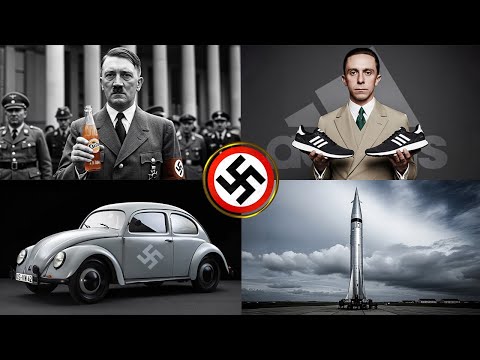
Some are obvious: the Sturmgewehr 44, the first assault rifle, set the standard for modern firearms. Others are more surprising: the Volkswagen Beetle, designed as a “people’s car” under Hitler’s regime, became a global icon of mobility. And then there’s Fanta—the soft drink born from wartime scarcity that now sells billions of cases worldwide.
Even the companies we know today—BMW, Hugo Boss, Adidas, and Puma—have roots tangled with the Third Reich. These brands, now symbols of luxury, fashion, and sport, were once cogs in the Nazi war machine. Their stories are a troubling paradox: how did inventions conceived in oppression become integral to our daily lives?
Consider Fanta. When trade embargoes cut off Coca-Cola’s German branch from essential ingredients, director Max Keith improvised a drink from whey, apple residue, and fruit scraps. It was a survival tactic, yet it became a symbol of national self-sufficiency. By 1943, over 3 million cases were sold. After the war, Fanta vanished—only to be reborn in 1955 with a new formula and a global identity. Today, it’s Coca-Cola’s second best-selling drink.
Or take the Autobahn. Though the idea of a national highway network predated the Nazis, Hitler’s regime drove its expansion as a propaganda tool and strategic asset. The high-speed, grade-separated roads impressed foreign observers, including Dwight D. Eisenhower, who later championed the U.S. Interstate Highway System. The Autobahn became a model for modern road transport worldwide.
And then there’s the V2 rocket. The first long-range ballistic missile, it was developed by Wernher von Braun and his team under horrific conditions, with thousands of forced laborers dying in the process. After the war, von Braun surrendered to the Americans and became a key figure in the U.S. space program. His work on the V2 directly contributed to the rockets that would eventually take humans to the moon.
These innovations—and many others like the jet engine, the assault rifle, and even the Olympic torch relay—show how technology born in darkness can shape a brighter future. But as we enjoy the conveniences they brought, we must also remember the context of their creation. The legacy of the Third Reich is not just one of horror, but also of unintended consequences that continue to influence our world today.
In the following pages, we will explore fifteen of these inventions, from the battlefield to the breakfast table, and uncover the hidden history that surrounds us all.
Yet the story of these inventions is not simply one of technological triumph. Each carries with it a shadow, a reminder that progress and cruelty can emerge from the same crucible. The V2 rocket killed thousands in London and Antwerp, but its design also launched humanity toward the stars. The Me 262 terrorized Allied bomber crews, yet its swept-wing aerodynamics informed generations of aircraft that followed.
Consider the Enigma machine. At Bletchley Park, Alan Turing and his team cracked its seemingly unbreakable code, shortening the war by years and saving countless lives. But the effort also gave birth to Colossus, the first programmable digital computer. From that secret British project emerged the foundation of modern cryptography—the invisible architecture that now protects every credit card transaction, every encrypted message, every secure login we take for granted.
The paradox deepens when we look at the people behind these breakthroughs. Hugo Boss sewed uniforms for the SS, yet his company now dresses executives and celebrities. Ferdinand Porsche designed the Beetle under Hitler’s direction, yet that same car became a beloved symbol of freedom and practicality for millions. The Dassler brothers, both Nazi Party members, founded Adidas and Puma—rival brands that now sponsor athletes across the globe.
Perhaps the most unsettling example is Pervitin. The German army distributed millions of methamphetamine tablets to soldiers, believing it could replace sleep and boost performance. Troops marched for days without rest, feeling invincible—until the paranoia, addiction, and collapse set in. That same chemical structure later became the basis for crystal meth, a drug that has devastated communities worldwide. The line between a wartime stimulant and a modern epidemic is disturbingly thin.
And then there is the Ho 229, the flying-wing jet fighter that never saw combat. American engineers captured its prototype and studied its shape for decades. When Northrop Grumman designed the B-2 Spirit stealth bomber in the 1980s, the resemblance was unmistakable. The Horton brothers’ radical vision, born in the final desperate months of the war, had anticipated the invisible aircraft of the 21st century.
Even the Olympic torch relay—now a global symbol of peace and unity—began as a propaganda spectacle orchestrated by Joseph Goebbels’ ministry. The flame that travels from Olympia to the host city each four years was first conceived to link Nazi Germany to the glory of ancient Greece. What was designed to glorify a dictatorship became a ritual watched by billions, its origins carefully forgotten.
These stories force us to confront an uncomfortable truth: innovation is rarely pure. The same regime that committed unprecedented atrocities also produced technologies that shape our daily lives. The jet engine, the highway, the assault rifle, the computer, the night-vision scope, the soft drink—all emerged from a period of extreme pressure, scarcity, and moral collapse.
As we move through this examination of fifteen inventions, we must ask ourselves not only what they made possible, but also what they cost. The engineers who designed them were not monsters in laboratories—they were people, often brilliant, often compromised, working within a system that demanded results at any price.
The full accounting begins with the machines of war. The Sturmgewehr 44 was not merely a new rifle; it was a philosophical shift in how infantry combat would be waged. Its intermediate cartridge—the 7.92×33mm Kurz—struck a balance between the reach of a bolt-action rifle and the rapid fire of a submachine gun. Hugo Schmeisser’s design allowed a soldier to alternate between precise single shots and controlled automatic bursts, a flexibility that had never existed before.
Where the STG-44 reached the Eastern Front, reports filtered back that units equipped with it suffered fewer casualties. The weapon let men suppress an enemy while advancing, rather than exposing themselves during the slow cycle of a bolt action. Yet it arrived too late and in too few numbers. Germany’s factories were collapsing under Allied bombs, and only around 400,000 were ever built.
The true impact came afterward. Soviet engineers studied captured examples, and Mikhail Kalashnikov’s AK-47 absorbed the same principles—the intermediate round, the fire selector, the detachable magazine. Within two decades, the assault rifle had become the standard infantry weapon of virtually every army on Earth. The STG-44’s silhouette faded, but its logic conquered the world.
The same pattern repeats across the battlefield. The MG 42, with its terrifying rate of fire—up to 1,200 rounds per minute—earned the nickname ‘Hitler’s buzzsaw’ from Allied soldiers who heard it. Its design influenced the modern general-purpose machine gun, and its stamped-metal construction showed how weapons could be mass-produced cheaply and quickly.
In the air, the Me 262’s swept wings and jet propulsion were studied by every victorious power. Frank Whittle’s British engine and Hans von Ohain’s German design had raced in parallel, but it was the Me 262 that proved a jet fighter could dominate the sky. Its weaknesses—fragile engines, short range, vulnerable runways—were engineering problems, not conceptual ones.
When Eric Brown, the British test pilot, climbed into a captured Me 262, he called it the most impressive aircraft of the war. It gave the pilot a decisive advantage: the ability to choose when to fight and when to flee. That principle—speed as tactical freedom—remains the heart of air combat doctrine to this day.
And then there is the V2. Its guidance system, its liquid-fuel engine, its supersonic descent—each was a leap that no other nation had achieved. When Wernher von Braun’s team surrendered to the Americans, they brought not just hardware but knowledge. The Redstone rocket, the Mercury program, the Saturn V—all carried the DNA of Peenemünde. The same engineers who built a weapon of terror later built the rocket that carried men to the moon.
But the cost was never abstract. The V2 factories at Mittelwerk were underground tunnels where tens of thousands of prisoners worked and died. More people perished building the V2 than were killed by its explosions. This is the arithmetic of the Third Reich’s innovation: progress measured in corpses.
The civilian inventions carry the same double edge. Pervitin kept soldiers awake for the Blitzkrieg, but its chemical cousin now fuels a global addiction crisis. The Nazi quest for a performance-enhancing pill anticipated the modern debate over cognitive enhancers and stimulant abuse.
The Autobahn’s concrete ribbons were laid by forced laborers, yet they became the template for Eisenhower’s Interstate system—a project that reshaped American life, commerce, and culture. Every road trip on an American highway retraces, in a small way, a line drawn by the Third Reich.
And the Volkswagen Beetle—the ‘Strength Through Joy’ car that few German families ever received—became the most produced car in history. In Mexico, it was a taxi. In Brazil, a family heirloom. Its air-cooled engine and simple mechanics made it a lifeline in places where roads were rough and mechanics scarce. The irony is almost too neat: a car designed to serve a dictatorship became a symbol of personal freedom.
Fanta is perhaps the most mundane example, and that is precisely what makes it unsettling. A drink improvised from whey and fruit scraps became a global brand associated with youth and play. When Coca-Cola launched a 2015 campaign celebrating Fanta’s 75th anniversary, it omitted the war entirely—and was forced to apologize. The past, it seems, does not stay buried.
So the question is not whether these inventions changed the world. They did. The question is what we owe to the memory of how they came to be. Every jet engine, every highway, every bottle of orange soda carries a trace of the system that produced it. To forget that is to accept a sanitized history—one where progress arrives without cost and genius exists without guilt.
The engineers and entrepreneurs who built these things were not all monsters, but they worked within a monstrous system. Some were opportunists, some were true believers, some were simply trying to survive. Their creations outlived them, outlived the regime, and outlived the war. They are ours now, for better and for worse.
And as we continue through this catalog of fifteen inventions, the pattern becomes clear: the line between necessity and atrocity, between innovation and exploitation, is thinner than we would like to believe. The next invention on our list shows just how far that line can stretch—and how deeply it can cut.
The final invention on our list is not a weapon or a vehicle—it is the Enigma machine, the code that changed the world. At Bletchley Park, Alan Turing’s team cracked its ciphers and shortened the war by years. But the effort also birthed Colossus, the first programmable digital computer, and the foundations of modern cryptography. Every secure login, every encrypted message, every credit card transaction now rests on the shoulders of that secret British project.
The paradox is complete. From a regime built on surveillance and terror came the tools of digital privacy. From a war machine came the seeds of peace-time innovation. The legacy of the Third Reich is not a simple story of evil—it is a warning about how brilliance and brutality can share the same laboratory.
As we close this catalog of fifteen inventions, the pattern is clear: the line between necessity and atrocity is thinner than we would like to believe. These technologies are ours now, for better and for worse. But knowing their origins is the first step toward using them wisely.
What do you think—should we celebrate these inventions despite their dark beginnings, or does their origin forever taint their value? Share your thoughts below.
Report this article
Select a reason for reporting:






