The basement archive of the Boston Historical Society smelled of old paper and dust that had settled for decades. Dr. Emma Richardson pulled another cardboard box from the metal shelf, her fingers leaving trails in the grime. It was her third month cataloging the Victorian photograph collection, and most days blurred into an endless stream of stern faces and faded sepia tones. This particular box had been mislabeled, marked as agricultural equipment 1880s, but filled with family portraits.
She sighed, brushing off the lid. Just another box of unknowns. But as she lifted the first photograph, her breath caught. It was a family portrait from 1871, and something about it felt… wrong. The father stood rigid, the mother’s smile too tight, and the young girl in the center stared straight ahead with eyes that seemed to hold a secret. Emma’s heart quickened. She had seen thousands of these, but this one was different.
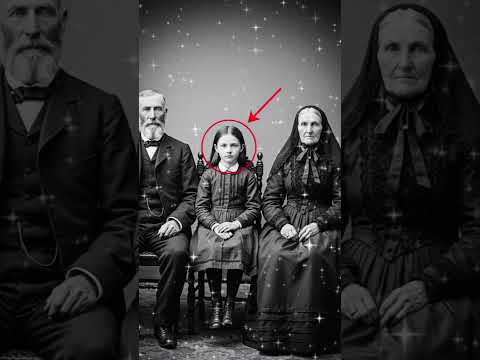
She placed it under the desk lamp, the black-and-white image sharpening. The girl couldn’t have been more than ten, her dress immaculate, her hands folded neatly. But those eyes—they looked terrified. Emma leaned closer, her pulse pounding. Why would a child look so afraid in a family portrait? She grabbed a magnifying glass from her drawer, her hands trembling slightly.
As she zoomed in, the details emerged. The girl’s eyes weren’t just scared; they were focused on something off-camera. And in the reflection of her pupils, Emma saw it: a shadowy figure standing behind the photographer. She gasped, dropping the glass. This wasn’t just a portrait. It was a warning.
Emma’s mind raced. Who was the girl? Why had this photo been hidden away? She flipped it over, searching for any inscription. Nothing. Just a faded number: 47. She checked the box again, finding a brittle envelope tucked beneath the others. Inside, a single sentence scrawled in ink: “She saw him before he took them.” Emma’s blood ran cold. The girl had witnessed something—something that led to their disappearance.
She needed answers. But as she reached for her phone to call her colleague, the lights flickered. Once. Twice. Then went out completely. In the darkness, Emma heard a soft whisper, almost like a child’s voice: “Don’t look.” But it was too late. She had already seen.
The darkness pressed in around her, thick and suffocating. Emma stood frozen, the photograph still clutched in her hand. The whisper had come from somewhere behind the shelves—or maybe from inside her own head. She couldn’t tell anymore.
Her phone. She needed her phone. She fumbled across the desk, knocking over the magnifying glass, which clattered against the concrete floor. “Don’t look,” the voice repeated, softer now, almost pleading. Emma’s fingers closed around her phone, and she thumbed on the flashlight.
The beam cut through the dark, sweeping across the shelves. Nothing. Just boxes and dust and the low hum of the building’s ancient heating system. She exhaled, a nervous laugh escaping her lips. “Get it together, Emma. You’re a historian, not a ghost hunter.”
But when she turned the light back toward the desk, the photograph was gone. The envelope too. In their place sat a small brass key, tarnished and cold, with a tag looped through its ring. The tag bore a single word, written in the same spidery ink as the note: Basement.
Emma’s breath hitched. She was already in the basement—the deepest level of the archive, sub-level two. There was no lower floor. She’d checked the building plans herself during orientation. Yet the key felt heavy in her palm, insistent, as though it had been waiting decades for someone to pick it up.
She thought of the girl’s eyes. The shadowy figure. The whisper. Every instinct told her to walk upstairs, call security, report the missing photograph. But another part of her—the part that had spent three months cataloging other people’s forgotten lives—needed to know.
She crossed the room to the far wall, where a rusted metal cabinet stood bolted to the concrete. She’d assumed it was electrical housing. But now, with the key in hand, she noticed the small keyhole beneath the handle, nearly invisible under layers of paint. The key slid in perfectly.
Inside the cabinet, there was no wiring. Only a narrow stairwell descending into absolute blackness, and a draft of cold air that smelled faintly of lilacs—the same scent, she realized with a shiver, that had clung to the old photograph.
From somewhere below, the whisper rose again, clearer this time, and unmistakably a child’s voice: “You looked. Now you have to see.”
Emma hesitated at the top of the stairs, one hand braced against the cabinet frame. The sensible part of her brain was screaming now, loud and insistent. Call someone. Anyone. Don’t go down there alone. But the stairwell seemed to breathe, a faint current of air rising to meet her, carrying that impossible lilac scent.
She pulled out her phone and thumbed a quick text to her colleague Marcus: Basement sub-2. Found something. Come down if I don’t answer in ten. Then, before she could talk herself out of it, she stepped onto the first stair.
The metal groaned beneath her weight. The flashlight beam bounced off damp brick walls, revealing a narrow passage that angled downward at a steeper pitch than any building code would allow. The stairs went deeper than the archive’s foundation should have permitted. Emma counted them under her breath—twelve, thirteen, fourteen—and still the bottom didn’t come.
At the twentieth step, her foot struck something soft. She aimed the light down and stifled a cry. A child’s shoe. Small, leather, scuffed at the toe—exactly the kind worn by the girl in the photograph. Beside it lay a second shoe, and beyond that, a scattering of objects: a tin soldier, a hair ribbon, a marble that glinted in the beam.
Emma crouched, her knees trembling. She picked up the hair ribbon. It was faded blue silk, still tied in a neat bow. These weren’t props. They were belongings, left here deliberately, arranged like a trail.
She straightened and swept the flashlight forward. The stairwell opened into a low-ceilinged room, no larger than a walk-in closet, its walls lined with shelves. Not archive shelves—these were rough-hewn wood, sagging under the weight of dozens of glass jars. Each jar held a photograph, curled and yellowed, submerged in cloudy liquid.
Emma lifted one from the nearest shelf. The label read Number 12—1871. Inside, a family stared out through the murk, their faces warped by the curve of the glass. She moved to the next jar. Number 23—1874. Another family. Another portrait. All of them frozen in that same stiff, formal pose.
Her light caught something on the far wall—a charcoal drawing pinned above a small wooden desk. It showed a tall figure in a long coat, his face blank and featureless, one hand extended toward the viewer. Beneath it, in a child’s careful cursive: He collects the ones who see him. I am next.
Emma’s phone buzzed. Marcus. On my way. What’s going on? She started to type a reply, but her thumb froze above the screen. From the darkness behind her, at the foot of the stairs, came the soft scuff of a footstep. Then another.
The whisper returned, no longer pleading but almost gentle, almost kind: “You brought someone with you. Good. He likes it when there’s more than one.”
Emma’s thumb jammed the send button. “Marcus, don’t come down. Stay up—” The message cut off as her screen flickered and died, the battery icon flashing red despite a full charge moments before.
The footsteps stopped. A shape stood at the base of the stairs—not the faceless figure from the drawing, but something smaller, child-sized. The girl. She held up one hand, palm out, as though warning Emma to stay back.
“He’s already here,” the girl whispered. “He’s always here. The jars keep him fed, but he wants a new one.” She pointed at the empty jar on the desk, its lid unscrewed, waiting.
Emma’s historian brain, the one that had cataloged thousands of forgotten lives, finally understood. The photographs weren’t records. They were cages. Each family trapped in glass, sealed away so the thing in the coat couldn’t take them. But the girl in 1871 had seen him—and seeing was the invitation.
Above her, the archive door slammed open. Marcus’s voice echoed down the stairwell: “Emma? You down there?” The child’s eyes went wide with terror. “No—don’t let him see you!”
Emma grabbed the empty jar and the brass key, shoved them into her coat, and launched herself up the stairs. She collided with Marcus on the landing, pressing the key into his palm. “Lock the cabinet. Now. And whatever you do, don’t look behind you.”
He fumbled with the lock, hands shaking, as a cold draft of lilac-scented air rushed past them. The cabinet clicked shut. The whispering stopped.
They sat on the archive floor, breathing hard, until the lights flickered back on. The photograph of the 1871 family lay on the desk again, exactly where Emma had first set it. But now, in the girl’s eyes, there was no fear. Only a quiet, grateful stillness—and a single tear, caught forever on a cheek that had never aged.
Emma never cataloged box 47. She sealed the record with a note of her own: Do not open. Do not look. But sometimes, late at night, she wonders if the girl is still down there, keeping watch—and whether someone else will find the key.
What would you have done when the whisper said your name?
Report this article
Select a reason for reporting:






