It was just a wedding photograph. A bride and groom side by side in 1894, their faces frozen in time. At first glance, it seems like an ordinary wedding portrait of the time. Formal, serene, nothing special.
But look closely. Look at her hands.
The bride’s hands tell a story that words never could. Scars, deep deliberate marks etched into her skin. What happened to this woman? Why is she standing next to a man who, according to all the laws and customs of the time, should never have married her? And why did someone hide this photograph for over 130 years?
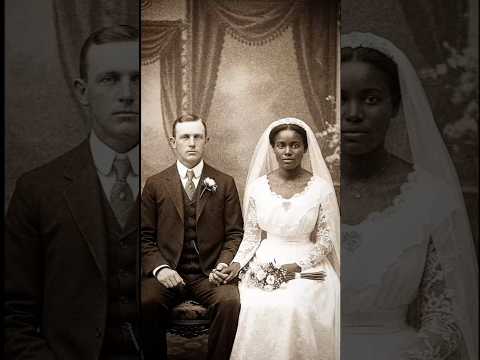
This is not just a picture. It is a crime scene of the heart.
The year is 1894. The place: a small town in the American South, where the color line is drawn in blood and law. A white man and a black woman, standing together as husband and wife. In that time and place, their love was illegal. Their marriage, a felony. Their very existence together, an act of defiance that could get them killed.
Yet there they are. His hand rests gently on her shoulder. Her eyes look straight ahead, unbroken. And those hands—those scarred, deliberate hands—clasped in front of her, holding a secret that has waited more than a century to be told.
Who was she? Her name was Eliza. A seamstress, they said. A quiet woman who kept to herself. But the scars on her hands were not from needle pricks. They were from something far darker. Whipping scars. Branding scars. The marks of punishment for a crime she did not commit—loving a man the world said she could not have.
Who was he? Thomas. A farmer. A man of few words and deep convictions. He had seen Eliza in town, watched her endure the stares and the whispers. And he had decided, against every warning, that he would not let her face it alone.
Their wedding was small. Secret. A preacher who owed Thomas a favor. Two witnesses who swore to silence. And a photographer, hired to capture the moment—not for celebration, but for proof. Proof that they had stood together, if only for one day.
But someone found out. Someone always finds out.
The photograph vanished. Hidden in an attic, tucked inside a book, passed down through generations with a warning: never show this to anyone. And for 130 years, no one did. Until now.
What happened to Eliza and Thomas after the shutter clicked? Why did the scars on her hands become the key to unlocking their story? And what does that hidden photograph reveal about a love that refused to be erased?
The answers lie in the details—in the scars, in the silence, in the shadows of a picture that was never meant to be seen.
The attic belonged to a woman named Cora, Thomas’s great-granddaughter. She found the photograph while clearing out her late mother’s house, wedged inside a leather-bound Bible that had not been opened in decades. The image slipped free and fluttered to the floorboards, and Cora knelt there for a long time, staring at faces no one in her family had ever spoken of.
On the back, in faded pencil, a single line: “For the child, when she is old enough to understand.”
That was the first mystery. There was no child in the photograph. No cradle, no small hand reaching into the frame. But the message was clear—someone had meant this picture to be found, just not by everyone. Not yet.
Cora began to dig. She wrote to the county clerk, to the historical society, to a distant cousin in another state who still kept the old family papers. What came back to her, piece by piece, was a story stitched together from tax records and church ledgers and one brittle letter that had survived by accident.
The letter was from the preacher—the one who owed Thomas a favor. He wrote it years after the wedding, to a friend he trusted, and in it he confessed that he had feared for his life the night he married them. “I have joined many souls in my time,” he wrote, “but never two who knew so well the cost of the joining.”
He described the ceremony in careful, trembling script. A barn. A lantern. Eliza in a borrowed dress, her hands folded so the scars would not show. Thomas repeating his vows in a voice so low the witnesses had to lean close. And afterward, the photographer setting up his tripod while the preacher prayed it would never be needed as evidence.
But it was needed. Within a month, a neighbor had reported them. A mob gathered at Thomas’s farm one night, and what happened next was never written down in any official record—only hinted at in the spaces between the lines.
Thomas was beaten. Eliza was taken. And the child—the child the photograph was meant for—was born the following spring, in a room with no windows, to a mother whose hands had been marked a second time.
Cora sat with that for a long while. Then she turned the photograph over again and noticed something she had missed. Along the bottom edge, nearly worn away, another line of pencil. Smaller. Written by a different hand.
“She lived. She remembered. She never stopped looking for you.”
Cora read those words a dozen times before she understood what they meant. The second line was not written by the same hand as the first. It was written by someone who had come later—someone who had known Eliza, or known of her, and wanted the truth to survive.
She took the photograph to a conservator in the city, a woman named Dr. Alcott who specialized in early photographic processes. Under a magnifier, the conservator confirmed what Cora had begun to suspect. The image was a salt print, common enough for the period, but the paper had been carefully mounted on a second sheet—a backing that had been added decades after the original exposure.
“Someone preserved this twice,” Dr. Alcott said. “Once when it was taken, and once when it was hidden. They wanted it to last.”
Beneath the backing, tucked into the mount, was a sliver of folded paper no larger than a thumbnail. Cora unfolded it with trembling fingers. A name. An address. And a date: 1927.
The address belonged to a boarding house in a city three hundred miles away. Cora wrote to the historical society there and received, weeks later, a packet of copied records. The boarding house had been run by a woman named Ruth, a widow who took in “respectable working women.” Among her long-term boarders, listed year after year in the city directory, was a seamstress named Eliza—no surname given, as was common for women who wished to disappear.
Cora cross-referenced the dates. Eliza had arrived in 1895, a year after the wedding. She had stayed for thirty-two years. She had paid her rent on time, attended no church, and kept a small sewing business that catered to the wives of merchants and lawyers.
But the records held one detail that made Cora’s breath catch. In 1927, the same year written on the slip of paper, Eliza had petitioned the county for a copy of a birth record. The petition was denied—the record had been sealed, or destroyed, or perhaps never officially existed at all.
Yet someone had tried. After three decades of silence, Eliza had walked into a government office and asked for proof of her own child. And she had been turned away.
Cora thought of the scars on those hands. The whipping. The branding. The second marking, in that windowless room. And then this—a third wound, quieter, delivered by a clerk with a stamp and a shrug.
She wrote again to the distant cousin, asking about the child. The cousin replied with a single photograph of her own: a young woman in a high-collared dress, standing beside a bicycle, her face turned slightly away from the camera. On the back, in the same careful hand as the second pencil line, were the words: “Ada. Raised by her grandmother’s people. Never told the whole truth.”
Ada. The child in the photograph. The reason for the message, the hiding, the century of silence.
Cora set the two images side by side on her kitchen table—the wedding portrait and the young woman with the bicycle—and saw what no one had seen in over a hundred years. The same set of the jaw. The same steady, unbroken gaze.
Eliza had not vanished after the mob came. She had rebuilt herself, thread by thread, in a city that did not know her name. And she had spent the rest of her life waiting for a daughter who was raised to believe her mother was gone.
Cora closed her eyes and let the weight of it settle. Then she did the only thing left to do: she wrote it down. Every piece—the scars, the barn, the letter, the sliver of paper—she gathered into a folder and mailed it to the historical society with a simple note: “This is for Ada’s people. All of them.”
Weeks later, a reply came. A great-granddaughter of Ada had seen the file. She had grown up hearing whispers of a seamstress who disappeared, but no one had ever known her name. Now they did.
The two women met at a diner off the highway, each carrying a copy of the same photograph. “She never stopped looking,” Cora said. “Neither did we,” the other replied.
They drove to the old boarding house that afternoon. The building still stood, its windows dark, its porch sagging. On the sidewalk, Cora knelt and pressed her palm flat against the concrete, as if she could feel the echo of footsteps that had worn it smooth.
No one spoke. There was nothing left to say that the photograph had not already said.
But the story is not finished. It never is. Somewhere, in another attic, another box, another unopened Bible, there is another face waiting to be seen. Another hand, scarred or smooth, holding a secret. Another love that refused to be erased.
What would you do if you found a photograph like this—would you hide it again, or would you finally let it speak?
Report this article
Select a reason for reporting:






