In the dead of night, July 21, 1918, a group of Australian soldiers crawled into no man’s land with nothing but rope, bare hands, and a plan so audacious it bordered on insanity. Their target: a 30-ton German tank named Mephisto, the rarest war machine on Earth, stuck in a shell crater between the trenches. The British had already written it off as impossible to recover. But these men—farmers and stockmen from Queensland—saw not a wreck, but the ultimate trophy.
“The British looked at it, shook their heads, called it impossible. But the Australians, they saw the ultimate trophy. And mate, they were taking it home.”
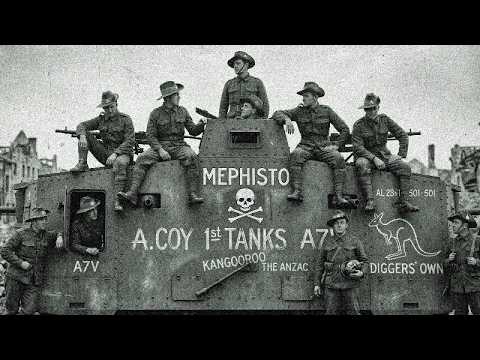
Mephisto wasn’t just any tank. It was an A7V Sturmpanzerwagen, Germany’s answer to the British rhomboids—a moving fortress 5 meters tall, wrapped in 30mm of Krupp steel, crewed by 18 men and bristling with a 57mm cannon and six machine guns. Only 20 were ever built, each worth its weight in strategic gold. And now one sat helpless in the mud, exactly halfway between the trenches.
The Australians of the 26th Battalion had taken over the sector in July. They were not professional soldiers playing gentlemanly war; they were blokes who’d grown up wrestling cattle and fixing machinery with fencing wire. To them, the stranded tank was a challenge and an insult. The British staff had their tea and updated their maps, but the diggers had other ideas.
Planning began in secret. The 26th needed heavy recovery vehicles from the British Tank Corps, which they secured with a mix of respect and sheer audacity. The actual dirty work—crawling through mud under sniper fire, digging out the tracks by hand, threading steel cables under the hull—would be done by Australian volunteers. The night chosen was July 21st, new moon, maximum darkness. The plan: crawl out, dig, rig, and drag the beast back before dawn. If spotted, German artillery would turn the area into a crematorium.
Zero hour arrived. The diggers slipped over the parapet like ghosts, crawling on their bellies through mud that stank of decay and four years of slaughter. Every sound was magnified; every flare a death sentence. Reaching Mephisto was only the beginning. The tank was buried deep, tracks embedded in clay like concrete. They dug with bare hands and sharpened sticks, fingernails breaking, hands bleeding, freezing at every distant rifle crack.
Threading the recovery cables was its own special hell. The cables were thick and rigid, and getting them underneath a 30-ton tank required crawling into gaps that barely fit human shoulders. One mistake and the cables could snap under tension, decapitating anyone in the wrong spot.
Hours passed. The darkest part of night slipped away. The recovery vehicles were positioned as close as possible without drawing fire. When the signal came, they’d have minutes to complete the extraction before German observers spotted the operation. The diggers attached the final cables, checked the connections, and crawled clear. A runner sprinted back with the all-clear. The British tankers fired up their engines.
30 tons of stuck German steel didn’t want to move. The recovery vehicles strained, engines screaming, tracks chewing dirt. For a terrifying moment, nothing happened. The cables stretched. Metal groaned. Then, with a sound like the Earth itself giving birth, Mephisto shifted. Inch by agonizing inch, the A7V came loose from its muddy grave.
That’s when the Germans noticed. Flares shot up, turning night into artificial day. Machine guns opened up, tracers arcing across no man’s land in glowing streams of rage. Artillery fire started dropping, German observers frantically trying to bracket the movement. The Australians were already sprinting for cover, diving into shell holes as bullets cracked overhead. The recovery vehicles kept grinding forward, armored enough to shrug off small arms fire but horribly vulnerable to a direct artillery hit.
Shells landed close enough to shower the operation in mud and shrapnel by the time the recovery vehicles hauled Mephisto across the Allied trench line. The Australians dove into cover, adrenaline drunk and laughing like maniacs. They’d actually stolen a 30-ton tank from the middle of no man’s land while both armies watched.
The German command was livid. Reports flew up the chain describing the loss of Sturmpanzerwagen 506—some colonial infantry had literally repossessed one of the Kaiser’s most valuable military assets. The propaganda value alone was catastrophic. Here was proof that German super weapons could be stolen by a bunch of farm boys with rope and audacity. Someone’s career probably ended over Mephisto’s disappearance.
But the story was far from over. The British naturally assumed they’d get custody for technical evaluation, their engineers salivating at the chance to examine German manufacturing. The Australians had different plans. They’d done the bleeding; they’d crawled through hell. According to the ancient law of finders keepers, Mephisto belonged to Queensland.
The battalion painted a large kangaroo on the hull, standing triumphantly atop a crushed German cross. The argument that followed was apparently quite spectacular—British staff officers waving regulations, Australian infantry waving something considerably less polite.
Eventually, someone high enough in the chain decided that letting the diggers keep their prize was less trouble than dealing with a mutiny. Mephisto was officially awarded to the Australian Imperial Force as a war trophy. But getting a 30-ton tank to the opposite side of the planet in 1918 was its own logistical nightmare…
Loading Mephisto onto a ship was a problem that had no precedent. The tank had to be hoisted by crane from the docks at Le Havre, swung out over the water, and lowered into the hold of a freighter with barely inches to spare on either side. The dockworkers—hardened French stevedores who’d seen everything—stopped to watch. Some of them crossed themselves. The crane operator took a long pull from a flask before he started.
The voyage itself was worse. Mephisto sat in the hold like a malevolent iron idol, chained down against the roll of the sea, while the ship pitched through the Bay of Biscay and down the length of the Atlantic. At one point a storm blew up that had the crew convinced the tank would tear loose and punch straight through the hull. It didn’t. But the sailors gave Mephisto a wide berth for the rest of the trip, and more than one of them swore the thing was cursed.
Six weeks later, the ship rounded the headland into Moreton Bay, and the tank that had terrified the Western Front came home to Queensland.
Brisbane turned out in force. The papers had been running the story for weeks—“QUEENSLAND BOYS STEAL KAISER’S TANK”—and by the time the freighter docked, half the city had found an excuse to be near the wharves. Schoolchildren waved flags. Old men who’d never see the front stood on tiptoe to catch a glimpse. When the crane lifted Mephisto clear of the deck and set it down on Australian soil, the cheer could be heard across the river.
The kangaroo was still there, that defiant white outline stamped on 30 tons of captured German steel. A brass band played. Politicians made speeches that nobody remembered afterward. And the diggers who’d actually done the crawling and the digging and the bleeding stood off to one side, grinning at each other, because they knew something the crowd didn’t: the best part wasn’t the parade. The best part was that the British had said it couldn’t be done.
The tank toured the state like a traveling carnival. It sat on a flatbed rail car and rolled through towns that had sent their sons to the war and gotten telegrams back instead. Farmers drove in from fifty miles out to see it. Kids climbed the sides until the police chased them off. Veterans stood in front of it for a long time without saying anything at all.
One old corporal, a Gallipoli man with a missing ear and a stare that went somewhere far away, walked the length of Mephisto three times before he spoke. “So that’s what we were fighting,” he said finally. “Bloody hell. No wonder it took us so long.”
Then he laughed, and thumped the steel with his fist, and said it was the finest souvenir he’d ever seen.
By the time Mephisto reached the Queensland Museum, the story had already begun to grow in the telling. The cables had been thicker. The shells had landed closer. The German sentries had come within a whisker of catching the diggers in the act. Every retelling added a new flourish, and nobody in the 26th Battalion ever bothered to correct the record. Why would they? The truth was already extraordinary enough.
But the museum years brought a quieter kind of battle—the slow war against rust, rot, and time itself. The tank sat outdoors at first, exposed to the Queensland sun and the subtropical rain. Its steel skin began to pit. The paint faded. Weeds grew up through the tracks. For a while, it looked like the greatest trophy in Australian military history might quietly dissolve back into the earth it had been stolen from.
It took a generation of stubborn museum curators to change that. They argued, fundraised, and fought for a proper home for Mephisto—an enclosed space where the elements couldn’t reach it. The tank was moved, and moved again, each relocation a minor engineering epic in its own right.
And through every restoration, every move, every decade of neglect and revival, the kangaroo stayed. Faded, chipped, painted over and repainted, but always there—a claim of ownership that had now outlasted the empire that built the tank and the empire that tried to take it.
The strangest chapter came decades later, when a delegation from Germany arrived with lawyers and cultural heritage paperwork and a proposal for a long-term loan. The Australians listened politely. They served tea. They showed the delegation around the museum, pointed out the bullet scars, explained the history.
Then they said no.
The delegation tried again the following year. And the year after that. Each time the answer was the same, delivered with the same cheerful Australian finality. The tank was won fair and square, in the middle of no man’s land, by men who’d been told it was impossible. That kind of thing isn’t for loan.
The Germans, to their credit, eventually stopped asking. But they never stopped visiting. And on those visits, standing in front of the last A7V on Earth, even the most formal delegation from Berlin would go quiet for a moment—because whatever else Mephisto was, it was also a reminder of what their own empire had been, and what it had lost.
Today, Mephisto sits in the Queensland Museum, the only surviving A7V in existence. Schoolchildren stand before it with wide eyes while teachers tell the story of the night a bunch of Queensland farmers stole a German super weapon with rope and bare hands. The kangaroo still stands triumphant atop the crushed cross, faded but defiant.
Military historians make pilgrimages from around the world. German museums still occasionally inquire about its return. The answer remains the same cheerful, immovable no. Some things are won fair and square, and some things are won by crawling through hell with bleeding hands because someone told you it couldn’t be done.
The British called it impossible. The Germans called it theft. The Australians called it a souvenir. And a century later, that souvenir still stands—30 tons of captured steel, bullet-scarred and rust-streaked, telling the most Australian story ever told.
So here’s the question for you: if you saw something priceless sitting just out of reach, defended by impossible odds and every expert saying no—would you have the guts to crawl out there and take it?
Report this article
Select a reason for reporting:






