He was the most trusted captain of his era, a man whose very presence on the bridge reassured the world’s wealthiest passengers. Yet on the night of April 14, 1912, Captain Edward J. Smith faced a catastrophe that would forever define his legacy. But who was the man behind the legend? How did a boy from the Staffordshire potteries come to command the largest ship ever built?
Edward John Smith’s journey from a steam hammer operator to the commodore of the White Star Line is a tale of ambition, skill, and relentless determination. Born in 1850 in Hanley, Staffordshire, young Edward seemed destined for a life in the pottery industry, far from the sea. But inspired by his half-brother Joseph Hancock, a sailing ship captain, Edward set his sights on the ocean.
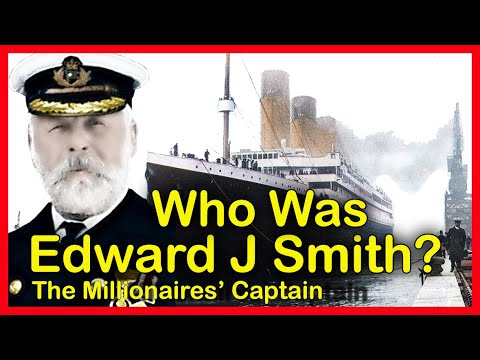
At 17, he left for Liverpool and began an apprenticeship aboard the SS Senator Webber. This first step into maritime life would set him on a path to greatness. Smith’s talents were quickly recognized, and by 1880, he had joined the White Star Line, serving as fourth officer on the SS Celtic. His rise was meteoric: within seven years, he received his first command, the SS Republic.
Smith’s reputation for safety and reliability grew. He was known as the “Millionaire’s Captain” because the wealthy elite would only sail on ships he commanded. His popularity among passengers was unmatched, and the White Star Line entrusted him with their newest and grandest vessels. In 1904, he took command of the RMS Baltic, followed by the RMS Adriatic in 1907. Each maiden voyage was a testament to his skill and the line’s confidence in him.
But Smith’s career was not without mishaps. In 1911, while commanding the RMS Olympic, he was involved in a collision with the British cruiser HMS Hawke. The inquiry found Smith at fault, tarnishing his previously unblemished record. Despite this, when the White Star Line prepared to launch the RMS Titanic, there was no doubt about who would be at the helm.
At 62, Smith was entrusted with the grandest ship ever built. Some said it would be his last command before retirement. As the Titanic left Southampton on April 10, 1912, Smith’s swift action averted a disaster when the SS City of New York was pulled toward the ship. But four days later, the unthinkable happened: the Titanic struck an iceberg.
The collision was a glancing blow, but the damage was fatal. Below decks, water poured into six compartments. Smith summoned the ship’s designer, Thomas Andrews, who delivered the grim verdict: the Titanic would sink in under two hours. The captain, who had spent decades mastering the sea, now faced a nightmare with only twenty lifeboats for over 2,200 souls.
Accounts of Smith’s final hours are conflicting. Some survivors described him as paralyzed, hesitant to order the lifeboats filled. Others, like Major Arthur Godfrey Peuchen, insisted, “He was doing everything in his power to get women in these boats.” First-class passenger Robert Williams Daniel called him “the biggest hero I ever saw.”
As the ship’s bow dipped and the water rose, Smith released the radio operators from their duties. He then walked the boat deck, telling crewmen, “It’s now every man for himself.” Steward Edward Brown saw him approach with a megaphone, shouting, “Well, boys, do your best for the women and children, and look out for yourselves.” Those were among his last reported words.
What happened next remains a mystery. Some survivors swore they saw Smith in the water near collapsible lifeboat B, handing a baby into the boat before swimming back toward the sinking ship. Others claimed he went down with the ship, standing on the bridge. A few even whispered that he tried to save himself. The truth died with him.
Yet a clue to his character lies in an earlier statement. When asked what he would do if his ship struck a hidden reef, Smith had replied, “Some of us would go to the bottom with the ship.” Those words, spoken years before the disaster, suggest a man who accepted the ultimate responsibility of command.
In 1914, a statue was erected in his honor in Beacon Park, Litchfield. Its plaque reads: “Bequeathing to his countrymen the memory of a great heart, a brave life, and a heroic death.” But the debate over his final moments continues, a haunting question that keeps the legend of Edward J. Smith alive.
Yet the story of Edward J. Smith does not end with the sinking. In the years that followed, the inquiries on both sides of the Atlantic painted a more complicated portrait. At the British Wreck Commissioner’s inquiry, questions were raised not only about Smith’s decisions that night but about the entire culture of the North Atlantic trade. Why had the ship been speeding through an ice field? Why were there so few lifeboats? The answers pointed beyond one man to an industry blinded by confidence.
Still, Smith bore the weight of public scrutiny. Some newspapers, particularly in America, demanded a scapegoat. Senator William Alden Smith, who chaired the U.S. inquiry, seemed baffled by the notion that a captain might go down with his vessel. “Is it the practice of the British seamen to remain on the ship until all the passengers are off?” he asked repeatedly, as if the answer might reveal some foreign code of honor he could not comprehend.
But the British public had already made up its mind. To them, Smith was not a failure but a martyr. The statue in Litchfield became a site of quiet pilgrimage. Letters poured into the White Star Line offices from passengers who had sailed with him, recalling small kindnesses: a word of reassurance to a nervous traveler, a joke shared on deck, the way he remembered a child’s name across a decade of voyages.
One such letter came from a woman who had crossed on the Adriatic years before. She wrote that during a fierce storm, when other passengers had retreated in terror to their cabins, Captain Smith had walked the promenade deck with perfect calm, pausing to speak with anyone who needed comfort. “He told us the ship was built to withstand far worse,” she recalled, “and somehow we believed him, because he believed it himself.”
That unshakable confidence, so admired in peacetime, had become a liability on the night of April 14. The same faith in modern technology that had made Smith a legend now seemed to have blinded him to the danger lurking in the dark water. The irony was not lost on his critics.
His widow, Sarah Eleanor, known as Eleanor, retreated from public life. She had married a sailor and understood the risks, but nothing could prepare her for the scale of the tragedy. She lived quietly in Southampton, receiving condolences from strangers and royalties from a memorial fund established in her husband’s name. She never spoke publicly about the sinking, and when she died in 1931, she was buried beside a memorial stone that simply read: “Captain Edward John Smith, RNR, Commander of the RMS Titanic.”
His daughter, Helen Melville, was only fourteen when her father died. She grew up in the shadow of a legend she could barely remember. In later years, she became a figure of quiet dignity, attending memorial services and corresponding with historians. She once remarked that the world remembered her father as a hero or a fool, but to her, he was simply “a kind man who smelled of salt and pipe smoke, and who always brought presents from faraway places.”
As the decades passed, the legend of Captain Smith evolved with the times. In the 1955 film Titanic, he was portrayed as a stoic figure, dignified to the last. In James Cameron’s 1997 epic, he was shown as a man overwhelmed by circumstance, staring blankly at the rising water before retreating to the bridge. Each generation imagined his final moments according to its own understanding of duty, courage, and failure.
But perhaps the most telling tribute came not from statues or films, but from the men who served under him. Charles Lightoller, the senior officer who survived the sinking, never wavered in his defense of his captain. He insisted that Smith had acted with composure, that the chaos of that night would have overwhelmed any man. “I have never known a finer seaman,” Lightoller wrote years later, “and I will not have his name dragged through the mud by those who were not there.”
Yet the questions never truly fade. Historians still debate whether Smith should have slowed his ship, whether he should have ordered the lifeboats filled sooner, whether his fatalism in the final hour cost lives. The answers remain buried in the cold North Atlantic, along with the man himself.
What is certain is this: Edward J. Smith spent forty-five years at sea, rising from apprentice to commodore, and in the end he faced the unthinkable with the same quiet resolve that had defined his entire career. Whether he stood on the bridge as the water rose, or handed a baby into a lifeboat before swimming back toward the ship, or simply disappeared into the dark, he did not run.
His story is not one of perfection. It is a story of a man who believed in the machines he commanded, who trusted the sea to be navigable, and who discovered too late that nature does not negotiate. In that, he was not unique. He was simply the one whose name would be remembered.
The statue in Litchfield still stands, though the world around it has changed beyond recognition. Visitors come and go, some knowing little of the man, others drawn by the legend. They read the plaque, gaze up at the bronze figure, and wonder what he was thinking in those final moments.
Perhaps the answer is simpler than we imagine. Perhaps, as the ship tilted and the screams rose and the icy water crept across the deck, Captain Edward J. Smith was doing what he had always done: his duty. Not perfectly, not without doubt, but to the end.
And so the question remains, as it has for over a century: When the ship goes down, do you stand on the bridge, or do you look for a way out?
Report this article
Select a reason for reporting:






