Adolf Hitler was a man on the edge. By December 1944, his armies were reeling on both fronts, and the Third Reich was crumbling. But in a desperate, audacious move, he summoned his top generals to a secret meeting at Ziegenberg Castle. What happened next would change the course of World War II.
Under the cover of darkness, the generals were stripped of their weapons, loaded onto a bus with blacked-out windows, and driven in circles to disorient them. They were led into a basement, forced to sit in chairs under armed guard. Then the door opened, and Hitler entered, smiling. He unveiled his plan: a massive offensive through the Ardennes that would split the Allies, capture Antwerp, and bring the West to its knees. The generals, terrified, had no choice but to nod and sign their support. The fate of the war was sealed in fear and coercion.
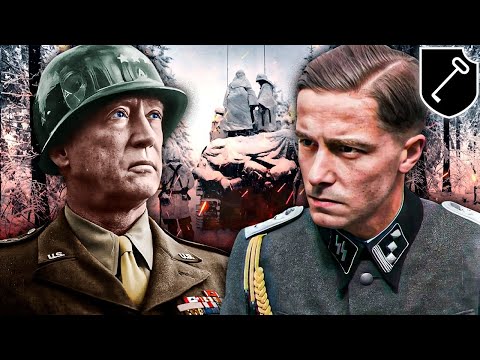
The Ardennes: a frozen hell of dense forests and snow-covered hills. The Allies, exhausted and overstretched, were caught off guard. But among them was a man who would become a legend: General George S. Patton. His Third Army was poised to strike, and when the German juggernaut smashed through the American lines, Patton’s forces would be called upon to perform a miracle.
As the German war machine lurched forward, spearheaded by fanatical SS divisions and the terrifying Tiger tanks, the Americans fought desperately. The 99th Infantry Division held the line near Hofen, but the 1st SS Panzer Division, led by the ruthless Joachim Peiper, was relentless. They carved a path of destruction, leaving a trail of dead and captured in their wake. The roads were choked with burning vehicles, and the snow was stained red with blood.
But the Germans had a secret weapon: Operation Greif. Commandos dressed in American uniforms, driving captured jeeps, infiltrated behind Allied lines. They spread confusion, changed road signs, and even impersonated military police. The chaos they caused was devastating. Checkpoints were flooded with paranoid soldiers, and rumors of German spies led to countless false arrests. Even General Eisenhower was confined to his headquarters, a prisoner of his own security.
The first day of the offensive saw the Americans reeling. Towns fell, entire divisions were cut off, and the way to the Meuse River seemed open. But then came the massacres: Malmedy, where 84 American prisoners were gunned down in cold blood, and later Chenogne, where American troops exacted a brutal revenge. The battle had descended into a savage war of attrition.
As the German advance slowed, the Allies rallied. Patton’s Third Army, in a legendary feat of logistics, turned its forces north and raced to relieve the besieged town of Bastogne. The 101st Airborne, surrounded and outnumbered, refused to surrender. Their defiant response to a German demand for surrender—”Nuts!”—became a symbol of American resilience.
The weather cleared, and Allied air power pounded the German columns. Fuel shortages and fierce resistance stalled the offensive. The SS elites, including Peiper’s Kampfgruppe, found themselves trapped, their tanks running dry, their men exhausted. Hitler’s last gamble was failing.
But the battle was far from over. In a final, desperate act, the Luftwaffe launched Operation Bodenplatte, a massive air assault on Allied airfields. It was a tactical success but a strategic disaster, crippling the German air force. The skies belonged to the Allies, and the German army began its long, bloody retreat.
The Battle of the Bulge would rage on for weeks, but the tide had turned. The Allies, though bloodied, had held. The SS elites had met Patton’s forces, and in the end, it was the Americans who stood victorious. But the cost was staggering. The snows of the Ardennes were soaked with the blood of tens of thousands, and the war in Europe would grind on for another brutal winter.
As the German forces withdrew, the world would soon learn of the horrors committed in the name of the Reich. And in the frozen forests of Belgium, the legend of the Battle of the Bulge was born—a story of courage, sacrifice, and the ultimate failure of Hitler’s last great offensive.
But the true reckoning was yet to come. As the last German rearguards slipped back across the Siegfried Line in early February 1945, the snows of the Ardennes began to melt—and with them, the earth gave up its dead. What the thaw revealed would haunt the American soldiers for the rest of their lives. Frozen bodies lay where they had fallen, some still clutching their rifles, others curled in the fetal position against a cold that had killed them before the enemy ever did.
In the town of Malmedy, investigators from the US First Army arrived at a field near the Baugnez crossroads. The bodies of the 84 murdered prisoners were exhumed from the snow, their hands still bound with wire, their faces frozen in expressions of disbelief. An autopsy team counted more than twenty bullet wounds in a single corpse. The evidence was irrefutable, and the hunt for Joachim Peiper and his men began in earnest.
Yet the reckoning was not confined to the Germans. In the village of Chenogne, a young American lieutenant named Horace B. Hanks had kept a private diary. On New Year’s Day, he had written of watching German prisoners gunned down in a roadside ditch. “It was murder, plain and simple,” he confided to a page no one was meant to read. When historians later unearthed his words, they confirmed what had long been whispered: the war crimes of the Ardennes cut both ways.
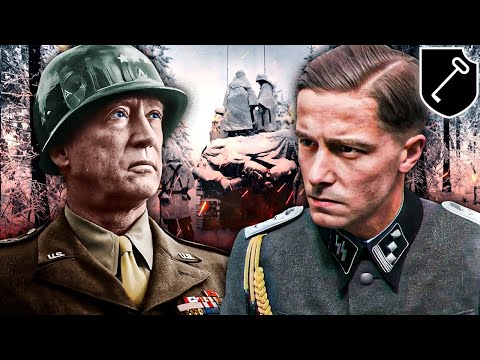
As the American counteroffensive rolled eastward, it was no longer a battle for ground—it was a battle for memory. Eisenhower, furious over Malmedy, ordered that every captured SS man suspected of involvement be brought to trial. The result was the Malmedy Massacre Trial of 1946, held in a former Dachau concentration camp. Seventy-three Waffen SS soldiers stood accused, and the verdicts came down like hammer blows: forty-three sentenced to death by hanging.
But the story twisted again. Defense attorneys uncovered evidence that American interrogators had used mock trials, beatings, and threats to extract confessions. The very men who had prosecuted the Nazis for barbarism now stood accused of it themselves. The scandal reached the US Senate, and by 1948, every death sentence had been commuted. Peiper himself walked free in 1956.
Meanwhile, in the Ardennes, the war moved on. The men of the 101st Airborne marched out of Bastogne with their heads high, their boots wrapped in rags against the cold. They had held the line, but at a cost that would not be fully counted for decades. The town itself lay in ruins, its streets a graveyard of shattered stone and blackened timber.
For the Belgian civilians who had endured the occupation, the liberation was bittersweet. In villages like La Gleize, where Peiper’s tanks had rumbled through, families returned to find their homes looted, their livestock slaughtered, their neighbors buried in hastily dug graves. Some had hung swastikas from their windows to welcome the Germans; now they tore them down and burned them in the square.
The Battle of the Bulge was over, but the war in Europe still had three brutal months to run. The men who survived the Ardennes would go on to fight in the Rhineland, cross the Rhine at Remagen, and finally meet the Soviets at the Elbe. Yet none of them would ever forget the frozen forests, the burning tanks, and the faces of the dead.
In the decades that followed, the battle became a legend—the largest engagement ever fought by the US Army, a crucible of courage and cowardice, of heroism and atrocity. And in the quiet Belgian fields, where the snow still falls each winter, the ghosts of December 1944 waited for the world to remember them.
But memory, as the survivors would learn, is a fragile thing. The men who fought at Bastogne came home to parades and handshakes, then to jobs and mortgages and the quiet amnesia of peace. Few spoke of the Ardennes to their children, and fewer still spoke of Chenogne. The official histories celebrated the victory and moved on, and the frozen fields were plowed over, and the foxholes filled with spring rain.
It was not until the 1980s that a handful of historians began to ask uncomfortable questions. Anthony Beaver, a British researcher with a taste for archives that others had left to gather dust, pulled the 11th Armored Division’s after-action reports and found gaps where there should have been pages. He found a single line in a company log: “Prisoners disposed of.” No names, no numbers, no explanation.
Beaver tracked down surviving veterans of the 11th Armored, men in their sixties who had spent four decades not talking about Belgium. One of them, a former corporal from Ohio, agreed to meet in a diner outside Dayton. He ordered coffee, stirred it for a long time, and then said the thing he had never said aloud.
“We lined them up against a wall and shot them. I don’t remember how many. I remember the sound.” The corporal set down his cup and looked out the window at the parking lot. “After Malmedy, none of us wanted to take prisoners. The officers didn’t stop it. Some of them were there.”
Beaver’s findings, published in a small academic journal, caused a brief scandal and then a longer silence. The US Army had no interest in reopening a case it had never officially opened. The German government, still processing its own crimes, had little appetite for prosecuting Americans. So the Chenogne massacre remained what it had always been: a shadow on the other side of the mirror.
Yet the reckoning did not stop with the historians. In 1994, on the fiftieth anniversary of the battle, the town of Malmedy unveiled a memorial to the murdered prisoners. Dignitaries spoke, a bugler played taps, and the last surviving witnesses wept in the cold. Across the valley, in Chenogne, there was no ceremony, no plaque, no wreath.
An old Belgian farmer named Émile, who had been a boy of twelve in 1944, remembered both. He had watched the SS march prisoners into the field at Baugnez and heard the machine guns. Weeks later, he had watched the Americans do the same. “They were all men,” he told a visiting journalist, “and men do terrible things when they are afraid.” He refused to say which memory troubled him more.
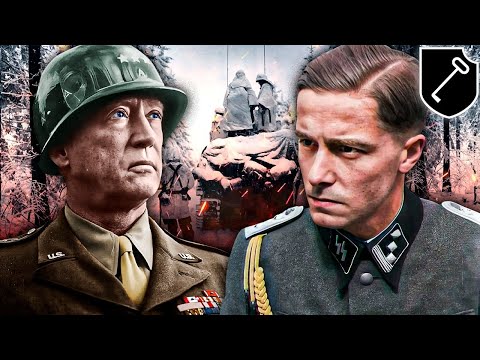
As the century turned, the last veterans of the Bulge began to die. Their obituaries spoke of Bastogne and the cold and the courage, and the darker chapters faded further into the snowmelt. But the war had one more reckoning to deliver, and it came not in Belgium but in Berlin.
In the spring of 1945, as the Red Army closed in, the men who had planned the Ardennes offensive scattered. Hitler took his own life in a bunker beneath the Chancellery. Hasso von Manteuffel, the brilliant commander of the Fifth Panzer Army, surrendered to the British and spent years in captivity before becoming a politician in West Germany. Sepp Dietrich, the brutal SS commander, was tried for the Malmedy massacre and sentenced to life—then released in 1955.
Joachim Peiper, the man whose tanks had carved the deadliest path through the Ardennes, lived on in infamy. He worked for Porsche, then moved to France, where he lived quietly under an assumed name. In 1976, someone recognized him. A firebomb destroyed his house, and the man who had once commanded the spearhead of Hitler’s last offensive died in the flames. No one was ever charged.
The war in Europe ended on May 8, 1945, but the Battle of the Bulge never truly ended for those who fought it. It lived in their dreams, in the flinch at a backfiring car, in the way they fell silent when the first snow came each December. And in the quiet Belgian fields, where the forests had regrown and the foxholes had softened into hollows, the ghosts of December waited still.
For the men of the 101st Airborne, Bastogne was a badge of honor. For the men of the 106th Infantry, who had surrendered by the thousands on the Schnee Eifel, it was a wound that never healed. Some came home to find their families had been told they were missing, presumed dead. They walked into their own funerals, and the joy was always tinged with something harder to name.
And for the Belgian civilians, the liberation had come at a price. Their towns were rubble, their fields sown with mines, their memories divided. Some had welcomed the Germans; some had hidden the Americans; most had simply tried to survive. When the war ended, the collaborators were punished and the resisters were honored, but the lines between them had blurred in the snow.
The Battle of the Bulge was the largest battle ever fought by the United States Army. It cost 19,000 American lives, 47,000 wounded, and 23,000 captured or missing. The Germans lost 80,000 men and the last of their armored reserves. But numbers, however staggering, could not capture what had happened in those frozen forests.
What had happened was this: ordinary men had been asked to do the impossible, and some had done it, and some had failed, and some had committed acts they could never undo. The snow had covered everything—the heroism and the horror alike—and when it melted, the world had to look at what lay beneath.
The last of the Bulge’s secrets died slowly, like embers in a wet fire. In 2001, a Belgian schoolteacher named Marie-Thérèse found a rusted ammunition box beneath her garden in Chenogne. Inside were eighty-three identification tags, German and American, tangled together like the men who had killed each other.
She wrote to the US Army, which wrote back politely and did nothing. She wrote to a German archive, which sent a form letter. So she built a small wooden cross at the edge of her property and planted snowdrops around it. “They were all somebody’s sons,” she told the village priest.
The priest nodded but said nothing. He had been a boy in 1944 too, and he remembered the sound of the machine guns on New Year’s Day. Some things, he knew, were better left to the snowdrops.
And so the Ardennes kept its silence, as forests do. The foxholes filled with leaves. The tanks rusted into the earth. The last veterans closed their eyes for the final time, and their grandchildren inherited only the stories they had chosen to tell.
But memory is patient, and the frozen fields are patient too.
What do you think—should the forgotten crimes of Chenogne be taught alongside Malmedy, or does some snow deserve to stay unmelted?
Report this article
Select a reason for reporting:






