The first shells hit Berlin on April 20, 1945—Hitler’s 56th birthday. Deep inside the Führerbunker, the walls trembled as Soviet artillery pounded the city above. The Reich that was supposed to last a thousand years was now cowering underground, while outside, over 42,000 guns and 6,000 tanks stood ready to deliver the final blow.
But this was no ordinary battle. Berlin had been transformed into a fortress—three concentric rings of defense, hundreds of reinforced strongpoints, and a labyrinth of tunnels and bunkers that allowed German troops to vanish and reappear behind advancing Soviet units. Hitler believed the city was impregnable. Nothing like it had been seen at Moscow, Leningrad, or Stalingrad.
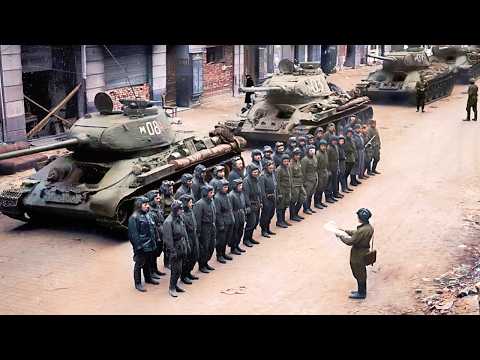
The Soviet plan was relentless. Marshal Zhukov’s 1st Belorussian Front would strike directly at Berlin, while Marshal Konev’s 1st Ukrainian Front would sweep around from the south. Stalin, suspicious that the Western Allies might seize the capital first, had ordered the race to begin. Churchill had even proposed beating the Soviets to Berlin, but American generals disagreed. The prize would go to the Red Army.
On the night of April 16, the offensive began with a massive artillery barrage. Zhukov’s troops advanced 1.5 to 2 kilometers—then stalled. The Seelow Heights, fortified with trenches, minefields, and camouflaged gun positions, proved a brutal obstacle. Some rifle divisions lost up to 60% of their men. Zhukov, under immense pressure from Stalin, pushed his reserves forward. A tense phone call between the two men ended with three days of silence.
Meanwhile, Konev’s front was advancing faster. By April 21, his tank armies had breached all three German defense lines and reached the southern suburbs of Berlin. Zhukov, finally overcoming the Seelow Heights, drove toward the city from the east. The German 9th Army, holding the front, was split into three isolated pockets. The defense Gerbils had called an impenetrable wall began to crumble.
Inside the city, the fighting became savage. Streets were barricaded, bridges mined, and 24 tanks buried as static gun emplacements. Metro stations, sewers, and basements became vital routes for maneuver and surprise attacks. In some sectors, the battle for a single building lasted two days. Soviet assault groups, veterans of Stalingrad and Budapest, fought floor by floor, using flamethrowers and demolition charges to clear fortified buildings.
On April 22, Hitler made his last desperate decision: General Walther Wenck’s 12th Army was ordered to abandon the Western Front and come to Berlin’s rescue. It was a futile gesture. By April 24, Wenck’s attacks were repulsed, and the Red Army had linked up with the Americans at the Elbe, cutting Germany in two. The 9th Army was encircled in the forests southeast of Berlin. The capital was now defended only by isolated groups of SS cadets and Volkssturm militia—teenagers and old men.
The focus of the Soviet effort became the Reichstag, the symbol of the Third Reich. As assault groups closed in, German resistance intensified. The Red Army applied every lesson learned in urban combat, attacking day and night to prevent the enemy from organizing new defenses. By April 28, Soviet troops had broken through into the central sector. The 3rd Shock Army reached the Spree River in the Tiergarten; the 5th Shock Army captured the Anhalt railway station and the State Printing House.
Hitler, now trapped in his bunker, dictated his political testament on April 28, appointing Admiral Dönitz as Reich President and Goebbels as Chancellor. The next day, General Wenck reported that his army was surrounded and could not break through. The last communication line to the bunker was cut. On April 30, around 3:00 PM, Hitler and Eva Braun took their own lives.
That same day, Red Army soldiers stormed the Reichstag. The fighting inside was ferocious—every corridor, every room had to be cleared. After several attempts, German troops entrenched in the basement finally surrendered on the evening of May 1. The storm flag of the 150th Rifle Division, raised over the Reichstag’s dome, became the symbol of victory.
But the battle was not over. In other parts of Berlin, resistance continued for another day. By the evening of May 2, the last German defenses collapsed. General Helmuth Weidling, commander of Berlin’s defense, crossed over to General Chuikov’s 8th Guards Army and accepted the Soviet terms of surrender. Mass surrenders followed—over 130,000 German soldiers were taken prisoner.
On May 3, combat operations in Berlin ceased. Soviet soldiers celebrated the long-awaited victory. Tanks were adorned with red flags, and soldiers danced and fired into the air. Photographs were taken against the backdrop of the ruined Reichstag—the symbol of the fallen Reich.
The Berlin offensive had destroyed the military and political leadership of the Third Reich. The main forces of the Wehrmacht were eliminated, and the German command was effectively paralyzed. Yet the cost had been enormous: 80,000 Red Army soldiers lost their lives in the battle for Berlin, while German casualties—killed, wounded, and captured—numbered around 800,000.
Even as Berlin fell, fighting continued elsewhere. Nearly 100,000 German soldiers were killed in Czechoslovakia, and about a million remained ready to fight. But when two tank armies from Konev’s 1st Ukrainian Front raced toward Prague and cut off their retreat west, the end became inevitable.
In the early hours of May 9, in the Berlin suburb of Karlshorst, the act of unconditional surrender of Nazi Germany’s armed forces was signed. Marshal Georgy Zhukov accepted it on behalf of the Soviet government. The war that had lasted nearly four years—and cost the Soviet people unimaginable suffering—was finally over.
As the news spread, Moscow erupted in celebration. Fireworks lit the sky, and strangers embraced in the streets. For the Soviet Union, the victory was absolute—but the scars would remain for generations. The Red Army had marched from the ruins of Stalingrad to the heart of Berlin, and in doing so, had changed the course of history.
Yet even as the guns fell silent, the shadows of the coming Cold War were already lengthening. Stalin’s ambition to secure Soviet influence over Eastern Europe would soon clash with his Western allies. The victory over Nazi Germany was complete, but the peace that followed would be anything but simple.
In the days that followed the surrender, Berlin lay in ruins—a wasteland of shattered stone and twisted steel. Smoke still rose from the Reichstag’s blackened shell, and the streets were littered with the debris of a fallen empire. Soviet soldiers walked among the rubble, their faces etched with exhaustion and quiet disbelief. They had fought across a thousand miles of blood and fire, and now the silence felt almost unnatural.
Zhukov himself toured the devastated city, accompanied by a small staff. He stood before the Brandenburg Gate, its columns pockmarked by shrapnel, and said little. The marshal who had defended Moscow and Stalingrad now surveyed the capital of the enemy he had pursued for four brutal years. There was no triumph in his eyes—only the heavy weight of what had been paid to reach this place.
Beyond Berlin, the war’s final hours played out across the shattered landscape of Europe. In Czechoslovakia, Konev’s tank armies raced toward Prague, where German forces still clung to the city. On May 9, Soviet tanks rolled into Prague’s streets to the cheers of Czech citizens, and the last organized German resistance in the east collapsed. The remnants of Army Group Center, nearly a million men, laid down their arms.
But even as the guns fell silent, another struggle was already beginning. Stalin’s gaze had turned from Berlin to the broader map of Europe. The Red Army now occupied half the continent, and the Soviet leader intended to use that position to reshape the postwar order. Churchill, watching from London, wrote to Truman with growing alarm about the Soviet presence in Eastern Europe.
The alliance that had defeated Hitler was fraying. At the Potsdam Conference in July, the leaders of the victorious powers would meet to decide Germany’s fate—but the trust that had held them together was already dissolving. The same soldiers who had embraced at the Elbe now found themselves eyeing one another across a divided Germany.
For the Soviet people, the cost of victory was staggering. Twenty-seven million Soviet citizens had perished in the war—soldiers and civilians alike. Entire cities had been erased from the map. The reconstruction would take decades, and the memory of the dead would never fade.
In the ruined streets of Berlin, Soviet soldiers continued to raise red flags over the city’s landmarks. The image of that flag over the Reichstag would become the defining photograph of the twentieth century—a symbol of the defeat of fascism and the triumph of the Red Army. Yet for many who had fought, the victory was bittersweet. They had won, but they had lost friends, brothers, and homes that would never return.
As the summer of 1945 unfolded, the world began to reckon with what had happened. The Nuremberg Trials would soon bring Nazi leaders to justice, and the full horror of the Holocaust would be revealed to a stunned global audience. The war had ended, but its consequences would shape the world for generations to come.
The Red Army’s march from the Volga to the Spree had been one of the most extraordinary military campaigns in history. It had destroyed the most powerful war machine ever assembled and toppled a regime built on hatred and conquest. But the victory had come at a price that no nation should ever have to pay.
In Moscow, the fireworks had faded, and the streets were quiet once more. The Soviet Union stood as one of the world’s two superpowers, its armies occupying half of Europe and its leader determined to secure his nation’s future at any cost. The war against Hitler was over. A new struggle—one of ideology and influence—was already beginning.
And in Berlin, the soldiers who had fought the final battle began to pack their belongings and prepare for the journey home. Some would return to families they had not seen in years. Others would never return at all. The victory flag still flew over the Reichstag, but the men who had raised it understood better than anyone what it had cost to see it wave.
Was the price of victory worth the peace that followed? Share your thoughts in the comments below.
Report this article
Select a reason for reporting:






