March 28th, 1945. The Soviet army is just kilometers from Berlin, and the German High Command is meeting in the cramped air raid shelter of the Reich Chancellery. The atmosphere is thick with tension, blame, and desperation. In this claustrophobic bunker, a confrontation is about to unfold that will go down in history—not just for its intensity, but for the fact that it would end the career of one of Germany’s most brilliant military minds: General Heinz Guderian.
The meeting’s purpose was to analyze the failed offensive at Küstrin and find scapegoats. General Busse, commander of the Ninth Army, began to explain the attack’s failure when Hitler abruptly interrupted. “Why did the attack fail?” Hitler shouted, not waiting for an answer. “Because of incompetence. For negligence. The attack was launched without sufficient artillery preparation.” Turning to Guderian, he demanded, “If Busse did not have enough ammunition, as you have put in his report, why did you not provide him with more?”
Guderian tried to respond, but Hitler cut him off. “Explanations, apologies, that’s all you can give me,” the Führer roared. “Well, tell me once and for all who made us fail in Küstrin—the troops or Busse?” Guderian, losing his composure, shot back, “What nonsense. That’s silly. Can’t blame Busse. I’ve already told you, he was just following orders. He used all the ammunition he had available, as well as all of his strength.”
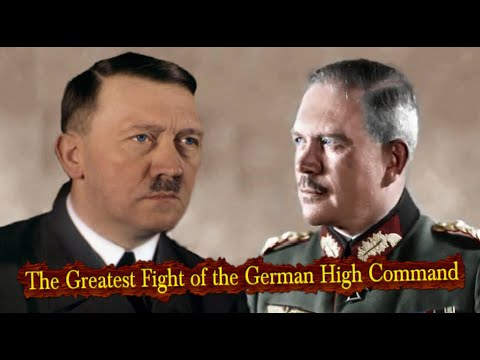
But Hitler was not to be deterred. He continued to accuse the troops of failure. Guderian, now red with rage, roared, “Before you blame the troops, look at the casualties. Be aware of casualties. The troops did their duty and the sacrifice of those men proves it. It is estimated that we have suffered about 8,000 casualties.” Hitler immediately shouted back, “They failed. That’s what I know, that they failed.”
By now, the two men were practically face to face, their noses almost touching. Guderian, completely beside himself, bellowed, “I have to ask you. I have to tell you not to make any more accusations against Busse or his troops.” The room fell silent, the other officers frozen in shock. Hitler, his voice dripping with contempt, called his general staff “lazy, goofy, empty-headed people” and complained that he was always misinformed.
Seizing the moment, Guderian brought up a report Hitler had rejected months earlier—the Gehlen report, which had warned of the imminent Soviet attack on the Vistula in January. “Had he been misinformed on that occasion?” Guderian asked. Hitler dismissed it: “Gehlen is crazy.” Then he shot back, “And what about the 18 divisions we still have in Courland?” Guderian retorted, “Exactly when do you intend to evacuate the army from Courland?” The two men were off again, their voices echoing off the bunker walls.
The argument grew so intense that General Busse later remarked he had never witnessed anything like it. Jodl grabbed Guderian’s arm and pulled him away, urging him to calm down. Guderian’s assistant, fearing his boss would be thrown into prison, arranged a fake phone call to get him out of the room. Guderian reluctantly left, and for 15 minutes, he paced outside, trying to regain his composure. Inside, Hitler slumped in a chair, exhausted.
When Guderian returned, Hitler asked everyone to leave except Guderian and Keitel. “General Guderian, your health requires that you immediately take six weeks of convalescent leave,” Hitler said. “Please wait until the conference is over and leave. I beg you to do everything you can to recover your health because in six weeks the situation will be very critical and then I will need you urgently.” Keitel asked where he planned to go, and Guderian replied he hadn’t decided, but would try to go somewhere the Allies couldn’t reach within 48 hours.
With that, the meeting ended, and Guderian left the bunker, never to hold a position again. He would surrender to the Americans on May 10th, 1945. The dramatic confrontation had sealed his fate—and highlighted the chaos and denial at the highest levels of the Third Reich.
But the story of that afternoon does not end with Guderian’s departure from the room. What happened in the hours and days that followed reveals just how deeply the confrontation had shaken the German High Command—and how desperately its members tried to paper over the cracks.
As Guderian gathered his belongings, his assistant—still pale from what he had witnessed—followed him through the corridors of the Chancellery. “Herr General, I thought they were going to arrest you,” he whispered. Guderian, still trembling with residual fury, managed a grim smile. “So did I. Perhaps they should have. It might have been more honest than this farce of ‘convalescent leave.'”
Outside, the streets of Berlin were a study in contrasts. Bombed-out facades stood next to shops still stubbornly open for business, and civilians hurried past with the hollow-eyed look of people who had long since stopped believing in victory. Guderian climbed into his staff car and ordered the driver to take him to his office at the General Staff headquarters. There was work to be done—even if he was no longer officially permitted to do it.
Back in the bunker, Keitel and Jodl lingered with Hitler, who had not moved from his chair. The Führer’s hands trembled slightly, and his voice, when he finally spoke, was hoarse. “That man has no sense of loyalty,” he muttered. “None at all. He questions everything. He undermines everything.” Keitel, ever the sycophant, nodded vigorously. “He has been a thorn in your side for months, mein Führer. The leave is well deserved—for all of us.”
But Jodl, more pragmatic than his colleague, dared to raise a practical concern. “Mein Führer, with Guderian gone, who will coordinate the Eastern Front? The situation at Küstrin remains critical.” Hitler waved a dismissive hand. “The front will hold. It always holds. What we need is not another defeatist general but men who believe in the final victory.”
That evening, word of the confrontation began to spread through the corridors of power. Officers who had long resented Guderian’s abrasive manner exchanged knowing glances. Others, more sympathetic, quietly predicted that his dismissal would only hasten the collapse. General Busse, still shaken, confided to a fellow officer that he had never seen the Führer so close to physical violence. “It was not a meeting,” he said. “It was a brawl with maps.”
Meanwhile, Guderian spent his first evening of exile in a small apartment on the outskirts of Berlin, far from the Chancellery’s oppressive atmosphere. He sat at a desk, reviewing the same intelligence reports that had so enraged Hitler—the ones that showed Soviet strength building inexorably along the Oder. The numbers were damning. The war, he knew, was lost. The only question was how many more men would die before the end came.
His thoughts turned to the Courland divisions—the 18 divisions Hitler had refused to evacuate. They were still trapped in the Baltic, cut off from the main front, their transport ships sunk and their supply lines severed. “Eighteen divisions,” Guderian murmured to himself. “Eighteen divisions that could have defended Berlin. And he calls Gehlen crazy.”
The next morning, Guderian received a visitor: a young colonel from the operations staff, carrying a sealed envelope. Inside was a formal notice confirming his convalescent leave and a curt note from Keitel instructing him to refrain from any political or military activity. Guderian laughed bitterly. “They think I am a danger to them now. Perhaps I should be flattered.”
He spent the following days preparing to leave Berlin, aware that the Soviet encirclement was tightening. The roads west were still open, but barely. Trains were packed with refugees, and the military police had begun turning back civilians without proper permits. Guderian arranged for his family to be moved to Bavaria, where the Americans were expected to arrive first—and where surrender, he calculated, would be less brutal than falling into Soviet hands.
On the morning of his departure, he took one last walk through the city center. The Brandenburg Gate stood scarred but upright, and the Tiergarten was a wasteland of craters and broken trees. A column of exhausted soldiers trudged past, their faces gray with dust. One of them recognized him and paused. “Herr General—are we going to win?” The question hung in the air. Guderian looked at the young man for a long moment, then said quietly, “Do your duty. That is all any of us can do now.”
He turned away and walked back toward his waiting car. Behind him, the soldier stared after him, then rejoined the column, disappearing into the smoke and rubble of a city that was living on borrowed time.
Guderian’s car threaded through the rubble-strewn streets toward the western outskirts. He carried only a single suitcase and a bundle of maps he could not bring himself to leave behind. At a checkpoint, an SS sergeant demanded his papers. Guderian handed over the leave notice, and the sergeant’s eyes widened. “You are the General who argued with the Führer?” he asked, half in awe, half in warning. Guderian nodded. “I am the General who told him the truth. That is all.”
The sergeant waved him through without another word. As the car pulled away, Guderian glanced back at Berlin—the smoke, the shattered spires, the endless columns of refugees. He knew he would never see it again. “Drive,” he told his driver. “And do not stop until we reach the Elbe.”
Weeks later, in a small Bavarian village, Guderian listened to the radio as the announcement came: Hitler was dead, and the war was ending. He surrendered to the Americans on May 10th, 1945, as he had predicted—just in time. In the years that followed, he would write his memoirs, defending his conduct and criticizing Hitler’s interference. But he never forgot that afternoon in the bunker, when the truth had been shouted and then buried under six weeks of forced silence.
The confrontation between Hitler and Guderian remains one of the most dramatic moments of the Third Reich’s final days—a clash between reality and delusion, between duty and denial. It was a brawl with maps, as Busse said, but the stakes were far higher than any map could show.
What do you think? Was Guderian’s dismissal justified, or did Hitler simply shoot the messenger? Share your thoughts in the comments below.
Report this article
Select a reason for reporting:






