You’ve seen them larger than life on the silver screen, their presence commanding every frame, their romances and rivalries the stuff of legend. But what if the most towering figures of Hollywood’s Golden Age were, in reality, far from it? What if the men who played the toughest gangsters and the most romantic heroes, and the women who defined glamour and sex appeal, were hiding a secret that studios spent millions to keep? The truth is more surprising than any plot twist.
Behind the cameras, a different story unfolded—one of wooden blocks, hidden platforms, and even trenches dug into the earth. The stars you idolized were often among the shortest people on set, yet they became giants through sheer talent, charisma, and a little bit of movie magic. From Humphrey Bogart standing on phone books to kiss Ingrid Bergman, to Alan Ladd’s co-stars literally sinking into the ground, the lengths Hollywood went to maintain the illusion are as fascinating as the films themselves.
Take Gloria Swanson, the epitome of silent-era grandeur, who delivered the immortal line “I am big” while standing barely five feet tall. Or Jean Harlow, the original blonde bombshell, whose platinum allure made her seem statuesque, but who was actually 5’0”. These weren’t exceptions—they were the rule. The camera added ten pounds and, apparently, several inches.
But why did height matter so much? In an industry built on image, the leading man was supposed to be tall, dark, and handsome, and the leading lady was supposed to be a vision of elegance. When nature didn’t comply, the studios improvised. They built up shoes, dug trenches, and used every trick in the book to make sure audiences never suspected. “The toughest gangster in 1930s Hollywood was 5 foot five,” and the most romantic leading man had to stand on wooden blocks just to kiss his co-star. It was a carefully guarded secret, one that, if revealed, could shatter the illusion.
Yet, these stars didn’t just survive despite their height—they thrived because of their extraordinary talents. Bette Davis, at 5’3”, dominated the screen with a ferocity that made her seem ten feet tall. James Cagney, all 5’5” of him, exploded with an energy that Orson Welles called “maybe the greatest actor who ever appeared in front of a camera.” And Mickey Rooney, at 5’2”, was the biggest box office draw in America for three years running. Their stature on screen had nothing to do with inches and everything to do with presence.
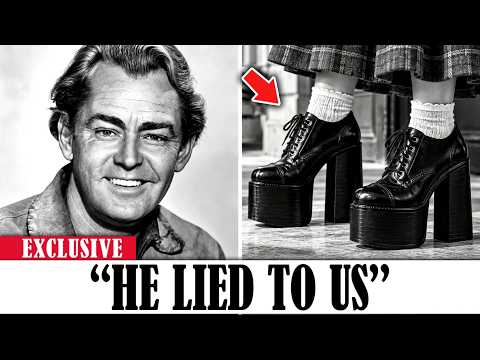
But perhaps the most astonishing case is that of May West. On screen, she seemed to tower over her leading men, a statuesque goddess of desire. In reality, she was just 5’0” and wore custom-made platform shoes that added a staggering 8 to 9 inches to her height. These weren’t just heels—they were engineering marvels, hidden under floor-length gowns, so tall and rigid that she had to develop that famous slow, swaying walk just to stay upright. That walk, the one that became her trademark, was a direct result of her trying not to fall off a pair of 8-inch wooden stilts hidden under a dress. Nobody knew. For decades, May West’s most famous physical characteristic existed because she was secretly 5 feet tall and refusing to let anyone find out.
And then there’s Alan Ladd, the ultimate Hollywood tough guy. At around 5’5”, he was often paired with taller leading ladies, so the studios resorted to extreme measures: they dug trenches for his co-stars to stand in, a practice that became known as “trenching.” When Sophia Loren, who was 5’8”, co-starred with Ladd, she reportedly stood in a trench for their scenes together. Actress Carol Matthews said Ladd stood on a box during their scenes, and she wore tennis shoes instead of heels. The illusion was so complete that audiences never questioned his size. The practice of trenching didn’t die with Ladd’s career—decades later, Pixar animators used a similar technique for Woody and Buzz Lightyear in Toy Story, naming it after Ladd’s old trick.
These stories are just the tip of the iceberg. From Judy Garland’s tragic manipulation by MGM to Veronica Lake’s decline into obscurity, the lives of these stars were shaped by the very illusion they helped create. And as we delve deeper into the list, you’ll discover even more shocking secrets—like the star who was so short that without her platforms, she barely cleared five feet, and the one whose height was so sensitive that the industry simply refused to discuss it. The Golden Age of Hollywood was a factory of dreams, and these stars were its most brilliant conjurers, making us believe in giants when they were merely mortal.
Consider Peter Lorre, a man who radiated menace from every frame. At just 5’3”, he understood that true terror doesn’t come from size. In Fritz Lang’s M, his performance as a child predator remains one of the most disturbing ever captured on film. Directors quickly learned that placing him alongside taller actors only made him more unsettling—the audience couldn’t understand why this small man frightened them so deeply. His wide, haunted eyes and that whisper-soft voice did what inches never could.
Then there was Edward G. Robinson, the quintessential gangster of the 1930s. Studio records list his height anywhere from 5’3” to 5’7”—a sure sign that someone was actively managing the number. In Little Caesar, he created the template for every movie mobster who followed. Directors positioned him closer to the camera in group shots or had him stand on slightly raised surfaces. But in close-ups, none of it mattered. Those eyes did all the work. Robinson never got the classic romantic lead roles, and the studio used his height as the reason to keep him in tough-guy parts—which turned out to be a gift, because those are the roles people still remember eighty years later.
And what about Humphrey Bogart? Here’s the one that surprises almost everyone. Rick Blaine himself—the man who delivered “Here’s looking at you, kid” while gazing down at Ingrid Bergman—was shorter than the woman he was looking at. Bogart stood around 5’8”. Bergman was 5’9” and wore heels on set. Their co-star Paul Henreid was 6’3”. So the romantic hero of the most beloved film in American cinema was the shortest of the three leads by a wide margin.
To make the height difference disappear, director Michael Curtiz had Bogart stand on wooden blocks for standing scenes. In seated scenes, Bogart sat on stacked cushions and phone books. He wore shoes with built-up soles that added several inches. Bergman was reportedly told to slouch in some scenes to shrink the gap further. The result? Throughout Casablanca, Bogart’s height shifts from scene to scene because the tricks worked in some shots and didn’t in others. If you watch the film knowing this, you can actually spot the moments where the illusion breaks.
It wasn’t just Casablanca. Bogart was sensitive about his height for his entire career. He wore lifts in other films, too, and the industry knew not to bring it up. Even his wife, Lauren Bacall, who was about the same height, was frequently photographed in flat shoes when they appeared together in public. The two of them managed the optics for years, and most people today still picture Bogart as a tall man. He wasn’t. He just acted like one.
Then there’s James Cagney—a man Orson Welles once called “maybe the greatest actor who ever appeared in front of a camera.” He was 5’5”. Think about what that means. In White Heat, Cagney climbs to the top of a gas storage tank and screams, “Made it, Ma! Top of the world!” right before it explodes. That scene is terrifying and iconic at the same time—and the man delivering it could barely see over a standard kitchen counter. Cagney never let his height define him, and the studios gave up trying to hide it early on because the energy he brought to every frame made the question completely irrelevant.
But if Cagney refused to hide, others had no choice. Judy Garland was 4’11½” when MGM signed her as a teenager, and studio head Louis B. Mayer reportedly called her “my little hunchback.” They capped her teeth, adjusted her nose with prosthetics, and laced her into corsets—all to keep her looking small, young, and castable. In The Wizard of Oz, she was sixteen playing a child, and her natural petiteness helped sell the illusion. But off-screen, the pressure to maintain a specific size followed her for the rest of her life. What makes Garland’s story different is that her height wasn’t just managed for the camera—it was weaponized against her by the people who employed her. And still, at 4’11½”, she filled arenas and made ten thousand people feel like she was singing to each one of them alone.
Veronica Lake solved a different problem entirely. At 4’11”, she was cast opposite Alan Ladd not for chemistry but for geometry—the studio needed a leading lady who wouldn’t tower over him. Together, they looked perfectly proportional, and audiences never suspected that both of their noir icons were among the shortest people in Hollywood. Lake’s peekaboo wave became one of the most imitated looks of the decade, but her career collapsed in the late 1940s. By the 1960s she was working as a cocktail waitress in a New York hotel, and when a reporter tracked her down, nobody recognized her. At 4’11”, without the hair and the lighting, she could disappear into any crowd.
And then there was Mickey Rooney—the number one box office draw in America from 1939 to 1941, bigger than Clark Gable, bigger than Spencer Tracy. He was 5’2”. Rooney hated being short and said so openly, but he refused to let it stop him from doing anything. He was married eight times, burned through fortunes, battled addiction, and kept showing up on set into his nineties. When the studio needed to pair him with an appropriately small leading lady, they landed on Judy Garland—Rooney at 5’2” and Garland at 4’11½”, a pairing where neither one exposed the other’s height. It was the same trick they used with Ladd and Lake, and it worked just as well.
The fact that the most popular movie star in the world during the late 1930s was a 5’2” teenager tells you everything about how the illusion worked. The audience didn’t see inches. They saw energy, and Rooney had more of it than anyone. But not every star on this list escaped so lightly. Some paid a price for the secret that went far beyond a pair of lifts or a dug trench—and one of them, a man who seemed to command entire rooms on screen, would see the studio turn his height into a cage he could never quite escape.
That man was Edward G. Robinson—but the cage had a silver lining. His short stature kept him out of romantic leads, yet it locked him into the very gangster roles that made him immortal. “The studio used his height as a reason to keep him in tough guy and character parts, which turned out to be a gift,” because those are the roles we still quote eighty years later.
From Mickey Rooney at 5’2” to May West on her eight-inch stilts to Alan Ladd’s co-stars standing in ditches, Golden Age Hollywood ran one of the most elaborate illusions in entertainment history. The audience never caught on. The magic was never just in the scripts or the lighting—it was in the fact that the biggest stars in the world were very often the smallest people in the room.
So the next time you watch Casablanca or Sunset Boulevard, look closely. You might spot the blocks, the trenches, the shifting heights. But you’ll also see something else: the sheer force of talent that made us believe in giants. Which of these revelations shocked you the most—and who would you add to the list?
Report this article
Select a reason for reporting:






