I’d been in country for five months when I saw it happen. The jungle heat of Vietnam felt like it could cook you from the inside out—hot, humid, relentless. We were at a joint base outside Nui Dat, prepping for a multi-day recon operation with a small Australian SAS team. I’d worked with the Aussies before, but nothing could have prepared me for what I was about to witness.
They were sitting near the weapons pit, casually stripping their gear, checking magazines, wiping down rifles. All routine. Then, without a word, one of them pulled out a hacksaw and started cutting his rifle in half. Not a damaged spare. Not a cleaning exercise. A fully functional L1A1 SLR—their standard issue battle rifle. My team froze. We watched in disbelief as he sawed clean through the barrel, shortened the stock, and shaved off unnecessary attachments. Within minutes, two more Aussies joined in, butchering their weapons with the same calm efficiency.
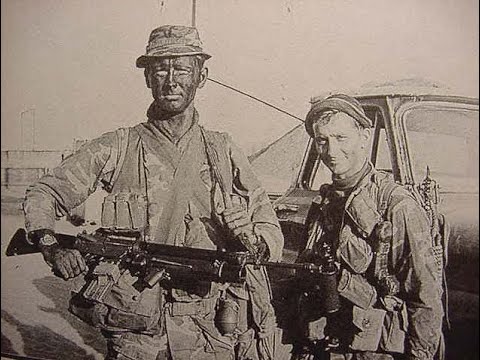
To us, rifles were sacred. You cleaned them like they were your firstborn. You didn’t destroy them. I approached one of them—a wiry corporal with a thick accent and a bored expression. “You realize you’re destroying a perfectly good rifle, right?” I asked. He shrugged. “Too bloody long for the jungle, mate.” That was it. That was the logic.
I looked down at my own M-16, which suddenly felt like a tree trunk in my hands. It hadn’t been a problem before—not until I saw what those Australians were turning their weapons into. Short, compact, brutal close-quarter machines. Back at the tent that night, we argued about it. Some thought they were reckless. Others wondered if they were onto something. But one thing was clear: we were rattled. Not by the act itself, but by how sure they were. No hesitation, no apologies—just cold, practical efficiency.
The Australians didn’t just modify their weapons; they modified everything. One guy cut the frame off his rucksack to crawl through elephant grass more easily. Another carried grenades in an old sock. A third shaved down the handles of his entrenching tool for silent draws. It looked like chaos, but when you watched them move in formation—slow, smooth, surgical—you realized it was anything but.
We Americans fought by the book. We had doctrine, flowcharts, equipment SOPs. The Aussies? “We’re not soldiers, mate. We’re hunters. Big difference.” That’s what one of them told me while cleaning a sawed-off SLR. At first, I laughed. Then I thought about it. They moved like hunters—stalked, waited, struck, disappeared. No firefight unless necessary. No lingering. They weren’t there to take ground or raise flags. They were there to end threats and survive to do it again.
It was hard to admit, but deep down, I respected it. Maybe even envied it. We were elite, yes, but we were still bound by a system that often told us how to fight. They rewrote the rules on the fly. And that day, when they sawed their rifles in half, that wasn’t recklessness. That was freedom.
Before Vietnam, I trusted my rifle like I trusted my teammates. The M-16 had its quirks, but it was light, accurate, fast. At least, that’s what I thought—until I hit the jungle. In the triple canopy of Phuoc Tuy, you don’t fight like you do on a shooting range. You’re crawling on your belly, vines around your neck, mud up to your thighs, visibility maybe five meters ahead if you’re lucky. If something moves, you have seconds—maybe one—to react.
That’s when I started to understand the Australians’ madness. The L1A1 SLR was a monster—long, heavy, hard-hitting. It fired the 7.62 NATO round with stopping power that punched through brush and bone. But in the jungle, it was a liability. Try turning quickly in a bamboo thicket with a rifle over a meter long. Try getting a clean shot without your barrel catching on vines. Try staying quiet when metal clinks off a branch with every step.
The Aussies figured it out before we did. They weren’t cutting their rifles out of disrespect. They were doing it out of experience—hard-earned, blood-soaked experience. I learned later that one of their patrols had lost a man because he couldn’t swing his SLR around fast enough in an ambush. The muzzle got tangled. He hesitated. The VC didn’t.
So they took action. They cut the barrels down, shortened the stocks, removed the flash hiders. What they lost in long-range accuracy, they made up for in survivability. Speed is king. It wasn’t just their rifles—their entire kit was optimized for the environment. Softer boots, fewer magazines, lightweight jungle knives instead of bayonets. It was all about mobility, reaction time, and silence.
We had engineers in Saigon testing rifles in air-conditioned labs. The Aussies had dirt under their nails, sweat in their eyes, and blood on their uniforms. They didn’t theorize. They adapted. At first, we mocked them—called them jungle cowboys. But slowly, quietly, that mockery turned into respect. Because they were right. The jungle didn’t care how advanced your rifle was if it got you killed before you could fire it.
In their hands, a sawed-off SLR was more than a weapon. It was a tool—forged by the environment, modified by necessity, carried with the calm confidence of men who knew exactly what they needed to stay alive. And it made me realize something I hadn’t learned in BUD/S or in briefings. War doesn’t reward the best gear. It rewards the best judgment.
Two weeks later, near the Cambodian border, we saw the proof. A VC advance element walked right into the SAS patrol’s path. Shots rang out—sharp, muffled, fast as a hammer drill. Then silence. When we moved to support, we found six VC bodies neatly dropped, all shot center mass or head. No stray rounds, no panic. And there they were—the Aussies, already back in cover, reloading their sawed-off SLRs like it was just another Tuesday.
That’s when it clicked. The cut-down rifles hadn’t cost them a thing. In fact, they’d given them exactly what they needed: maneuverability, speed, and a psychological edge. Our M-16s suddenly felt sterile—great on paper, but not what I’d want if I was ambushed at five meters by a man in sandals holding an SKS.
Later that day, I found myself beside the same corporal who’d first sawed his rifle. I nodded toward his weapon. “That thing… it worked.” He smirked. “Told you, mate. Jungle doesn’t care about specs.” He was right, and it burned a little—not out of pride, but because I realized how many fights we’d trained for in theory while they’d trained for this.
That moment rewired something in me. It wasn’t just the gear—it was the mindset. The willingness to break rules if the rules didn’t fit reality. The guts to take a hacksaw to a service rifle and say, “This will save my life.” And on that day, when six men with butchered rifles dropped a whole VC squad before we could even react, they proved it wasn’t madness. It was mastery.
Back at the forward base that evening, the Americans were buzzing. The COs were impressed with the kill report but confused by the after-action breakdown. One intel officer asked, “What’s this about unauthorized weapons modification?” You could practically hear the alarm bells going off in his head.
Word got around quickly. A couple of rear-echelon types started whispering about equipment violations, breach of allied standards, risking ballistics integrity. It was classic doctrine versus dirt—the kind of clash that always happens when the people writing the manuals meet the people who have to survive by breaking them. And in the middle of it were the Australians, calm, unbothered, almost amused.
One American captain tried to challenge them. “Why are you cutting down NATO standard weapons without authorization?” The SAS sergeant didn’t flinch. He just said, “Because this isn’t a NATO standard jungle.” Boom. No anger, no excuses—just a plain fact that hung in the air like gunpowder after a contact.
You see, we Americans had grown up in a system that taught structure. Our weapons were cleaned to spec, our gear packed by the book, our tactics drawn from binders thicker than a phone book. Even in SEAL teams, where we were trained to be flexible, there were still boundaries, still expectations, still red tape. But the Aussies—their doctrine came from the field, not from a classroom. They’d fought in Malaya and Borneo. They’d learned the hard way that jungles don’t follow bullet points. And their officers, many with bush experience, trusted their men to make decisions that worked, not just what looked good on a weapons checklist.
That’s what rattled our system. We were used to being the innovators, the elite, the ones who did things differently. But now we were face-to-face with guys who were even more ruthless in how they stripped down tradition to fit the terrain. It forced some of us to question what we’d been told. Was the rifle a sacred object, or just a tool? Was the manual more important than the mission? Could you respect the chain of command and still take a hacksaw to your issued weapon because you knew deep down it would save lives?
That night, as I sat cleaning my M-16, I kept thinking about it. I remembered how fast the Aussies had reacted, how clean their contact had been, how much they trusted their own judgment. No fear of being reprimanded—just clarity of purpose. Some of the guys still scoffed, said it was dangerous, irresponsible. “They got lucky,” one muttered. Maybe. Or maybe they just knew something we didn’t. Maybe experience beats doctrine every time if you’ve got the courage to break the rules and the skill to survive the consequences.
Something changed after that firefight near the creek bed. It wasn’t spoken outright—no formal acknowledgements or handshakes—but we all felt it. The dynamic between us and the Aussies shifted. We started watching them differently, and we started listening. Before, we saw them as a bit rogue, too casual, too informal. We chalked it up to cultural differences—Aussie sarcasm, their love of swearing, the way they seemed to treat war with a kind of grim humor. But now, every decision they made seemed to have a reason. Every strange piece of kit, every odd adjustment, every habit born in the bush—it all made sense.
We noticed how their patrol formations changed depending on the terrain—no fixed pattern. How they spent ten minutes observing a tree line before moving five steps. How they listened to the jungle like it was whispering secrets. And how those cut-down rifles, crude as they looked, moved like extensions of their bodies.
One of our guys, Rodriguez, had been skeptical from the beginning—a by-the-book operator, squared away, sharp. But even he started asking questions. “You reckon it’s worth shortening the barrel a bit?” he asked me one night, running a cleaning rod through his M-16. I shrugged. “If it means shooting faster in tight bush, maybe.” Soon after, a couple of our team started modifying their gear—nothing major, just small tweaks. Swapping gear pouches, taping down metal clasps. One guy even sawed two inches off his cleaning rod so it fit better in his ruck. We were becoming believers.
The Aussies didn’t gloat. If they noticed, they didn’t say anything. That was part of what made them so damn effective. They didn’t care about credit—they cared about outcomes. I remember one evening after patrol, I found myself sharing a smoke with one of their corporals—the same guy who’d first sawed his rifle. I asked him point-blank, “Where do you learn to think like this?” He looked at me, grinned, and said, “We get taught to survive. Everything else, we figure out on the job.”
It hit me hard because back home, we trained like warriors. But out here, they were surviving like hunters. And there’s a difference. From then on, we stopped calling them reckless. We started calling them quiet professionals. And I don’t think I was the only one who began to realize that discipline doesn’t always wear a uniform or follow a manual. Sometimes, discipline looks like a man with dirt on his face, sweat-soaked sleeves, and a rifle that’s been sawed in half because he knew he’d need to clear a corner faster.
By the time the operation ended, there wasn’t a man in our unit who doubted their methods. We didn’t always understand them, but we respected them deeply. Because in that jungle, respect wasn’t given to those who looked sharp. It was given to those who walked out alive.
Years later, I stood in a sterile classroom at a special warfare school, clean uniform, laser pointer in hand. A young trainee asked, “Is it ever acceptable to modify your issued weapon in the field?” Half the room laughed. I didn’t.
I told them about the red soil of Vietnam, the hacksaw, the six Australians, and the firefight near the creek bed. “The best gear in the world means nothing if it gets you killed before you can use it.” The room went quiet—really quiet.
That’s the legacy of the cut rifle: not the weapon, but the mindset. See the problem, adapt to the terrain, survive the fight. And if all it takes is a hacksaw, don’t ask for permission.
So here’s my question for you: if the manual fails and lives hang in the balance, would you have the guts to pick up the hacksaw? Tell me in the comments.
Report this article
Select a reason for reporting:






