He was a man who needed no introduction, yet his name still sends shivers down the spines of those who knew him. Ronald Speirs was not just a soldier; he was a legend forged in the crucible of war, a figure whose actions on the battlefield were as calculating as they were courageous. But behind the myth lies a truth more complex and haunting than any television drama could capture. He refused interviews, shunned the spotlight, and let the rumors swirl—because he understood that in war, reputation is a weapon and silence is armor.
Born in Edinburgh in 1920 and raised in Boston, Speirs was a man of discipline and precision long before he jumped into Normandy. He studied accounting, enlisted in the Army Reserve, and was commissioned as a second lieutenant before the United States even entered the war. When he volunteered for the paratroopers, he found his calling among the intense and the brave. At Camp Toccoa, he became a platoon leader in Dog Company of the 506th Parachute Infantry Regiment, respected for being fair, clear, and competent—but also feared for his strict discipline.
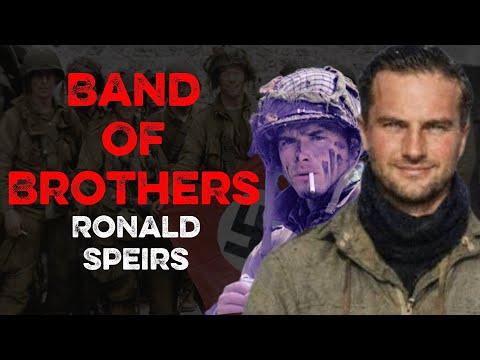
On D-Day, Speirs parachuted into Normandy, and it was there that the first dark legend took root. A drunken sergeant named Carrington, eager to engage the enemy, drew his weapon on Speirs after an argument. Speirs warned him, “If you’re going to pull your weapon out, you better use it.” Moments later, Speirs fired his Thompson machine gun, killing Carrington instantly. The shooting was ruled a valid act of self-defense, but the story added to the aura of a man who was not to be crossed. The incident was officially recorded as killed in action on June 6th, under unknown circumstances—a convenient fog of war that would follow Speirs throughout his career.
He went on to help in the Brecourt Manor assault, capturing a German howitzer with speed and precision that impressed every officer who saw him. But it was the prisoner scene that would cement his reputation as a cold-blooded killer. Band of Brothers dramatized him offering cigarettes to German prisoners before allegedly killing them. The real account is far more complicated. One soldier present claimed Speirs and others executed three prisoners under orders to take none. Dick Winters himself confronted Speirs about the rumors. “Sparky, these stories have been going around for years. Are they true?” Speirs replied, “Oh, yeah. They’re true.” He even put it in a letter, knowing full well the weight of his words.
Speirs fought through Carentan, where he was wounded by a grenade but returned quickly to duty. He jumped into Holland as part of Operation Market Garden, earning a Silver Star for swimming alone across a river while wounded to gather intelligence. But it was the assault on Foy that would become his most iconic moment. When Easy Company’s attack stalled under brutal German fire, Speirs was called to relieve Lieutenant Dyke. He took command instantly, reorganized the company, and executed a coordinated assault. But the situation was collapsing. I Company, on their flank, was out of communication, and the danger of friendly fire was real. So Speirs ran. Through machine gun fire, across open ground, he sprinted to reach I Company, relayed the correction, and then ran back. He didn’t do it for glory; he did it because the alternative was chaos. The series portrayed it as almost mythical, but the real Speirs was simply a man who knew the clock was running out.
After Foy, he officially took command of Easy Company and held that position longer than any other wartime commander. He led them through the occupation of Germany, including the liberation of camps near Landsberg and the siege of Berchtesgaden. Though he had enough points to return home, he chose to stay until Japan surrendered. His life after World War II was just as unusual. He stayed in the army, jumped into Korea as a rifle company commander, fought Chinese forces, and later trained in Russian before serving as a liaison officer to the Red Army. In 1958, he became the American governor of Spandau Prison, responsible for guarding Nazi leaders like Rudolf Hess. He served in Laos as part of Operation White Star before retiring as a lieutenant colonel.
Speirs died in Montana in 2007, having refused all interviews for the series. He wanted no part in shaping his own mythology, which only deepened it further. He allowed the rumors to live because he understood that in war, reputation can be a weapon and silence can be armor. The man Band of Brothers presents is a shadow—cold, lethal, mysterious. But the real Ronald Speirs was far more grounded. He was a career officer with a clear sense of structure and responsibility, a man who did not embrace the legend but simply lived through it. And perhaps that is the most impressive truth of all.
But the story does not end with the legend. It ends with the quieter, stranger chapters that television never touched—the ones Speirs himself carried without complaint. After the guns fell silent in Europe, he did not fade into civilian anonymity like so many of his brothers. He stayed in uniform, because the army was the only language he had ever truly mastered.
When he jumped into Korea as a rifle company commander, he was no longer the young lieutenant sprinting through machine gun fire at Foy. He was older, harder, and fighting a different kind of war against a different kind of enemy. The Chinese forces he faced were hardened, numerous, and relentless—and Speirs met them with the same cold precision that had defined his entire career. Men who served under him there described a commander who never raised his voice, never wasted a word, and never asked a soldier to do something he would not do himself.
It was that reputation, perhaps, that led to one of the most surreal assignments of the Cold War. Speirs was selected to train in Russian and serve as a liaison officer to the Red Army during the tense early years of the standoff between East and West. He sat across tables from Soviet officers, translating intentions as carefully as he had once translated orders in the field. The same man who had killed without hesitation in Normandy now navigated the quiet, dangerous corridors of diplomacy, where a single miscalculation could mean something far worse than a failed assault.
Then came Spandau. In 1958, Speirs became the American governor of the prison that held some of the last surviving Nazi leaders—men like Rudolf Hess, once Hitler’s deputy, now a hollow figure shuffling through a courtyard under armed guard. For four years, Speirs walked the same corridors as the architects of the horror he had fought to destroy. He never spoke publicly about what that felt like. He never wrote a memoir. He simply did his duty, day after day, guarding the remnants of a regime he had helped to bury.
Later, he served in Laos as part of Operation White Star, training local forces in a shadow war that the American public knew almost nothing about. By the time he reached the Pentagon and finally retired as a lieutenant colonel, he had spent nearly three decades in uniform—through Normandy, Holland, Bastogne, the fall of Germany, Korea, and the frozen standoff of the Cold War. He had earned every promotion, every medal, and every rumor that clung to his name.
And yet, when the cameras came calling, he turned them away. When the historians knocked, he closed the door. When the world wanted to know who Ronald Speirs really was, he gave them nothing but silence. Perhaps because he knew that the men who had served with him did not need the truth explained to them—and the men who had not would never understand it anyway.
He settled in Montana, far from the battlefields and the bureaucracies, and lived out his final years in quiet obscurity. He died in 2007, the same year the world was busy rediscovering his legend on television screens. He never watched the series. He never read the books. He never corrected a single detail.
To the end, he let the stories stand—the cigarettes, the prisoners, the sprint through Foy. Some of them were true. Some were exaggerated. Some were flatly false. But all of them served a purpose that only a soldier like Speirs could fully appreciate. In war, reputation can be a weapon. Silence can be armor. And sometimes the less you say, the more people believe you’re capable of.
Maybe that’s because Speirs understood something that few men ever do—that the meanest, toughest son of a bitch in the whole Roman legion was not a man to be loved. He was a man to be followed. And follow him they did, through the worst the twentieth century had to offer, into the fire and back again.
The man Band of Brothers presents is a shadow—cold, lethal, almost superhuman in his calm. But the real Ronald Speirs was something far more remarkable. He was a soldier who did his duty, kept his counsel, and let history decide what to make of him.
And history, as it always does, made a legend.
But legends, once born, take on a life of their own. In the years after his death, Speirs became something he never sought—a symbol. Historians parsed his every action, veterans swapped stories in hushed tones, and a new generation discovered him through the screen. Yet the man himself remained an enigma, even in death.
Those who knew him best offered only fragments. His son Robert once said his father rarely spoke of the war, keeping his memories locked away like classified files. “He was a soldier,” Robert recalled. “He did what he was asked to do, and he never expected a parade for it.”
In Montana, the neighbors knew him simply as Ron—a quiet man who kept his lawn neat and his past buried. They had no idea they were living next to a man who had dined across from Soviet generals and guarded Hitler’s deputy. He preferred it that way.
What remains of Ronald Speirs is not a monument or a memoir, but a question. Why did he let the darkness cling to his name? Why not set the record straight? Perhaps because he knew that in war, the truth is never clean—and a legend, even a flawed one, serves a purpose.
He was not a saint. He was not a monster. He was a soldier who understood that survival sometimes means making choices no one else can judge. And in the end, he chose silence over self-defense, letting the myth speak for him.
So we are left with the shadow and the man—the cold killer of television and the quiet officer of reality. Which one was the real Ronald Speirs? Maybe the answer is both. Maybe the answer is neither. Maybe the only man who truly knew died in Montana, taking the truth with him.
What do you think—was Speirs a hero, a villain, or simply a soldier doing what war demanded? Leave a comment below and tell us your take.
Report this article
Select a reason for reporting:






