They were the soldiers Hitler believed would forge a new world order—or burn it to ashes trying. The Waffen SS, the armed wing of the Nazi Party’s Schutzstaffel, was envisioned by Heinrich Himmler as an Aryan elite, a breed apart from the conventional German military. But becoming one of these feared warriors was not merely a matter of physical prowess; it demanded a complete psychological overhaul, a transformation that pushed the boundaries of human endurance and moral compromise.
From the outset, the selection process was ruthless. Recruits had to be under 23, stand at least 1.74 meters tall, and prove their Nordic or Germanic ancestry. Any hint of ‘mutation or malformation’ meant instant rejection. But meeting these criteria was just the beginning. Those who passed the initial screening faced a battery of physical and mental tests designed to weed out the weak and the ideologically unreliable.
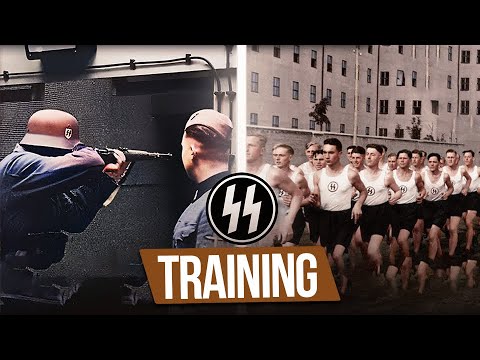
Himmler’s vision required more than just strong bodies; it demanded unwavering loyalty and a willingness to embrace the SS’s twisted ideology. Training was not just about learning to fight—it was about learning to believe. Sports like boxing, running, and rowing were integrated into daily life, not only to build physical resilience but to foster camaraderie and a competitive spirit. As one SS manual noted, sport cultivated self-discipline, determination, and a sense of subordination, turning ordinary men into skilled combatants.
But the physical regimen was only half the battle. Ideological indoctrination was relentless. Educational officers, akin to political commissars in the Red Army, worked to reshape the recruits’ values. Traditional ideals of loyalty, courage, and self-sacrifice were distorted to serve Hitler’s agenda. The SS loyalty oath bound them exclusively to Adolf Hitler, making betrayal the only unforgivable crime. This fanatical devotion was reinforced by the concept of ‘blood and soil,’ a narrative that painted their enemies as subhuman and their cause as a righteous crusade.
As the war progressed, the Waffen SS evolved into a formidable fighting force, spearheading major campaigns and earning a reputation for brutality and effectiveness. Yet, the cost was immense. Casualties were high, and the ideological fervor that drove them often led to atrocities. The training that produced such disciplined soldiers also created fanatics capable of unimaginable cruelty.
This is the story of how the Waffen SS was built—not just as a military unit, but as an instrument of terror and ideology. And as we delve deeper, we will uncover the true extent of their training, their combat experiences, and the dark legacy they left behind.
The training grounds themselves were designed to break the weak. Recruits rose before dawn for hours of physical conditioning—calisthenics, long-distance runs, and obstacle courses that tested every ounce of stamina. Sleep deprivation was routine, and failure was met with harsh punishment, sometimes public humiliation. The goal was to strip away individuality and rebuild the recruit as a cog in the SS war machine.
Weapons training was equally intense. The Karabiner 98k, the MP40 submachine gun, and the MG34 machine gun became extensions of the soldier’s body. Live-fire exercises were conducted under realistic combat conditions, with recruits crawling under barbed wire while machine-gun bullets whizzed overhead. This was not mere preparation—it was a baptism by fire, designed to inoculate them against fear.
But the most disturbing aspect of the training was the ideological instruction. Lectures on racial superiority, the evils of Bolshevism, and the destiny of the Aryan race were woven into every aspect of daily life. Recruits were taught that they were not just soldiers but defenders of a sacred bloodline, and that mercy toward the enemy was a sign of weakness. This indoctrination created a mindset that would later manifest in the brutal treatment of prisoners and civilians on the Eastern Front.
As the war dragged on, the Waffen SS expanded rapidly, and the quality of training inevitably declined. Foreign volunteers—from France, Spain, Ukraine, and elsewhere—were often rushed through abbreviated programs and thrown into combat with minimal preparation. The elite status of the Waffen SS became a hollow shell, maintained more by propaganda than by reality.
Yet, even as their numbers swelled and their standards slipped, the core divisions—Leibstandarte, Das Reich, Totenkopf—retained their fearsome reputation. They were Hitler’s fire brigade, rushed from one crisis to another, often arriving just in time to prevent a collapse. Their mobility and fanaticism made them a unique threat, but also a fragile one, as they were consumed by the very fires they were sent to extinguish.
The story of the Waffen SS is one of paradox: a force of extraordinary military skill built on a foundation of hatred and bigotry. Their training forged bonds of brotherhood that were real, but they were bonds sealed in blood and ideology. And as the tide of war turned, these soldiers would face the ultimate test—not just of their training, but of their humanity.
The final months of the war stripped away any remaining illusions. The Waffen SS, once the proud spearhead of the Reich, was now a shattered force, cobbled together from remnants and foreign conscripts who barely understood the ideology they were dying for. Supply lines had collapsed, fuel was scarce, and ammunition was rationed to the point of absurdity. Yet, they fought on, driven by a mixture of fanaticism, fear of surrender, and the simple instinct to survive.
In the ruins of Berlin, the last stand of the SS became a macabre spectacle. Teenage boys and old men, hastily inducted into the Volkssturm, were thrown into the meat grinder alongside the hardened veterans of the Leibstandarte. The city became a labyrinth of death, where every street, every building, every pile of rubble was contested with a ferocity that defied logic. Soviet soldiers, hardened by years of brutal combat, showed no mercy—and expected none in return.
For the foreign volunteers, the end was particularly bitter. Men from France, Spain, and the Low Countries, who had joined to fight against Bolshevism or for a twisted vision of European unity, found themselves abandoned by their German masters. Many were captured and executed on the spot, their uniforms marking them as traitors to their own nations. Others managed to surrender to the Western Allies, hoping for a more lenient fate, only to face years of imprisonment and social ostracism.
As the guns fell silent, the true cost of the Waffen SS’s fanaticism became clear. Their legacy was not one of glory, but of ashes—cities reduced to rubble, millions dead, and a continent scarred for generations. The elite soldiers Himmler had dreamed of creating had become instruments of destruction, their training and indoctrination serving only to prolong a war that was already lost.
In the end, the Waffen SS was a mirror held up to the darkest impulses of humanity: the desire for power, the fear of the other, and the willingness to sacrifice everything for a cause that was rotten to its core. Their story is a warning, a reminder of what happens when military prowess is divorced from morality. And as we look back, we must ask ourselves: what lessons have we truly learned?
What do you think—can elite military training ever be separated from the ideology that shapes it? Share your thoughts in the comments below.
Report this article
Select a reason for reporting:






