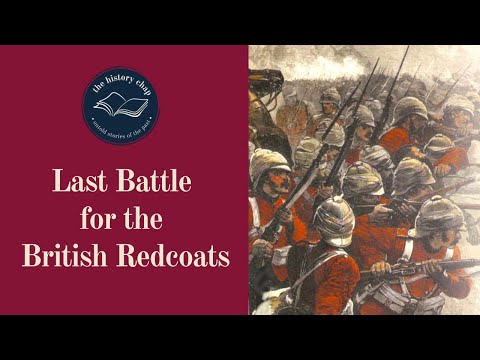
The sun had barely risen over the Nile when the order came. British soldiers, who had traded their scarlet tunics for dusty khaki, were told to put the red coats back on. It was December 30, 1885, and on the banks of the Nile in northern Sudan, the British Army would fight in its traditional red uniforms for the very last time.
Almost no one remembers this battle. Yet it was a clash that stopped the Mahdi’s Islamic revolution from spreading to Egypt, and it marked the end of the first chapter of Britain’s wars in the Sudan. This is the story of the Battle of Ginnis.
The backstory is one of empire, fear, and politics. In January 1885, the Mahdi’s army had captured Khartoum and killed General Charles Gordon. The British, under General Wolseley, had been forced to evacuate. But the Egyptians clung to a tiny piece of their empire in northern Sudan—not for prestige, but because they were terrified that the Mahdi’s followers, the Ansar, would invade Egypt itself.
The Mahdi’s message was clear: submit or perish. The Egyptians begged the British for help. In London, the government had changed. The new Conservative administration under Lord Salisbury was more willing to protect Egypt, but not to pay for a full reconquest of Sudan. Instead, they sent troops to defend the border and the Suez Canal.
Forts were established along the border, including one at Kosheh, about a hundred miles south of the main base at Wadi Halfa. Two companies of the Cameron Highlanders and two companies of the 9th Sudanese Regiment were stationed there. In the autumn of 1885, emboldened by the fall of Khartoum, Mahdist forces pushed into these borderlands.
Reinforcements were rushed to Wadi Halfa: the Royal West Kents, the Green Howards, the Royal Berkshire Regiment, and the 2nd Battalion of the Durham Light Infantry. A camp was established at Ginnis, and the Mahdists laid siege to the fort at Kosheh. The garrison made a sortie on December 15 but was ambushed and forced to retreat. A week later, the fort’s machine gun was knocked out by dervish artillery. The situation was dire.
The commanders in Egypt decided the siege had to be lifted. Major General Francis Grenfell, a 44-year-old British officer and Sirdar of the Egyptian Army, was given command of a joint British-Egyptian force of about 3,500 men. He formed three brigades. The 1st Brigade, under Major General Butler, included the Royal Berkshires, the Royal West Kents, the Durham Light Infantry, and an Egyptian artillery detachment. The 2nd Brigade was more international: the 1st Battalion of the Yorkshire Regiment (the Green Howards), a Royal Artillery unit with two 2.5-inch mountain guns, and nearly 300 men of the 1st Egyptian Regiment. The Cavalry Brigade, under Colonel Blake, consisted of a troop of the 20th Hussars, the Egyptian Camel Corps, British mounted infantry, and 50 Egyptian cavalry.
Grenfell arrived with the infantry on December 29, lifting the siege. The next morning, he marched out to meet the Mahdists. Before the battle, he ordered his British units to swap their khaki for their traditional red coats—a tactic to impress and intimidate the enemy. All did so except the Durham Light Infantry, who had left theirs in Cairo.
Just after 6 a.m., Grenfell’s artillery opened fire, catching the Mahdists by surprise. The attack was two-pronged: the 2nd Brigade would storm the village of Kosheh, while the 1st Brigade would pin down the Mahdist camp at Ginnis, one mile upriver. The cavalry screened the east to prevent flanking.
The Cameron Highlanders and the 9th Sudanese attacked along the Nile into Kosheh, supported by covering fire from the rest of the 2nd Brigade and a Nile steamboat, the Lotus, with its Gardner gun. Having fought through the houses, they were joined by the rest of the brigade in the palm groves beyond the town.
By now, the Mahdist army—6,000 strong—was streaming out of their camp to meet Grenfell’s 3,500 men. In the palm groves between Ginnis and Kosheh, they ran into the Yorkshire Regiment. The Green Howards, who had missed the Nile Expedition, now had their moment. They poured volley fire into the Mahdist advance.
Frustrated, the Mahdists swung towards the 1st Brigade on the high ground and launched a surprise attack on the camel corps. But the Durham Light Infantry moved forward and opened well-controlled volley fire. Unlike previous battles, Grenfell had not formed a defensive square; instead, he deployed his men in an 800-foot extended line. The withering firepower was something the Mahdists had never experienced. They began to fall back.
Before they could make a stand at their camp, Grenfell sent the cavalry forward, and the mounted infantry cleared the defenders with a bayonet charge. By 10 a.m., the dervish army was fleeing south into the desert.
As the victorious army made its way back through Kosheh, they were fired upon by dervish riflemen holed up in a house. Lieutenant Colonel Wodehouse brought one of his screw guns forward to end the resistance.
The Battle of Ginnis had lasted four hours. The Mahdists lost 400 dead and many more wounded. Grenfell’s force lost 10 men dead and about 40 wounded. Ironically, the Yorkshire Regiment, which had lost one man injured at Ginnis, would lose 84 men to typhoid and other diseases back at Wadi Halfa. The Durham Light Infantry would lose 50 men.
The battle is almost lost to history. It wasn’t a close-run thing like Abu Klea, and the losses weren’t on the scale of Omdurman. No Victoria Crosses were won. But it was the last time British troops fought in their traditional red tunics. It was the first time the new Egyptian Army had successfully faced the Mahdists, and the first time British and Egyptian armies had fought side by side.
Above all, the victory at Ginnis halted the Mahdist steamroller, and Egypt was safe. Grenfell had won a battle according to plan, with an international army including untried Egyptians, and taken the lightest of casualties. He hadn’t done a bad job.
As he surveyed the battlefield, Grenfell could see the Mahdists streaming away across the desert. What he was unaware of was that a boat full of dervish banners, arms, and important refugees was desperately following them up the Nile, seeking safety. But the British were in hot pursuit. Two days later, a small party of Durham Light Infantry would catch up with that boat—and what happened then would be the beginning of another fascinating story.
The Durham Light Infantry detachment that set off after the fleeing dervishes was small—barely a dozen men under a young lieutenant—but they moved fast along the riverbank, following the trail of discarded equipment and trampled reeds. The boat they were chasing had a head start of two days, but it was heavy with refugees and supplies, and the current of the Nile was against it.
By the afternoon of January 1, 1886, they caught sight of it: a broad-beamed native vessel, its single lateen sail patched and sagging, hugging the western bank where the water ran slow. On its deck, they could make out the huddled shapes of women and children, and the glint of weapons among the men.
The lieutenant ordered his men to take cover behind a low ridge of sand and scrub. He had no intention of rushing headlong into a fight he couldn’t win. Instead, he sent two men back to Ginnis to request reinforcements, while the rest kept the boat under observation through the afternoon.
What he saw puzzled him. The boat did not try to flee. It did not put men ashore to dig in. Instead, it simply drifted, as if waiting for something—or someone. As dusk fell, a figure emerged from the small cabin at the stern: an old man in a white jibbah, leaning on a staff, who stood watching the shore with the calm of a man who had already accepted his fate.
This was not a random band of fugitives. Among the banners and the arms, there were said to be relatives of the Mahdi himself—members of his family, and a handful of his most trusted emirs, fleeing the collapse of their frontier. The boat was carrying the last embers of the Mahdist cause in the north.
The lieutenant, a practical young man from County Durham, had no way of knowing any of this. All he knew was that he had a boat full of armed men in front of him and orders to pursue. He decided to wait for reinforcements before making his move. It was a decision that would prove fateful.
That night, the boat did something unexpected. It ran aground on a sandbank just offshore, and the refugees began to disembark—not to fight, but to scatter into the desert, abandoning the vessel and everything on it. By the time the reinforcements arrived the following morning, the boat was empty. All that remained were the banners, a few old muskets, and a locked wooden chest that no one had thought to carry away.
The Durham men waded out to the stranded vessel and climbed aboard. The chest was forced open. Inside, wrapped in oilcloth, they found a collection of letters and documents—correspondence between the Mahdi’s commanders, written in Arabic, detailing their plans for the invasion of Egypt. It was intelligence of the highest value, and it had fallen into British hands almost by accident.
The young lieutenant had no idea what he was looking at. He sent the chest back to Ginnis under guard and continued his pursuit of the scattered refugees, but the desert had swallowed them. The boat, stripped of its cargo, was burned where it lay.
When the documents reached Grenfell’s headquarters, they were translated by an interpreter and caused a stir. They confirmed what the British had suspected: the Mahdist threat to Egypt had not ended at Ginnis. There were more attacks planned, more armies gathering in the south. The victory on the Nile had bought time, but not peace.
Grenfell forwarded the papers to Cairo, and from there they traveled to London, where they were filed away in the War Office and largely forgotten. The Battle of Ginnis, and the strange little episode of the boat, slipped quietly into the footnotes of history.
But the story of the Durham Light Infantry and the abandoned chest was not quite over. Among the documents was a single letter, addressed not to any military commander but to a merchant in Cairo—a name that would reappear, years later, in a very different context. The golden thread of history, as it always does, kept on weaving.
The merchant’s name was Yusuf al-Mansuri, and his Cairo shop dealt in ivory, gum arabic, and—quietly—information. The letter, written by a Mahdist emir, promised him a fortune in trade concessions if he would help smuggle weapons up the Nile. It was evidence of a spy network hiding in plain sight, and it had been sitting in a locked chest on a sandbank.
Whether al-Mansuri was ever arrested is unclear. The War Office files were sealed, then misplaced, then forgotten. But the Durham Light Infantry’s small patrol had done something remarkable: they had turned a routine pursuit into a quiet intelligence coup.
Grenfell went on to smash a Mahdist invasion at Toski in 1889. The Egyptian Army he had rebuilt proved itself again and again, and Kitchener’s campaign would finish the job at Omdurman in 1898. But the men who wore red at Ginnis never knew how much their four-hour fight mattered.
It was the last time British soldiers fought in scarlet, and almost nobody remembers it. The redcoats marched into history that morning, and the sand covered their footprints by noon.
So here is the question I leave with you: if a battle can be so decisive and yet so forgotten, how many other moments like Ginnis are buried in the footnotes of history, waiting for someone to dig them up? Let me know in the comments below.
Report this article
Select a reason for reporting:






