August 17th, 1944. Northern France, near Falaise. The GMC CCKW sat abandoned on the roadside, its canvas cover torn by shrapnel, engine still ticking as it cooled. The American convoy it belonged to had been caught in a Luftwaffe strafing run—one of the increasingly rare occasions when German aircraft actually appeared over France.
Wehrmacht mechanics from the 276th Infantry Division approached cautiously, eyes fixed on the massive vehicle the Americans called a deuce and a half. “Get the half-track over here,” one mechanic called. “This one’s intact.”
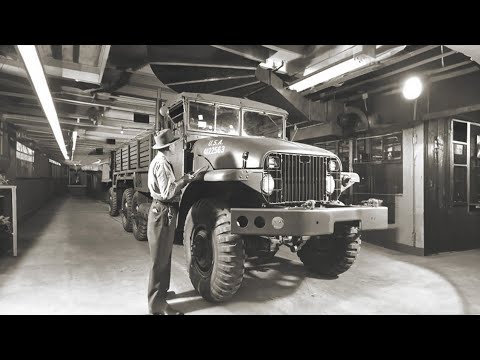
They had captured American trucks before, but never examined one so thoroughly. The GMC bore markings indicating it was a 1943 model CCKW 353, the long wheelbase version. Production stamps showed it was one of thousands built that year at the Pontiac plant.
Thousands from a single factory.
The first mechanical inspection revealed the philosophy. The GMC 270 engine produced 104 horsepower from 269 cubic inches—not impressive by German standards. But the mechanic recognized immediately that performance wasn’t the goal. Every bolt was the same size. Every nut could be turned with the same wrench. The spark plugs were positioned for easy access. The oil filter could be changed without tools.
“This is designed for idiots,” one mechanic muttered.
The half-track driver corrected him. “No, it’s designed for an army of millions where most men aren’t mechanics. This is brilliant.”
He was right. The GMC wasn’t engineered for perfection. It was engineered for America’s conscript army, where farm boys from Iowa and factory workers from Pennsylvania would become combat drivers with minimal training. Every component was selected for availability and ease of replacement. Nothing was exotic. Nothing required specialty knowledge.
They examined the six-wheel drive system. A simple transfer case engaged the front axle with a single lever. In comparison, their Opel Blitz trucks were rear-wheel drive only, struggling constantly in French mud and requiring careful driving to avoid getting stuck. This American truck could power through terrain that would immobilize German vehicles.
The suspension used basic leaf springs—crude, but unbreakable. The half-track driver thought of the sophisticated torsion bar suspension on the Opel. Beautiful engineering that required factory tools to repair. These leaf springs could be hammered straight with a rock if necessary.
Most troubling was what the numbers revealed. Stamped into the frame was Pontiac plant number one. The production number indicated this truck was one of approximately 150,000 built in 1943 alone. One plant, one year—more trucks than Germany produced in all categories combined.
One mechanic did the math. “If one American plant produces this many trucks, how many plants do they have?”
The answer was dozens. GMC, Chevrolet, Studebaker, International Harvester, Dodge, Ford—all producing similar vehicles to standardized military specifications, all with interchangeable parts.
That evening, the unit’s supply officer joined the inspection. He had worked in the Opel plant in Brandenburg before the war, understanding automotive manufacturing deeply.
“We’re looking at this wrong,” he said. “We see a simple truck, but what this represents is an entire manufacturing philosophy we can’t match.”
He explained what the GMC revealed about American production. The stamped steel body panels were crude but could be produced in vast quantities by any press shop. The wooden cargo bed used standard lumber that any sawmill could provide. The canvas top was commercial fabric. Nothing was specialized. Everything was abundant.
“Look at the chassis,” he continued, pointing to the ladder frame. “Straight channel steel welded together. Any structural steel plant could produce these. Compare that to our Opel with its precisely formed frame rails requiring specialized dyes.”
The Americans had designed for their strength: massive industrial capacity. The GMC wasn’t superior to the Opel Blitz in engineering elegance. But it was superior in the metric that mattered—producibility.
The supply officer’s assessment grew darker. “In 1943, we produced approximately 27,000 Opel Blitz trucks. The Americans probably built 20 times that number of these GMC trucks alone. And that’s just one truck type from one manufacturer.”
He was understating it. American factories would produce over 562,000 CCKW trucks during the war. Germany’s entire wartime production of the Opel Blitz—the backbone of Wehrmacht logistics—totaled perhaps 100,000 units, most being the 4×2 version that lacked the GMC’s all-wheel drive capability.
Over the next week, the unit used the captured GMC for supply runs. It transformed their capabilities. Where their Opel trucks struggled through muddy farm roads, the GMC simply powered through. When loaded beyond its rated capacity—something that happened constantly—it continued functioning. The six-wheel drive provided traction that their rear-wheel drive vehicles couldn’t match.
A supply sergeant who drove it daily offered his assessment. “This truck is reliable in a way our vehicles aren’t. It’s not that it’s better built. It’s that it’s built expecting abuse. They designed it knowing soldiers would overload it, neglect maintenance, and drive it like they’re trying to destroy it.”
That was the revelation. American engineers had designed the GMC for the reality of war, not the theory of it. They assumed drivers would be poorly trained, maintenance would be delayed, and operating conditions would be terrible. So they built accordingly. Simple, robust, forgiving.
On August 25th, 1944—the same day the Red Ball Express began operations—the 276th Infantry Division received orders to withdraw eastward. They witnessed something that completed their education in American logistics.
An American convoy passed on a parallel road. Not a tactical movement, but a supply column. The watching Germans counted vehicles as they rolled past. After half an hour, they gave up counting.
Truck after truck after truck, stretching to the horizon. GMC CCKW trucks predominated, all identical, all loaded with supplies, all moving with mechanical precision toward the front.
“Where are their horses?” a young soldier asked, genuinely confused.
The half-track driver realized the boy had never seen a fully motorized army. In the Wehrmacht, 80% of logistics relied on horses. Their division alone required over 5,000 horses to move supplies. Those horses needed food, water, rest, and veterinary care. They could march perhaps 30 kilometers per day in good conditions. They died by the thousands in winter.
American divisions had no horses. They had trucks. Thousands of trucks that could move hundreds of kilometers per day, required no fodder, didn’t tire, and didn’t freeze to death.
The supply officer did more calculations that night. “Each American division has approximately 2,000 trucks. They have 40 divisions in France. That’s 80,000 trucks supporting combat operations, not counting the supply services. We have 3 million horses total across all fronts and maybe 100,000 trucks.”
Someone asked the obvious question: how can they produce so many vehicles?
The answer was painful to articulate. American automotive plants had been designed for mass production long before the war. Ford’s assembly line, GM’s production systems. When war came, they simply converted civilian production to military needs. The same factories that built Chevrolet sedans built GMC trucks. The same workers who assembled Oldsmobiles assembled military vehicles. The transition was seamless because the manufacturing philosophy was identical: standardization, interchangeability, mass production.
Germany had excellent engineers but lacked this production infrastructure. The Opel plant in Brandenburg, even at peak production, couldn’t match a single American automotive complex. And America had dozens of such complexes.
By September 1944, the unit had captured three more GMC trucks and a Dodge WC63. The mechanics noticed something remarkable. Parts were interchangeable not just between GMC trucks, but between different manufacturers. A GMC carburetor fit the Dodge. Electrical components were standardized. Even tires were the same size.
“They’ve standardized their entire vehicle fleet,” the supply officer explained. “One set of specifications, multiple manufacturers. It means any mechanic can service any truck, any parts depot can supply any vehicle. Their logistics are unified in a way ours have never been.”
The Wehrmacht used vehicles from dozens of manufacturers with incompatible parts. A mechanic trained on an Opel couldn’t necessarily service a Büssing or a Mercedes. Parts warehouses had to stock components for hundreds of vehicle types. It was a logistical nightmare.
On October 3rd, 1944, the division’s remaining vehicles became stranded when fuel supplies failed to arrive. The horses could forage, but the trucks sat immobile. Meanwhile, American operations continued unabated because their supply network, built on thousands of GMC trucks, delivered fuel reliably to forward units.
The mechanics spent their enforced idleness studying the captured American trucks. One made an observation that crystallized their understanding. “We designed our vehicles to be good. They designed theirs to be good enough—but in overwhelming numbers. In total war, that wins.”
The half-track driver wrote a detailed technical report on the GMC CCKW. It documented every aspect: the standardized components, the simple maintenance procedures, the robust construction that sacrificed elegance for durability. The report noted that while the Opel Blitz was superior to the GMC in fuel efficiency and maneuverability, these advantages were meaningless when Germany produced one truck for every five or six American trucks.
The report concluded: “American vehicle production represents industrial capacity we cannot match. Their manufacturing philosophy prioritizes quantity and standardization over individual vehicle perfection. In sustained warfare, this approach has proven devastatingly effective.”
Similar reports were flooding Wehrmacht headquarters from every front. German intelligence analysts compiled American production statistics with growing alarm. The numbers were staggering. American factories produced 2.4 million military trucks during the war. Germany, Italy, and Japan combined couldn’t approach that total.
December 1944 brought the Ardennes offensive—Hitler’s last gamble in the West. The operation’s logistics plan relied heavily on capturing American fuel supplies because Germany lacked sufficient fuel to sustain the offensive. German soldiers were ordered to use captured American vehicles whenever possible because German logistics couldn’t keep pace.
The irony was bitter. Germany’s last major offensive depended on capturing the very vehicles and fuel that symbolized why Germany was losing.
The 276th Infantry Division participated in the offensive using their collection of captured American trucks alongside their few remaining Opel vehicles. When the offensive stalled, it wasn’t primarily because of American resistance—though that was fierce—but because German logistics collapsed. Panzer divisions abandoned tanks when fuel trucks couldn’t reach them. Infantry units resorted to horse-drawn wagons because motorized transport had broken down.
Meanwhile, American supply operations continued with mechanical efficiency. The Red Ball Express had ended in November, but American logistics now operated from Antwerp, Brussels, and Cherbourg. Trucks moved supplies on routes that became more efficient as engineers rebuilt French infrastructure. The American army was a machine fed by industry operating at a scale Germany had never achieved.
In January 1945, as the Ardennes offensive failed and German forces retreated, the captured GMC trucks proved invaluable. They still ran. The Opel trucks, subjected to the same harsh conditions, had mostly broken down. The difference wasn’t just maintenance. It was design philosophy. The GMC was built to absorb punishment. The Opel was built to German standards of precision that couldn’t tolerate wartime abuse.
By March 1945, the 276th Infantry Division was defending positions in the Rhineland. American forces had crossed the Rhine in overwhelming strength. The mechanics watched American supply operations with professional admiration tinged with despair.
“They’ve built an army that runs on logistics, and they’ve built logistics that can’t be stopped,” the half-track driver observed. “Our army was built assuming we’d fight short campaigns where tactical excellence would overcome material disadvantages. We never planned for this—years of sustained combat against an enemy that produces equipment faster than we can destroy it.”
The division surrendered on April 18th, 1945. They became prisoners transported to processing centers in American GMC trucks. The journey provided a final education in American industrial capacity.
At the processing center near Koblenz, prisoners saw hundreds of American trucks in motor pools. Young GIs serviced them with a casual efficiency impossible in the Wehrmacht. Parts were abundant. Manuals were simple enough that any soldier could perform complex repairs.
A captured mechanic spoke with an American motor sergeant, surprisingly friendly given the circumstances. “Your mechanics? Hell, we need mechanics. Can you work on these?” He gestured at the GMCs. “War’s over for you guys, but these trucks still need maintenance.”
Over the following weeks, German mechanics worked alongside American soldiers, maintaining the very vehicles that had helped defeat them. The sergeant explained the philosophy with unguarded honesty. “We design everything for speed—quick maintenance, common parts, simple procedures. Complete overhaul by a two-man team in eight hours using field tools. Try that with one of yours.”
The German acknowledged the truth. An Opel overhaul required factory conditions. “We designed for precision. You designed for practicality.”
“Exactly. In peacetime, your way probably builds better vehicles. In war, ours keeps armies moving.”
In late 1945, as repatriation began, the mechanics returned to a devastated homeland. But everywhere were American vehicles—GMCs hauling rubble, jeeps carrying occupation forces, equipment supporting the first stirrings of rebuilding.
The half-track driver, now a civilian, found work at a reconstruction depot in Frankfurt. Training young Germans, he reflected on what the war had taught him. “Before the war, we believed German engineering was superior. We were wrong. They built adequate equipment in overwhelming numbers, standardized ruthlessly, and designed for the army they had—millions of ordinary men, not the elite specialists we wished for.”
He gestured at the trucks in the yard. “These aren’t masterpieces. But there were hundreds of thousands of them, all using the same parts. Any soldier could drive them. Any mechanic could fix them. That was the genius—not in individual vehicles, but in the system that produced them.”
By 1947, the Marshall Plan was delivering aid, transported primarily in American trucks. German mechanics maintained them, applying lessons learned through years of observation. When German industry rebuilt, many incorporated American principles: standardization, component commonality, design for manufacturability.
One consultant, interviewed in 1967, summarized the lesson. “The GMC taught us that in modern warfare, perfection is the enemy of good enough. Germany designed beautiful vehicles too complex to produce in necessary quantities. America designed adequate vehicles that could be produced by the millions and maintained by anyone. We lost not because our engineers were inferior, but because we misunderstood what industrial warfare required.”
The mechanics who examined that first captured GMC in August 1944 had understood immediately. They had seen the future and Germany’s past. American industrial philosophy—refined in the plants of Detroit—had proven itself the superior approach. The GMC CCKW wasn’t just a truck. It was a teacher of hard lessons about industrial warfare, and about why quantity has a quality all its own.
For the German mechanics who maintained these vehicles as prisoners and later as civilians, those lessons shaped the rest of their lives—and influenced German manufacturing for generations. The story is ultimately about learning through defeat: they had believed in precision over quantity, in engineering perfection over mass production. American trucks—simple, abundant, reliable—taught them otherwise.
That knowledge, painful in acquisition, became invaluable in reconstruction, helping transform Germany from a defeated enemy to a prosperous ally. The mechanics who drove captured GMC trucks admitted they had never had vehicles quite like them—not because of superior engineering, but because of a production philosophy Germany had never mastered.
That admission, honest and humbling, marked the beginning of wisdom that rebuilt a nation.
What do you think—was Germany’s defeat truly inevitable once Detroit’s assembly lines began rolling, or could better strategic choices have changed the outcome?
Report this article
Select a reason for reporting:






