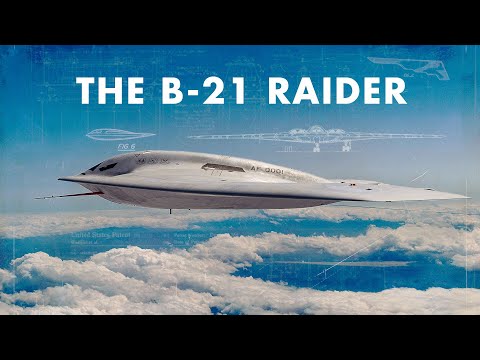
In the dead of night, a sleek, bat-like silhouette slices through the sky, invisible to the most advanced radar systems. This is the B-21 Raider, the United States’ next-generation stealth bomber, a machine designed to penetrate the most formidable air defenses and deliver precision strikes anywhere on the globe. It is a flying wing of pure menace, a ghost that even the most sophisticated air defense networks cannot touch.
Unveiled in 2022 amid a shroud of secrecy, the B-21 Raider represents a generational leap in military aviation. This aircraft is not just an evolution; it is a revolution. It is set to become the backbone of the US Air Force’s bomber fleet, a dual-capable platform ready to carry both nuclear and conventional weapons, ensuring American dominance in the skies for decades to come.
But to truly understand the B-21’s significance, we must journey back to the early days of aviation, where the dream of a flying wing was born. In the 1930s and 1940s, visionaries on both sides of the Atlantic pursued this radical design. In Germany, the Horton brothers crafted the Ho 229, the world’s first jet-powered flying wing, whose stealthy silhouette was decades ahead of its time. Simultaneously, Jack Northrop in the United States developed the XB-35 and YB-49, massive flying wing bombers that demonstrated low radar returns and impressive range. Yet, these pioneering projects were ultimately shelved, their potential locked away by technical challenges and shifting priorities.
The flying wing concept was resurrected with the B-2 Spirit in the 1980s. Northrop’s earlier research paved the way for the B-2, the world’s first operational stealth bomber. It proved its worth in combat from Kosovo to the Middle East, but its astronomical cost—over $2 billion per jet—and maintenance nightmares limited its fleet. The B-2 was a technological marvel, but it was also a logistical burden.
Enter the B-21 Raider. This is not just an upgrade; it is a complete rethinking of what a stealth bomber can be. Visually, it resembles a smaller, sleeker B-2, but beneath the surface, it leverages over 30 years of advances in computing, materials, and systems engineering. The Raider was designed from the outset for maintainability, using durable low-observable coatings that eliminate the need for climate-controlled hangars. It is stealth made practical, affordable, and sustainable.
The B-21 emerged from the Air Force’s Long-Range Strike Bomber program, aimed at replacing the B-1 and B-2 with a more affordable, survivable platform. Northrop Grumman won the contract in 2015, and the aircraft was developed under tight classification. When it was unveiled in December 2022, the world got its first glimpse of a bomber that would redefine aerial warfare. With a wingspan under 150 feet and a payload of around 30,000 pounds, the Raider is designed for a two-person crew but includes provisions for future unmanned operations. Its open systems architecture allows for rapid integration of new sensors and weapons, ensuring it remains ahead of emerging threats.
As a dual-capable platform, the B-21 will be certified to carry nuclear weapons and a broad array of conventional munitions. Its two weapon bays can accommodate standoff munitions and direct attack ordinances, giving it flexible targeting options for both strategic deterrence and tactical strikes. The Air Force states that the B-21 will have the range, access, and payload needed to hold any target around the globe at risk, even in highly contested environments.
By mid-2023, at least six Raiders were in various stages of testing and assembly, and the first flight finally took place in late 2023 from Palmdale to Edwards Air Force Base. The early flight data closely matched predictions, validating the accuracy of its digital design. Structural and fatigue testing are also underway to ensure the bomber meets long-term service goals into the 2050s.
The Raider entered low-rate initial production in 2024, with infrastructure including training simulators and deployable hangars already being established. Ellsworth Air Force Base in South Dakota will host the first operational squadron and training unit, followed by Whiteman and Dyess. Initial operational capability is expected by 2026 or 2027. Until then, the B-1B and B-2 fleets will remain in service before transitioning to a future bomber force built around the B-21 and upgraded B-52s.
From the outset, the B-21 program was shaped by a strict cost cap—$550 million per aircraft in 2010 dollars—mandated as a key performance requirement. That target has reportedly remained on track, with officials in 2024 confirming the program is meeting affordability and schedule goals. The initial development contract, valued at $23.5 billion, covered five prototypes. Over 30 years, total costs are projected at around $23 billion for R&D, procurement, and support of at least 100 aircraft.
However, senior Air Force leaders have acknowledged that 100 may be insufficient, with analyses suggesting a need for 145 or more. If production ramps to 15 per year, the full fleet could be fielded by the early 2030s, aligning with the retirement of the B-1 and B-2.
The B-21 Raider is set to reshape America’s long-range strike capability and reinforce strategic deterrence across the nuclear and conventional spectrum. As the future air leg of the US nuclear triad, it will replace the B-2 in delivering gravity bombs and cruise missiles, ensuring the ability to penetrate advanced air defenses and hold strategic targets at risk, even in the most heavily contested environments. This penetrability is central to US air power doctrine. By threatening hardened and mobile targets with precision, the Raider is intended to complicate enemy planning and discourage aggression.
In conventional roles, the B-21 provides a global strike option with unmatched stealth, range, and flexibility. It can operate without forward bases or large support packages—an advantage in theaters like the Indo-Pacific. By doing so, it forces adversaries to invest in costly countermeasures that may still prove ineffective, restoring the US advantage against integrated air defense systems like Russia’s S-500 or China’s layered anti-access and area denial defense networks.
For allies and partners, the Raider reinforces the credibility of US security guarantees. Though not offered for export, it’s designed with interoperability and coalition integration in mind, including an open architecture to adapt to future allied systems. The B-21’s presence will strengthen allied deterrence postures, especially in regions where peer competitors are expanding their reach.
Strategically, the B-21 is touted as a generational leap in long-range strike capability. Its ability to conduct regular bomber task force deployments will support persistent presence and rapid crisis response. Paired with a standoff-capable B-52 fleet, the US aims to maintain a dual bomber force able to operate across the full spectrum of conflict scenarios.
Yet, this strategic promise is not without challenges. The B-21’s effectiveness is heavily reliant on the continued viability of stealth technology, which faces future risks from emerging detection methods like quantum radar or advanced passive sensor networks. Additionally, in a saturation conflict, even stealth platforms will depend on secure basing and support infrastructure—both potential targets for long-range precision missiles.
While the B-21 represents a leap in stealth and precision capabilities, its effectiveness in a protracted conflict may be challenged by adversaries employing mass conventional forces. In such scenarios, the sheer volume of less advanced but numerous systems could impose significant attrition, underscoring the importance of balancing technological superiority with adequate force structure to sustain operations over time.
At the end of the day, the Raider does seem to mark both a technological and doctrinal milestone for the US. It inherits the legacy of the flying wing but advances it with modern stealth, digital engineering, and sustainment-focused design. Its affordability and modularity set it apart from its predecessors. Yet, some concerns remain. The program’s secrecy limits public oversight, and while it promises optionally manned operations, those capabilities have yet to be demonstrated. Critics also argue that large manned bombers may eventually face strategic obsolescence as autonomous systems and hypersonic weapons mature.
Still, as it enters service, the B-21 is poised to extend US strategic reach deep into the 21st century, offering a flexible, survivable platform that denies adversaries sanctuary while reinforcing allied confidence in the credibility of American air power. Will the B-21 Raider truly dominate the skies, or will emerging technologies render it obsolete? Share your thoughts in the comments below.
Report this article
Select a reason for reporting:






