What if the most paranoid man in history wasn’t paranoid enough? In the dark heart of the Third Reich, Adolf Hitler ruled through terror, but he feared loyalty, competence, and ambition even more. This is the story of 21 men inside the Nazi regime—officers, ministers, manipulators—each one powerful enough to make Hitler flinch. Some he destroyed, some betrayed him first, others simply vanished when they became too useful. These are the Nazis Hitler feared the most. Not because they hated him, but because they reminded him of himself. And in his empire of monsters, only one law mattered: Never outshine the Führer.
Before we dive in, if you love deep, unsettling dives into power, paranoia, and history’s darkest corners, make sure to subscribe. It helps the channel survive the algorithm wars. And while you’re here, where in the world are you watching from? And what time is it right now? Midnight, 3:00 a.m.? Are you listening in bed or hiding this tab at work? Drop it in the comments. I read every single one.
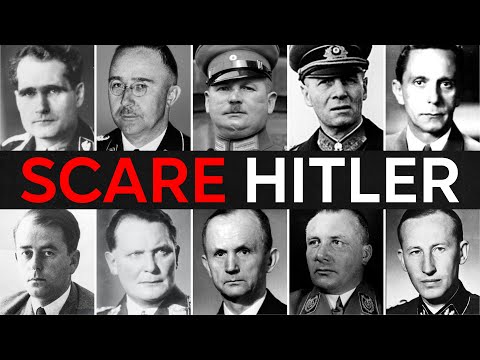
One. Ernst Röhm. In the early days of Hitler’s ascent, there was one man who didn’t just walk beside him. He practically shoved him forward. Ernst Röhm, burly and bullheaded, wasn’t merely a soldier or a sycophant. He was a revolutionary and worse, a true believer. Head of the SA, the Nazi party’s original paramilitary arm, Röhm built a street army of over 3 million men, not for Hitler, but for the movement. And therein lay the problem. Röhm didn’t want to play second fiddle to Prussian generals or sip champagne at long tables. He wanted a second revolution, the real one. He believed the Nazi party should devour the old German state, not partner with it. In his vision, the SA would replace the conservative army. He’d tear down the officer class, purge the aristocrats, and rebuild Germany in his own brutal image. To him, Hitler was too cautious, too willing to compromise.
But Hitler, ever the pragmatist when it came to self-preservation, watched Röhm grow louder, bolder, more dangerous, and more surrounded. Surrounded by men who saw him, not Hitler, as the true revolutionary. It wasn’t a betrayal that frightened Hitler. It was competition. In 1934, the Reich turned cold overnight, and Röhm, once a kingmaker, became a cautionary tale in boots. And yet Röhm’s removal didn’t end Hitler’s paranoia. It only taught him how to sharpen it, especially when the next threat wore a black uniform instead of brown.
Two. Heinrich Himmler. Heinrich Himmler looked like someone who had memorized a thousand names and buried the bodies alphabetically. Small, unassuming, and painfully awkward in public, he had the charisma of a filing cabinet and the ambition of a medieval inquisitor. What he lacked in presence, he made up for in infrastructure. An empire built not with armies, but with bureaucrats, ledgers, secrets, and silence. Himmler ran the SS like a kingdom within the Reich, one with its own laws, its own police, its own ideology, and eventually its own armies. Hitler admired Himmler’s loyalty, but never mistook it for love. Himmler didn’t love Hitler. He worshiped order, hierarchy, purification, the cold machinery of control. And if that machine required a new operator someday, well, history showed that Himmler was nothing if not adaptive.
Hitler kept Himmler close, but on a leash made of contempt. He never invited him into the innermost circle of personal trust. Not really, because Hitler could see what others didn’t: that Himmler’s genius lay in making himself look harmless. Even when consolidating power that rivaled the Führer’s own, the SS was no longer just a guard unit. It was an ecosystem, and ecosystems, when untended, grow wild. Himmler didn’t make demands. He made departments. And the next man Hitler feared, he made something far more dangerous: promises.
If you’re still with us after that, you’re exactly the kind of person this channel was made for. So, go ahead and subscribe if you haven’t already. It keeps these stories alive. And just out of curiosity, where are you watching from? What time is it on your end? Midnight in Berlin, 3:00 a.m. in Texas? Let me know in the comments. I’m always fascinated by who’s out there listening in the dark.
Three. Hermann Göring. Hermann Göring was many things. A World War I ace, a morphine addict, a collector of stolen art, and a man who could eat an entire roast goose while declaring moral superiority. He was also for a time the second most powerful man in Germany. And Hitler, despite their friendship, kept one eye on him and one hand on the trap door. Göring wasn’t discreet. He didn’t whisper in corridors or plot in shadows. He built palaces, paraded in outrageous uniforms, and named himself after medieval nobility. At one point, he held more titles than a small country. Hitler found him useful, but the sheer volume of Göring’s power—control over the Luftwaffe, the Four-Year Plan, the Gestapo in its early years, and much of the German economy—made him dangerous. Not because Göring had a spine, but because he had reach.
For all his decadence and theatricality, Göring was no fool. He knew Hitler’s moods, fed his fantasies, and stayed indispensable until the war started going badly. Then Göring made his fatal mistake. He began preparing for life after Hitler, drafting succession plans, testing loyalties, assuming that the Reich would need a new emperor. And Hitler noticed. Oh, he noticed. Because the only thing worse than a traitor is a loyalist with a retirement plan. And the next man, he didn’t want Hitler’s crown. He wanted his microphone.
Four. Joseph Goebbels. Joseph Goebbels didn’t need armies. He had metaphors, and with them he marched millions into madness. The man was five-foot-five and emotionally bulletproof. He limped. He raged. He romanticized ruin. But above all, he spoke with a fire that could melt skepticism into obedience. Hitler didn’t fear Goebbels because he was ambitious. He feared him because Goebbels was better at being Hitler than Hitler was.
As Minister of Propaganda, Goebbels was the voice behind the curtain, the ghostwriter of the national psyche. He understood before anyone else that narrative is stronger than truth. He didn’t just craft lies. He choreographed them, set them to music, timed them with silence, turned them into operas of hate and hope. His rallies were theater, and he was both playwright and pyromaniac. But what made Goebbels dangerous wasn’t just his influence over the public. It was his understanding of Hitler himself. He knew how to flatter, how to push, how to whisper exactly what the Führer needed to hear when reality didn’t cooperate.
Their relationship was part confessional, part competition. Goebbels worshiped Hitler, but he also suspected he could replace him, if only by imitation. And Hitler, ever wary, kept one eye on his silver-tongued shadow. The next man didn’t need words. He simply made sure you couldn’t speak at all.
Five. Martin Bormann. If Joseph Goebbels controlled what people thought, Martin Bormann controlled who got to think it. The most dangerous man in the Reich didn’t wear a uniform, didn’t give speeches, and rarely left the shadows. He was Hitler’s private secretary, which sounds quaint until you realize that meant controlling access to the most powerful man in Europe. He was the gatekeeper of the apocalypse. Bormann didn’t shout or command. He signed. He filtered. He withheld. And by doing so, he rewrote the Reich in triplicate.
Ministers discovered one day that they no longer had Hitler’s ear because Bormann had quietly glued it to his own desk. He read Hitler’s correspondence, decided which memos got seen, and rephrased orders to suit his goals. The man practically ghostwrote reality. Hitler never trusted him, not fully. But he used him the way a king uses poison: sparingly, carefully, and always with the antidote nearby. Bormann didn’t need loyalty. He needed proximity, and he had it. Always in the background, always writing, always one step ahead in the bureaucratic jungle that passed for a functioning government. Others fought battles. Bormann redrew maps. And yet in the steel-cold hierarchy of terror, even Bormann had someone to watch his back around. Someone whose idea of diplomacy started with dossiers and ended with disappearances.
Six. Reinhard Heydrich. Reinhard Heydrich was what happened when intelligence decided to wear jackboots. Cold, calculating, and eerily elegant, he walked through rooms like he owned the air in them. His nickname among colleagues wasn’t flattering—the Blonde Beast—but it fit, because Heydrich wasn’t just ruthless. He was better at everything. At planning, at deception, at killing quietly, surgically, with paperwork instead of pistols. He built the Reich Security Main Office like a spiderweb, sticky with secrets. It was part Gestapo, part SS, part administrative abyss, and entirely his. He had files on everyone: habits logged, whispers recorded, weaknesses indexed. And while Hitler appreciated competence, he distrusted independence. Heydrich had too much of it.
He didn’t need to curry favor. His results spoke fluently. He could sniff out dissent faster than it formed, anticipate plots before they hatched, and remove problems so efficiently they never knew they were problems. Hitler feared him in the same way a king fears his most capable general: loyal today, but dangerously irreplaceable tomorrow. There were whispers even among the SS that if anything ever happened to Hitler, Heydrich already had a plan—a clean one. But for all his shadows, Heydrich wasn’t the only predator lurking behind polite uniforms. The next man didn’t build empires. He erased people from them.
Seven. Heinrich Müller. Heinrich Müller had a talent for disappearing while standing directly in front of you. As head of the Gestapo, he wasn’t the loudest man in the room. He was the room. A gray, dull presence with the emotional range of a brick wall, Müller perfected an art form Hitler valued and secretly feared: absolute silence. Silent loyalty, silent efficiency, silent knowledge. Where others built power through ambition or charm, Müller built power through information. He knew who complained, who whispered, who questioned, who hesitated. He read intercepted letters the way other men read love poems. His network was so vast that even other intelligence chiefs wondered whether their own employees were actually working for him on weekends.
Hitler valued Müller for one reason: he solved problems. Not with flare, not with theatrics, but with the quiet finality of a closed drawer. But the problem with indispensable men is that they become impossible to control. Müller didn’t care about ideology or glory or even Hitler himself. He cared about the system, the machinery of surveillance. And if that machine ever needed a new operator, Hitler knew Müller could slide into the role without blinking. Some said Müller’s real loyalty was to the files, not the Führer. Others said he didn’t need to be loyal at all. He simply needed to know more than everyone else combined. And he did.
But for all his unseen power, Müller still operated inside a government structure he didn’t own. The next man did—at least for a while—until Hitler decided the structure itself was a threat.
Eight. Wilhelm Frick. Frick was the regime’s architect of legality, the Interior Minister who turned radical chaos into neat stacks of laws. He controlled elections, civil service appointments, and the fine print that made authoritarianism look like administrative housekeeping. Hitler trusted him early because Frick was predictable—until he wasn’t. Frick believed in a centralized state; Hitler believed in chaotic competition among lieutenants. When Frick resisted Himmler and Bormann’s empires, he became inconvenient. Power in the Reich didn’t go to the strongest. It went to the least inconvenient.
Nine. Rudolf Hess. Once so close that people assumed he was heir by proximity, Hess flew alone to Scotland in 1941, believing he could negotiate peace behind Hitler’s back. Hitler saw not peace-seeking but disobedience—and in his worldview, disobedience was betrayal. Hess vanished into imprisonment, a footnote with wings.
Ten. Albert Speer. He didn’t shout or wear thunderous uniforms. He simply got things done, squeezing more tanks and time out of a collapsing economy. By 1944, whispers suggested Speer might lead a post-Hitler Germany. Whether he entertained the idea was beside the point. Being too useful was just another kind of threat.
Eleven. Karl Dönitz. He never plotted, but he commanded an ocean of submarines and the quiet loyalty of his men. In the final days, Hitler named him successor—not from trust, but desperation.
Twelve. Wilhelm Keitel. He mistook obedience for virtue, signing anything, codifying horrors into policy. A perfect tool—until he becomes someone else’s.
Thirteen. Alfred Jodl. Too professional, too clean-cut, too willing to bend the map around fantasy. Hitler feared not treason, but the quiet complicity of a man who knew better and still nodded.
Fourteen. Erich Raeder. Aristocratic, independent, and too old-school. He questioned orders and didn’t grovel. Even naval legends could be sunk from shore.
Fifteen. Werner von Blomberg. He believed he could manage Hitler. A fatal assumption. When scandal came, Hitler used it as pretext—not for honor, but consolidation.
Sixteen. Werner von Fritsch. Not a Nazi—already suspicious. He was principled, and principled men are dangerous. Hitler didn’t wait for treason. He invented it.
Seventeen. Walter von Reichenau. He embraced Nazi ideology too well, developing his own voice and following. He died suddenly in 1942—officially of a stroke, unofficially of too much potential.
Eighteen. Gerd von Rundstedt. Aristocratic, composed, and unafraid to disagree. His mere existence reminded Hitler that the army still had its own gods.
Nineteen. Erwin Rommel. The Desert Fox was everything Hitler pretended to be—brave, decisive, respected without fear. His fame outgrew the Führer’s comfort zone. In the Third Reich, legends were only allowed if they served one story.
Twenty. Hans Lammers. He looked like a clerk—that was his genius. He controlled the paperwork, and the person who controls the paperwork controls the regime. A manila folder with fangs.
Twenty-One. Hjalmar Schacht. The banker who made rearmament look solvent. He questioned spending, warned of collapse, and did it with authority. Hitler never forgot the quiet ones who could open the books—and worse, testify.
In the end, Hitler’s empire of monsters devoured itself. Each man he feared was a mirror reflecting his own methods back at him. He had built a system where loyalty was suspicion and competence was competition. And when the bunker finally fell silent, the only question left was the one he never dared ask aloud: if he feared them all, who was left to fear him?
Which of these men do you think was the most dangerous to Hitler—and why? Let me know in the comments below.
Report this article
Select a reason for reporting:






