The war in Europe was over, but the killing had only just begun. In the smoldering ruins of the Third Reich, a new wave of violence swept across the continent—not of armies clashing on battlefields, but of revenge, ethnic cleansing, and cold-blooded murder. More than 100 people lost their lives in a single day as lynchings of Germans became a common event. Not far from Prague, an amateur filmmaker captured the horror on his 8mm camera: thousands of civilians forced to the side of the road, executed without trial. “We kept our mouths shut just like the whole of Germany did,” one Czech student later admitted, his voice heavy with shame.
This was the birth of a new world order, forged in blood and betrayal. The map of Europe was being redrawn, and millions would pay the price.
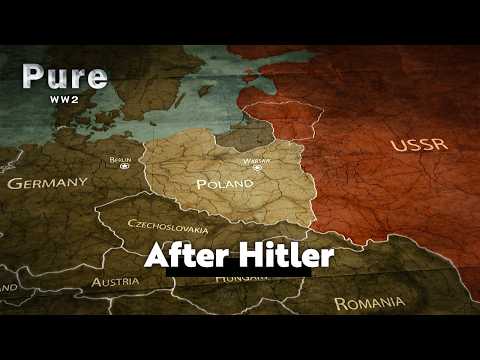
From 1945 to 1947, at least 12 million Germans were driven out of Eastern Europe—one of the largest refugee floods in history. They marched along the same routes once taken by Jewish victims of the Nazis, a cruel twist of fate that left even the victors uneasy. “We tend to regard occupied Germany as a waste paper basket with a limitless capacity for the unwanted waste of the world,” remarked one British colonel, his words a chilling testament to the era’s moral decay.
But German minorities weren’t the only targets. In Poland, nationalist militias decimated Ukrainian minorities; in Yugoslavia, Tito’s regime wiped out 70,000 Croatian collaborators; in Greece, a civil war between communists and royalists left over 50,000 dead. Ethnic cleansing and the settling of old scores were everywhere, as if the war had obliterated all moral codes.
By 1947, the displaced persons had at last made it home—but for many, home was a place of fresh horror. German prisoners of war continued to be exploited in the victorious countries. In the east, they were detained in appalling conditions, where extreme weather and food shortages conspired to finish off survivors. One-third of them—about a million souls—disappeared in the desolate wastelands of the Gulags. The Russians, it seemed, never forgot.
Meanwhile, Jewish survivors of the Holocaust sought a new life in the West. Many gathered for the voyage to Palestine, then under British control. In 1947, an old tub rebaptized the Exodus carried more than 4,500 refugees, only to be boarded by the Royal Navy, which refused to let them into their promised land. They were transferred to prison ships and taken back to Germany, where they found themselves in internment camps once more. The worldwide outcry that followed forced the UN General Assembly to vote for partition—and for the creation of two states, one Jewish, one Arab. At last, the Holocaust survivors had a destination. Europe, though, washed its hands of them.
But a new conflict was already brewing. In March 1947, one year after Churchill’s Iron Curtain speech, Harry Truman addressed Congress with words that would change the face of postwar Europe. “I believe that it must be the policy of the United States to support free peoples who are resisting attempted subjugation by armed minorities or by outside pressures,” he declared. The principal danger, he warned, was not Soviet military might—the Russians didn’t have the bomb—but poverty. And in 1947, people were exhausted.
To prop up Europe and hold back communism, Washington unveiled the Marshall Plan: massive credits to help the continent out of the slump. Raw materials and machine tools were dispatched to rescue the old world. But Stalin was well aware that this plan could weaken his hold on Eastern Europe. He forbade all countries in his clutches from accepting Washington’s offer, and ordered Western Communist parties to take action. In France and Italy, communists threw themselves behind rapidly proliferating strikes—it was starting to look like civil war.
The French government feared a coup, and not without reason. The socialist minister of the interior, Jules Moch, called up 80,000 reservists and gave them permission to shoot. In a matter of weeks, order was restored at the cost of a few lives—but the communists had failed to foil the Marshall Plan. All those millions from Uncle Sam rebooted the old continent’s economies. Farmers saw harvests return to pre-war levels and soon even overtake them. The Americans were betting on restoring the German economy—a strong Germany would be less costly to maintain and a rampart against communism. Prosperity had returned, but it left Europe wide open to American big business.
Stalin, however, had his own plans for stopping capitalism in its tracks. The name of the game was merger and acquisition, made in Moscow. The ruler of the Kremlin encouraged communists to get into government, but now he wanted them to eradicate the other parties they’d been associated with. It was the birth of the single-party state. In Romania, the conservatives were thrown out, the administration purged, a thousand magistrates removed, and the elections rigged. The young King Michael was forced to abdicate. In Hungary, Prime Minister Ferenc Nagy stood up to the communists—until his son was kidnapped in June 1947. He resigned, paid the ransom, and retired to the United States. Three months later in Bulgaria, the hardcore Stalinist leader Georgi Dimitrov came to power. His rival Nikola Petkov was immediately arrested and condemned to death; he was hanged in September 1947. Meanwhile, in Poland, Stanisław Mikołajczyk, head of the Polish People’s Party, spoke out against the Communist Party. By October, he feared for his life, and he and his wife sought refuge in England. “I didn’t want to be only a sheep who will be killed,” he later said, “especially because my party couldn’t work anymore.”
It had taken Stalin just a few months to have his way. Now he had nearly all of Eastern Europe under his flag. Churchill’s prophecy had come true. The Iron Curtain had descended across the continent—and the world was about to split in two.
But the Iron Curtain was not yet a wall of stone. In the months that followed, the division of Europe became a contest of nerves, played out in the ruined cities and frozen villages of the continent. The Americans, convinced that poverty was the true breeding ground of communism, poured billions into Western Europe. The Marshall Plan was not merely charity—it was strategy, a bet that prosperity could inoculate a people against revolution.
And it worked. By 1948, the factories of the Ruhr were humming again, the ports of Rotterdam and Marseille were choked with cargo, and the farmers of France and Italy were bringing in harvests that had not been seen since before the war. Western Europe was not merely recovering; it was being rebuilt as a bulwark.
Stalin watched from the Kremlin with mounting fury. The Marshall Plan had drawn a line across the continent, and the countries of the East were on the wrong side of it. His response was swift and brutal. In February 1948, a communist coup in Czechoslovakia—the last democracy in the Soviet sphere—sealed the fate of Eastern Europe. The foreign minister, Jan Masaryk, was found dead beneath the windows of his ministry, in what the regime called a suicide. Few believed it.
Then came Berlin. The former capital of the Reich lay deep inside the Soviet zone, divided into four sectors among the victorious powers. In June 1948, the Western Allies introduced a new currency in their sectors—a move that Stalin saw as a direct challenge. He responded by cutting off all road, rail, and canal access to West Berlin. Two million people were suddenly stranded in a city surrounded by Soviet troops.
The West had no intention of abandoning them. Instead of forcing a confrontation, the Americans and British launched an airlift of unprecedented scale. For nearly a year, planes flew around the clock into Tempelhof and Gatow, delivering coal, food, and medicine to the besieged city. At its peak, a plane landed every thirty seconds. Children gathered at the end of the runways, waiting for the candy that pilots dropped on tiny parachutes.
Stalin, faced with this silent defiance, eventually backed down. The blockade was lifted in May 1949. West Berlin had survived—and the message was unmistakable. The West would not be pushed out. The Iron Curtain was now a permanent frontier, guarded by soldiers and barbed wire.
That same year, the division of Germany became official. The Federal Republic of Germany was born in the west, and the German Democratic Republic in the east. Two states, two ideologies, two armies—each claiming to be the true Germany. The continent was split from the Baltic to the Adriatic, and the old world of empires and alliances was gone forever.
Yet the struggle was only shifting its ground. With Europe divided, the two superpowers turned their eyes elsewhere—to Asia, where the collapse of the old colonial order was creating new battlegrounds. In China, a civil war was reaching its climax, and in Korea, a peninsula divided at the thirty-eighth parallel was becoming the next flashpoint. The Cold War had begun in earnest, and its shadow was spreading across the globe.
The year 1949 brought another kind of reckoning. In Washington, the State Department published a white paper on the flight of the Exodus and the fate of the displaced—and the world finally understood that the refugee crisis had not ended with the war, only changed its address. “The problem of the Jewish refugees is a closed case,” one official had said, but history would not close it so easily. By the following year, the survivors of the camps were no longer supplicants; they were citizens of a new state.
In the east, Stalin’s grip hardened into ice. The show trials of the late forties gave way to the quieter purges of the early fifties—poets arrested at midnight, priests vanished from their parishes, peasants starved into collectives. Yet even the Kremlin could not extinguish every flicker of dissent. In Berlin, in Budapest, in Warsaw, the young were beginning to listen to foreign radio stations and whisper about a different kind of Europe.
And in the west, the old continent was learning a new vocabulary. The Marshall Plan’s dollars had become the coal and steel that fed the factories; the factories fed the cities; the cities fed the hope that the future might be better than the past. “Prosperity has returned,” the newsreels declared, though the cameras rarely lingered on the bombed-out churches or the widows in black.
The Iron Curtain had descended, but it was not yet the only curtain. In Asia, the Chinese civil war ended in a communist victory, and the United States found itself drawn into a new war on the Korean peninsula. The Cold War had begun in earnest, and its shadow was spreading across the globe.
Yet for those who had survived the slaughter of 1945, the question was simpler. Could a continent that had descended into barbarism learn to live with its ghosts? Could the men who had seen the worst of humanity build a world worthy of the best of it? The answer, like the century itself, remained unwritten.
What do you think—was the Marshall Plan a genuine act of generosity, or simply a shrewd move in a new kind of war? Share your thoughts below.
Report this article
Select a reason for reporting:






