Imagine you’re at the controls of Britain’s most legendary fighter, screaming into a dive at over 350 miles per hour. An enemy aircraft is dead ahead. You slam the stick sideways to maneuver—and nothing happens. Your arm is fully extended, muscles straining, but the aileron simply won’t budge. It’s not because you’re weak or afraid. It’s because the air rushing over that beautiful elliptical wing is physically stronger than you are. No amount of willpower can change that.
This was Britain’s hidden World War II crisis, baked into the very aircraft everyone believed was perfect. And the solution was smaller than your forearm.
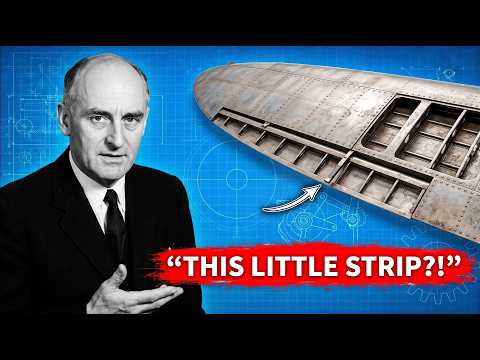
To understand how this happened, you have to see the Spitfire’s wing for what it truly was—not the romanticized curve or organic perfection, but a mechanical device interacting with air at brutal speeds. Reginald Mitchell chose the elliptical shape to minimize induced drag, achieving near-mathematical lift distribution. The result was a wing that generated less drag for a given lift than any other shape. Pilots felt it in the cockpit: controls so light and precise they seemed to anticipate inputs. It wasn’t romantic exaggeration—the wing worked exactly as designed.
Mitchell died in June 1937, aged 42, shortly after the prototype flew. He never saw the Spitfire in combat. He also never lived to discover the problem his elegant wing had quietly planted.
Here’s the physics in simplest terms. The aileron—the hinged surface on the outboard wing—generates resistance the moment you try to move it. Air flowing over and under creates a restoring force trying to push it back to neutral. Engineers call this hinge moment. And hinge moment doesn’t grow linearly with speed. It grows with the square of speed. Double the speed, and the force required quadruples. Triple it, and you need nine times the force.
At 200 mph, the Spitfire’s ailerons were light, precise, almost telepathic. At 300, noticeably heavier. At 350, a pilot attempting a sharp turn met substantial resistance. Above 380, maintaining full aileron deflection demanded muscular effort no arm could sustain through a combat maneuver.
Geoffrey Quill, Supermarine’s chief test pilot, knew something was wrong before the war. In his pre-production flight reports and later memoirs, he documented that aileron heaviness was noticeable during high-speed dives, even in early aircraft. But operational speeds in 1938 and 1939—the speeds everyone imagined combat would occur at—didn’t push the aircraft far enough into the danger zone to demand an urgent fix. At planned wartime speeds, the ailerons were heavy but usable.
Then actual war arrived with different ideas about speed.
In the Battle of Britain, most combat occurred at speeds where the Spitfire’s ailerons, though stiff, remained workable. The aircraft performed. Britain survived, and the Spitfire entered a myth so powerful it began functioning as its own propaganda. The design was complete. The aircraft was finished. What the war revealed was a perfect tool—Mitchell’s masterpiece, the machine that saved the country.
But combat reports accumulating through autumn 1940 and into 1941 told a more complicated story. Pilots chasing diving German aircraft, trying to hold position behind a maneuvering enemy above 300 mph, hit a limit the specifications never described. The controls didn’t suddenly freeze. The degradation was gradual and insidious. As dive speed increased past 300, then 320, then 350, stick resistance climbed. At 380, a pilot demanding a sharp turn fought aerodynamic forces he couldn’t sustain for the duration required. The window of opportunity was brief. The enemy pulled away. The engagement ended without the Spitfire executing the turn that might have changed its outcome.
When those reports reached the Air Ministry—from multiple squadrons, multiple theaters, multiple months—they described the same constraint at the same speeds. Not mechanical failure, not pilot error, but physics. The pattern was too consistent to ignore. An official investigation was the only logical response.
That investigation revealed something hiding inside the problem. The Spitfire’s ailerons in 1940 were fabric-covered. The structure was metal, but the skin stretched over it was treated cloth, taut on the ground and smooth at low speeds. At high speed, that fabric didn’t stay smooth. Aerodynamic pressure forced it to bulge outward, distorting the surface shape. That distortion created a second restoring force on top of the hinge geometry. The aileron was trying to streamline itself back to neutral. The pilot was fighting both the hinge moment and the fabric’s aerodynamic deformation simultaneously. Neither force alone was insurmountable. Together, in a high-speed dive above 350 mph, they were enough to strip the pilot of effective lateral control at the exact moments he needed it most.
Joseph Smith had to solve this. Smith is consistently ranked as one of the least famous names in Spitfire history—a strange fate for the man whose engineering kept Mitchell’s creation competitive through six years of war that never stopped raising the bar. When Mitchell died in 1937, Smith became Supermarine’s chief designer. Every modification, every development, every aerodynamic fix that kept the Spitfire relevant passed through his team. The aircraft in the famous photographs, bearing Mitchell’s conceptual signature, was in its details and performance characteristics Smith’s aircraft. Mitchell invented the Spitfire. Smith kept inventing it.
The first response was obvious: replace the fabric with metal. Metal-covered ailerons entered service on the Spitfire Mark V in 1941. It wasn’t simple—adapting tooling and assembly in a production program under relentless demand required careful management—but the change was absorbed. Pilots noticed controls became more predictable at high speed, more responsive and precise. The surface held its designed shape under aerodynamic load, removing one layer of the problem.
But only one layer.
At 400 mph, the ailerons were still heavy enough to restrict effective combat maneuvering. The metal fix eliminated fabric distortion. What remained was the fundamental hinge geometry—the pivot point’s position relative to the surface’s aerodynamic center. That geometry still produced hinge moments beyond what a pilot could comfortably sustain in a sharp turn. The fabric had been partially masking the full scope of the problem. Without it, the engineering challenge stood fully exposed, and it remained unsuitable for the speeds the war demanded.
The popular Spitfire development narrative grows quiet here. It acknowledges model evolution and engine improvements—Merlin 3 to Merlin 45 to Merlin 61, with power figures climbing through the war years. It says little about control surfaces, because control surfaces don’t carry the same narrative momentum as supercharger altitudes and horsepower numbers. The comfortable version is that Mitchell created something essentially complete, and later development was refinement of a sound design.
That version is incomplete in a way that matters.
The pilot’s physical relationship with the wing—the experience of demanding a sharp roll above 350 mph, the interplay between arm strength and aircraft response—had to be rebuilt. Not the aerodynamic theory of the elliptical platform, but the pilot interface in the specific sense of what a pilot’s muscles could achieve at combat speeds. And rebuilding it required aerodynamic understanding that was, in the early 1940s, at the cutting edge of British research.
You can’t solve hinge moment by simply making the control surface lighter across all speeds. An aileron requiring almost no force at 400 mph would be dangerously sensitive at 150—twitchy and imprecise on approach, where an over-responsive surface could kill a pilot during landing. The solution had to be proportional. It had to distinguish between low-speed conditions where pilot strength sufficed, and high-speed conditions where it didn’t. It needed to provide almost nothing when the problem was minimal, and graduated assistance when it was worst. The mechanism had to know the difference without sensors, electronics, or hydraulics.
That’s exactly what the spring tab does.
The tab is a small hinged surface at the trailing edge of the control surface. When it deflects, it generates aerodynamic force. Arrange that force to help deflect the main surface, and you have a servo tab—the air itself assists the pilot. The spring tab refines this with elegant mechanical specificity. The aileron connects to the auxiliary surface through a calibrated spring rather than a rigid link. At low speeds, aerodynamic loads on the aileron are small. The spring is stiff relative to those loads, so the auxiliary surface and aileron move as one piece. The pilot experiences direct, natural control response.
At high speeds, aerodynamic loads become large enough to compress the spring. As it yields, the auxiliary surface moves increasingly relative to the aileron, generating proportional assistance on the main surface. The more the air resists the pilot’s input, the more the auxiliary surface deflects and the more help the pilot gets.
It’s a self-regulating mechanism. No sensors measuring airspeed. No hydraulic actuators. Just a spring whose stiffness was calculated so that the very aerodynamic force impeding the pilot became the means of assisting him. The problem contained its own solution.
That understanding came from the Royal Aircraft Establishment at Farnborough, where aerodynamicists systematically studied control surface behavior at speeds aircraft were beginning to reach in numbers. Wind tunnel tests, mathematical analysis, instrumented flights—the RAE built a precise understanding of what happened to hinge moments as speed increased. The spring tab concept emerged from that research environment. It wasn’t invented specifically for the Spitfire, nor was it the product of one engineer’s vision. It came from a research system operating precisely because it had to.
Supermarine’s engineers translated that theoretical understanding into hardware that could be manufactured, installed, and verified under real flight conditions. The Aeroplane and Armament Experimental Establishment at Boscombe Down conducted the verification. They measured stick forces in modified and unmodified Spitfires across the relevant speed range. The comparison was unambiguous. At 380 mph, the unmodified aircraft required forces beyond what a pilot could sustain through a full combat maneuver. The aircraft with the auxiliary surface kept forces within the possible range—making the maneuver difficult but achievable.
The aircraft were visually identical. A Spitfire with a spring tab and one without looked like the same plane from outside. The tab was a narrow metal strip at the aileron’s trailing edge. It was defined and practical, easy to overlook in the historical record because it carried no dramatic external signature—no new engine, no changed silhouette, no new wing shape. But inside the cockpit at 380 mph, the experience was entirely different. The aileron responded. The roll happened. The lateral authority that had been gradually fading with increasing speed re-emerged.
What that meant tactically must be stated in concrete terms. A pilot in a high-speed dive has a narrow window in which decisions are possible. If the ailerons don’t respond effectively, the pilot commits to whatever roll attitude the aircraft entered the dive with. The enemy pulls away. The engagement ends without the Spitfire executing the maneuver the situation demanded. With effective lateral control above 350 mph, the pilot could track and respond to what the enemy was doing, adjusting angles during a turning fight at speeds where the unmodified aircraft was effectively constrained to a straight line.
There’s confusion in this part of Spitfire history worth addressing directly. The Focke-Wulf 190, encountered systematically from late 1941, had a genuine advantage in roll rate over the Spitfire Mark V—a real and dangerous tactical problem documented in RAF combat reports. But that was a distinct problem from aileron heaviness. The 190’s inherent roll rate was superior by design. That gap was largely closed by the Spitfire Mark 9, with the Merlin 61 restoring performance parity. Aileron heaviness addressed an entirely different failure mode: what happened when the pilot’s muscles couldn’t generate enough force to move the surface at all. Both problems were real. They had different causes and required different solutions. Confusing them misrepresents the tab’s contribution and obscures what the Mark 9 actually fixed.
The Hawker Typhoon fought the same aerodynamic physics independently. At high speed, its ailerons presented the same fundamental problem. Spring tabs were fitted to the Typhoon. The solution that worked for Supermarine worked for Hawker because the underlying theory came from the same research institution. The RAE’s understanding of spring tab mechanics belonged to British aviation as a system, not to any single manufacturer.
By mid-war, Spitfire production had become something the small team that built the pre-war prototypes wouldn’t have recognized. The Castle Bromwich shadow factory was producing hundreds of Spitfires monthly by 1942. Monthly output had grown from single digits before the war to an industrial tempo reflecting the nation’s commitment to keeping one aircraft in the fight. The dispersal of production after the Southampton works were bombed in 1940 distributed manufacturing across dozens of small facilities, creating a system that was hard to destroy and capable of sustaining output despite repeated disruption. Any aerodynamic modification requiring production stoppage would have arrived too late to matter for the period it was designed for.
The spring balance tab was a change that could be integrated into the existing production flow. A modification at the aileron’s trailing edge, not a redesign of the wing or structure. It arrived in time.
Pilots who received aircraft fitted with these tabs noticed the difference without always knowing the mechanism. Controls responded better at speeds above 300 mph. The aircraft became capable of maneuvering in high-speed dives in the way tactical requirements demanded rather than the way physics allowed. Some knew the term “tab.” Most simply knew that the aircraft they flew in 1943 was a more complete weapon than the one they flew in 1941, without being able to name the change that made it so.
The Spitfire across its production life became a platform in a way Mitchell hadn’t fully designed at the start. An airframe accommodating more powerful engines and progressively more sophisticated aerodynamic refinements as war requirements escalated. Early marks flew with the Merlin producing around 1,030 horsepower. Later marks flew with engines producing 1,700 horsepower and above. Higher power meant higher speed. Higher speed meant higher aerodynamic loads on every surface. And higher loads meant the hinge moment problem returning more severely with every 100 mph that engine development delivered. The spring tab’s self-balancing mechanism responded to all those returns with proportionally greater assistance. The aircraft repeatedly outgrew its original control geometry, and the tab kept pace.
Geoffrey Quill, who had noted aileron heaviness in those first experimental flights and continued flying Spitfire marks until war’s end, understood this dynamic clearly. The aircraft’s long operational career wasn’t simply the expression of Mitchell’s original genius persisting through time. It was the product of continuous engineering effort executed under time pressure by people who received a fraction of the recognition centered on the founding moment.
The Spitfire that fought in 1944 was related to Mitchell’s design the way a building continuously renovated over a decade is related to its architect’s original drawings. The address is familiar. Much of the interior changed gradually at the hands of people who left no plaques on the walls.
Joseph Smith continued at Supermarine after the war. His major post-war project, the Spiteful, was a direct attempt to address the aerodynamic complexities his team had come to know intimately through six years of war. The Spiteful’s laminar-flow wing was designed for improved high-speed performance from the outset, rather than relying on successive modifications. The aircraft flew and performed well in testing. The RAF placed orders, but jet aircraft had arrived, and the calculus of technologies with military futures shifted decisively. Piston-engined fighters had perhaps three years of frontline relevance remaining when the Spiteful entered serious development, and production numbers reflected that reality.
Smith died in 1956. His name is known primarily among those who have engaged with Spitfire history at an engineering level, not through the mythology surrounding the aircraft. He devoted his career to refinement and development. Supermarine entered the jet age with the Attacker, a carrier-borne fighter combining jet propulsion with a straight wing and tailwheel landing gear—a transitional machine reflecting a company still trying to find footing in a world where everything it had mastered about high-speed propeller aviation became historical knowledge overnight.
Vickers acquired Supermarine. The name faded from factory signs and official documents. The Southampton facilities where Mitchell worked and where Smith’s team spent the war years keeping an aircraft the war was constantly trying to outgrow were eventually cleared and redeveloped. The physical place no longer exists. What it produced still flies at air shows, recognizable from a mile away by the wing shape, still drawing every eye that sees it.
The Royal Aircraft Establishment at Farnborough continued through post-war decades, eventually restructured and privatized as QinetiQ. The aerodynamic research on hinge moments and spring tabs that supported the Spitfire’s control solution became part of the foundational knowledge of British aeronautical engineering, absorbed, generalized, and passed to later generations—ultimately made obsolete by powered flight controls. In modern combat aircraft, the pilot’s muscles have no mechanical connection to the control surfaces. The force a human arm can generate is entirely irrelevant to whether the surface moves. The problem the spring tab solved with such precision—how to match aerodynamic loads increasing with the square of speed to the limited strength of a human arm—was solved by removing the arm from the equation entirely. But during the specific years when it mattered, the tab was the solution.
The tab itself has no biography. It doesn’t appear in the paintings of Spitfires soaring over the English Channel. It isn’t what people point to when they explain why this aircraft is famous. It was a metal strip at the trailing edge of an aileron, connected to the surface through a calibrated spring, doing invisible work at the speeds where the famous aircraft most needed to be a weapon and was increasingly losing that capacity without it.
Return to the cockpit one last time. You’re past 350 mph. The enemy below is pulling away in a turning move. You push the stick sideways. In the unmodified aircraft—the one in the myths, the one in every museum painting—the aileron barely moves. Your arm reaches its limit. The roll doesn’t happen. The moment is lost.
In the aircraft Joseph Smith’s team modified, made possible by the RAE’s aerodynamicists and verified at Boscombe Down, the aileron moves. The roll happens, and you can follow. Mitchell’s wing gave the Spitfire its grace and efficiency, and the same aerodynamic quality that made the controls feel almost telepathic at moderate speeds placed a physical limit no pilot’s arm could exceed. The spring tabs lowered that limit. They used the same air that was defeating the pilot to assist him instead. They were smaller than your forearm. They required no electrical power, no hydraulic fluid, no electronics. They turned an aircraft losing its fight with physics above 350 mph into one capable of continuing the fight there.
The Spitfire people remember, the one that remained a frontline competitor until 1945, was partly the creation of engineers most of those people never looked up. The aircraft that fought in the war’s middle and late years wasn’t entirely the aircraft Mitchell drew. It was the aircraft others kept fixing, developing, and making suitable for a war that refused to stay within the performance boundaries anyone had planned for.
This doesn’t diminish what Mitchell accomplished. He created something good enough to be saved repeatedly. That’s no small thing. But that saving required people. And the spring tab is where you can see most clearly that the Spitfire’s story didn’t end with its inventor. It simply moved to the engineers who had to fix what the war revealed.
So here’s the question: when we celebrate the legends of engineering, should we be looking harder at the quiet fixes that kept them flying—and the people who made them?
Report this article
Select a reason for reporting:






