In the heart of a crumbling Berlin, beneath the relentless roar of Soviet artillery, Adolf Hitler sat in a concrete tomb of his own making. The year was 1945, and the Führerbunker, once a symbol of Nazi invincibility, had become a prison of paranoia and despair. “The war is lost,” Hitler had finally admitted, his trembling hands and bloodshot eyes betraying the toll of stress, Parkinson’s disease, and a cocktail of drugs. Outside, the Red Army advanced street by street, their tanks grinding over the rubble of what was to be the capital of a thousand-year Reich. Inside, the bunker’s inhabitants—a mix of loyalists, opportunists, and the doomed—watched their world shrink to a few underground rooms filled with the stench of fear and cyanide.
Hitler had retreated to this subterranean labyrinth on January 16, 1945, accompanied by his mistress, Eva Braun, and a cadre of sycophants. The bunker, with its three-meter-thick concrete roof, was designed to withstand the heaviest bombs, but it could not shield Hitler from the reality closing in. “It never entered my mind even then, as the bombs rained down, that we would lose,” recalled Armin Lehmann, a 16-year-old Hitler Youth runner who witnessed the Führer’s final days. But loss was inevitable. The Wonder Weapons—jet fighters, ballistic missiles, super-heavy tanks—that Hitler believed would turn the tide were figments of a broken imagination, their production lines long since pulverized by Allied bombers.
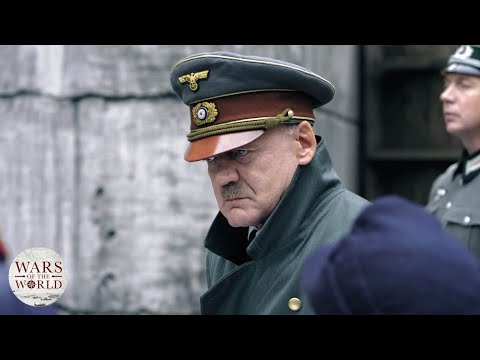
The bunker was a world unto itself, lavishly decorated with a painting of Frederick the Great and stocked with fine wines, a stark contrast to the squalor above. Martin Bormann, Hitler’s private secretary, was known for his drunken orgies with women hiding from the Soviet rape gangs, while outside, starving civilians carved flesh from a still-living horse. “The decadence shocked even a committed young Nazi like me,” Lehmann remembered. Hitler, isolated and increasingly detached, suffered a nervous breakdown when his orders were ignored, and began investigating methods of suicide. The arrival of news that Heinrich Himmler, the once-loyal SS chief, had attempted to negotiate surrender with the Western Allies sent Hitler into a rage. “Treason!” he screamed, ordering Himmler’s arrest and execution.
By April 28, the Red Army had reached the Potsdamer Platz, less than a kilometer from the bunker. Hitler knew his time was up. That night, in a macabre ceremony, he married Eva Braun, who had refused to leave his side. “She was loyal to the very end,” Hitler remarked, a rare moment of tenderness in a life defined by brutality. The wedding was a somber affair, witnessed by Bormann and Joseph Goebbels, followed by a modest reception and Hitler’s dictation of his last will and testament. He named Goebbels as Chancellor and Grand Admiral Karl Dönitz as head of state, and instructed that his body and Eva’s be burned to prevent them from being displayed like Mussolini’s corpse.
On April 30, as Soviet soldiers charged the Chancellery, Hitler and Eva retreated to his private quarters. “He wanted to die at the exact same time as his wife,” recalled Dr. Ernst Schenck, who overheard the couple’s final plans. At 2:30 PM, a gunshot echoed through the bunker. When Heinz Linge and Martin Bormann entered, they found Hitler slumped on the sofa, blood pouring from his temple, and Eva Braun lifeless beside him, the smell of almonds—hydrogen cyanide—filling the air. Their bodies were carried upstairs, doused in petrol, and set ablaze in the garden. The flames consumed the remains of one of history’s most evil men, but the legacy of his tyranny would linger, a dark shadow over a world still struggling to comprehend how one man could cause such devastation.
The news of Hitler’s death spread through the bunker like a shockwave. “The Führer is dead,” Goebbels announced to the remaining staff, his voice flat. Some wept openly, others stood in stunned silence. Armin Lehmann, the teenage runner, felt a strange emptiness. “I had believed in him until the end,” he later admitted. But there was no time for mourning. The Soviet guns were closer now, their shells pounding the Chancellery garden where the bodies still smoldered.
Goebbels, now Chancellor for a matter of hours, attempted to negotiate with the Soviets. He sent a message via a German general, offering surrender if the new government was recognized. Stalin’s reply was swift and merciless: “No negotiations. Unconditional surrender.” The Propaganda Minister, who had orchestrated so many lies, now faced a truth he could not spin. That evening, he and his wife Magda poisoned their six children with cyanide, then shot themselves in the garden. Their bodies were burned hastily, half-consumed by the flames.
In the chaos that followed, the bunker’s inhabitants began to scatter. Some, like Hitler’s adjutant Otto Günsche, attempted to break through the Soviet lines. Others, including Eva Braun’s brother-in-law Hermann Fegelein—already executed days earlier—had met their end before the Führer. “It was every man for himself,” recalled one survivor. The once-orderly command center descended into a frenzy of escape attempts, with SS officers discarding uniforms and soldiers melting into the ruined streets.
But the story of Hitler’s end was not yet fully written. In the days that followed, Soviet forces captured the bunker. They found the charred remains in the garden and, through dental records, identified Hitler’s jaw. Yet Stalin, ever the propagandist, spread rumors that Hitler had escaped. “He wanted the world to believe the monster might still be alive,” a Soviet officer later noted. The uncertainty fueled conspiracy theories for decades, though historians would eventually confirm the truth: the Führer had indeed died by his own hand.
For the ordinary Berliners, the end of the war brought no immediate relief. The city lay in ruins, its women subjected to mass rape by Soviet soldiers, its infrastructure shattered. “We survived the bombs only to face a new horror,” wrote one diarist. The Nazi regime’s legacy of suffering did not end with Hitler’s death; it merely changed shape. The world would spend years uncovering the full extent of the Holocaust, the atrocities committed in the name of a twisted ideology.
As the Soviet flag rose over the Reichstag, Armin Lehmann was captured. He would spend years as a prisoner of war, eventually returning to a divided Germany. “I was a child who believed in a monster,” he reflected later. His story, like so many others, became a cautionary tale. The bunker, now a parking lot, bears no marker. But the lessons of those final days—of hubris, of loyalty misplaced, of the cost of tyranny—echo through history, a warning to a world that too often forgets.
The bunker fell silent after Goebbels’ announcement. The distant thud of artillery seemed to pause, as if the war itself was catching its breath. In the cramped corridors, the smell of sweat, smoke, and cyanide lingered. “We are now leaderless,” whispered one SS officer, his voice cracking. The chain of command, so rigid under Hitler, dissolved into a patchwork of desperate men clutching at straws.
That evening, as the sky outside turned a bruised purple, a group of officers gathered in the upper bunker. Among them was Wilhelm Mohnke, the commander of the Chancellery defense. He proposed a breakout to the west, hoping to surrender to the Americans rather than the Soviets. “Better a capitalist prison than a communist grave,” he muttered. But not everyone agreed. Some argued for staying, for fighting to the last bullet as the Führer had once demanded.
Armin Lehmann, still carrying messages between the bunker and the few remaining outposts, found himself caught between the two camps. He was just sixteen, his uniform too big for his thin shoulders, his eyes hollow with exhaustion. “I didn’t know who to obey anymore,” he later said. The Hitler Youth had taught him to die for the Führer, but the Führer was ash in the garden. Survival now meant something different.
As night fell, a group of about twenty people—soldiers, secretaries, and a few civilians—prepared to make their escape. They gathered in the lower bunker, checking weapons and supplies. Eva Braun’s sister, Gretl, who had been hiding in the bunker since her husband’s execution, clutched a small bag. “I will not be taken by the Russians,” she said, her voice trembling. She had heard the stories, the horror that followed the Red Army’s advance.
They moved in small groups, slipping through the Chancellery’s cellars and out into the ruined streets. The air was thick with dust and the stench of death. Flames from burning buildings cast flickering shadows on the rubble. Lehmann was with the first group, led by Mohnke. They headed north, hoping to reach the U-Bahn tunnels and then the western suburbs.
But the Soviets were everywhere. Searchlights swept the streets, and the crack of rifle fire echoed in the distance. “Halt! Halt!” a voice shouted in Russian. The group scattered. Lehmann ran blindly, tripping over debris, his heart pounding. He ducked into a bombed-out building, pressing himself against a wall. Through a shattered window, he saw Soviet soldiers dragging two of his comrades into the street. He covered his ears, but he could still hear the shots.
For hours, Lehmann hid, listening to the sounds of the city being torn apart. When dawn broke, he crept out, alone. The streets were littered with bodies, German and Soviet alike. He made his way toward the Tiergarten, hoping to find other survivors. Instead, he found a group of Soviet soldiers lounging in a captured German trench, drinking stolen wine and laughing. They spotted him and raised their rifles, but an officer waved them down. “A boy,” he said in broken German. “Take him prisoner.”
Lehmann was marched with other captives to a makeshift holding area in the ruins of a factory. There, he saw the faces of the defeated—soldiers, civilians, even women and children. The Soviets sorted them, separating the able-bodied men from the rest. Lehmann was pushed into a line of prisoners, their destination unknown. “I thought of my mother,” he said. “I wondered if I would ever see her again.”
Back at the bunker, the remaining occupants faced a different fate. Those who had stayed, including several wounded soldiers and a few loyal secretaries, were captured by Soviet troops on May 2. The bunker, once the nerve center of a continent-spanning empire, was now a dark, empty shell. Soviet soldiers posed for photographs in Hitler’s study, sitting in his chair and mocking the portrait of Frederick the Great. “So this is where the devil lived,” one remarked, kicking over a bottle of wine.
The world outside was only beginning to learn of what had happened. On May 1, German radio announced Hitler’s death, claiming he had fallen fighting Bolshevism. But the truth was messier. The burned bodies in the garden, the hurried wedding, the cyanide—these details would emerge slowly, pieced together by survivors and investigators. “History will remember him as a monster,” said one of the bunker’s doctors, captured days later. “But monsters are made, not born.”
For Lehmann, the war ended not with a bang but with a long, slow march into captivity. He would spend months in Soviet camps, witnessing more death and suffering. When he was finally released, he returned to a Germany divided and scarred. He never spoke of his time in the bunker for decades, haunted by the memory of the Führer he had once worshipped. “I was a child,” he said. “But that is no excuse.”
The bunker itself was demolished by the Soviets, its remains buried under a parking lot and apartment blocks. For years, the site was unmarked, a deliberate erasure of the past. But the stories persisted—of the final days, of the desperate escape attempts, of the ordinary people caught in the collapse of a madman’s dream. And as the world moved on, the lessons of those days remained, waiting to be learned.
Decades later, Armin Lehmann returned to Berlin. The bunker site was now a quiet parking lot, indistinguishable from any other. “I felt nothing at first,” he recalled. “Then I wept—not for Hitler, but for the boy I was.” He spent his later years speaking to schoolchildren, warning them against blind faith. “Charisma is not a virtue,” he would say. “It is a weapon.”
Hitler’s ashes had long since scattered, but the ideology he unleashed did not die. Neo-Nazi groups still march, Holocaust deniers still publish, and tyrants still rise. The bunker’s lesson is simple: evil thrives when ordinary people stop asking questions. Lehmann died in 2010, his story a fragile bridge between history and memory. The parking lot remains unmarked, but the warning echoes.
Will we ever truly learn, or will the cycle repeat?
Report this article
Select a reason for reporting:






