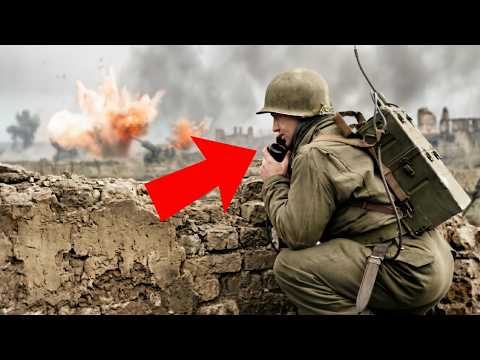
August 1944, Hill 314 above Mortain, France. Lieutenant Robert Weiss huddled in a foxhole, his SCR-610 radio’s batteries dying one cell at a time. Around him, the remnants of the 2nd Battalion, 120th Infantry Regiment, encircled by two Panzer divisions—the 2nd and the 2nd SS Das Reich—poised to break through the valley below. Weiss was not a rifleman. He was a forward observer, and his radio was the most dangerous weapon on the hill.
For six days, Weiss called down 193 fire missions, directing every artillery piece in range onto the advancing German armor. The Panzers could not break through. One man, one radio, two Panzer divisions stopped. But why did the Germans not simply shoot him? The answer is more complex than the internet myth of a standing order to spare the man with the radio.
Every army in World War II had forward observers, but the American system was structurally different. It was born not on the battlefield but on a firing chart at Fort Sill, Oklahoma. Major Carlos Brewer and Major Orlando Ward developed a centralized plotting method and fire direction center that allowed one observer’s call to mass every howitzer in a division, corps, or even army. No other army could do this. The system proved itself at El Guettar, Tunisia, in March 1943, when American artillery shredded a German Panzer division in the desert.
The forward observer was a lieutenant from a 105mm howitzer battery, detached to a rifle company. He carried binoculars, a map, a compass, and an SCR-610 radio. He lived, ate, and died with the infantry. With one radio call, he could unleash 12 to 36 howitzers within two minutes—600 to 6,000 pounds of high explosive per minute. The Germans feared this above all else.
The myth claims German snipers were ordered never to shoot the man with the radio. No captured order or manual supports this. Interrogations of top German snipers, like Matthias Hetzenauer and Sepp Allerberger, reveal that observers were a priority target, not a protected one. First Lieutenant Irwin Blonder, a forward observer with the Lost Battalion, was actively hunted by a German sniper in the Vosges Mountains. So why the myth? The truth is tactical, not doctrinal. Shooting at a forward observer and missing was suicide. The survivor would call grid coordinates on your muzzle flash, and within two minutes, every gun in range would erase your position.
German prisoners consistently cited American artillery as the arm they feared most. Patton himself said, “I do not have to tell you who won the war. You know, the artillery did.” The system was not invincible—weather, terrain, and communication failures could degrade it—but when it worked, the man with the radio was the most lethal individual on the Western Front.
Hill 314, August 1944. A lieutenant with dying batteries and a map. Panzer divisions in the valley below. Every time he keyed the handset, three words came back through the static: “On the way.”
But the myth did not survive Hill 314 by accident. It survived because the men who told it were not historians. They were the German infantry who crawled back down that slope alive, and what they carried with them was not a doctrine. It was a memory of what happened when someone shot at the radio.
On the second night of the siege, a German patrol worked its way up the reverse slope toward the command post. They had a machine gun and grenades and a clear line on the antenna. They did not fire. Not because of an order. Because the last patrol that had tried had been found the next morning in a crater where the coordinates of their muzzle flashes had landed a battalion’s worth of 155s.
The word passed down the German line the way rumors always pass—not as regulation, but as survival. Leave the radio alone. If you must, kill him fast and move. And if you miss, run.
What the myth obscures is that Weiss was not protected. He was hunted continuously. Sergeant Sasser, his radio operator, took fragments in the legs and kept the set running. Lieutenant Barts was killed. The hilltop was shelled, mortared, and probed for six days straight. The Germans wanted that radio dead more than they wanted the hill.
They simply could not afford to miss.
And there was a deeper reason the myth took root, one that had nothing to do with snipers at all. The American forward observer was not a lone specialist the way the German Vorgeschobener Beobachter was—a man tethered to a telephone wire, waiting for approval up a chain of command. The American was a node in a network. Kill him and another radio call could come from the infantry company commander’s SCR-300, or from a liaison plane overhead, or from a wire team that had spliced the line back together in the dark.
The system was redundant in a way no other army’s was. That was the true reason the Germans could not simply eliminate the threat with a single well-placed round. There was always another voice on the net.
By the fifth day, Weiss’s batteries were down to their last cells. He rationed them the way a medic rations morphine—one mission, then silence, then another mission when the Panzers moved. The FDC at the other end could hear the static eating the transmission. Lieutenant Colonel Vieman kept answering anyway. Three words, every time. “On the way.”
On the sixth day, the relief column broke through. The 2nd Panzer Division had not passed. It had been held, bled, and broken by a lieutenant with binoculars and a map and a radio that should have died on the second day.
Weiss would receive the Distinguished Service Cross. The hill would become a case study at Fort Sill. And the myth would grow—that the Germans had orders to spare him—because it was easier to believe in a chivalrous enemy than to understand the mathematics of what happened when a forward observer saw you and you did not kill him on the first shot.
The truth was simpler and colder. No order protected Robert Weiss. The guns did.
But the guns did not protect every observer, and Weiss knew it. On the same hilltop, Lieutenant Barts was already gone—killed in the first days of the siege, his body wrapped and laid in a shallow grave behind the command post. The men who dug it did not speak. They had watched him call fire until a mortar shell found the slit trench he was using for cover.
So the myth of the protected observer was not merely wrong. It was insulting to the men who had died proving it wrong.
What the myth missed entirely was the question the German commanders actually asked themselves in August 1944. It was not “should we shoot the observer?” It was “where is he, and can we kill him before he finishes the call?” The answer, more often than not, was no—because the American observer did not work alone and did not work slowly.
Consider what a German battery commander faced when he saw an American radio antenna on a ridge. He had perhaps ninety seconds to bring effective fire onto that position before the first American shells arrived. His own guns took time to lay, time to load, time to adjust. The American FDC had already computed the solution from a surveyed grid and a pre-registered defensive fire plan. The observer’s first transmission was often not a request but a correction—“Drop fifty, add twenty-five, fire for effect.” The guns were already laid. They had been laid for days.
That was the real asymmetry. The American system had done its math before the battle began. The German system was still doing it when the shells landed.
There was one more piece the myth never accounted for, and it was the piece that made men like Weiss terrifying to the German infantry in a way no sniper order could match. The American observer could see the battlefield the way no German observer could—not because his eyes were better, but because he had radios that talked to everyone.
Weiss on Hill 314 was not just talking to the 230th Field Artillery. He was talking to the infantry battalion commander beside him, to the regimental headquarters below, to the liaison planes circling overhead when the weather allowed, and to every artillery battalion in the sector that had a gun in range. When the Panzers massed for a push, Weiss did not need to call one battery. He called the whole net.
The Germans called this Feuerzusammenfassung—the massing of fire—and they understood it in theory. What they could not match was the speed. Their observers waited for approval. Weiss did not wait for anyone. The authority to mass every gun in range had been delegated down to a twenty-four-year-old lieutenant in a foxhole, because the American artillery doctrine trusted the man at the sharp end to know what needed killing.
That trust was the true weapon. Not the radio. Not the howitzers. The decision to let one man spend the entire weight of American industry with three words into a handset.
And so the German infantry on the slopes of Hill 314 learned what their counterparts had learned at El Guettar and would learn again at Dom Butgenbach and Lanzerath. The man with the radio was not to be feared because he was protected. He was to be feared because he was empowered.
When the relief column finally reached the hilltop on 12 August, the men of the 2nd Battalion were down to their last rounds, their last water, and their last working radio battery. Weiss was still calling fire. The Panzers were gone from the valley—not destroyed, but withdrawn, redirected, their timetable shattered by six days of observed fire from a position they could not take and could not ignore.
What happened next would be studied for decades. But the lesson the German army took from Hill 314 was not written in any manual. It was carried in the memory of every soldier who had watched a radio antenna on a ridge and understood, with a cold certainty in his stomach, that the next two minutes belonged to the man holding it.
Weiss came down off that hill with his Distinguished Service Cross and a radio that had died on the last day. The men who relieved him found the foxhole littered with empty battery casings, the way a trench is littered with spent brass. He had done his job. The system had done the rest.
But the myth outlived the men who made it, and it grew in the telling. Somewhere along the line, the memory of German infantrymen whispering to each other on a dark slope—leave the radio alone—became a story about a chivalrous order that never existed. The truth was harder to tell and easier to forget.
The truth was that Robert Weiss was not spared. He was missed. And the men who missed him paid for it with everything they had.
Today the job is called 13 Foxtrot, and the radio is lighter, and the math is faster, and the guns are farther away. But the principle is unchanged. One man, one voice, and every tube in range answering.
So the next time you read that German snipers were ordered never to shoot the forward observer, remember Hill 314. Remember Barts in his shallow grave. Remember Sasser’s legs. Remember the static eating the transmission and the three words that never stopped coming.
No order protected the man with the radio. The guns did.
And that, in the end, is the most dangerous thing of all—not a myth about mercy, but the cold mathematics of a system that trusted one lieutenant to spend an army’s fire.
What do you think—was the American forward observer the most lethal man on the Western Front, or was it the network behind him? Let me know in the comments.
Report this article
Select a reason for reporting:






