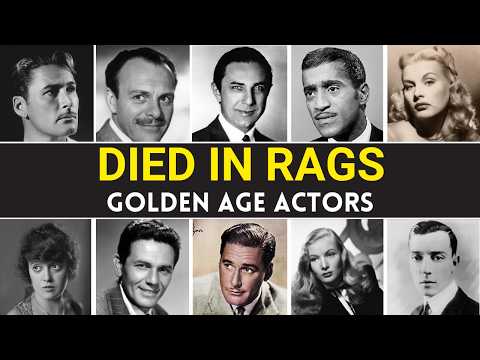
They had it all—fame, adoration, and fortunes that seemed limitless. Yet behind the dazzling lights of Hollywood’s Golden Age, some of the most beloved actors and singers faced a devastating reality: they died in poverty, their wealth vanished like a fleeting dream. The stories of these legends are not just about money lost, but about the cruel twists of fate, personal demons, and a system that often discarded its stars when they needed help the most.
Judy Garland, the girl who captured hearts as Dorothy in The Wizard of Oz, earned an estimated $40 million over her career—a fortune at the time. But when she died on June 22, 1969, at just 47, her estate was valued at a mere $40,000, and she left behind debts totaling around $4 million. How did one of the most talented performers of her generation end up nearly destitute? The answer lies in a tragic combination of addiction, mismanagement, and betrayal.
Garland’s struggles with prescription drugs and alcohol led to costly medical bills, while her third husband, Sid Luft, reportedly squandered much of her wealth on failed business ventures. In her final years, she was forced to perform in small venues, even fleeing hotel bills she couldn’t pay. She spent her last days at a London nightclub, singing for modest fees, desperately trying to settle her debts and support her children. The woman who once embodied hope and home ended her life far from both.
But Garland was not alone. Errol Flynn, the dashing star of Captain Blood and The Adventures of Robin Hood, earned millions yet died with just $10,000 to his name. His lavish lifestyle—yachts, homes, and a highly publicized 1943 trial for statutory rape—drained his finances. A failed film project and a costly divorce left him in debt, and in his final years, he performed in low-budget films to make ends meet, his health failing from alcoholism.
Then there was Barbara Payton, a luminous starlet whose beauty promised a dazzling career. She captivated audiences alongside James Cagney in Kiss Tomorrow Goodbye, but behind the glitter, her life spiraled out of control. Scandals, tumultuous relationships, and substance abuse tarnished her reputation. Arrests for public drunkenness and writing bad checks became frequent, eroding her finances. By her late 30s, she was living in squalor, walking the shadowed streets of Hollywood as a prostitute to survive. On May 8, 1967, at just 39, she died at her parents’ modest home, with no funds for a proper burial.
The silent film era had its own casualties. Roscoe “Fatty” Arbuckle, once one of the highest-paid actors in Hollywood, saw his career crumble after a scandalous 1921 trial. Although acquitted, he was blacklisted, his legal defense costing him an estimated $700,000. He died in 1933 with minimal assets, still in debt.
And who could forget Dorothy Dandridge, the radiant talent who broke barriers as the first African-American woman nominated for an Academy Award for Best Actress? Despite her groundbreaking success, racial discrimination limited her roles and earning potential. By 1963, she declared bankruptcy with $150,000 in debt. On September 8, 1965, at 42, she was found dead in her modest apartment, her bank account holding just $24.
These stories are not just about money—they are about the fragility of fame and the human cost of an industry that often takes more than it gives. As we delve deeper into the lives of these fallen stars, we uncover the harsh realities hidden behind the spotlight, reminding us that success can be fleeting and the price of fame can be extraordinarily high.
Marie Prevost was the embodiment of the Roaring Twenties—a radiant star whose charisma lit up the silent screen in films like The Marriage Circle and Kiss Me Again. But the dawn of sound cinema brought unforeseen challenges. Her voice didn’t resonate with the new medium, and roles became scarce. The once-celebrated actress slipped into obscurity, turning to alcohol as solace for her mounting despair.
By the time of her death on January 21, 1937, at just 38, Marie was living in a modest, dilapidated apartment in Los Angeles. She was found alone, having succumbed to acute alcoholism and malnutrition, with a mere $300 to her name. The glamour and opulence that once defined her existence had vanished entirely.
Then there was Sammy Davis Jr., an iconic entertainer whose talent knew no bounds. Despite his fame, he faced severe financial issues. When he passed away on May 16, 1990, at 64, he owed the IRS over $7 million in back taxes. After liquidating his assets, his estate was still in debt by $5.2 million. Excessive spending, gambling, and mismanagement—multiple homes, luxury cars, expensive jewelry—had drained his fortune. In a bid to repay his debts, Davis continued to perform almost until his death, despite battling throat cancer.
Veronica Lake, famed for her peekaboo hairstyle and roles in films like Sullivan’s Travels, saw her fortunes decline rapidly. By the time she died on July 7, 1973, at 50, she had little to her name. She declared bankruptcy in 1951, and in the 1960s, she was reportedly working as a waitress and hostess in a New York hotel to support herself. She spent her final days suffering from hepatitis and acute kidney injury, alone in a Vermont hospital, with only a small bank account and a few personal belongings.
Buster Keaton, the great stone face of silent cinema, faced his own challenges. The arrival of sound films diminished his creative control, and an expensive divorce in 1932 depleted his wealth. Despite a modest comeback in the 1950s, he never regained his earlier success. Keaton passed away from lung cancer on February 1, 1966, at 70, living a humble life that contrasted with his monumental legacy—though he was not destitute.
Mabel Normand, a pioneering comedic actress and director, saw her career tarnished by the 1922 murder scandal of director William Desmond Taylor. Though never a suspect, the relentless media scrutiny caused film offers to dwindle. Battling tuberculosis, she spent her final days in a sanitarium, her wealth significantly diminished. She died on February 23, 1930, at just 37.
Terry-Thomas, the English comic actor, faced dire financial straits after being diagnosed with Parkinson’s disease in 1971. Medical expenses soared to £75,000 a year, forcing him to sell his home and personal property. Friends organized a benefit concert in 1989, raising £75,000 for his care. He spent his final days in a modest actor’s retirement home, having exhausted nearly all his wealth on battling his illness. He died on January 8, 1990, at 78.
Bela Lugosi, forever immortalized as Count Dracula, struggled financially for much of his life. Typecast as a horror villain, he found it difficult to secure varied roles. His addiction to morphine and methadone impacted his career and finances. By 1955, he filed for bankruptcy, listing debts of $3,500 and assets of only $11,000. Lugosi died of a heart attack on August 16, 1956, at 73, leaving behind just $1,900 in cash and a few personal effects. His funeral expenses were paid by Frank Sinatra.
Bud Abbott, one half of the legendary comedy duo Abbott and Costello, faced severe financial difficulties due to tax issues. During World War II, the duo raised an estimated $85 million in war bonds, but the IRS disallowed $500,000 in tax exemptions they claimed as bond-raising expenses. After Lou Costello’s death in 1959, Abbott struggled to find work, and the IRS seized his home to settle unpaid taxes. In desperation, Abbott made televised appeals for financial assistance from fans. He died virtually penniless on April 24, 1974, at 78.
John Garfield, a dynamic force in 1940s Hollywood, saw his career abruptly halted by the Red Scare. Blacklisted after refusing to name colleagues, he was unable to secure acting work, and financial pressures mounted. On May 21, 1952, at just 39, Garfield died of a heart attack in a New York City apartment. While not destitute, the combination of professional exile and personal turmoil had eroded much of his wealth and stability.
These actor stories serve as poignant reminders that fame and fortune can be fleeting. Despite their immense talents and contributions to the entertainment industry, they faced significant hardships in their final days. Mismanagement, legal troubles, health issues, and personal demons eroded their wealth, leaving them with little at the end of their lives. Their legacies live on through their work, but their personal struggles offer sobering lessons about the vulnerabilities that even the most celebrated individuals can face.
Their stories are not merely cautionary tales but mirrors reflecting the fragility of fortune in an industry that often celebrates youth and beauty while ignoring the human cost. Judy Garland’s voice still echoes in our hearts, yet she died owing millions. Errol Flynn’s swashbuckling charm couldn’t save him from bankruptcy. Dorothy Dandridge’s barrier-breaking talent left her with just $24. These are not isolated incidents but a pattern—a reminder that the spotlight can burn as fiercely as it shines.
What unites these legends is not just their financial ruin but the systemic failures that enabled it: predatory contracts, unscrupulous managers, punishing tax laws, and a culture that discards its stars when they falter. As Buster Keaton once said, ‘Tragedy is a close-up; comedy, a long shot.’ Perhaps their lives were both—a long shot at stardom that ended in tragic close-up.
Yet their legacies endure. Their films still play, their songs still resonate, and their stories now serve as a stark warning. Fame is a fickle mistress, and fortune even more so. Behind every glittering premiere lies the shadow of those who gave everything and received nothing in return.
So as we remember these fallen stars, let us ask: What does it truly mean to succeed in an industry that so often fails its own? And how many more will we lose before we change the script?
Report this article
Select a reason for reporting:






