In the jungle darkness of South Vietnam, two Americans lay on their packs inside a ring of Australians. Feet out like the spokes of a wheel, a weapon beside every man. Nobody spoke. Nobody had spoken since they set out. For ten days, not a single word was uttered. One of those Americans was Roger Hayden, a machine gunner from SEAL Team 1. He would later call the Australians the best he ever saw. But what did he actually witness? And why did it leave such a mark?
The silence was absolute. Hand and arm signals only. At night, the Australians lay in a circle, each man on his pack, feet outward, so that if sprung, they had 360 degrees of firepower. Somebody in that circle was always awake. Hayden and his fellow SEAL, used to operating in the dark, couldn’t sleep for the first two nights. Then they began to trust the rhythm. They closed their eyes because the men next to them were doing their job.
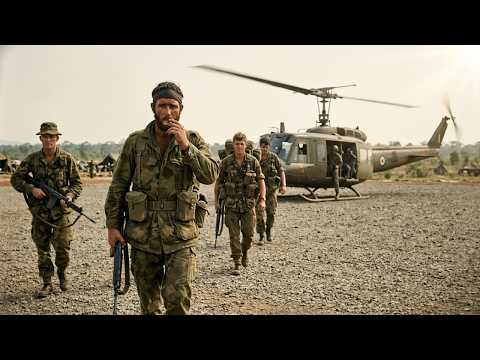
Hayden was no stranger to elite training. He had been through Army Ranger School and a reconnaissance course. Yet he said that one ten-day patrol taught him more about reconnaissance than anywhere else. “The Australians came down and worked with us,” he recalled. Then he and another American went up to the Australian base and patrolled with them. The year was likely 1971, near the end of the Australian SAS presence in Vietnam. The place? Possibly Nui Dat, but Hayden never named a squadron, and the captions of his podcast garbled the details.
What is verifiable is that an exchange program existed. The Australian War Memorial and historian David Horner confirm that SAS patrols worked with US Navy SEALs in the Mekong Delta. A photograph from April 1971 shows a US Navy man, John Deacon, with an Australian SAS patrol after a nine-day mission. Not Hayden, but proof that such joint patrols happened. And in September 1971, the commander of US Naval Forces Vietnam wrote a letter praising the SAS for their “superb examples of professionalism” and the “interchange of tactical knowledge” that created mutual respect.
Hayden’s own journey to that jungle ring was unconventional. He started in underwater demolition training in 1967, became a frogman, and later went through the SEAL course. He admitted that frogmen weren’t trained for land warfare. “Some UDT men who went into the jungle looking for people were killed on trails because they did not have the fieldcraft,” he said. Fieldcraft—moving, hiding, listening, surviving on land with a rifle—was what the Australians had mastered. And that was exactly what Hayden saw in those ten silent days.
The SEALs fought with light and noise: claymores, flares, ambushes on rivers. The Australians wanted the opposite: see without being seen. They moved like ghosts. They communicated without sound. “They never talked, not one word,” Hayden remembered. “The whole patrol.” It was a different kind of war, and Hayden recognized it as something extraordinary.
But was it truly ten days of absolute silence? Horner’s history notes that SAS patrols in Borneo used hand signals or whispered conversation. Perhaps the Australians did whisper. Hayden, unable to read their signals, heard nothing. The memory is his alone, but the lesson is universal: sometimes the most powerful statement is silence.
As the patrol ended and the two Americans returned to their own unit, Hayden carried with him a new understanding. He had seen the best, and it changed him. But the story doesn’t end there. The exchange program, the photograph, the letter—they all point to something larger. What happened when these two elite forces met in the jungle? And what does it mean for the legend that grew?
The legend grew because the men who lived it rarely spoke. Hayden’s podcast interview in August 2016 was a rare crack in the wall. He was not trying to build a myth. He was answering a question about reconnaissance, and the Australians were his answer. “That one ten-day patrol taught me more about reconnaissance than anywhere,” he said. The host pressed him. He repeated it.
But the story took on a life of its own. We Are the Mighty ran it under a headline about Australian special forces spending ten days in Vietnam without saying a word. The year dropped out. The place shifted. A base called BF Egypt appeared in one version, a detail that belonged to Hayden’s first platoon in 1969, not the second tour. An undated video clip circulated, titled They Were the Best I’d Ever Seen. Each retelling was a little tidier than the last. By the time it reached a certain kind of audience, it sounded like a classified file declassified.
It was not. It was a man remembering a patrol.
Here is what the paper trail actually shows. The exchange program was real. Horner’s history of the SAS regiment, Phantoms of War, records it plainly: the SAS had an exchange program with the US Navy SEAL teams operating in the Mekong Delta. The Australian War Memorial’s own history says the same. SEAL Team 1 sent one officer and one enlisted man to Perth for two-year postings, a arrangement that lasted until 1984. The Australians came down to the Delta. The Americans went up to Nui Dat. Both directions are documented.
The photograph from April 1971 is the closest the record comes to Hayden himself. A group portrait at Nui Dat, men of Number 25 Patrol, F Troop, Second Squadron, returning from a nine-day patrol. In the front row, the caption reads: John Deacon, United States Navy. Not Hayden. Nine days, not ten. A caption, not a patrol report. But it proves the thing the podcast could not: a US Navy SEAL went out with five Australian SAS men for nine days and came back and was photographed with them. Nobody had to remember it fifty years later. The camera was at the landing zone the day the patrol came in.
And then there is the letter. When the exchange program ended in September 1971, the commander of US Naval Forces Vietnam wrote to Brigadier Bruce Macdonald, commander of the Australian task force. He was the senior Navy officer in the country, and he was writing about a handful of SEALs and a handful of SAS. “I wish to extend my personal congratulations to the special air service squadrons for the superb examples of professionalism displayed by those who participated in this worthwhile endeavor.” He went further. “The interchange of tactical knowledge and operational techniques has provided the basis for mutual respect and admiration between the two organizations as well as many longlasting friendships.”
Read that against what Hayden said on a podcast forty-five years later. A machine gunner at the bottom of the chain says the best I’ve ever seen. The senior American naval officer in the country writes a letter in which the esteem in which the Australian SAS is held is stated for the record. Two men, one at the bottom and one at the top, reach the same verdict in different words. The phrase that carries the weight is the dry one: the interchange of tactical knowledge and operational techniques. Ten silent days in a naval officer’s prose.
But the numbers on the Australian side need the same caution. One man’s tally of eleven insertions out of fifteen ending in contact within twenty minutes is one man’s tally of his own patrols. Brian Daru’s count of about 110 contested extractions across roughly 1,130 insertions measures something different. Being shot at on the way in and being shot at on the way out are not the same event. And some of those contested extractions followed ambushes the patrols had started themselves. The overall scale is just as soft. The SAS ran about 1,175 patrols in Vietnam by one count, about 580 men served, other counts say nearly 1,200. Enemy killed totals differ. One count gives 492 killed and 106 possibly killed. A popular write-up says 600 with no source. Against that, the SAS lost one man killed in action, one dead of wounds, three killed in accidents, one missing, one to illness, and twenty-eight wounded. Treat all of it as a scale, not a score.
What is firmly dated is the end. Second Squadron arrived in February 1971. By March it had run twenty-three patrols, twenty-two of them in eastern Phuoc Tuy. In July its intelligence underpinned Operation Iron Fox. Over ten months it ran a hundred reconnaissance patrols and sixty-seven fighting patrols. After the government announced the task force’s withdrawal, the last SAS patrol ran from the first to the fifth of October with no contact with the enemy. The advanced party flew out on the seventh. The main body followed three days later. Six days after that, on the sixteenth of October, the Australians handed Nui Dat to South Vietnamese forces.
In September, the Navy’s exchange had already closed with its letter. And on the seventh of December 1971, the last SEAL platoon left Vietnam. Hayden says his platoon was the last fully deployed one, and that another platoon at Ben Luc, forty miles away, went home after only three months. The Navy’s own museum records the last platoon leaving on the seventh of December. The records do not contradict him, and they do not prove him either.
So the two men on the patrol, the American on his pack and the Australian somewhere in the ring, come to the end of the story within weeks of each other. The SAS flew home in October. The last SEAL platoon followed in December. What is left is a letter in a book, a photograph with a caption, and a man on a podcast forty-five years on remembering how quiet it was.
Go back to the circle. Feet out. A weapon beside every man. Somebody in that ring awake always, so that nobody else has to be. The American lies on his back for two nights and cannot sleep. And then he begins to. That may be the real compliment. A man trained to do his work in the dark finally closes his eyes because the men next to him are doing theirs.
Ten days. Two Americans. Not one word. The story survives because a machine gunner carried it out of the jungle and set it down fifty years later, and because a letter and a photograph were waiting to catch it. The record is thinner than it should be, but it holds.
Hayden measured the Australians against what he had been taught, not against every soldier in the war. He said so himself. The compliment was a statement about a gap—a frogman trained to swim, blow, and leave, sent to a war fought on foot. The Australians had been learning that war for five years. It does not make them the best soldiers in Vietnam. It makes them the lesson he needed.
So the circle closes. The SAS flew home in October. The last SEAL platoon followed in December. What remains is a whisper of a memory, a caption, a letter, and the quiet certainty of men who trusted the dark because someone else was watching it.
If someone in your family served in Vietnam with the SAS, the task force, on a helicopter, in any unit, Australian or American—tell me about them. Names, units, a letter home. What is the one story your family never told, and who should hear it now?
Report this article
Select a reason for reporting:






